To save content items to your account,
please confirm that you agree to abide by our usage policies.
If this is the first time you use this feature, you will be asked to authorise Cambridge Core to connect with your account.
Find out more about saving content to .
To save content items to your Kindle, first ensure no-reply@cambridge.org
is added to your Approved Personal Document E-mail List under your Personal Document Settings
on the Manage Your Content and Devices page of your Amazon account. Then enter the ‘name’ part
of your Kindle email address below.
Find out more about saving to your Kindle.
Note you can select to save to either the @free.kindle.com or @kindle.com variations.
‘@free.kindle.com’ emails are free but can only be saved to your device when it is connected to wi-fi.
‘@kindle.com’ emails can be delivered even when you are not connected to wi-fi, but note that service fees apply.
First episode psychosis (FEP) is the first manifestation of psychotic disorders lasting at least one week, but not longer than 2 years, causing personal suffering and decreased functional outcome of patients. The early intervention in FEP is crucial. Published results on early intervention programmes indicate that during the first 5-10 years relapse prevention and functional outcomes can be improved and mental health care costs can be reduced, compared to treatment as usual.
Objectives
Our objective was to examine FEP patients at the Department of Psychiatry and Psychotherapy. Our aim was to create a homogeneous sample and identify factors that can help in early differential diagnosis and therapy. Our goal was to compare the neuropsychological performance and MRI results of patients and healthy controls.
Methods
Male and female inpatients hospitalized at our department due to a first psychotic episode and consenting to participate were included, since 2019 October. Cases with drug induced psychosis and organic background in the etiology of the psychotic episode were excluded. Male and female healthy controls were matched by age and education. Including healthy controls is still in progress. The duration of the project is 36 months, 24 months for recruiting patients and healthy controls, 12 month for analyzing data. The investigation includes detailed clinical, neuropsychological examination (baseline, 6th, 12th, 18th, 24th month) and MRI (baseline and in the 24th month).
Results
Forty patients and sixteen healthy controls were included. 60% of the patients were rehospitalized due to relapses. Neuropsychological tests (RBANS, faux pas, Baron-Cohen eyes test) indicate cognitive dysfunction compared to healthy subjects. Using resting state fMRI second level analysis we found alterations in thalamo-cortical connectivity. We found significant differences in the connectivity of the thalamus and frontal lobe, postcentral gyrus, insula and cerebellum.
Conclusions
Our FEP research, although limited by the COVID-19 pandemic, shows promising results that can help in better understanding of the underlying factors of psychotic disorders.
Motivation for treatment is an important socio-psychological characteristic of patients, which is subject to the joint influence of various factors, each of which may require specific rehabilitation interventions.
Objectives
To analyze and evaluate the cumulative influence of adverse childhood experiences (ACE), internal stigma, social characteristics on the intensity of treatment motivation in patients with mental disorders.
Methods
102 patients with mental disorders were examined using Adverse Childhood Experience Questionnaire (ACEQ), Russian-language validated Internalized Stigma of Mental Illness (ISMI) scale and Treatment Motivation Assessment Questionnaire (TMAQ).
Results
As a result of regression analysis (table 1), a model was obtained that predicted an increase in the chances of high patient’s motivation for treatment with an increase in the total score of ACEs (ACEQ total score) and with higher education. The overall severity of internal stigma (ISMI total score) did not show a significant effect on the chances of developing intense motivation in patients.Table 1.
Model of logistic regression analysis of educational, ACE total score and ISMI total score with the severity of motivation for treatment.
Predictor
B
SE
p
Exp (B)
95% confidence interval for EXP(B)
Secondary education
1,120
0,699
0,109
3,065
0,778-12,074
Higher education
1,972
0,775
,011
7,189
1,574-32,834
ISMI total score
-0,435
0,773
0,574
0,647
0,142-2,946
ACEQ total score
0,346
0,147
0,019
1,414
1,060-1,886
After post data analysis (table 2), a cut-off point was established for the ACEQ total score of 4 points, corresponding to an increased chances of high patient’s treatment motivation.Table 2.
Results of the test ROC analysis for ACEQ total score and the severity of motivation for treatment.
Cutpoint
Sensitivity (%)
Specificity (%)
Youden’s index
AUC
3
64.71%
53.57%
0.183
0.689
4
50%
75%
0.250
0.689
5
38.24%
85.71%
0.239
0.689
Conclusions
ACEs may likely be a source of posttraumatic growth in adulthood in patients with mental illness specially if their count amounts to 4 or more variants. The role of social and psychological characteristics of patients with mental disorders in the psychology of the treatment process should be considered systemically, rather than discretely.
Prevention of relapse in schizophrenia is a major public health issue. A recent network meta-analysis investigating interventions for relapse prevention in schizophrenia found that the efficacity of family psychoeducation and systemic integrated interventions were superior to treatment as usual at 12 months (Bighelli I, Leucht S et al. Lancet Psychiatry 2021). Other studies also found that multi-family therapies (MFT) were superior to treatment as usual and family psychoeducation in preventing relapses at 2 and 4 years (McFarlane WR, Lukens EP et al. Archives of General Psychiatry.1995). Considering this, we developped in our community center an MFT program based on systemic approach and psychoeducation.
Objectives
Investigate the subjective experience of participants of an MFT group focusing on schizophrenia.
Methods
A qualitative study was designed to explore personal experience of participants using the Interpretative Phenomenological Analysis (IPA) method in order to analyse participant’s feedback during semi-directive interviews. By using IPA, participants are experts of their experience. Eight participants took part in this study: 4 patients and 4 parents.
Results
Within all participant’s feedback around 10 different themes emerged. We identified three major themes which we have described as: “Affiliation to the group”, “Framework of Discovery”, “Benefits of MFT”.
According to “Affiliation to the group”, all participants report movements of adhesion or rejection towards the group. This theme has been subdivided into two sub-themes: “Temporality”, and “Identification/differentiation”. These sub-themes revealed inter-individuals’ differences.
According to “Framework of discovery”, the MFT group has been identified as a secure place allowing self and other’s discovery place. This theme has been divided into two sub-themes: “discovering skills” and “improving oneself and relatives’ understanding”. Participants experience taking a step back and decentering oneself from usual personnal position.
According to “Benefits of MFT”, participants report the feeling of belonging to a group, the impact on self-esteem, on mentalization skills, and on the reflexion on family members’ experience of the disease.
Conclusions
This study is, to our knowledge, the first qualitative study examining the subjective experience of members who participated in a psychoeducational and systemic MFT group focusing on schizophrenia. It provides insight into the families’ experience, both from the patient’s and from each family member’s perspective. Results highlight that participants seized the MFT group as a learning space at several levels: personal, intra-family and inter-family.
These data could enlighten professionals working with families on the potential apprehensions of participants, their representations of the group and what process MFT could initiate.
Several studies have shown an association between suicidal behavior and increased C-reactive-protein (CRP) levels (Ghayour-Mobarhan M. et al. Comb Chem High Throughput Screen 2022; 25 1047-1057) although most studies evaluated the association between CRP levels and suicidal ideation in depressed patients (Olié E. et al. Eur Neuropsychopharmacol 2015; 25 1824-31).
Objectives
Our study assessed baseline high-sensitivity CRP (hsCRP) levels in a cohort of adult inpatients affected by severe mental illness (SMI) and their association with Mini-International Neuropsychiatric Interview-5 subscale suicidality (MINI-5-s).
Methods
A naturalistic, observational, cross-sectional study was carried out by retrospectively recruiting 127 adult SMI inpatients, excluding patients with an organic pathology. HsCRP levels were assessed at the ward admission. To assess the suicidal behaviour all patients filled the same day the MINI-5-s.
Results
The number of patients with hsCRP>3mg/l were significantly higher among those with thoughts of death (p=0.002) and suicidal attempt (p=0.026). No statistically significant associations were observed between hsCRP levels and other suicidality dimensions.
Limitations: Small sample size, heterogeneous diagnoses, lack of diagnostic sub-analysis, cross-sectional design, and lack of a healthy control group.
Conclusions
The study reveals a transdiagnostic association between inflammation, thoughts of death and suicidal attempt in SMI inpatients. Our preliminary findings could support a routine introduction of hsCRP measurement, due to its relatively low cost, possible utility in trans- diagnostically suicide risk assessment. Large-scale clinical trials would be recommended to evaluate the effects of early anti-inflammatory therapy in patients with death ideation and/or suicidal attempt and concomitant low-grade hsCRP elevation. HsCRP could potentially represent an early biomarker for suicidal risk.
tardive dysphoria is a relatively new term used to describe the phenomenon of clinical worsening of depression after long-term antidepressant use. Most of the theories proposed to explain this talk about antidepressants tachyphylaxis that implies the loss of efficacy with its prolonged use, or even a pro-depressant effect of antidepressants when used for long periods of time.
Objectives
to explore the concept of tardive dysphoria, potential causes and clinical implications, by making a literature review on the topic. Moreover we pretend to understand the challenges in its diagnosis and treatment.
Methods
bibliographical search in PubMed database, using the key-words “long-term antidepressant”, “tardive dysphoria” and “antidepressant tachyphylaxis”, limited to works published in the last twenty years.
Results
from our search resulted 53 articles, 26 were chosen for further analysis.
Conclusions
the concept of tardive dysphoria is controversial, namely doubt persists if it constitutes a clinical entity by itself caused by long-term antidepressant use or if it simply relates to cases of treatment-resistant depression. We conclude that it is necessary further investigation in this area given the significant implications on clinical practice specifically in the psychopharmacological treatment with antidepressants, which is very common in psychiatric and general practices, with antidepressants being used to treat many mental health conditions.
Presence of the disabled child in the family poses many challenges for their siblings, especially in adolescence. Children with disabled siblings often receive less attention from family and friends, experience a sense of injustice and anger towards sick siblings, as well as they are more likely to experience various somatic complaints and higher levels of depression and anxiety. However, research shows that resiliency could be a protective factor associated with the functioning of children and adolescents in certain life events, such as sibling’s disability, referring to good adaptation despite facing emerging adversities.
Objectives
Therefore, the aim of the current study was to examine the role of resilience as a possible protective factor for the occurrence of internalizing and externalizing disorders in adolescents having disabled sibling.
Methods
175 diads of a healthy adolescent and one of its parents (N = 350) participated in the study. Participants were divided into two groups - 119 diads in the group with disabled sibling (Madolescent’s age = 16.70; SD = .66) and 56 diads in the group with a healthy sibling (M adolescent’s age = 16.64; SD = .75). The following measures were used in the study: Resilience Measurement Scale (SPP-18) and Child Behavior Checklist for Ages 6-18 (CBCL/6-18).
Results
The results showed no statistically significant differences in any of the measured resilience factors (optimistic attitude and energy, persistence and determination in action, sense of humor and openness to new experiences, personal competences and a tolerance for negative affect), in adolescents with disabled sibling, comparing to the control group. However, adolescents with disabled sibling were found to have a significantly higher risk of the occurrence of both, externalizing and internalizing disorders compared to adolescents with healthy siblings. Furthermore, findings of the study also confirmed that personal competences and a tolerance for negative affect predicts lower risk of the occurrence of internalizing disorders in adolescents having disabled sibling.
Conclusions
Our findings highlights that resilience may have important role in reducing the risk of the clinical problems occurrence in adolescents having disabled sibling. Therefore, comprehensive psychological support enhancing their personal growth and competence should be provided in the above group.
Clozapine is an atypical antipsychotic synthesised in 1958. It was withdrawn from the market in the 1970s due to the appearance of agranulocytosis, but was reintroduced due to strong evidence of its efficacy and superiority over other antipsychotics in treatment-resistant schizophrenia.
Objectives
To describe the adequate response to clozapine in treatment-refractory psychosis.
Methods
Review of the scientific literature based on a relevant clinical case.
Results
A 16-year-old woman was admitted to a psychiatric inpatient unit for psychotic symptoms and behavioural disorders. She lives with her father and older sister; she has not been in contact with her mother, who lives in another country, for several years. She attends secondary school, with poor academic performance. Maternal diagnosis of schizophrenia. She started using cannabis two years ago, with a progressive increase up to 20 grams per week. He reports the onset of a feeling of strangeness a year ago, with progressive isolation in his room, referring to delirious ideation of harm towards classmates and people from his town, self-referentiality and delirious interpretations of religious mystical content (“God speaks to me through a dove”). He comments on the phenomenon of theft and thought-reading. Soliloquies and unmotivated laughter are observed.
Conclusions
Treatment was started with risperidone, progressively increasing the dose up to optimisation, without achieving a decrease in positive symptoms, but with the appearance of excessive sedation and sialorrhoea. It was combined with aripiprazole up to 20mg, maintained for a couple of weeks, without significant clinical improvement. Given the failure of two lines of therapy, it was decided to change to clozapine up to a dose of 75mg, with adequate tolerance and response, achieving a distancing of the delirious ideation. Regular haematological controls were performed, with no alterations in haemogram or troponins.
The chain of care in psychiatric emergencies should be reviewed to improve assistance.
Objectives
Our objective was to determine the reality behind the reasons for consultation assigned in triage as “Psychiatry Assessment” and “Psychiatric Patient”, examining diagnoses to the discharge of said patients
Methods
To this end, reasons for triage consultation and patient diagnoses are retrospectively collected who were evaluated by the main author in the emergency room of Hospital de Jaén between June 23, 2019 and May 31, 2020. They were selected following these criteria; inclusion: patients with psychiatry consultation, evaluated by the first signatory of the text and with reasons for consultation in triage: “Psychiatric patient” or “Assessment by Psychiatry”. As exclusion criteria: high due to escape. Among the 224 patients evaluated, we found 35 who met criteria
Results
Of the total reasons of consultation collected at beginning, 16.6% corresponds to “Assessment by Psychiatry” (13.9%) and “Patient psychiatric” (2.7%), this being group the second reason for most frequent consultation after of “Anxiety” with 33%. Relating these reasons for consultation with the discharge diagnoses made in these patients, we found that the percentage of patients in each diagnosis would be: Regarding the action plan followed after the evaluation and diagnosis of these patients, it is reported that 45% of them required admission, 37% were referred to Mental Health Unit, 9% to family doctor and 6% to the Drug Addiction Center. - 11.4% of pharmacological intakes; 8.6% of psychotic episodes, symptoms anxiety, treatment renewal and mood disorders personality; respectively; 5.7% of autolytic attempts, autolytic ideation, schizoaffective disorder, bipolar disorder, heteroaggressiveness and depression; respectively; 2.9% of adverse effects to drugs among others diagnostics
Conclusions
It is appreciated that the reasons for consultation triated as “Psychiatric patient” or “Psychiatry assessment” does not provide real information about the clinical characteristics of the patient to be evaluated in the emergency room, having a wide range of diagnoses encompassed in these terms. This fact does not allow discern the fundamental reason why the patient goes to the emergency room, nor receive assistance adequate to the problem it presents, nor a correct regulation of waiting and logistical planning. We believe it is advisable to review the use of these terms in the practice of the psychiatric emergencies training all professionals involved in the triage chain and we value the need to count on all emergency services with a standardized triage method for the psychiatric emergencies.
Panic disorder (PD) and agoraphobia (AG) are highly comorbid anxiety disorders with an increasing prevalence that have a significant clinical and public health impact but are not adequately recognized and treated. Although the current functional neuroimaging literature has documented a range of neural abnormalities in these disorders, primary studies are often not sufficiently powered and their findings have been inconsistent.
Objectives
This meta-analysis aims to advance our understanding of the neural underpinnings of PD and AG by identifying the most robust patterns of differential neural activation that differentiate individuals diagnosed with one of or both these disorders from age-matched healthy controls.
Methods
We conducted a comprehensive literature search in the PubMed database for all peer-reviewed, whole-brain, task-based functional magnetic resonance imaging (fMRI) activation studies that compared adults diagnosed with PD and/or AG with age-matched healthy controls. Each of these articles was screened by two independent coding teams using formal inclusion criteria and according to current PRISMA guidelines. We then performed a voxelwise, whole-brain, meta-analytic comparison of PD/AG participants with age-matched healthy controls using multilevel kernel density analysis (MKDA) with ensemble thresholding (p<0.05-0.0001) to minimize cluster size detection bias and 10,000 Monte Carlo simulations to correct for multiple comparisons.
Results
With data from 34 primary studies and a substantial sample size (N=2138), PD/AG participants, relative to age-matched healthy controls, exhibited a reliable pattern of statistically significant, (p<.05-0.0001; FWE-corrected) abnormal neural activation in multiple brain regions of the cerebral cortex and basal ganglia across a variety of experimental tasks.
Conclusions
In this meta-analysis we found robust patterns of differential neural activation in participants diagnosed with PD/AG relative to age-matched healthy controls. These findings advance our understanding of the neural underpinnings of PD and AG and inform the development of brain-based clinical interventions such as non-invasive brain stimulation (NIBS) and treatment prediction and matching algorithms. Future studies should also investigate the neural similarities and differences between PD and AG to increase our understanding of possible differences in their etiology, diagnosis, and treatment.
The debates on euthanasia and assisted suicide (EAS) are topical in Europe. The extension of EAS for psychiatric reasons, already legalized in some countries, raises ethical and clinical issues, given the proximity between suicidal patients and patients who request or have accessed EAS. How can ESA be reconciled with the promotion of suicide prevention, which kills nearly 10,000 people per year in France? We will raise here several key questions that deserve a clear answer before considering going further in the social debates: how to ensure the irreversibility of psychological suffering? how to ensure that patients requesting EAS have full decision-making capacity? how to judge therapeutic futility? It seems crucial to protect the most vulnerable patients by ensuring that psychiatry benefits from scientific progress and can offer new solutions to suffering patients.
Thes issues will be discussed viewing the proposed law on EAS in France, which is supposed to come in February 2024…
Childhood cancer survivors have neurocognitive sequelae that in most survivor follow-up programs are underdiagnosed and for which there is usually no treatment plan.
Video games have demonstrated various psychological and neurocognitive benefits in different subpopulations, such as patients with organic neurological deficits or children with ADHD. However, few studies have been carried out using video games-based interventions in the paediatric oncology population.
Objectives
The aim of this work is to present the WINNERS study protocol, the objectives of which are to diagnose the neurological and cognitive sequelae in child cancer survivors, and to demonstrate the benefit in these areas of a training program based on video games.
Methods
A randomized controlled and unblinded trial is presented. Fifty-six patients aged 8 to 17 years stratified into two age groups (8-12 and 13-17) who had received any of the following treatments 1 to 6 years before the enrolment will be selected: high-dose chemotherapy with blood-brain barrier crossing, intrathecal or intraventricular chemotherapy, CNS radiotherapy or hematopoietic stem cell transplantation.
A neuropsychological evaluation will be performed consisting of a battery of neuropsychological tests to assess parameters such as attention, memory, visuospatial ability or speed of response, as well as a neuroimaging evaluation by structural and functional magnetic resonance imaging. The evaluation will be repeated 3 months and 6 months after the enrolment. Patients will be randomized to a treatment group or to a recycled waiting group. Intervention will consist on a 12-week training at home using 3 video games: a brain training game, an exergaming game and a skill training game.
Results
According to the hypotheses of this study, it is expected that the proposed program of videogame-based interventions will improve neurocognitive and other wellbeing parameters in the intervention group.
Conclusions
This study aims to improve the quality of care for patients who have survived a cancer disease by detecting sequelae that have so far been poorly attended, and by proposing a gamification-based intervention program that is effective and attractive for this population.
An increase in suicidal behavior among the adolescent population is reflected in the literature and in clinical practice. According to a study of suicidal behavior and mental health by the Spanish ANAR Foundation, the number of cases with suicidal behavior has experienced an accentuated growth in the period 2012-2022 (1,921.3%), highlighting the increase produced in the post-COVID-19 period, between 2020 and 2022 (128%)
Objectives
To analyze the reasons for admission to the short hospitalization unit. To describe the sociodemographic characteristics of hospitalized adolescents.
Methods
Descriptive observational study of the sample of adolescents admitted to the inpatient psychiatric unit of the Hospital Universitario Puerta de Hierro between January 1, 2023 and June 30, 2023. It is carried out through the information obtained in the clinical history of the patients.
Results
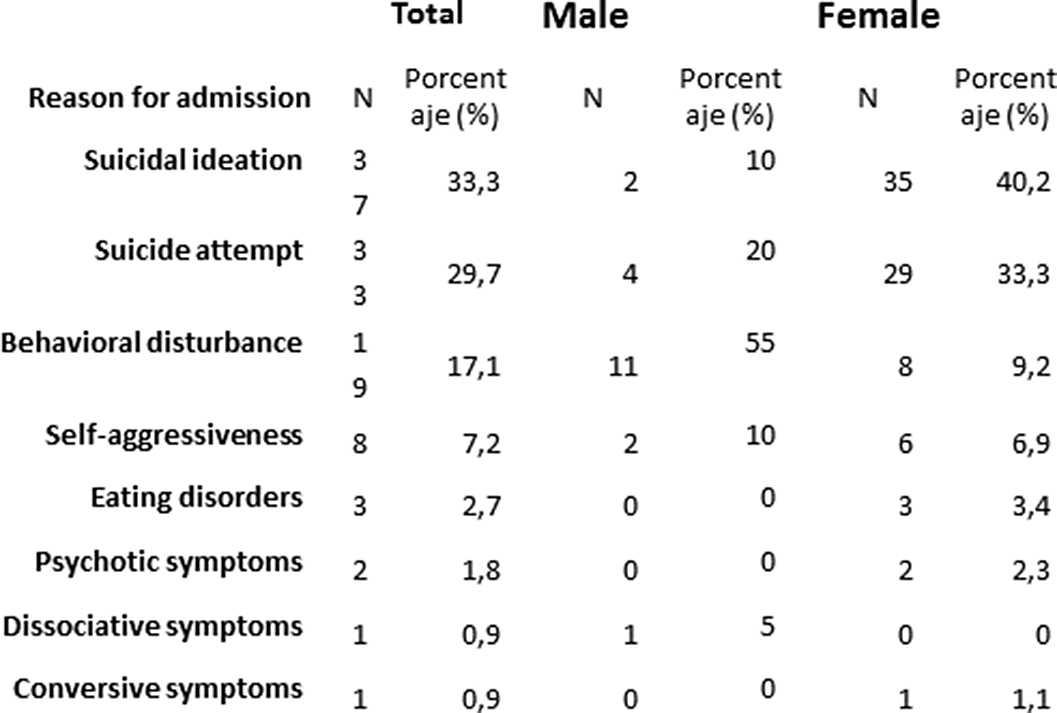
During this period of time 113 adolescents were admitted, 80.2% were female. The mean age was 15.16 years. The main reason for admission was autolytic ideation, occurring in 33.3% of the patients. The second most frequent reason for admission was suicide attempt (29.7%) and behavioral disturbance (17.1%) was the third most frequent. Of the methods used in suicide attempts, drug overeating stands out among the methods used in suicide attempts. (75.8%), followed by attempted hanging (12.1%) or cutting (12.1%).
Image:
Conclusions
The results corroborate what is reported in the scientific literature, where self-harm and self-injury attempts have increased and are the most frequent reasons for admission. This shows that suicide is a public health problem of the first order, where prevention and early intervention programs are necessary.
An “escape room” is a game requiring teamwork and problem-solving during which a series of puzzles are solved to escape a locked room. Various escape room activities have been designed for healthcare professionals, including internal medicine residents and nursing students (Anderson et al. Simulation & Gaming 2021; 52(1) 7-17; Rodríguez-Ferrer et al. BMC Med Educ 2022; 22:901; Khanna et al. Cureus 2021; 13 (9) e18314). Escape rooms provide an opportunity for social activity, an important component of resident wellness (Mari et al. BMC Med Educ 2019; 19(1):437). This abstract describes an escape room challenge designed and implemented at our psychiatry residency program quarterly wellness afternoon event, which is an afternoon session dedicated to resident wellness.
Objectives
The objective of this project was to design and implement an escape room challenge containing multiple game mechanics, including hidden roles, information asymmetry, acting, logical deduction, and spying. This activity was conducted to enhance bonding among residents while reinforcing knowledge in psychiatry.
Methods
We designed and implemented an escape room for 22 residents. Residents were divided into four teams each tasked with completing a sequence of puzzles to open the final lockbox. Two novel mechanics were added to the activity. Each team had a “clue holder” with clues to help solve all the puzzles. This team member had to conceal their identity because, if any of the other teams identified this person, the original winning team would have to give up the prize to the team that guessed the identity of this person. One member of each team was assigned a “spy” role whose mission was to make it hard for the clue holder to reveal all the clues. An anonymous post-activity survey was completed using Google Forms.
Results
The script was set in a fictional, abandoned psychiatric emergency room. The first task was a visual puzzle of a historic figure in psychiatry. The second activity involved residents guessing the psychotropic medication being acted out by another resident in the style of charades. The third activity required residents to apply developmental milestones to decode a combination lock. The fourth puzzle involved residents solving riddles by using information gathered from resident profiles on the residency program website.
Eleven (50%) residents completed the post-game survey. All residents answered true or very true that they enjoyed the game and that participation helped them better connect with their peers. Eight (73%) residents answered true or very true that they learned something from the activity.
Conclusions
An adapted escape room challenge is a novel wellness activity that enhance resident collegiality, teamwork, and bonding. All residents who completed the post-activity survey indicated that they enjoyed the activity and felt more connected to their peers afterwards.
The bidirectional relationship between the effects of sleep and exercise is often underappreciated. We aim to explore the bidirectional relationship of sleep and exercise. We further discuss the prominence of poor sleep in both the athletic and general population and understand the underlying mechanisms of interdependencies between the two. The goal is to illuminate practical implications to improve both areas and optimize physical and mental health.
Objectives
- To explore the bidirectional relationship between sleep and exercise
- To understand how exercise can counterbalance the adverse metabolic consequences of sleep deprivation.
Methods
We conducted a systemic literature review from Pubmed, Scopus, and PsychINFO using the search terms: “(exercise) and (sleep),” “(exercise performance) and (sleep),” “(sleep quality) and (exercise).” We included original studies in English conducted on age groups 18 years and older.
Results
Data from 31 studies shows that a significant number of athletes experience poor sleep quality and daytime sleepiness. 68.5% of Qatar Stars League soccer players and 61% of collegiate athletes in NCAA institutions report daytime fatigue several times a week. Most common causes include overtraining, hectic travel schedules, and sleeping in unfamiliar settings. Studies confirm athletes often sleep less before intense training or competitions. Sleep deficiency may lead to reduced muscular strength and endurance, mood changes, increased perceived effort, impaired cognitive processing, and diminished motor skills. Athletes averaging less than 8 hours of sleep nightly were 1.7 times more prone to injuries. Physiologically, sleep loss alters ventilation, plasma lactate concentration, hormone secretion, and inflammatory responses, hinders muscle glycogen restoration. Extended sleep restriction decreases testosterone levels, which influence muscle mass, energy, bone strength, and more. On the contrary, exercise may counter adverse metabolic impacts of sleep deprivation. High-intensity interval exercise (HIIE) has shown to nullify negative metabolic effects of sleep deprivation, suggesting exercise’s protective potential.
Conclusions
Sleep and exercise are fundamental to maintaining physical, mental, emotional, and spiritual health. The bidirectional, interdependent relationship can be best utilized by the providers to optimize overall well being. The critical impact of adequate sleep, particularly among athletes, is frequently underestimated. Poor sleep can detrimentally affect performance, amplify injury risks, and disrupt physiological functions, yet contemporary lifestyles often downplay its significance. It is important for healthcare professionals to emphasize a balanced approach to optimize these vital aspects. Continued research can offer strategies that benefit athletes and the broader populace, aiming to uplift daily life functionality.
The expression of sexuality in the adult with mental disorders depends on the early incorporation of factors for promoting social inclusion. It is fundamental that sexual educators and advisors, in addition to working with the clients, also work with close family members. Intervention programs should establish objectives for developing a positive attitude towards sexuality in people with mental disorders and improving self-esteem (Katz G,Salud Publica Mex. 2008;50 Suppl 2:s239-54).
Challenge
Achieving support for people with mental health problems and/or substance use disorder admitted to the Social Rehabilitation Process of a psychiatric hospital so that they develop their sexuality satisfactorily. The right to privacy must be taken into account.
Objectives
Promoting a healthy and satisfactory development of sexuality in people with severe mental disorders. Raising awareness among healthcare teams, families and legal representatives regarding the need and suitability for support. Introducing the concept of sexuality as a dignifying perspective. Promoting sexual education that avoids disadvantages and situations of abuse in the target group. Coordinating the continuity of the project with non-health social services after discharge.
Hypothesis
Possibility of receiving support in the development of sexuality through training, information and improvement in the management of emotions/feelings in people who express the need or willingness to receive it, will contribute to overcoming limitations or difficulties.
Methods
Detecting people who during 2021 wish to work on the objectives through the care team. Searching for community resources aimed at attending sexuality issues in people with mental health problems. Proposing the hospital a collaboration with a non-profit entity that develops a specialized program for attention to sexuality in disability. Coordination between Treatment team and Entity. Quantitative and qualitative assessment of one year of experience according to the parameters of the entity.
Results
2022
People included
Percentage of people admittedto the Income Unit (65)
Detection concern sex-affectivity
5
7,69%
Verbalized concern
3
4,61%
Referral to the entity program
2
3,07%
Conclusions
All patients included have a diagnosis of psychosis. Experience was very positive for the participants. Community intervention projects that lead to an education in healthy and respectful relationships in the field of sexuality and affectivity are necessary. This would allow to prevent behaviours and situations at risk of abuse as well as social and emotional instability.
From recent epidemiological studies to emerging epidemiological evidence, it becomes evident that numerous primary studies have investigated the prevalence of ADHD in children and adolescents. Additionally, several systematic reviews and meta-analyses have explored this subject. The objective of this umbrella review is to offer a robust synthesis of evidence derived from these systematic reviews and meta-analyses
Objectives
To conduct a comprehensive umbrella review that synthesizes emerging epidemiological evidence regarding the prevalence of ADHD in children and adolescents, drawing insights from numerous primary studies as well as systematic reviews and meta-analyses.
Methods
We conducted a systematic search across multiple databases, including PubMed, Web of Science, PsychINFO, and Scopus, to identify relevant studies. The study was preregistered with PROSPERO (registration number: CRD42023389704). To assess the quality of these studies, we utilized the Measurement Tool to Assess Systematic Reviews (AMSTAR). We employed an inverse variance-weighted random-effects meta-analysis to combine prevalence estimates from the included studies.
Results
The final analysis incorporated thirteen meta-analytic systematic reviews, encompassing 588 primary studies and a total of 3,277,590 participants. A random-effects meta-analysis of these studies revealed that the global prevalence of ADHD in children and adolescents stood at 8.0% (95% CI: 6.0%–10%). Notably, the prevalence estimate was twice as high in boys (10%) compared to girls (5%). Among the three subtypes of ADHD, the inattentive type (ADHD-I) emerged as the most prevalent, followed by the hyperactive type (ADHD-HI) and the combined type (ADHD-C).
Conclusions
The comprehensive umbrella review findings emphasize the high prevalence of ADHD in children and adolescents, with a notable gender disparity, wherein boys are twice as likely to be affected compared to girls. These results underscore the urgency of prioritizing prevention, early identification, and treatment strategies for ADHD in children and adolescents.
This unusual case report unfolds a complex and emblematic scenario involving the diagnosis and management of a 46-year-old patient with treatment-resistant psychiatric symptoms, eventually revealing a significant association with Huntington’s Disease (HD). The initial presentation at Obregia Hospital featured early signs of psychosis, such as mood swings, social withdrawal, and mild cognitive impairment. Despite predominant treatment with atypical antipsychotics, significant improvements remained elusive.
Objectives
Our primary objectives were to document the intricate diagnostic journey, the challenges faced in managing the patient’s psychiatric symptoms, and the eventual revelation of an underlying neurological disorder, Huntington’s Disease. We aimed to emphasize the importance of a multidisciplinary approach to such complex cases.
Methods
The patient’s clinical course was closely monitored, and the Positive and Negative Syndrome Scale (PANSS) was used to assess the severity of symptoms upon admission. The patient’s severe psychotic state led to involuntary hospitalization. Clinical observations pointing to an underlying neurological disorder prompted a neurology consultation and further investigations, including brain CT and MRI scans, but also genetic testing.
Results
The CT scan revealed potential Huntington’s Disease evolution, while genetic testing confirmed the presence of the specific HTT mutation. Brain MRI with contrast substance highlighted characteristic Huntington’s Disease changes, such as cortical atrophy, necrosis, and substantial loss of brain tissue, particularly in the basal ganglia, cortical regions, and thalamic nuclei. The patient was hospitalized for nearly seven weeks, during which various psychiatric medications were trialed with limited success. However, a gradual increase of Trihexyphenidyl dosage, as well as a wash-up with saline solution and vitamin supplements (B1, B6, and C), was initiated. Subsequently, the introduction of oral haloperidol in gradually increasing doses led to significant improvements in psychiatric symptoms, dyskinesia, and overall functionality.
Conclusions
This complex case underscores the paramount importance of a multidisciplinary approach in diagnosing and managing patients with Huntington’s Disease and concurrent psychiatric symptoms. The revelation of a confirmed Huntington’s Disease diagnosis also necessitated genetic testing for the patient’s two adult children, with the son testing positive. This case illustrates the challenges of adapting treatment strategies continuously in such multifaceted scenarios and highlights the compelling need for a collaborative and integrative approach.
The literature on Values-Based Practice often neglects the significance of love in therapeutic interactions, sometimes treating it as taboo or crossing professional boundaries.
Objectives
This systematic review investigates the role of humanitarian love in the lives of healthcare professionals and its psychosocial impact, aiming to establish it as a core value in values-based practice.
Methods
We conducted a PRISMA 2020-compliant systematic review, searching databases (CINAHL, PubMed, Scopus) from inception to April 3, 2023, using PEO elements: health professionals (P), love (E), psychosocial impact (O). Two independent reviewers conducted screening, data extraction, and bias assessment. A narrative synthesis of the data was applied. The selection process is presented in Figure 1.
Results
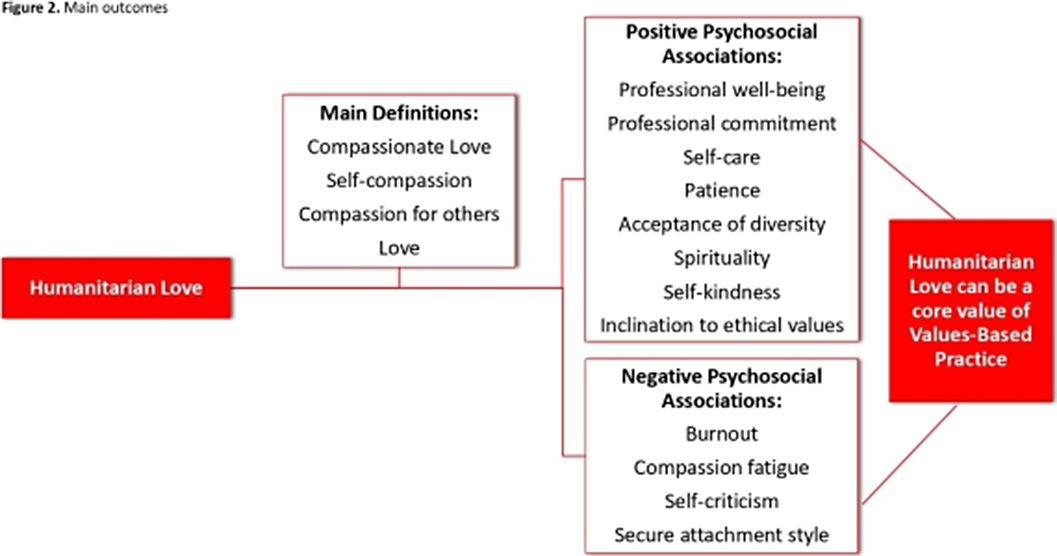
Eight articles met the inclusion criteria, comprising 1,948 participants (median age: 28.55). Humanitarian love encompassed compassionate love, self-compassion, and affection. Humanitarian love showed a negative correlation with burnout, compassion fatigue, self-judgment, and secure attachment, while positively correlating with professional well-being, professional commitment, self-care, patience, diversity acceptance, spirituality, self-kindness, and ethical values. Humanitarian love significantly influenced healthcare professionals’ psychosocial well-being. The main outcomes are presented in Figure 2.
Image:
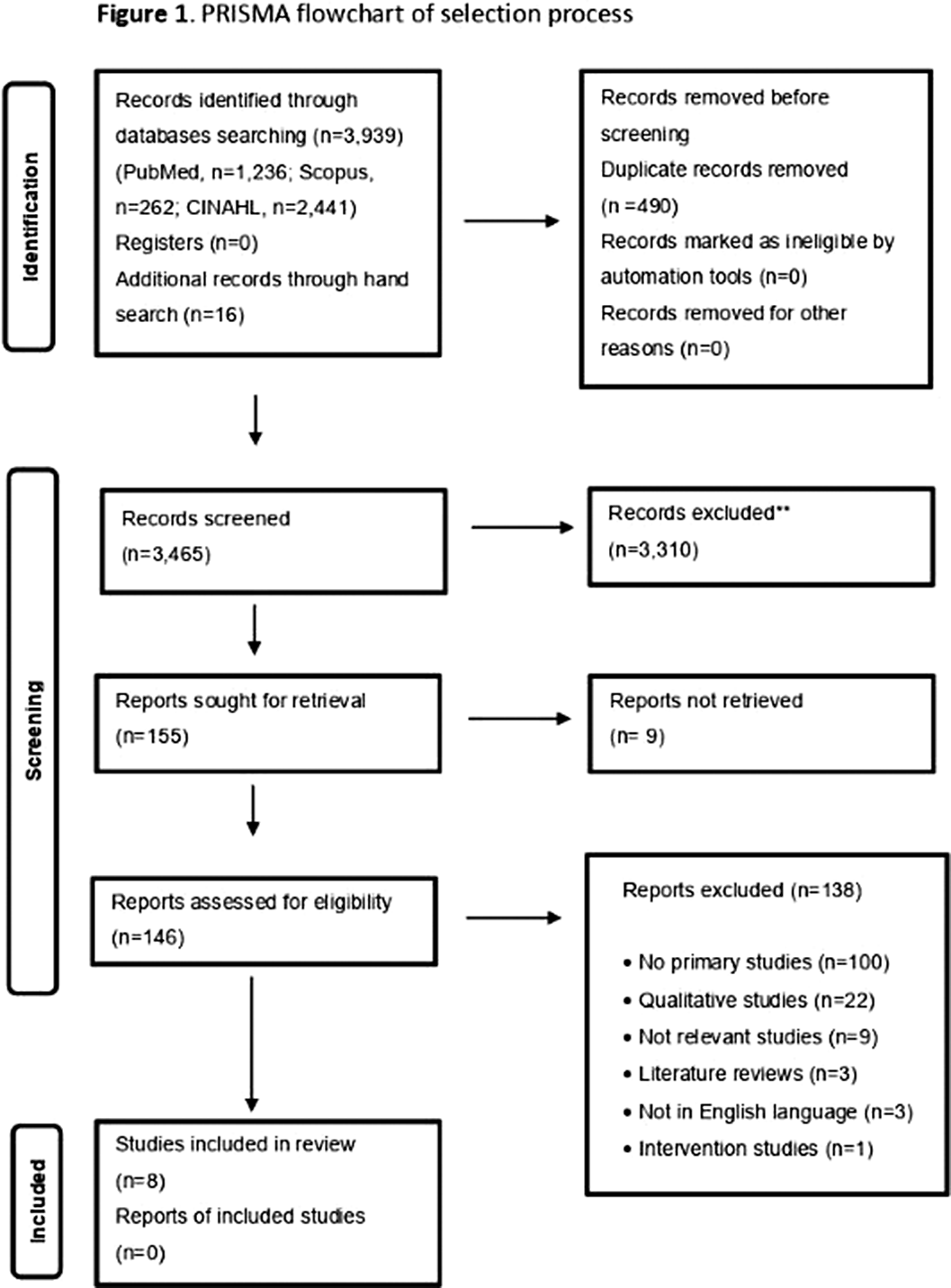
Image 2:
Conclusions
This review highlights humanitarian love’s potential to enhance the psychosocial well-being of healthcare professionals and emphasizes its significance as a core value in values-based practice. Cultivating humanitarian love among healthcare professionals through research and interventions could bolster their resilience, job satisfaction, and overall fulfillment in their roles.
Wildfire disasters have become increasingly rampant. There is a critical need for all to fully understand the mechanism and impact of these disasters on humans, with a special emphasis on the mental health effects they pose on the affected individuals and communities. This article specifically presents a scoping review of the psychological reactions of children and adolescents post-wildfire disaster.
Objectives
This review aims to synthesize currently available literature regarding the impact of wildfire on mental health, specifically the psychological reactions of children to wildfires.
Methods
We identified 8 research articles using 6 databases for this review. Data extraction was performed using a qualitative descriptive approach.
Results
The results identified post-traumatic stress disorder (PTSD), anxiety, depression, stress, alcohol/substance misuse, hopelessness, low resilience, reduced quality of life, and self-esteem as the psychological conditions manifesting in children and adolescents post-wildfire disaster. PTSD was the most evaluated psychological reaction in the participants (7 out of eight studies).
Conclusions
This review highlights that deleterious mental health effects, such as PTSD, depression, anxiety, and suicidality, can persist in children for years post-wildfire disaster. Factors such as gender, direct exposure to the wildfire, re-traumatization, and resilience informed or ameliorated the severity of the impact of wildfire on children and adolescents. Our findings further emphasize the need for multi-year funding and programs to support children and adolescents’ mental health, including children with disabilities in the communities that have experienced wildfire disasters.
Mixing describes the process by which solutes evolve from an initial heterogeneous state to uniformity under the stirring action of a fluid flow. Fluid stretching forms thin scalar lamellae that coalesce due to molecular diffusion. Owing to the linearity of the advection–diffusion equation, coalescence can be envisioned as an aggregation process. Here, we demonstrate that in smooth two-dimensional chaotic flows, mixing obeys a correlated aggregation process, where the spatial distribution of the number of lamellae in aggregates is highly correlated with their elongation, and is set by the fractal properties of the advected material lines. We show that the presence of correlations makes mixing less efficient than a completely random aggregation process because lamellae with similar elongations and scalar levels tend to remain isolated from each other. We show that correlated aggregation is uniquely determined by a single exponent that quantifies the effective number of random aggregation events. These findings expand aggregation theories to a larger class of systems, which have relevance to various fundamental and applied mixing problems.