To save content items to your account,
please confirm that you agree to abide by our usage policies.
If this is the first time you use this feature, you will be asked to authorise Cambridge Core to connect with your account.
Find out more about saving content to .
To save content items to your Kindle, first ensure no-reply@cambridge.org
is added to your Approved Personal Document E-mail List under your Personal Document Settings
on the Manage Your Content and Devices page of your Amazon account. Then enter the ‘name’ part
of your Kindle email address below.
Find out more about saving to your Kindle.
Note you can select to save to either the @free.kindle.com or @kindle.com variations.
‘@free.kindle.com’ emails are free but can only be saved to your device when it is connected to wi-fi.
‘@kindle.com’ emails can be delivered even when you are not connected to wi-fi, but note that service fees apply.
According to the latest Intergovernmental Panel on Climate Change (IPCC) Report (2022), climate changes (e.g. rising sea levels and temperatures and) are noticeable and intensifying on the entire planet. Extreme weather events or ecological disasters are occurring with increased frequency and intensity. Anthropogenic climate change has been called “the defining issue of our time” (United Nations, 2022) and “the greatest threat to global health in the 21st century” (World Health Organization, 2015). Health impacts from climate change may include increased morbidity and mortality from worsening cardiopulmonary health, and greater risk of infectious diseases and mental illness. During this lecture, we will discuss environmental aspects that clearly have a negative impact on the mental well-being of the general population and, more specifically, the psychiatric population. The focus will primarily delve deeper into climate anxiety.
The results of the study of psychological factors of hostility in depression are presented. The topicality of the study is due to hostility considered, on the one hand, as a property of depression, and on the other hand, as a risk factor, associated with the likelihood of auto-aggressive behavior.
Objectives
The aim of the study was to analyze the relationship between hostility and attachment disorders in endogenous depression.
Methods
The study involved 49 patients with depressive disorder (mean age 19,8±4,5). All patients were assessed using the Hamilton Depression Rating Scale (HDRS-17 mean 21,03±6,02). All completed the following methods: Revised Experiences in Close Relationships (ECR-R); Symptom Check List-90-Revised (SCL-90R); Aggression Questionnaire by Buss and Perry (BPAQ); I-structural test by G. Ammon (ISTA). According to the “depression” parameter of the SCL-90R, the group was divided into subgroups with high and medium severity of depression. Analysis of variance (ANOVA) or Mann-Whitney test were. Correlation analysis (Spearman) and stepwise multiple regression analysis were also used.
Results
At high levels of depression, the indicators of “hostility”, “destructive” and “deficit aggression” are statistically significantly higher. The severity of depression significantly correlates with the severity of “anxiety” in attachment (close relationships), as well as with pathological “narcissism”, “destructive external self-delimitation”, “deficient internal self-delimitation”.
For the measure of depression, regression analysis showed that the regression model explained more than 76% of the variance, with the measures of “interpersonal sensitivity”, “deficit narcissism”, and “avoidance” in attachment making significant contributions. For the “hostility” the regression model explains about 62% of the variance, while a significant contribution is made, as in the analysis of “depression”, by the indicators of “interpersonal sensitivity” and “avoidance”, however, unlike “depression”, the contribution of the “destructive narcissism” is noted in contrast to the “deficit narcissism”.
Conclusions
With severe depressive symptoms, indicators of hostility are increased. Hostility in depression is associated with factors caused by a violation of early interpersonal relationships (anxious attachment), which causes increased sensitivity in relations with others, “building a barrier” between oneself and the external environment perceived as hostile in the narcissistic pathology, problems in emotional regulation. One of the targets of psychotherapeutic work may be the ambivalence between desire for symbiotic dependence and the experienced hostility.
Use of psychoactive substances is a risk factor for mental health. Studying the peculiarities of using psychoactive substances by university students is extremely important for organizing preventive health care
Objectives
To specify the frequency of smoking and alcohol drinking, as well as the peculiarities of the correlational interconnections, in domestic and foreign university students
Methods
The survey covered 546 undergraduate domestic and foreign university students of both genders and different religious backgrounds. As a tool, we used the Sociocultural Health Questionnaire (E. Nikolaev)
Results
It has been revealed that domestic students smoke cigarettes and hookahs surely more often (p=.01) than foreign students (30.49% vs 19.08%). It is obvious that they also more often (p=.01) use electronic cigarettes or vaping drugs (25.24% vs 12.86%) and alcohol (54.42% vs 9.96%). Students in both groups denied using other psychoactive substances. Foreign students reveal positive correlational interconnections between smoking and alcohol drinking (r=.44), while there is no evidence of such interconnections in domestic students. Both groups show valid interconnections between the frequency of smoking and the level of stress (r=.15 и r=.17 correspondingly), the frequency of smoking and monthly financial expenses (r=.21 и r=.22 correspondingly). With domestic students, vaping negatively correlates with exercising in gyms (r=-.12), with foreign students it directly correlates with bodybuilding supplements consumption (r=.15). Those foreign students who drink alcohol more often point to the necessity of having a psychologist in the university (r=.13).
Conclusions
The revealed general and specific factors associated with domestic and foreign students’ use of psychoactive substances call for the necessity of developing culturally differentiated preventive programs
An undeniably significant amount of psychotropic medication can evidently affect the corrected QT (QTc) interval, which puts patients’ lives at risk. More specifically, certain anti-psychotic medication can increase the risk of QTc prolongation and by extension the risk of a potentially fatal arrhythmia or sudden cardiac death.
Objectives
Electrocardiograms (ECG) were contacted in one hundred and four (104) chronic patients, with psychosis, through out their hospitalization in several enclosed psychiatric facilities in Corfu. Almost the entirety of the patients along side their anti-psychotic medication were also taking various other medication for their individual pathological issues. We observed any changes that might have occurred on the ECG in comparison with each patient’s medication and it’s potential effect on the QTc.
Methods
The measurements of the QT interval were made manually in lead V5 and the mathematical conversion was contacted using the Hodges correction formula.
Results
At least one ECG (n = 104) was performed. Among them 29,8% (n=31) had ECG abnormalities, including 13,5% (n=13) with a prolonged Qtc (481.2 ± 26,8 ms). Covariates significantly associated with the QTc were gender (+17.2 ms if female, p < 0.0001) and age (+0.4 ms/year, p = 0.0001).
Conclusions
The QTc prolongation that was evident in a notable number of patients, emphasizes the importance of QTc monitoring in patients who are taking anti-psychotic medication. QTc prolongation risk factors should be assessed before the administration or prescription of any anti-psychotic medication.
The time period between the onset of a mental disorder and its first adequate treatment (duration of untreated illness - DUI) influence long-term prognosis and outcome in patients with severe mental disorders. The relationship between DUI and outcome was originally found in people affected by schizophrenia spectrum disorders, however in patients with Obsessive-Compulsive Disorder (OCD) DUI is significantly longer compared with that of patients with other severe mental disorders, such as schizophrenia and bipolar disorder.
Objectives
Aims of the present study is to assess the impact of DUI on long-term outcomes in OCD patients across published studies.
Methods
A systematic review was carried out by selecting relevant articles on the topic present in three common on-line databases, such as PubMed, APA PsycInfo, and Scopus, up to June 2023.
Results
Among included studies, DUI ranged from 7,0±8,5 to 20,9±11,2 years. Patients reporting a longer DUI have a poor long-term outcome, in terms of greater symptom severity and lower level of treatment response, whether pharmacological treatment or psychotherapy or a combination of these two. This is particularly true when the onset of the disease is insidious and subthreshold. However, there are severe early-onset forms of OCD in which the request for help is anticipated due to the severity of the symptoms, the DUI is shorter, but the prognosis is still negative.
Conclusions
The present review confirms that longer DUI has a negative impact on the long-term outcome of patients with OCD. Furthermore, it is reasonable to hypothesize that cultural factors, such as the perception of the disease and the ability to access treatment, may result in a prolongation of the DUI. All these elements cannot be evaluated in our review due to the paucity of studies on the topic. Future studies could be useful to better understand the causes of a longer DUI, to guide and to promote the dissemination of early interventions with a specific focus on OCD symptoms.
The research was conducted to explore the mental health issues, including anxiety, depression, low mood, emotional irrationality, and stressors related to pregnancy in the tertiary care hospital, in Karachi, after getting diagnosed with a life-threatening virus of hepatitis C and to determine the factors associated with depression among HCV-infected pregnant women. There appears to be a dearth of literature on this particular topic, and depression in HCV-infected pregnant women might not be dealt with effectively till this gap in the literature is addressed. The findings are to aid counselors in the formulation of treatment plans to help the patients during pregnancy and it helped to address the gaps in the antenatal care plans and support provided to the vulnerable population like HCV-Infected pregnant women.
Objectives
To explore what are the anxieties, stressors, and fears of HCV-infected young mothers.To explore the experiences of infected young mothers with HCV.
Methods
We have used a qualitative design of the study and a convenient, purposeful sampling technique to acquire the data. In Karachi, Pakistan, a tertiary care hospital will host this trial. Young moms who registered HCV+ infections between January 2022 and June 2022 were included in the study. The tertiary healthcare setting was used for the investigation. The suggested number of 10 young moms with HCV who had been detected during pregnancy and came to the clinic for treatment were selected, those who provided consent and who were neither pregnant nor extremely unwell at the time of the study were eligible. The average age of the inhabitants was 26. There were 42.85% undergraduate mothers, 28.57% mothers with graduate degrees, and 28.57% mothers with postgraduate degrees in the population. Thematic analysis was utilized to evaluate the data, and the themes were generated by looking at the data and creating codes to look into the transcription’s content.
Results
According to the findings, the referral system appeared to place a significant burden on individuals who were already dealing with the potentially fatal hepatitis C infection and were pregnant. In the antenatal period, when there should have been two different doctors’ visits, they were compelled to go to the same clinic.
Conclusions
The finding addressed the importance of specialized care setting in the tertiary care hospital in Karachi, Pakistan. There is a requirement of training programs for the development of soft skills of health care professionals and there must be awareness sessions to promote and mobilize the understanding of the spread of this disease.
To this research finding the importance of comprehensive health care support was identified. And it also depicts the importance of inclusive antenatal program design.
Motivational interviewing (MI) is an evidence-based communication style that is effective in facilitating behaviour change and patient engagement. Originally developed in the field of addiction, MI can be applied to address a range of health behaviours including smoking cessation, medication adherence and diabetes and weight management. Given its demonstrated efficacy, training clinicians in medical and psychiatry specialties in MI has potential to enhance patient outcomes.
Objectives
1. Enhance awareness and understanding of the basic concepts and methods of MI among NCHDs (Non-Consultant Hospital Doctors) and hospital staff.
1. Assess the perceived effectiveness of the training and help foster a culture of teaching and learning within the hospital.
Methods
MI training was organised by the psychiatry department and delivered by a certified external trainer. The training was structured into 2 sessions, each lasting three hours, with a six-week gap between sessions. The training was integrated into the regular academic teaching for psychiatry trainees and a circular email invite was sent to the medical NCHD cohort and psychology department. Pre and post-training questionnaires were collected from participants with five-point Likert scales used to gather responses
Results
There were 40 attendees across the two sessions. In total, 25 questionnaire responses were collected for the pre training (62.5%) and 30 responses were collected post-training (75%).
Prior to training 48% (12/25) indicated they were familiar with MI, 48% felt confident in using MI and 88% (22/25) felt it was applicable to their practice. Post-training, 73% (22/30) felt confident in using MI, 90% (27/40) felt MI was applicable to their practice and 100% indicated they would use MI in their practice. The perception of applicability (p=0.011) and likely utilisation of MI skills (p<0.001) significantly increased over the course of the training as measured by paired t-test (n=23). Ninety-seven percent of responders stated they would recommend the training and 57% (17/30) indicated that they would use MI on a weekly basis in the future.
Conclusions
NCHDs and other staff welcomed this training and indicated the training was relevant to their practice. MI demonstrated a positive effect on staff perceptions of applicability and future utilisation of MI skills. Increasing clinician self-perceived efficacy through training events may help contribute to a culture of learning and teaching in hospital settings.
Treatment-resistant depression (TRD) lacks a universally consistent definition due to varied interpretations despite attempts to define it based on inadequate response or remission despite sufficient antidepressant treatment. There’s a crucial demand for a uniform definition and staging to streamline its effective management amid diverse treatment options and the complex nature of resistance. Five methods have emerged to define and classify treatment resistance reliably.
Objectives
The aim of this study is to compare the five staging methods (Thase&Rush SM (T&R), European Staging Method (ESM), Maudsley Staging Method (MSM), Massachusetts General Hospital Staging Method (MHG-s), Conway Staging Method(Conway)) in assessing treatment resistance within a single sample.
Methods
Retrospective analysis involved medical records of inpatient psychiatry clinic admissions at Hacettepe University between October 2012 and October 2014. Patients with a primary diagnosis of bipolar affective disorder, schizophrenia, other chronic psychotic disorders, dementia or cognitive disorders, alcohol and substance use disorders, and those with missing data were excluded.
Results
Initial screening yielded a total of 115 patients. 64 patients were included in the study, 13 patients were excluded due to missing data, and 38 patients were excluded due to comorbidity.
Characteristic
Total (N=64)
Last Episode Characteristics
Total (N=64)
Female - N(%)
44 (69)
Episode duration – month (mean ± SD)
13.75 ± 16.09
Age – yr (mean ± SD)
48.39 ± 18.81
Psychotic symptoms – N(%)
20 (31)
Married – N(%)
41 (64)
Anxiety symptoms – N(%)
24 (38)
Secondary school and over – N(%)
38 (59)
Suicidal attempt – N(%)
19 (30)
Employed – N(%)
16 (25)
TRD definition and staging method (N=55)
T&R
ESM
MSM
MGH-S
Conway
Not resistant by this method
26 (47.3)
45 (81.8)
0 (0)
27 (49.1)
43 (78.2)
Identified by this method
29 (52.7)
10 (18.2)
55 (100)
28 (50.9)
12 (21.8)
Exclusively identified by this method
0 (0)
0 (0)
21 (38.2)
0 (0)
0 (0)
By this and one other method
27 (49.1)
0 (0)
11 (20)
5 (9.1)
0 (0)
By all methods
10 (18.2)
10 (18.2)
10 (18.2)
10 (18.2)
10 (18.2)
Identified as TRD
Age of onset (mean ± SD)
40.28 ± 17.42
35.6 ± 18.27
40.44 ±18.38
40.07 ± 17.9
38.17 ± 17.71
ATHF score (mean ± SD)
7.55 ± 5.46
12.1 ± 6.51
4.93 ± 4.98
7.43 ± 5.69
11.08 ± 6.47
Last episode duration (month) (mean ± SD)
17.11 ± 17.25
22.10 ± 20.96
14.22 ± 17.08
16.33 ± 17.66
20.83 ± 19.25
Conclusions
There is no universally agreed-upon definition for treatment resistance. In this sample, different definition and staging methods were employed to examine the similarities and differences in the clinical and treatment related characteristics of groups with TRD identified with each. The reasons and possible implication of concurrence and discordance between the methods will be discussed.
The evaluation of manic behavior with later onset is crucial, as various organic factors such as medications, infections, metabolic disturbances, tumors, and epilepsy can serve as potential etiological causes. While not universally observed, most studies indicate a connection between late-onset mania and neurological disorders like neurosyphilis.
Objectives
Our study aims to investigate the relationship between late-onset mania and neurosyphilis.
Methods
In this paper, we present a case of neurosyphilis presenting exclusively with symptoms of mania.
Results
A 72-year-old Tunisian woman with no prior medical or psychiatric history was referred to the psychiatric emergency room due to alterations in her mental state and behavior over the past ten days. During the psychiatric assessment, she displayed increased motor activity, fluctuating emotions, and rapid flow of ideas. The general physical examination yielded no notable findings. The serum Venereal Disease Research Laboratory (VDRL) test returned a strongly positive result (+++), and the TPHA examination confirmed a positive result at a titer of 1/60. In the serologic analysis of cerebrospinal fluid, VDRL was also positive, thereby confirming the diagnosis of neurosyphilis (NS). The diagnosis of mania secondary to a medical condition was established. The patient was treated with ceftriaxone and antimanic medications, resulting in a significant improvement in her psychiatric symptoms within a few days.
Conclusions
This case underscores the importance of conducting serologic testing for syphilis in patients who present with manic symptoms, experience a late-onset mental disorder, and have no prior history or family history of affective disorders.
Current healthcare policies encourage the investment in transition units between hospitalization and outpatient care. Psychiatry day hospitals (DH) serve as partial hospitalization structures that facilitate this transition. The DH at the Faro Unit of the Centro Hospitalar Universitário do Algarve (CHUA), began its activity in 2008, is situated in southern Portugal and provides support to the entire eastern Algarve region (approximately 300,000 people). Its focus is on rehabilitating individuals with severe mental illnesses necessitating multidisciplinary care, with personalized therapeutic plans.
Objectives
We aimed to categorize patients based on diagnoses (primary psychotic disorder, depressive disorder, and others) according to the International Classification of Diseases (ICD-11) and to characterize and compare sociodemographic and clinical data among these three groups.
Methods
A retrospective study spanning from May 2008 to June 2023 was conducted. We assessed sociodemographic, clinical, and epidemiological data of patients undergoing treatment at CHUA Faro Unit’s DH.
Results
Over this period, 541 treatment cycles were carried out to 433 distinct patients, between 18 and 78 years old. Of the total treatments, 38% were for Primary Psychotic Disorder (PPD), 24% for Depressive Disorder (DD) and among the others (39%) the diagnosis of Bipolar Affective Disorder and Personality Disorder predominated . Statistically significant differences were identified among these three groups. The PPD group exhibited a male predominance, whereas DD and others were largely female. Patients in the PPD group were significantly younger (average age of 36 in PPD, 40 in others, and 48 in DD), more likely to be single, and a majority were unemployed (with several patients retired due to disability). No significant differences were noted regarding dropouts, expulsions, or the duration of DH treatment. These results are preliminary, and additional relevant data are being collected and processed.
Conclusions
The diagnostic group’s consideration revealed differences in the social, demographic, and clinical characteristics of patients. These findings offer insights into patient details, enabling the future adaptation of intervention strategies in a more personalized manner.
Understanding adolescents perceptions of their weight status and the factors influencing these perceptions is pivotal for developing targeted interventions and policies to counteract the rising obesity trends.
Objectives
This cross-sectional study aimed to determine the accuracy of weight status perceptions among Tunisian adolescents compared to objective metrics and to identify sociodemographic characteristics and life habits associated with the underestimation of weight status.
Methods
A cross-sectional, school-based study was conducted among a randomized sample of adolescents attending secondary schools in Sousse, Tunisia. A total of 1399 students participated, with anthropometric measurements taken, and a pre-tested Arabic questionnaire administered to gather sociodemographic data and perceived weight status, assessed using the Figure Rating Scale (FRS). The accuracy of perceived weight status was determined by comparing the measured weight status with participants; self-reported perceptions. We evaluated the association between body weight distortion and life habits which included regular physical activity, screen time (time spent on internet per day), number of fruits and vegetables consumed per day, and fast-food consumption.
Results
The study achieved an 86.68% response rate, with over half of the participants being female (60.5%), and the average age being 17 years. The majority of adolescents (41%) perceived themselves as having normal body weight, while 34.5% perceived themselves as underweight, 16.6% as overweight, and 7.9% as obese. However, based on BMI categories, 72.6% had a normal measured weight, 20.4% were overweight, and 6.9% were obese. A substantial proportion of participants (45.6%) underestimated their weight status, with a significant proportion being objectively overweight or obese (26%). Furthermore, we found a significant association between the perception of weight accuracy with four correlates: gender, mother educational level, regular physical activity, and the number of fruits and vegetables consumed per day.
Conclusions
The findings revealed a disparity between perceived and actual weight status among Tunisian adolescents, with a significant underestimation of weight status, particularly among those who are overweight or obese. The results highlighted the crucial need for interventions that address weight perception inaccuracies and promote healthy weight awareness and management among adolescents in Tunisia. The study underscored the importance of further research to understand the development and progression of body weight underestimation throughout adolescence and the roles of lifestyle behaviors in shaping weight perceptions.
This presentation provides an overview of the impact of information technologies on contemporary psychiatric practice, focusing on resources and strategies beneficial for early career psychiatrists. Considering the increasing role of digital technologies in diagnosing and treating mental disorders, the presentation emphasizes the practical applications of artificial intelligence (AI) and machine learning. These technologies offer novel approaches for analyzing large volumes of clinical data, enhancing diagnostic accuracy, and personalizing treatment.
The presentation further examines ethical and legal issues associated with using digital technologies in psychiatry, including ensuring data confidentiality and complying with patient rights. The importance of developing competencies in information security and ethical principles when using digital tools is highlighted.
The talk concludes with an overview of the current and future trends in the use of digital technologies in psychiatry, including the development of virtual therapeutic environments and mobile applications for monitoring and supporting mental health. Examples of successful integration of these technologies into clinical practice are presented, emphasizing their potential to improve the quality of patient care.
Overall, the presentation underscores the importance for early career psychiatrists of mastering information technologies, highlighting their role in enhancing diagnosis, treatment, and patient care, as well as discussing the challenges and opportunities they present.
Previous research has implicated herpes simplex virus 1 (HSV1) and cytomegalovirus (CMV) in severe mental illness (SMI) with conflicting results. Both pathogens have high universal seroprevalence, are neurotropic and after the primary infection typically establish a persistent latent infection with periodic reactivations. Increased immunoglobin G (IgG) concentrations are considered to be attributable to an increased infection severity with more frequent reactivations or host immune system alterations.
Objectives
We assessed the HSV1 and CMV IgG concentrations in previously infected (seropositive) patients with SMI and healthy controls (HC). We hypothesized that seropositive patients would show higher IgG concentrations than seropositive HC.
Methods
We included 765 patients, 515 with schizophrenia (SZ) and 250 with bipolar disorder (BP), and 541 HC. HSV1 and CMV IgG seropositivity and concentrations were measured with immunoassays. 355 patients, mean age 33 years, 45% females, and 238 HC, mean age 35 years, 44% females, were HSV1 seropositive (HSV1+) while 447 patients, mean age 33 years, 50% females, and 296 HC, mean age 34 years, 47% females, were CMV seropositive (CMV+). In our main analysis among seropositive participants, we investigated the main effect of patient/control status on HSV1 and CMV IgG concentrations.
Results
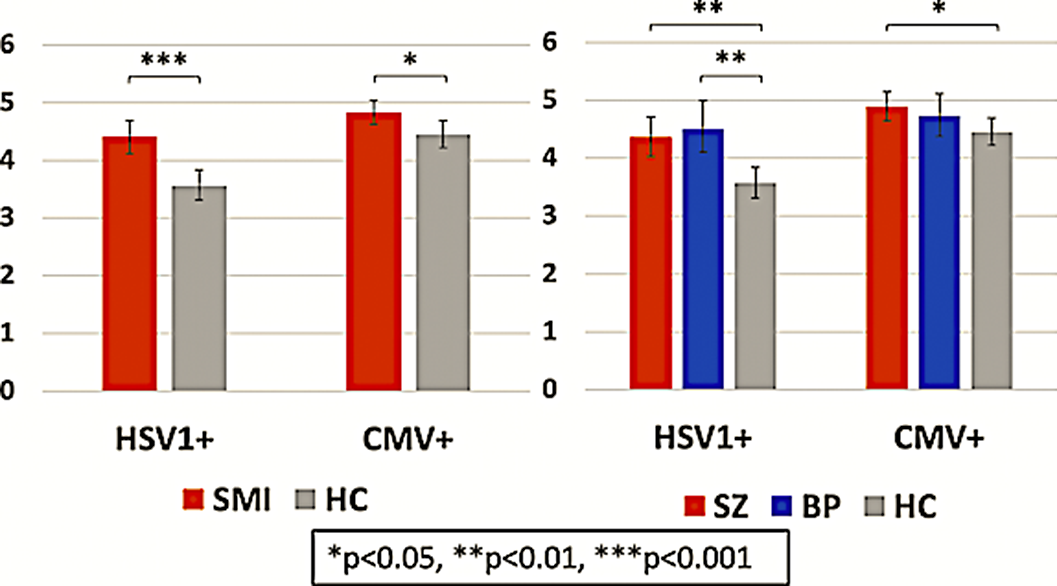
There were no significant differences in CMV or HSV1 seropositivity frequencies between patients with SZ, patients with BP and HC. Among seropositive participants, patients had higher HSV1 (p<0.001) and CMV (p=0.018) IgG concentrations than HC; stratifying by diagnosis, both patients with SZ (p=0.001) and patients with BP (p=0.001) had higher HSV1 IgG concentrations than HC, while patients with SZ, but not BP, had higher CMV (p=0.045) IgG concentrations than HC (Image). For HSV1, higher IgG concentrations were associated with higher general (p=0.017), negative (p=0.041) and positive (p=0.028) psychotic symptom scores.
Image:
Conclusions
Seropositive patients with SMI showed higher HSV1 and CMV IgG concentrations than seropositive HC suggesting that patients suffer a more severe infection or exhibit an altered immune response when contracting the pathogens. For HSV1, higher IgG concentrations were linked to more psychotic symptoms.
Disclosure of Interest
D. Andreou: None Declared, N. E. Steen: None Declared, K. N. Jørgensen: None Declared, T. Ueland: None Declared, L. Wortinger: None Declared, L. Mørch-Johnsen: None Declared, R. Yolken: None Declared, O. Andreassen Consultant of: Consultant to HealthLytix, Speakers bureau of: Received speaker’s honorarium from Lundbeck and Sunovion, I. Agartz Speakers bureau of: Received speaker’s honorarium from Lundbeck
The global COVID-19 pandemic and subsequent lockdowns have significantly impacted global wellbeing and highlighted the close link between mental and physical health. Social isolation and quarantine have proven to be major stressors, leading to emotional distress and unpredictable psychological consequences.
Objectives
We explored the pandemic’s impact on individuals’ physical and mental health and social relationships.
Methods
We conducted a cross-sectional study using a questionnaire which included among other socio-democratic questions, the Fear of COVID-19 Scale, the World Health Organization Quality-of-Life Scale (WHOQOL-BREF) and the Toronto Empathy Questionnaire (TEQ).
Results
A total of 511 adults (55.1% males) participated in this study. Participants reported increased social media use (more than 4-5 times/week) during the lockdown, which was associated with increased fear of COVID-19 and negative effects on mental and physical health, and social relationships (p<0.01). Conversely, non-work-related outings (once a week) were associated with lower fear (p<0.01) and better well-being (p<0.05). Higher fear, particularly for loved ones, was associated with negative effects. The level of physical health was moderate to high, with varying levels of satisfaction in different areas. Empathy correlated with increased fear (p<0.01) and reduced mobility (p<0.05).
Conclusions
The COVID-19 pandemic and lockdowns significantly affected physical and mental health, highlighting the importance of tailoring interventions for vulnerable populations and promoting adaptive coping strategies in times of crisis.
Since its first publication in 1977, the World Health Organization’s (WHO) Model List of Essential Medicines (EML) has guided the national procurement of medicines deemed essential to inform public health policy worldwide. Aiming to include the most effective, safe, and cost-effective medicines for priority conditions, WHO updates the EML every two years. However, over the past 45 years, updates to the mental health section of the EML have been infrequent, mostly involving the addition of individual medicines. A comprehensive revision of the entire section was never attempted.
Objectives
The aim of this project was to update the mental health section of the EML to identify the most effective and safest medicines for mental disorders in the light of the most up-to-date evidence base.
Methods
A series of nine evidence-based applications were submitted to the WHO Expert Committee on the Selection and Use of Essential Medicines in December 2022, recommending a substantial revision of the entire mental health section.
Results
All of our applications were accepted by the WHO Expert Committee. For psychotic disorders, aripiprazole, olanzapine, paliperidone, and quetiapine were added as therapeutic alternatives to risperidone; short-acting intramuscular chlorpromazine was replaced by short-acting intramuscular olanzapine; first-generation antipsychotics were limited to oral haloperidol and chlorpromazine. For bipolar disorder, the list now includes second-generation antipsychotics such as quetiapine, aripiprazole, olanzapine, and paliperidone. Tricyclic antidepressants for depressive disorders were limited to amitriptyline alone. Treatment options for anxiety and obsessive-compulsive disorder are now expanded to include SSRIs. For anxiety disorders, diazepam and lorazepam became the only benzodiazepines recommended, with the specific caveat that they should only be used for short-term emergency treatment of acute and severe anxiety symptoms. Finally, chlorpromazine and haloperidol are no longer considered essential medications for psychotic disorders in children under 13 years of age.
Conclusions
The WHO released the 23rd EML in July 2023. After decades of minimal and inconsistent updates, groundbreaking changes have been made to its mental health section. The updated mental health section provides a compelling opportunity to improve the quality of medicine selection at the country level, with the goal of increasing the availability of the safest and most effective psychotropic medicines worldwide.
A 56-year-old patient diagnosed with bipolar affective disorder type II, who remains stable, with no manifest episodes, thanks to aripiprazole 60mg daily.
Objectives
The aim is to carry out a brief review of the use of the drug as the only stabiliser in bipolar affective disorder.
Methods
A 56-year-old patient, who has been suffering from episodes of hypomania since the age of 40, with episodes of depression. After poor tolerance to the use of the usual stabilisers, and the impossibility of using antidepressants due to hypomanic swings, it was decided to start treatment with aripiprazole orally, up to a maximum of 60mg daily. Despite the fact that the patient, with this treatment, had no side effects and remained more stable psychopathologically, the patient did not comply adequately with the correct dosage, due to his rotating work shifts. This fact explained that although he acknowledged an improvement, he continued with episodes of depressive symptoms lasting several days followed by episodes of hypomanic characteristics.
Results
For this reason, it was decided to change treatment to aripiprazole long-acting injectable, in order to ensure linear blood levels of the drug. Initially, it was decided to prescribe 400mg every 28 days. However, after the first administration, 20 days later, the patient began to show dysphoric mood, with marked emotional lability, living in an egodystonic manner. For this reason, the dose was increased to 600mg on a monthly basis. Since then, after a year and a half with the same treatment, the patient has been stable and in line. There has been no further decompensation of the underlying psychopathology and no side effects.
Conclusions
Aripiprazole in TAB is superior to placebo in type I patients, mainly affecting manic and mixed episodes, but not so much in depressive episodes. It has also been observed that it not only acts in the acute phases, but also has a stabilising function, preventing manic episodes.
One study showed that up to 65% of patients on oral aripiprazole in whom it was replaced by AOM remained clinically stable. In the same study, approximately 50% of those who completed 52 weeks of follow-up were able to maintain clinical stability.
Orthorexia and exercise addiction can lead to serious health problems, such as malnutrition and exercise-related injuries.
Objectives
The aims of our study were to assess the prevalence of exercise addiction and orthorexia nervosa in Tunisian students at the Institute of Physical Education in order to investigate the relationship between these different health dimensions.
Methods
An anonymous self-administered questionnaire was distributed to students in the Sfax and Gafsa sports sections during March 2023. The orthorexic tendency was assessed using the ORTO-15 questionnaire. An ORTO-15 score below 40 points indicates orthorexic tendencies. The Exercise Addiction Inventory (EAI) was used to study exercise addiction
Results
In our study, 240 students were included. Mean scores on the ORTO-15 and EAI scales were 38.6 ± 8 and 16.6 ± 4.1 respectively. Participants at risk of exercise addiction had a statistically significant tendency towards orthorexia (p<0.001). Among the students, 82.5% had engaged in regular physical activity at a gym in the last two years. The reasons given by students for going to the gym were muscle strengthening (57.9%) and preparation for a sporting competition (37%).
Among students taking part in sports activities at the gym, the mean ORTHO-15 score was significantly lower among those doing so to prepare for a sports competition (p=0.005). Participants who believed that they were addicted to sport had a statistically greater tendency towards orthorexia (p=0.012).
Conclusions
Our study revealed an association between addictive exercise and orthorexic eating in Tunisian athlete students.
Contrary to classical belief, people affected by this disease are at greater risk of developing organic pathologies.This risk has a very complex origin: a greater exposure to risk factors and specific socioeconomic conditions, a high prevalence of risk behaviors, the use of antipsychotics, and a potential common genetic background. (Reynolds et al.Int. J.Neuropsychopharmacol.2021; 24 854–855, Suvisaari J et al. Curr Diab Rep. 2016 16). Multiple studies demonstrate that Schizophrenia confers a high endogenous risk of Diabetes. Before patients diagnosed with Schizophrenia start taking antipsychotics (Andreassen OA et al. Am J Psychiatry. 2017;174 616-617), they have an approximately 3 times higher risk of developing Diabetes compared to the general population. The risk increases 3.6 times after the initiation of antipsychotic treatment compared to drug naive patients(Annamalai A et al World J Diabetes. 2017 390-396)
Objectives
To study the association between Schizophrenia or other Psychotic Disorders and Diabetes Mellitus in a sample of patients diagnosed with Schizophrenia or other Psychotic Disorders.
Methods
This is a Descriptive and Cross-sectional Observational Study. Clinical Histories were reviewed and a personal or telephone interview was established to expand data related to the objectives of the study. The patients were recruited among the patients seen in the specific Severe Mental Disorder consultation who had a diagnosis of schizophrenia or other Psychotic Disorders, according to DSM 5-TR criteria.
Results
From a sample of 93 patients, 24 had Diabetes. The Prevalence of Diabetes in patients with Schizophrenia or other Psychotic Disorders was 25.8%. Of the patients without a diagnosis of Diabetes, 15 of them had values of Glycosylated Hemoglobin (HbA1c) for Prediabetes. Using the Chi-Square Test, statistically significant differences were found between the variable Main Psychiatric Medication and Diabetes. Patients treated with Clozapine, Aripiprazole and Olanzapine had a Prevalence of Diabetes of 40.9%, 33.3% and 28.5%, respectively.
Conclusions
Prevalence of Diabetes in our sample was 3.4 times higher than the 7.51% of the general population in Spain. This presumes a significant importance and impact on the health of these patients. The diabetic patients in our sample were diagnosed with Diabetes years after the diagnosis of the mental illness, which seems to indicate that the causes have to do with lifestyle, dietary habits, weight, and exposure to chronic antipsychotics. Premature death in schizophrenia has several explanations, being of special importance the development of cardiovascular disorders and Diabetes This can be due to many reasons, but it is worth highlighting the metabolic side effects of some antipsychotics and lifestyle. In this sense, it is essential to carefully monitor this group of patients.
In general, resilience is a process in which the interplay of risk and protective factors of the system itself and its environment is balanced in such a way that positive development opportunities open up. The resilience of a person, a system and a profession is therefore reflected in the ability to shape conditions in such a way that positive coping with challenges and crises is possible as a basis for positive further development. The time of the pandemic and the war in Ukraine has led to a large number of adjustments to psychology as a science, as a profession and as a perspective on life. This is associated with opportunities for positive further development of the discipline. European psychology has so far mastered the challenge of the pandemic and the war in Ukraine very well. The task now is to harness its successes as a multifunctional hub for other sciences, professions and society as a whole. The aim is to develop an identity that strengthens the unity of psychology in its diversity. With wisdom and resilience, psychology is also increasingly facing up to the challenges expressed in the United Nations Sustainable Development Goals (UN SDGs). In the discussion of social and professional change, the possibilities for a joint positive development of all professions in these stressful times become clear.
Major depressive disorder stands as one of the most significant mental health issues in the general population. It impacts the patients’ quality of life and increases both morbidity and mortality. Response and tolerability to available pharmacological treatments are often inefficient, sometimes requiring extended periods to achieve acceptable remission through combinations or augmentations. Non-pharmacological approaches constitute an element in the therapeutic options for this mental disorder. In recent years, there has been a growing interest in non-pharmacological biological treatment interventions. Among the principal ones are Electroconvulsive Therapy (ECT), Transcranial Magnetic Stimulation (TMS), Deep Brain Stimulation (DBS), and Vagus Nerve Stimulation (VNS).
Objectives
The aim of this paper is to review the current available literature to expand our knowledge about biological non-pharmacological treatment in depression, particularly ECT, TMS, DBS, and VNS.
Methods
A qualitative review was conducted over the last 5 years, using the Medline database through PubMed. We selected studies in English or Spanish that met the objectives of the review, excluding references in other languages. The scientific evidence obtained was analyzed and synthesized.
Results
There is growing evidence in this area. TMS, whose place in clinical guidelines remains unclear, is a less available treatment but might be considered in patients with moderate to severe depression who cannot receive pharmacological treatment. DBS, which shows good results in treatment-resistant major depressive disorder, achieves response rates greater than 50%. VNS has accumulated studies since its approval for treatment-resistant depression, showing some latency of response but demonstrating improvement persistence for at least two years, although some studies have not clearly shown a benefit. We also found studies demonstrating the effectiveness and favorable cost-benefit balance of ECT.
Conclusions
This review highlights the importance of increasing knowledge in these types of treatments. They have shown significant progress in recent years. We have a better understanding and use of the technique of ECT, while newer options have gained evidence in effectiveness over these years, with improvements facilitating their use in patients with treatment-resistant depression.
