To save content items to your account,
please confirm that you agree to abide by our usage policies.
If this is the first time you use this feature, you will be asked to authorise Cambridge Core to connect with your account.
Find out more about saving content to .
To save content items to your Kindle, first ensure no-reply@cambridge.org
is added to your Approved Personal Document E-mail List under your Personal Document Settings
on the Manage Your Content and Devices page of your Amazon account. Then enter the ‘name’ part
of your Kindle email address below.
Find out more about saving to your Kindle.
Note you can select to save to either the @free.kindle.com or @kindle.com variations.
‘@free.kindle.com’ emails are free but can only be saved to your device when it is connected to wi-fi.
‘@kindle.com’ emails can be delivered even when you are not connected to wi-fi, but note that service fees apply.
Patients with schizophrenia have shown a high mortality rate, and life expectancy is shortened by 10-20 years. This seems to be mainly caused by metabolic and cardiovascular diseases. Several risk factors are identified, including sedentary lifestyle, poor diet, low socioeconomic status, cognitive dysfunction, and antipsychotics iatrogenicity.
Objectives
We aimed to explore somatic pathologies reported in patients with schizophrenia, and to assess risk factors predisposing to these impairments.
Methods
We conducted a retrospective descriptive and analytical study, based on clinical and psychiatric observations of 60 patients with schizophrenia, hospitalized in psychiatry “B” department, Hedi Chaker university hospital (Sfax, Tunisia), during the period between 2015 and 2017.
Results
Among our patients, 38.3% suffered from somatic comorbidities: diabetes (21.7%), hypertension (15%), coronary disease (15%), hyperlipidaemia (15%), respiratory diseases (6.7%).
Tobacco consumption was reported in 53.3% of patients. It was significantly associated with the occurrence of cardiovascular diseases (p=0.036). Alcohol abuse was noted in 16.7%, while obesity was reported in 6.7% of patients.
Significant associations were found between obesity and diabetes (p=0.001), and between organic diseases and cognitive disorganisation (p=0.022). Somatic comorbidities were more frequent in patients with low socio-economic level (p=0.015).
Among our patients, 83.3% were treated with conventional antipsychotics while 38.3% were treated with atypical antipsychotics (AAP). We showed that AAP were associated with the occurrence of organic diseases (p=0.037).
Conclusions
Physical health of patients with schizophrenia requires a serious attention. Coordinated care between psychiatrists and other healthcare professionals should monitor the physical health of these patients to prevent a premature death.
Depression in psychosis has been more or less neglected as a field of study, due to its vague nosographic framework. Some studies have nevertheless focused on certain features of depression in psychosis, such as post-psychotic depression. This is a frequent phenomenon with a nosographic and etiopathogenic complexity that can lead to confusion.
Objectives
To study the characteristics of post-psychotic depression and compare results with those in the literature.
Methods
It is a prospective, descriptive, case series study conducted at the Ar-Razi psychiatric hospital in Salé. Inclusion criteria were patients diagnosed with a brief psychotic disorder, schizophreniform disorder or schizophrenia, in remission, who met the criteria for a DSM 5 characterized depressive episode. Data are collected during the psychiatric interview with the patient, using a questionnaire.
In May 2021 a group of 96 classical antiquities was seized from Fordham University where they had formed part of their museum collection. The seizure was directly linked to the investigation by US authorities of objects that had been handled by the dealer Edoardo Almagià. The Fordham material was dominated by objects derived from Italy: Apulian, Campanian, and Paestan figure-decorated pottery; red-on-white ware associated with Crustumerium in Lazio; and Etruscan pottery, architectural terracottas, and terracotta votives. The objects were all donated to Fordham by William D. Walsh and had largely been acquired at auctions or through a narrow group of Manhattan galleries.
What is the psychiatrist’s role on a burning planet? As our world faces the existential ramifications of irreversible climate change, clinicians are contending with what purpose a normalizing institution like psychiatry can have in increasingly abnormal times.
Objectives
This presentation investigates the role of the modern mental health clinician by examining psychiatry’s current impotence in the face of climate crisis. It will be shown that current approaches are often complicit in psychiatry’s historical depoliticization of mental health and subsequent individualization of social concerns. It will be argued that the only way psychiatry can maintain its ethical obligations to its patients is by taking a courageous sociopolitical stance.
Methods
Emerging from a multidisciplinary literature review on the relationship between psychiatry and social crises, this work examines our field’s response to climate change in particular. A focus is made on literature that explores psychiatry’s political obligations, current trends in climate psychiatry, and proposed social psychiatric approaches to the climate crisis.
Results
It is shown that while ecological collapse tangibly affects our patients, psychiatry often fails to engage socio-politically with the crisis’ root causes. Framing intense reactions to climate change as trauma responses and developing neo-diagnoses such as “ecoanxiety” both risk individualizing inherently social experiences. However, Psychiatrists are also uniquely positioned to speak with authority about social crises and to articulate what a more comprehensive medical response to climate change might look like.
Conclusions
Given climate change’s disproportionate effects on disenfranchised populations, it is increasingly clear that health is inextricable from social circumstances. As a result, political inaction is incompatible with our ethical duty to serve patients’ health, both in the clinic and beyond it.
Psychotic disorders are strongly linked to a higher risk of mandatory hospitalization, often affecting men more, though some studies report the opposite. Recent investigations also show a higher rate of involuntary admissions in younger individuals. Knowledge in this area is still limited despite extensive research.
Objectives
Analyze whether there is an association between sex and age with involuntary admissions of individuals with psychotic disorders.
Methods
Retrospectively, 254 people with psychotic disorders admitted between 2018-2023 to the adult psychiatric inpatient unit at Hospital Universitari Germans Trias i Pujol were selected, collecting their nature of admission, sex, age, and discharge diagnosis. Comparisons between voluntary and involuntary admissions, with respect to sex and age variables, were conducted using independent sample t-tests, Mann-Whitney U tests, Fisher’s exact test, and chi-square tests. A logistic regression model was used to identify variables significantly associated with mandatory admission.
Results
In both the male and female groups, there were no statistically significant differences in terms of the mean age at admission (p = 0.162) or the nature of admission (p = 0.586) (Table 1). When analyzing the voluntary nature of admission based on age and sex, statistically significant differences were only found in the female group (p = 0.01), resulting in a 9.18 year age difference among those admitted voluntarily (Table 2). The model that best predicted the probability of involuntary admission in individuals with psychotic disorders included the sex variable (OR = 4.88) and the interaction between sex and age (OR = 0.97) (Table 3).Table 1:
Differences between sex regarding voluntariness of patients with psychotic disorders.
Male
Female
p value
N (%)
122 (48%)
132 (52%)
Age, m (SD)
38.39 (16.64)
44.15 (18.44)
0.162
Admissions, N (%)
Voluntary
38 (31.1%)
37 (28.0%)
0.586
Involuntary
84 (68.9%)
95 (72.0%)
Table 2:
Analysis of voluntariness by sex and age.
Age, m (SD)
Voluntary
Involuntary
p value
Male
37.45 (16.38)
38.81 (16.84)
0.677
Female
50.76 (18.19)
41.58 (17.98)
0.01*
Total
44.01 (18.44)
40.28 (17.46)
0.127
Table 3:
Predictors of involuntariness in psychotic patients: Logistic regression model (ENTER METHOD).
Predictor
-2log likelihood
Nagelkerke R2
x2 (df*)
OR* (95% CI*)
p value
301.22
0.039
0.03 (1)
Age
1.01 (0.98; 1.03)
0.674
Sex
4.88 (1.15; 20.72)
0.032*
Age x Sex Interaction
0.97 (0.94; 0.99)
0.046*
Conclusions
Young women with psychotic disorders face a higher risk of involuntary admissions, emphasizing the need for gender-specific strategies to improve care of these patients.
In recent decades, there has been increasing interest in neurocognitive function, including non-social and social cognition. Cognitive impairment has a significant impact on functional outcome, especially in schizophrenic disorders, but also in affective and other psychiatric disorders.
Objectives
It is our aim to present the assessment and measurement of cognitive dysfunction through adequate instruments and to evaluate the effects of combining pharmacotherapy and cognitive remediation.
Methods
A review of the modern literature is undertaken and results of own investigations using the Screen for Cognitive Impairment in Psychiatry (SCIP, Sachs G et al. Schizophr Res Cogn. 2021 May 12;25:100197; Sachs G et al. Schizophr Res Cogn. 2022 Jun 6;29:100259) are presented and evaluated.
Results
Our data show that it is possible to capture cognitive dysfunction in clinical practice.
Conclusions
After a differentiated assessment of cognitive dysfunction, a specific combination of pharmacotherapy and cognitive remediation should be applied to patients with schizophrenia and affective disorders.
Obsessive-Compulsive Disorder (OCD) and Major Depressive Disorder (MDD) are among the ten most disabling disorders, yet only 30-40% of people with the condition seek specialist care (WHO). Considered a relatively new tool in the treatment of OCD and MDD, repetitive transcranial magnetic stimulation (rTMS) was first used by our team 1 year ago. Based on current literature cognitive behavioural therapy (CBT) is effective in 60% of OCD cases, with MDD also having a good response rate of 50-60%. The efficacy of SSRI’s has been demonstrated, but side effects can have a negative impact on adherence in the long term. Prolonged use of certain drugs has adverse reactions that lead specifically to memory impairment, which compromises suitability for psychotherapy. The same problem applies to the use of electroconvulsive therapy (ECT) in a major depressive episode.
Objectives
Our aim was to study the efficacy of combining rTMS with CBT, to gather clinical experience on how these two different methods work in practice when combined.
Methods
Patients diagnosed with therapy resistant MDD received rTMS treatment using 50Hz theta burst over 10 sessions. Therapy resistant OCD patients were treated by a 15 sessions rTMS using 1Hz single pulse. These rTMS sessions were combined with CBT, of which we would like to highlight two cases: one of them is a 34 years old woman, who has wide range of sexual, checking and contamination-related OCD symptoms and only received SSRI treatment so far. The other one is a 29 years old man, who suffers from religious obsessions, cleaning compulsions and other repetitive behaviours.
Results
The positive effects of rTMS treatment on working memory functions, attentional capacity and cooperative skills without significant additive effects suggest exciting possibilities for combining the two treatments, thus the combined treatment has been tested in clinical practice. In our own patient care, an important experience was that patients were committed to the therapy, felt safe and, unlike with medications, did not have to worry about side effects. While medication and ECT can make psychotherapy more difficult in the long term - mainly because of memory problems - rTMS facilitates it. Patients appreciate that we approach their problems in a complex way, and they perceive that the combination of the two very different methods reflects professionalism. Our poster attempts to present the experience of combining rTMS and CBT from the therapist’s perspective through two case studies.
Conclusions
Based on our experiences it is an effective approach to combine rTMS with CBT in therapy resistant MDD and OCD patients. In the light of these results the revision of the existing guidelines are considerable.
Acknowledgements
This study has been supported by the Human Resource Development Operating Programme 5.2.6 grant.
Human faces generally attract immediate attention. However, it has been found that children with autism spectrum disorder (ASD) tend to allocate relatively less attention to faces. Previous research showed that typically developing children (TD) exhibited an attentional bias to angry faces, regardless of their anxiety levels, but it’s unclear if this applies to children with ASD. Therefore, the present study aims to investigate attentional bias induced by angry and/or happy faces in children with ASD.
Objectives
We explored attentional bias toward angry faces in both TD children and children with ASD. We hypothesize that while TD children will show attentional capture effects in response to angry faces, children with ASD will not exhibit such attentional bias to facial stimuli, irrespective of their emotional content.
Methods
By now, five ASD participants (all male) and 34 TD participants (17 male), aged 6-12, have completed a continuous performance task. In this task, irrelevant distractors (angry or happy faces) appeared and disappeared abruptly, while the orientation of the target changed every 1,250 ms. Participants were asked to respond as quickly and accurately as possible to the orientaiton of the target. We designated the time when the distractor first appeared as T1, and subsequent time intervals at 1,250 ms increments were labeled as T2, T3, and T4. The time intervals when no distractor was present were labeled as TB (baseline). If the reaction time (RT) at T1 was significantly slower compared to TB, it indicated attentional bias by the distractor.
Results
For the RT data, separate repeated measures ANOVAs with 2 (emotion) * 5 (time) factors were conducted for each group. The results revealed a significant main effect of time (F(4, 132) = 17.59, p < .01) and a significant interaction between emotion and time (F(3.27, 107.74) = 4.92, p < .01) only in TD. Post hoc t-tests indicated that TD children exhibited significantly slower RT at T1 compared to TB, but this difference was observed only for angry faces (t(33) = 4.84, p < .01). In contrast, no significant effect was found in children with ASD. In other words, TD demonstrated attentional bias only when exposed to angry faces, while ASD children did not exhibit attentional bias to either emotion.
Conclusions
This study aimed to investigate attentional bias to angry faces in both TD and ASD children. The results indicate that TD children exhibited an attentional bias when exposed to angry faces, whereas ASD children did not display such bias. These findings are consistent with previous research suggesting that TD children tend to show attentional bias towards angry faces, regardless of their anxiety levels. Furthermore, the absence of attentional bias to angry faces in ASD suggests that their characteristic of reduced attention to faces may contribute to the lack of attentional bias towards angry faces.
Anhedonia is a transdiagnostic psychopathological phenomenon that is considered a key feature for several disorders, primarily affective spectrum disorders. It exhibits a significant association with social and occupational maladjustment, reduced quality of life, and increased suicidal risk among psychiatric patients.
Objectives
The aim of this study is to identify recommendations for psychotherapeutic assistance for patients with affective spectrum disorders.
Methods
A total of 26 patients with affective spectrum disorders (ICD-10 code - F33, F31) and the phenomenon of anhedonia were examined. We utilized neuropsychological methods aimed at investigating a wide range of cognitive functions (Dynamic praxis; Color interference test; Arithmetic Tasks; Number of skips and impulsive errors; Reverse and straight rows; Verbal fluency; Design fluency; Rey-Osterritz figure) and psychometric methods designed to diagnose various types of anhedonia (consummatory (TEPS), anticipatory (TEPS), social (RSAS), and physical (PAS)).
Results
Among patients with depression, the consummatory type of anhedonia was the most pronounced. A relationship was found between anticipatory anhedonia and phonetic verbal fluency (r = 0.487; p < 0.01). Additionally, there were correlations between immediate (consummatory) pleasure experience and Rey figure errors (r = -0.349; p < 0.05). Social anhedonia was associated with phonetic verbal fluency productivity (r = -0.509; p < 0.01) and performance in visual fluency productivity (r = -0.473; p < 0.01).
Conclusions
The obtained results allow us to hypothesize that anhedonia is associated with difficulties both in evaluating and imagining possible positive stimuli, which leads to a lack of emotional response to the current stimulus. Thus, the availability of current pleasure may be linked to memory accessibility and regulatory function. When these domains are weakened, the respondent loses the ability to associate the current stimulus with positive past experiences, making it challenging to generate an emotional response in the current stimulus situation and disrupting the anticipation of pleasure. Based on the results, we propose the effective use of behavioral activation and work on the actualization of past experiences. Behavioral activation can be implemented by gradually introducing behaviors associated with past pleasures into the patient’s life, followed by cognitive restructuring aimed at focusing the emotional response on past and current stimuli. In addition to this, from a neurocognitive perspective, an additional element of therapy could involve training various types of cognitive functions, with an emphasis on the auditory modality.
Many medical workers suffered from severe professional burnout while working in the conditions of the COVID-19 pandemic, but few of them had the opportunity to find psychological help.
Objectives
The aim of the research was to study the relationship between emotional burnout and self-help strategies in medical professionals during the pandemic.
Methods
The Maslach Burnout Inventory (MBI) was used to measure the level of professional burnout. It was filled out by medical workers from January 2021 to November 2022.
The sample consisted of 314 medical workers (57 men and 255 women), whose average age was 36.97±11.93. According to the level of education, the sample included specialists with secondary general education (4.14%), with secondary special education (19.4%), with incomplete higher education (11.46%), with higher education (59.87%) and PhD (5.1%). 35 people (11%) of the surveyed medical workers worked in the red zone.
Results
When medical workers experience severe Emotional Exhaustion and Depersonalization, they often try to help themselves by drinking alcohol (r=0.156; p=0.005; r=0.184; p=0.001), eating (r=0.227; p=0.000; r=0.151; p=0.007), taking medications (r=0.204; p=0.000; r=0.212; p=0.005), solitude (r=0.204; p=0.000; r=0.133; p=0.019), watching TV series (r=0.173; p=0.002; r=0.146; p=0.01). With an increase in the Reduction of professional skills, medical workers also eat more (r=-0.148; p=0.009) and try to learn something new, engage in self-development (r=-0.137; p=0.015). It is important to note that the desire to seek psychological help is associated only with Emotional Exhaustion (r=0.121, p=0.032), that is, he/she may be aware at an early stage of professional burnout, when the symptoms of depersonalization and reduction of professional skills have not yet occurred.
Conclusions
Thus, all the considered self-help methods are already used with pronounced symptoms of professional burnout, but do not lead to its pronounced decrease. It is important to note that seeking psychological help is possible with awareness of emotional exhaustion, but not with depersonalization and reduction of professional skills.
Disclosure: Research is supported by the Russian Science Foundation, project No. 21-18-00624.
Psychotropic substance use among medical residents represents a critical concern due to its potential impact on patient care and practitioner well-being. This topic looks into the prevalence and characteristics of psychotropic substance use, including prescription medications and illicit drugs, among individuals pursuing medical residency. Understanding the scope of the problem and its distinctive features is essential for developing targeted interventions and support mechanisms within the medical community.
Objectives
To assess psychotropic substance use among medical residents, describe its characteristics and determine the prevalence of problematic use.
Methods
We conducted a cross-sectional and descriptive studyamong Tunisian medical residents over a three-month period (August - September 2022) using an online survey. Different specialties and levels of residency were included. An online self-questionnaire was used including a data collection form and the DAST-10 (Drug Abuse Screening Test) scale. The data was analyzed using the SPSS 20th version software
Results
Among the 80 residents in our study, 19 (23.8%) reported psychotropic substance use, and 12 (15%) reportedthat they had misused psychotropic drugs at least once in their lives (without a prescription and/or with a prescription but not following the instructions). The most commonly psychotropic drugs used were benzodiazepines, followed by amphetamines, analgesics, anesthetics, and pregabalin (28%, 16%, 12%, 12%, 12%, respectively).
Consumption was regular for 41.7% of those who reported psychotropic drugs misuse. The initiation of psychotropic use followed a desire to experiment various substances (41.7%), a medical prescription (33.3%), or their availability due to medical practice (25%). Self-medication and recreational use were the most common reasons for use (41.7% each). Furthermore, 31.6% of consumers revealed a problematic substance use as assessed by the DAST-10 scale.
Conclusions
Our study showed a concerning prevalence of psychotropic substance use among medical residents, benzodiazepines being the most prevalent. Notably, 15% acknowledged misuse and a significant proportion displayed problematic substance use. These results highlight the potential health risks and the importance of addressing this issue within the medical community.
The existing body of evidence on the association between maternal diabetes and attention deficit/hyperactivity disorder (ADHD) in offspring is inconsistent and inconclusive. Thus, we need to synthesise the available evidence to examine the association between maternal diabetes and risk of ADHD in offspring.
Objectives
The aim of this meta-analysis was to examine the association between maternal diabetes and the risk of ADHD in offspring.
Methods
We conducted a comprehensive search across PubMed, MEDLINE, EMBASE, Scopus, CINAHL and PsychINFO databases from their inception to September 8th, 2023. The methodological quality of the included studies was evaluated using Joanna Briggs Institute (JBI) and Newcastle-Ottawa Scale (NOS). Between-study heterogeneity was assessed using I2 statistic and potential publication bias was checked using both funnel plot and Egger’s test. Randomeffect model was used to calculate the pooled effect estimates and subgroup, sensitivity, and meta-regression were further performed to support our findings
Results
Twenty observational studies (two cross-sectional, five case-control and thirteen cohort studies) were included in this systematic review and meta-analysis. Our meta-analysis indicated that intra-uterine exposure to any type of maternal diabetes was associated with an increased risk ADHD in offspring [RR=1.33: 95 % CI: 1.23–1.43, I2=79.9%]. When we stratified the analysis by maternal diabetes type, we found 17%, and 37% higher risk of ADHD in offspring exposed to maternal gestational [RR=1.17: 95 % CI: 1.07–1.29] and pre-existing diabetes [RR=1.37: 95 % CI: 1.27–1.48] compared to unexposed offspring respectively. Results of subgroup and sensitivity analysis further supported the robustness of our main finding.
Conclusions
Our review suggested that exposure to maternal diabetes increased the risk of ADHD in offspring. These findings underscore the need for early screening and prompt interventions for exposed offspring.
Schizophrenia is a complex and multifactorial disorder believed to arise from the interplay between genetic factors and environmental influences. Among these environmental factors, childhood trauma stands out as a significant contributor to the onset of schizophrenia in adulthood.
Objectives
The objective of this study was to assess the occurrence rates of physical, emotional, and sexual abuse, as well as physical and emotional neglect in a group of Tunisian women diagnosed with schizophrenia spectrum disorders.
Methods
We conducted a descriptive cross-sectional study among stabilized female patients with schizophrenia or schizoaffective disorder, in the ‘B’ psychiatry department at Hedi Chaker University Hospital in Sfax, Tunisia, from May to June 2023. We administered the 28-item Childhood Trauma Questionnaire (CTQ).
Results
In this study, 41 female patients were enrolled, with 65.9% diagnosed with schizophrenia and 34.2% with schizoaffective disorder. The average age of participants was 49.19 years, ranging from 17 to 79. The mean score on the Childhood Trauma Questionnaire (CTQ) was 56.34, with scores ranging from 43 to 98. Emotional neglect was the most prevalent form of trauma, reported by 40 patients (97.6%). Following emotional neglect, physical abuse was found in 16 patients (39%), sexual abuse in 10 patients (24.4%), emotional abuse in 6 patients (14.6%), and physical neglect in 2 patients (4.9%).
Conclusions
Based on these findings, our recommendation is to establish government-operated facilities that offer emotional and psychological support, legal assistance, parenting guidance, and medical monitoring in collaboration with educational institutions and social and child protection services for those in need.
According to data, psychiatric re-admissions rates vary from 10%-80%, while they negatively affect the patients’ quality of life and life expectancy. The limitation of multiple psychiatric hospitalizations represents a clinical challenge for all mental health professionals.
Objectives
To investigate risk factors of hospitalization in a sample of psychiatric patients in Northern Greece.
Methods
1,633 records of psychiatry inpatients were examined retrospectively throughout the 10-year records of the Psychiatry Department of Papanikolaou General Hospital in northern Greece. The research was conducted between 2013 and August 2023. The sample was divided into subgroups according to gender, diagnosis, and year of hospitalization. A bivariate analysis was performed to examine relationships between the examined variables: (a.) place of residence; (b.) age; (c.) type of admission; (c.) hospitalization duration; (d.) number of lifetime hospitalizations; (e.) lifetime prosecutor’s orders for coercive examination; and (f.) lifetime suicide attempts.
Results
A fairly equivalent number of males and females was included in the study (M: 874; F: 759).The mean age of the sample was 44.7 years with males being younger than females (males 43.23; females 46.39). Males residing out of the co-capital as well as females residing within the co-capital of Greece, Thessaloniki, disclosed higher odds of being hospitalized (p<0.03). Coercive hospitalizations represented 47% of cases, bore the highest duration (20.7 days), and involved the youngest patients. Coercively hospitalized male patients outnumbered their female counterparts (p<0.001). Voluntary urgent hospitalizations duration was estimated at 17.04 days, followed by outpatient admissions (12.64 days) and transfers from other clinics (11.35 days). 37% of patients experienced psychosis while 35% experienced affective disorders. Males were more affected by psychosis (Odds Ratio: 1.35; p<0.001). Females were more liable to affective disorders (OR: 1.78; p<0.001). 7% of the sample had committed suicide attempts, with single suicide attempts being ten times higher than multiple suicide attempts (p<0.001). Females were more than twice as likely as males to commit a suicide attempt (p<0.001). Females tended more to be hospitalized self-willingly (p=0.0015) and to voluntarily terminate hospitalizations prematurely (p=0.0014). Patients with a single hospitalization were seven-fold compared to those with multiple hospitalizations (p<0.001). The average lifetime hospitalization number for a patient was one hospitalization, while the average for a patient with previous hospitalizations was three.
Conclusions
Being in position to identify the patients in high-risk for hospitalization -as well as for suicide attempt- the clinician can proceed to initiatives such as treatment modifications or further involving the patient’s family.
Autism Spectrum Disorder (ASD) is a neurodevelopmental condition characterized by challenges in social communication and behaviour. Timely identification of ASD is pivotal for effective intervention. However, significant gaps persist in our understanding of early signs and biomarkers, particularly among infants with older siblings already diagnosed with ASD. Furthermore, factors during the perinatal and neonatal period remain underexplored.
Objectives
This systematic review aims to investigate early autism markers within this specific cohort and assess their potential impact on intervention strategies.
Methods
A thorough search of electronic databases, including PubMed, PsycINFO, and Scopus, was conducted, initially identifying 161 relevant papers related to ASD and resilience published from 2013 to 2023. After excluding studies focused on environmental determinants of resilience in ASD, 75 papers remained. We concentrated on studies examining early identification of autism, especially in infants with older siblings with ASD, biomarker discovery, or predictive factors within this unique population. The search strategy employed a diverse set of keywords encompassing ASD, genetics, neurobiology, and the perinatal period to ensure comprehensive coverage of pertinent studies. Quality assessment of each study followed standardized criteria, and data synthesis utilized a thematic analysis approach.
Results
Our systematic exploration revealed a spectrum of early markers associated with ASD in high-risk infants, spanning behavioural, neurodevelopmental, genetic, and perinatal domains. Recognizing these early indicators offers promise for timely and potent intervention strategies, potentially refining long-term outcomes for children at risk of ASD.
Discussion
The synthesis of existing research in this systematic review underscores the significance of studying early markers within high-risk populations. Early intervention, guided by these markers, holds the potential to enhance the quality of life for at-risk children with ASD and their families. This review contributes to our understanding of the early identification of autism and emphasizes the imperative need for continued research in this critical area.
Conclusions
This systematic review sheds light on the current state of research on early signs and biomarkers of autism in infants with older siblings diagnosed with ASD. The findings carry significant implications for the development of targeted interventions that can be implemented at an earlier stage of development. Future research should further investigate these markers and their potential role in guiding early and effective intervention strategies.
Keywords: Autism Spectrum Disorder, early signs, biomarkers, infants, older siblings, early intervention, high-risk population.
The diagnosis and treatment of depression are complex due to its diverse forms. Recent focus in clinical practice has been on identifying markers for mono- and bipolar depression, as early diagnosis significantly impacts treatment.
Objectives
To identify clinical characteristics of unipolar and bipolar depressive disorders and assess their correlation with aggression levels in patients.
Methods
We studied patients at the Mental Health Research Institute of Tomsk NRMC: ICD-10 codes: Bipolar Affective Disorder (BD) (n=28), Recurrent Depressive Disorder (RDD) (n=33). Patients with BD were older (49 (33; 52) years) than those RDD (40 (31; 51) years) (p=0.018). The current depressive episode duration was shorter for BD (3 (2; 7) months) compared to RDD (5 (2; 12) months) (p=0.018). Gender distribution was comparable (p=0.568). We measured clinical symptoms (depression, anxiety, anhedonia) using psychometric tools (HAM-D, HAM-A, SHAPS) at admission and after 3 weeks of therapy. Aggression was assessed with the Buss-Durkee Hostility Inventory (BDHI) at admission.
Results
Patients with RDD demonstrated a higher severity of depressive symptoms upon admission (Table 1).Table 1.
Clinical Characteristics of Unipolar and Bipolar Depression Course
Severity of Symptoms
Bipolar Depression
Unipolar Depression
р (U-test)
HAM-D on admission
19 (15.5; 24)
22 (18; 26)
0.044
HAM-D after 3 weeks
4 (2; 6)
4 (3; 7.75)
0.219
HAM-A on admission
16 (12; 25)
19.5 (13; 26.75)
0.098
HAM-A after 3 weeks
3 (2; 6.5)
4 (3; 7.75)
0.219
SHAPS on admission
5 (1.25; 9)
3 (0; 10)
0.7
SHAPS after 3 weeks
1 (0; 4)
1 (0; 3)
0.44
The severity of some aggressive patterns was higher in patients with bipolar disorder (Table 2).Table 2.
The severity of aggressiveness in unipolar and bipolar depression.
BDHI subscale
Bipolar Depression
Unipolar Depression
р (U-test)
Aggressiveness index
19 (13; 24)
18.5 (12; 24)
0.745
Hostility index
9 (7; 13.75)
9 (7; 11)
0.139
Assault Hostility
4 (2; 6)
4 (2; 6)
0.618
Indirect Hostility
5 (5; 6)
4 (4; 6)
0.015
Irritability
6 (4; 8)
5 (3; 7)
0.081
Negativism
2 (1; 4)
2 (1; 4)
0.262
Resentment
5 (4; 6)
5 (3; 6)
0.113
Verbal Hostility
7 (6; 8)
6 (5; 8)
0.008
As a result of the study, no statistically significant correlations were found (p>0.05, Spearman’s test).
Conclusions
The conducted research did not yield convincing data that would allow us to make judgments about specific clinical patterns in the course of unipolar and bipolar depression. Thus, the problem of searching for unique biological markers of the courses of affective disorders remains relevant. Support by the Russian Science Foundation grant No. 23-75-00023.
First-Episode Psychosis (FEP) is a variable condition, characterized by the emergence of new psychotic features for a period of at least 1 week. ( Marques et al.. European Psychiatry 2016; 33 S258) The treatment is antipsychotic medications, which are generally divided into two categories: first and second generation antipsychotics, and they are dopamine antagonists or dopamine partial agonists.
Objectives
The purpose of this presentation is to assess the efficacy of monotherapy treatment with cariprazine of the First Episode of Psychosis (FEP) in a young patient.
Methods
A 19-year old man was involuntarily admitted to the psychiatric intensive care unit because of aggressive and inappropriate behaviour towards his mother including threats to kill her and exhibiting his genitals. His medical history included short periods of depressed mood, as well as physical symptoms such as loss of hair and gastrointestinal symptoms, since he was 18 years old.
When the patient was admitted he was cautious and anxious. During the interview he made reference to auditory hallucinations that commanded him to sexually stimulate himself in front of his mother and also persecutory delusions. Upon admission his total PANSS score was 127. The positive subscale score was 21. The patient was treated with monotherapy cariprazine, gradually increasing the dose from 1,5 mg to 6 mg per day . Furthermore, he was adjunctively treated with sertraline, gradually increasing the dose from 50 to 150 mg.
Results
After a period 24 days since admission the patient clinically improved and was discharged. His total PANSS score was 73 and the positive subscale was 9. He suffered no adverse effects from his treatment.
Conclusions
The use of cariprazine as a treatment for a FEP of a young male significantly improved his PANSS score after a 24-day treatment and also his disorganised behaviour. Of note, rapid tranquilization was avoided. According to the literature this is considered satisfactory response to treatment (Leucht et al. Schizophr Res. 2005; 79:231-8.). Nevertheless further investigation on the efficacy of the particular medication is necessary as its use is relatively recent in the treatment of psychosis. (Garnock et al. CNS Drugs. 2017; 31:513-525)
Inflammatory processes may play a role in the pathophysiology of substance use disorders. Chronic opiate use may lead to inflammation, and elevated inflammation markers have been observed in individuals with opioid use disorder (OUD). The Neutrophil-Lymphocyte Ratio (NLR) serves as an indicator of systemic inflammation. NLR can be employed in both diagnosis and treatment monitoring as an inflammatory marker to gauge the severity of OUD.
Objectives
Our aim was to assess the utility of NLR as a marker of chronic inflammation in diagnosing and monitoring treatment in individuals with OUD.
Methods
A total of 200 patients with OUD and 78 healthy control subjects were enrolled in the study. Patients were initially admitted to a 28-day abstinence-based inpatient program and subsequently transitioned to outpatient buprenorphine/naloxone (B/N) maintenance treatment after hospitalization at the Alcohol and Substance Addiction Treatment Center in Trakya University School of Medicine (Edirne, Türkiye). NLR was employed as a measure of systemic inflammation. Blood samples were collected the morning following admission for detoxification. Patients were categorized into two groups: the treatment retention group and the dropout/relapse group based on their 3-month and 12-month follow-up results. Clinical data were obtained from patient records.
Results
At the 3-month follow-up, the median NLR with interquartile range was 1.34 (1.05-1.99) in the treatment retention group (n=112) and 1.72 (1.11-2.46) in the dropout/relapse group (n=88). At the 12-month follow-up, the median NLR with interquartile range was 1.28 (0.88-1.85) in the treatment retention group (n=52) and 1.56 (1.07-2.33) in the dropout/relapse group (n=148). The median NLR in the control group (n=78) was 1.36 (1.12-1.74). According to the 3-month and 12-month follow-up data, the difference between the groups concerning NLR was statistically significant (χ2=9.072, p=0.011; χ2=11.165, p=0.004; respectively). Pairwise comparisons indicated that patients in the dropout/relapse group had significantly higher baseline NLR values than those in the treatment retention group and healthy controls according to the 3-month (p=0.038 and p=0.019, respectively) and 12-month follow-up data (p=0.012 and p=0.040, respectively). NLR did not differ significantly between the treatment retention and control groups in both follow-ups (p>0.05).
Conclusions
Our findings suggest that elevated baseline NLR is associated with dropout/relapse in OUD, indicating its potential as a marker for treatment follow-up in these patients.
Verbal fluency, a cognitive function that reflects executive functions and the rapid retrieval of pertinent information from memory, has yielded inconsistent findings in previous research on autism spectrum disorder (ASD), however in schizophrenia (SCH) semantic fluency exhibits a more pronounced impairment compared to letter fluency.
Objectives
In this study we aim to comprehensively investigate verbal fluency in ASD, SCH, and neurotypical healthy control individuals (NTP). The primary objective is to investigate disparities in novel response generation, specifically between the ASD, SCH and NTP groups, using phonemic and semantic fluency tasks. Three central inquiries guide our research: (1) whether differences between groups (ASD, SCH, and NTP) can be identified in word productivity, clustering, errors, and perseverations; (2) whether participants with ASD and SCH exhibit different word production with elevated imageability and concreteness values; and (3) if individuals with ASD and schizophrenia demonstrate reduced productivity during the earlier phases of fluency tasks.
Methods
Forty participants with ASD (12 female, 24 male, 4 other, mean age: 30.5), 39 with SCH (10 female, 28 male, 1 other, mean age: 34.7) and 41 NTP (13 female, 28 male, mean age: 31.0) were recruited from the outpatient units of the Department of Psychiatry and Psychotherapy, Semmelweis University. Participants were requested to list as many words as they could on two phonemic and two semantic category conditions. Audio recordings were later transcribed. To assess concreteness and imageability, we employed a seven-point scale and recruited independent external raters to evaluate a total of 1481 words.
Results
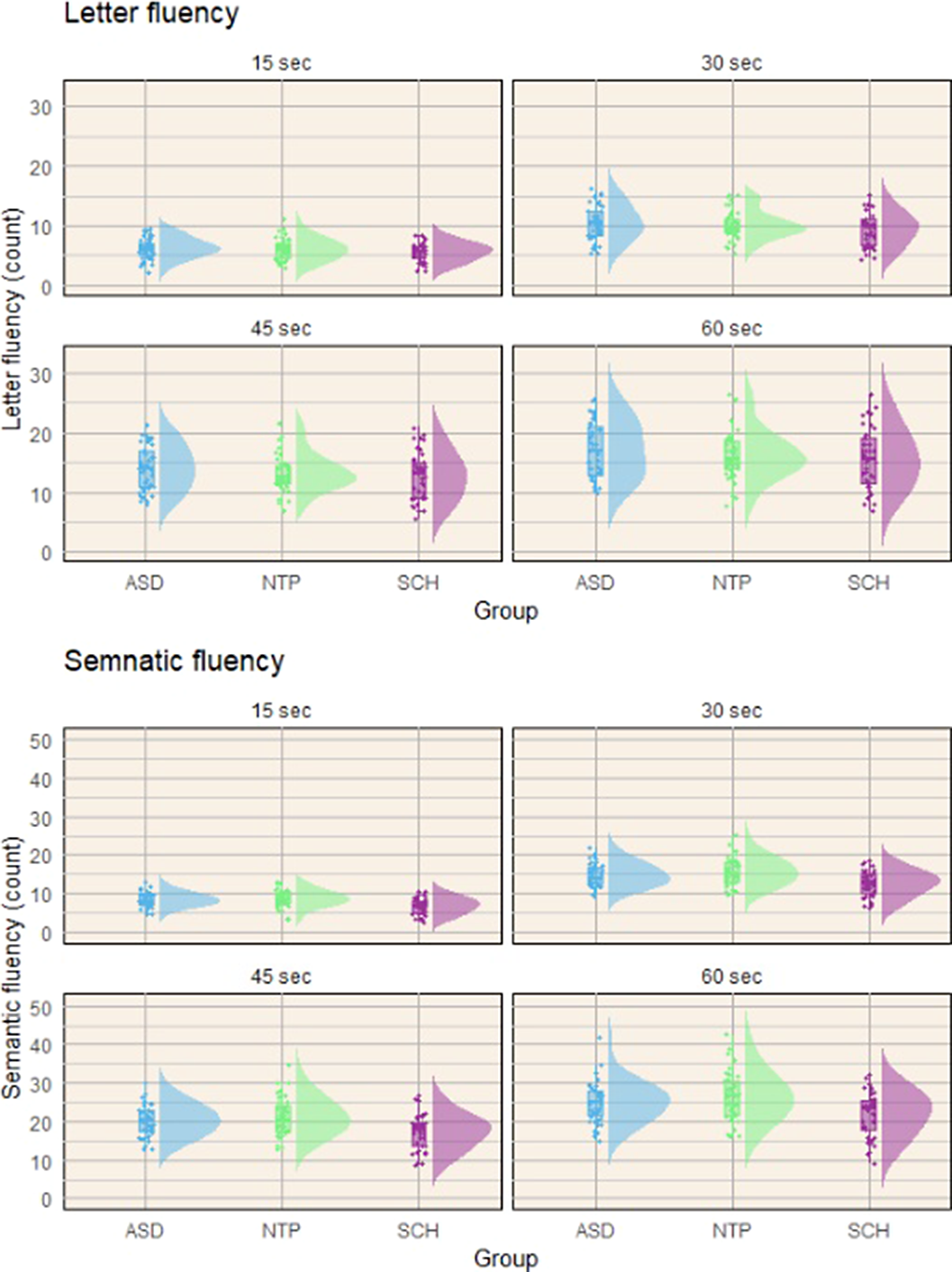
Preliminary results indicate that the three study groups did not differ significantly in phonemic fluency (F(2, 119)= 0.983, p=0.377), during either time period. However, a significant difference was observed in semantic fluency (F(2, 119)= 6.531, p=0.002). Post-hoc tests (Tukey corrected) revealed that this difference stemmed from impaired performance in the SCH group. Participants with schizophrenia (SCH) exhibited reduced semantic word productivity compared to both neurotypical (NTP) individuals and participants with ASD (Figure 1). However, there were no significant differences between participants with ASD and NTP individuals.
Image:
Conclusions
In conclusion, our study investigated the characteristics of verbal fluency in a transdiagnostic approach. While phonemic fluency did not reveal significant differences among the three groups, our analysis of semantic fluency unveiled a distinction. Specifically, individuals with schizophrenia exhibited impaired semantic word productivity. Our study highlights the complex nature of verbal fluency impairments in different conditions and the importance of considering more nuanced methods when assessing cognitive functions.
“Cluster suicides,” also known as “suicide clusters,” refer to a phenomenon in which a series of suicides occur within a specific community, group, or geographic area within a relatively short period of time. These suicides often appear to be interconnected, either through imitation or contagion, and may involve individuals who have some form of social or emotional connection to each other.
Objectives
- Understanding the definition and characteristics of cluster suicides.
- Analyzing common risk factors and triggers in cluster suicide cases.
- Evaluating prevention and support strategies for affected individuals and communities.
Methods
We conduct an analysis of this concept based on a sample of suicides that occurred in a Spanish region over an 8-year period (2015-2022).
We will Analyzethe following aspects:
- Definition and characteristics of cluster suicides.
- Risk factors contributing to the occurrence of cluster suicides.
- Examples of real cases or case studies illustrating this phenomenon.
- The role of imitation and contagion in cluster suicides.
- Prevention and support strategies, including education on warning signs and access to mental health services.
- The impact of media coverage and how it can amplify the contagion effect.
- Measures to reduce access to lethal means of suicide.
Results
We will discuss about the results found:
- Definition and characteristics of cluster suicides.
- Risk factors contributing to the occurrence of cluster suicides.
- Examples of real cases or case studies illustrating this phenomenon.
- The role of imitation and contagion in cluster suicides.
- Prevention and support strategies, including education on warning signs and access to mental health services.
- The impact of media coverage and how it can amplify the contagion effect.
- Measures to reduce access to lethal means of suicide.
Conclusions
The main conclusions of our presentation are :
- The importance of recognizing cluster suicides as a real and concerning phenomenon.
- The need to address specific risk factors and triggers in affected communities.
- The effectiveness of prevention and support strategies in reducing cluster suicide cases.
- The importance of promoting media responsibility in suicide coverage.
BIBLIOGRAPHY
1.Cluster Suicides: A Critical Review and Theoretical Framework” (2019) - Este estudio proporciona una revisión crítica de la literatura sobre cluster suicides y presenta un marco teórico para comprender mejor este fenómeno
2.“Clusters of Suicides and Suicide Attempts: Identification, Prediction, and Prevention” (2016) - Aunque este estudio no se centra exclusivamente en España, ofrece información sobre la identificación y prevención de clusters de suicidio que puede ser relevante.
3.“Epidemiology of Suicide in Spain, 1981–2008” (2012) - Proporciona una visión general de la epidemiología del suicidio en España, lo que podría ayudar a contextualizar los estudios específicos sobre clusters.
