To save content items to your account,
please confirm that you agree to abide by our usage policies.
If this is the first time you use this feature, you will be asked to authorise Cambridge Core to connect with your account.
Find out more about saving content to .
To save content items to your Kindle, first ensure no-reply@cambridge.org
is added to your Approved Personal Document E-mail List under your Personal Document Settings
on the Manage Your Content and Devices page of your Amazon account. Then enter the ‘name’ part
of your Kindle email address below.
Find out more about saving to your Kindle.
Note you can select to save to either the @free.kindle.com or @kindle.com variations.
‘@free.kindle.com’ emails are free but can only be saved to your device when it is connected to wi-fi.
‘@kindle.com’ emails can be delivered even when you are not connected to wi-fi, but note that service fees apply.
The prognostic prediction of outcomes in individuals at clinical high-risk for psychosis (CHR-P) is still a significant clinical challenge. Among multiple baseline variables of risk calculator models, the role of ongoing pharmacological medications has been partially neglected, despite meta-analytical evidence of higher risk of psychosis transition associated with baseline prescription exposure to antipsychotics (AP) in CHR-P individuals. In particular, baseline AP exposure in CHR-P individuals may be considered as a functional equivalent of the psychometric transition to psychosis, as already postulated in the original ‘Ultra High-Risk’ model.
Objectives
The main aim of the current study was to test the hypothesis that ongoing AP need at baseline indexes a subgroup of CHR-P individuals with more severe psychopathology and worse prognostic trajectories along a 1-year follow-up period.
Methods
This research was settled within the ‘Parma At-Risk Mental States’ program. Baseline and 1-year follow-up assessment included the Positive And Negative Syndrome Scale (PANSS) and the Global Assessment of Functioning (GAF). CHR-P individuals who were taking AP medications at entry were included in the CHR-P-AP+ subgroup. The remaining participants were grouped as CHR-P-AP-. The acquisition of drug and outcome information was collected both at baseline and across the follow-up period. Finally, logistic regression analyses with dichotomized 1-year outcome parameters (previously showing statistically significant differences in inter-group comparisons) as dependent measures and sociodemographic and clinical characteristics as independent variables were also performed.
Results
Hundred and seventy-eight CHR-P individuals (aged 12–25 years) were enrolled (91 CHR-P-AP+, 87 CHR-P-AP-). Compared to CHR-P AP-, CHR-P AP+ individuals had older age, greater baseline PANSS ‘Positive Symptoms’ and ‘Negative Symptoms’ factor subscores and a lower GAF score. At the end of our follow-up, CHR-P-AP+ subjects showed higher rates of psychosis transition, new hospitalizations and urgent/non-planned visits compared to CHRP- AP- individuals.
Conclusions
The current study suggests that AP need is a significant prognostic variable in cohorts of CHR-P individuals and should be included in the current risk calculators. In particular, the results of this study conducted in a realworld clinical setting indicate that the rate of CHR-P individuals who were already exposed to AP at the time of CHR-P status ascription was higher than those reported in recent meta-analyses on this topic. Moreover, our findings confirm that baseline AP prescription appears to increase psychotic transition risk.
Schizophrenia is characterized by a heterogeneous clinical expression. Schizophrenic symptoms fall into three main dimensions: positive, negative, and disorganized. Negative symptoms may be primary or secondary to positive symptoms.
Therapeutic compliance is essential in the management of mental illnesses and in particular schizophrenia. The associations between poor compliance and negative symptomatology are little studied even though it is found in several patients suffering from schizophrenia and is associated with a poor functional prognosis.
Objectives
The objective of this study is to evaluate the link between negative symptoms and medication adherence in patients with schizophrenia.
Methods
This is a cross-sectional study with a descriptive and analytical aim carried out among patients in whom a diagnosis of schizophrenia was made according to the diagnostic criteria of the DSM-5.
Data will be collected using an anonymous hetero-questionnaire including patients’ personal and sociodemographic data, as well as the negative symptoms subscale of the PANSS and Medication Adherence Rating Scale (MARS) which assesses therapeutic compliance.
Results
In total, we obtained a sample of 109 patients. The median age of the population is 37 years (+/- 8.2), the age varies between 18 and 64 years. The majority of patients were single, i.e. 79.6%. On average, patients had good compliance with the MARS with a mean score of 6.3 ± 1.9 [0;10]. A negative correlation between the negative symptoms subscale of the PANSS and the MARS was found significant (p=0.003), with a moderate effect.
Conclusions
This study showed that the negative signs of schizophrenia have an impact on therapeutic compliance. Therefore, it would be useful to enlarge the sample and study this association in depth in order to be able to improve these signs to ensure good care and better quality of life for these patients.
Increasing volumes of information are being collected via electronic health records and there is growing multi-site expertise in utlising these for research. This emerging field of healthcare data science is not only concerned with the technical challenges associated with complex data, but also with the need for effective security and governance in the use of sensitive information with robust structures for stakeholder input and guidance. To date, most of the focus has been on supporting observational cohort studies nested within clinical records data - particularly investigating research questions around treatment response and course/prognosis. It is likely that electronic health records will become increasingly integrated with clinical trials, providing opportunities for pre-study feasibility scoping, targeted recruitment, and enhanced and extended follow-up. In addition, there is interest in emulated trials using routine data. For mental health data science, key challenges lie in the quality and quantity of data made accessible, with a particular need for natural language processing to derive structured data from extensive clinical text. Many of the challenges have been addressed for observational research, creating exciting prospects for a transformed trials landscape.
Disclosure of Interest
R. Stewart Grant / Research support from: Janssen, GSK, Takeda
Psychiatric disorders are large contributors to the global disease burden and their prevalence is increasing. Global climate is also facing changes, including a rise in temperatures. Many clinical conditions are affected by meteorological factors and there are numerous reports on the effect of climate changes on such conditions. Psychiatric disorders are also influenced by climatic factors but the literature on the effects of climate changes on mental health is limited.
Objectives
The aim of this study is to investigate the impact of rising temperatures on the risk of acute exacerbation of psychiatric disorders.
Methods
Data were collected retrospectively for a total of 139 months, i.e. from January 2012 to July 2023. Recordings of mean monthly temperatures were obtained from registries of the meteorological station of the Department of Physics of the University of Turin. For each of the 139 months, deviations from the average temperature of that month of any year were computed (ΔTm). Anonymised socio-demographic and clinical data on patients admitted during the observation period to the acute psychiatric unit of San Luigi Gonzaga University Hospital (Turin, Italy) were extracted from the hospital registry. Linear regression analyses were used for statistical analyses.
Results
A total of 5420 admissions to our psychiatric ward were recorded over the observation period. Monthly deviations from average temperature and monthly number of admissions were directly correlated, with regression coefficient 1.803 (P = 0.0048) (Fig.1A). Linear regression analysis was performed between ΔTm and number of admissions according to diagnostic group. The regression coefficient was 0.1336 (P=0.5334) for admissions of patients with schizophrenia and related disorders (SCZ) (Fig.1B), 0.4575 (P=0.0295) for bipolar disorders (BD) (Fig.2A) and 0.3381 (P=0.0382) for major depressive disorder (MDD) (Fig.2B).
Image:
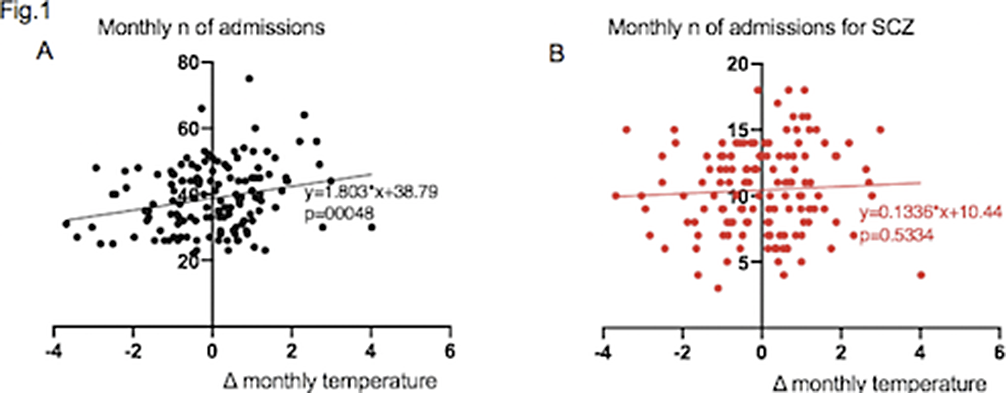
Image 2:
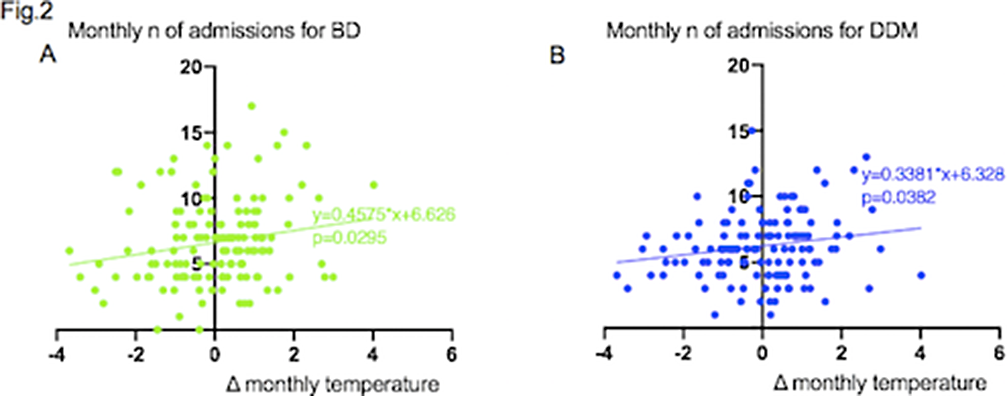
Conclusions
These results confirm the impact of meteorological factors on mental disorders. In particular, we observed a positive correlation between monthly temperature and the number of admissions to our acute inpatient unit. The correlation was significant when taking into consideration admissions for exacerbation of bipolar disorder and major depressive disorder, but not when considering admissions for schizophrenia. This highlights the importance of climatic factors especially in mood disorders, provides new insights into their etiopathological mechanisms and provides information that can be implemented for follow up and relapse prevention.
Peer support has been identified as successful in improving patient wellbeing and empowerment and there is evidence that peer support can also help their family members (FMs). A peer support programme for FMs, developed in Germany, significantly improved FMs’ quality of life. We have worked to adapt this support programme for delivery in England. We will report the results of this adaptation process and of the implementation of peer support for FMs.
Objectives
To examine the feasibility of the peer support programme developed and assess whether it can be delivered using a “train-the-trainer” approach.
Methods
The peer support programme is being implemented in two stages. In stage one, FMs with experience of supporting an involuntarily hospitalised patient (family peer supporters (FPSs)) receive an online training programme consisting of four sessions. These sessions, provided by the research team and FMs with lived experience of caring for an involuntarily hospitalised patient, teach FPSs skills in communication, reflection, coping and trialogue (promotion of equal communication between FMs, professionals and patients). FPSs then use these skills to deliver support to FMs of patients who are currently involuntarily hospitalised. This support is delivered for up to three months. The impact of this programme is assessed through one-to-one interviews with FPSs and FMs. Questionnaires are also provided to FMs measuring their quality of life, caregiving burden and psychological wellbeing before and after receiving support from FPSs.
In stage two, a modified version of the training programme (based on FPS feedback) is provided to a new group of FPSs. This training will be delivered by FPSs from stage one. After receiving the training programme, stage two FPSs will deliver support to other FMs as described for stage one. Assessment of the modified programme will mirror stage one.
Results
Provision of the stage one training programme is complete, and delivery of support is in progress with modifications being made for stage two. Eight FPSs and six out of a target of 12 FMs have been recruited for stage one. FPSs reported the training programme to be a positive experience, highlighting that it was engaging, easy to understand and gave them the confidence to support other FMs. Technical difficulties and an overload of information were cited as areas to improve for the next stage.
Conclusions
FPSs described the peer support training programme as a positive experience overall. However, improvements need to be made for stage two which is in progress. A more comprehensive report of our findings, including the impact of this peer support programme and the feasibility of implementing it in England, will be provided as the programme progresses.
Hospital at home for psychiatric patients is a new emerging resource of delivering acute mental health care in the community. The main objective of this program is to provide intense care to patients with severe mental disorders at home as an alternative to acute admission.
Although home hospitalisation has begun to develop widely in recent years there is a notable lack of studies
The CAEM Psychiatric Home Hospitalization Unit (HAD-CAEM) has been operating since 2018 and takes place in Santa Coloma de Gramenet; and from March 2022 also in a part of Badalona. Both are sociodemographically depressed areas near Barcelona.
Objectives
The aim of this study is to describe the characteristics of patients attended at the Psychiatric Home Hospitalization Unit of our hospital and to study differences according to area and place of referral.
Methods
Socio-demographic and clinical data were collected retrospectively at admission and discharge of all patients treated at HAD-CAEM between March 2022 to february 2023.
Statistical analysis was performed by using SPSS program.
Results
85 patients were included in the study. 45.9% were women. The mean age was 45.5 years (SD 15.58 years). The main diagnoses of the sample were psychosis and schizophrenia (38.8%), Bipolar disorder (23.53%), Depressive disorder (21.18%), schizoaffective disorder (8.24%) and others (8,24%).
54 (63.53%) patients were from Santa Coloma area and 35 (41.18%) from Badalona area.
The total mean duration of admission was 40.22 days (SD 26.18 days), with a mean follow-up of 10.09 visits (SD 5.39 visits) and 2.41 teleassistence (SD 2.62).
The mean duration of admission for Santa Coloma patients was 43.98 days (SD 28.59), and for Badalona patients 33.68 days (SD 20.13). Trend without significance is observed (t= 1.77, p=0.08)
We found differences in the mean duration of admission according to referral location. Acute psychiatric unit 33.25 days (SD 18.06), Mental health Center 51.93 days (SD 33.45), Emergencies 34.28 days (SD 19.69) (F=5.1, p=0.008).
Conclusions
Sociodemografic and clinical característics obtained in our study are consistent with those reported in previous studies. The duration of admission of patients referred from the mental health center is longer than those referred from the acute psychiatric or emergency unit. Home hospitalization teams have been increasing in recent years, being an alternative to traditional hospitalization.
The diagnosis of Autism Spectrum Disorders is currently witnessing several changes, with direct consequences on the prevalence rates in the general population. However, little is known about ASD traits prevalence in clinical samples, and how much these traits interact with other mental health conditions, especially in young adults, a critical age for the outbreak of many psychiatric diseases.
Objectives
The aim of this study was to assess the prevalence of ASD traits in a sample of young adults (aged between 18 and 24 years old) referring to a specialized mental health outpatient clinic.
Methods
We administered to 259 patients the Autism Quotient (AQ) and the Ritvo Autism and Asperger Diagnostic Scale-Revised (RAADS‐R), along with a detailed sociodemographic and anamnestic interview.
Results
We found that 16.2% of our sample scored above the cut-off at both scales (a percentage that went down to 13.13% when restricting the RAADS-R cut-off at >119, as suggested for clinical samples).
Conclusions
This prevalence seems considerably higher than the one reported in the general population, and not negligible. The association with sociodemographic features such as sex assigned at birth, gender identity and employment status, and the validity of the screening tools we implemented, are discussed. In conclusion, we suggest that an assessment for autistic traits should be implemented in young adults seeking help for unspecified psychiatric symptoms and psychological suffering and that, despite the not unanimous consensus over self-report screening tools, a positivity to both the AQ and the RAADS-R should lead the clinician to conduct a full diagnostic evaluation with structured or semi-structured interviews.
Acute and transient psychoses (International Classification of Diseases) and Brief Psychotic Disorders (Diagnostic and Statistical Manual of Mental Disorders) constitute heterogeneous nosological groups, which have undergone successive reformulations in the past decades, remaining doubts regarding their diagnostic validity and independence.
Objectives
This work aims to review the nosological evolution of these complex and neglected groups.
Methods
A review of the literature was conducted using PubMed and The Cochrane Library. The following terms were used: “acute and transient psychoses”; “brief psychotic disorders”; “cycloid psychosis”; “reactive psychosis”.
Results
Since the early 20th century, a group of non-affective psychoses with acute onset and brief duration have been described in different countries and under various names, such as bouffeé delirante, reactive psychosis or cycloid psychosis, denominations still present in ICD-9. In presente-day classifications, as ICD-10 and DSM-IV, an effort was made to homogenise the various regional and national concepts creating the group of ‘Brief Psychoses’ (DSM) or ‘Acute and Transient Psychotic Disorders’ (ICD). The marked heterogeneity and low diagnostic stability of these groups, mainly based on temporal criteria, has posed significant obstacles to further research and conceptualization. Given these difficulties, the latest revision of the International Classification of Diseases (ICD-11) brought about a substantial change, restricting this diagnosis to polymorphic psychotic conditions of acute onset and rapid resolution, subgroup with greater diagnostic stability and characteristics distinct clinical features.
Conclusions
The relevance of a better clarification for this nosological group is evident in the successive changes over the last century. ICD 11, once again, substantially changed the diagnostic criteria and the scope of this nosological entity, leaving doubts about the independent nature of this group, its connection to schizophrenia, as an attenuated form (more common in women and in developing countries), or even as a form of psychosis that is closer to affective disorders (due to its clinical evolution). Although little explored, this issue remains a source of doubt and interest, calling into question the Kraepelinian dichotomy for the so-called endogenous psychoses.
Eating disorders have a key paper at the ongoing society. A key symptom of the Anorexia Nervosa and the Bulimia Nervosa is the alteration of the corporal image which observes that it continues being present after remitting the most flowery symptomatology. In terms of gender, we can observe that the esting disorders have a higher incidence in the feminine gender.
Objectives
Research how body image affects eating disorders and how the role of gender is a risk factor for developing Anorexia Nervosa or Bulimia Nervosa.
Methods
A systematic review was conducted using PubMed. Twelve studies were identified in order to do this review.
Results
At the twelve surveys included at the review we can observe that the incidence of Anorexia Nervosa and Bulimia Nervosa is higher in women than men. There are many facts that take part on the development of eating disorders, but there is consensus to understand them with a biopsicosocial point of view (interaction between the environment and biological facts). Body image disturbance takes part in both men and women, but it affects them in different ways.
Conclusions
Body image disturbances are a crucial factor when considering eating disorders’ symptomatology. One of the main components that affects its alteration is the internalization of standards of beauty. Women tend to focus on thin body types, meanwhile men’s attention tends to point to muscular and defined body types. Nevertheless, it must be taken into account that today’s gender conception may appear as one of the most important roles to understand Anorexia and Bulimia aetiology. Regarding gender, in nowadays society exists a dichotomy where masculinity and femininity lie in total opposites poles; but if the gender approach socially changed, Anorexia and Bulimia might take a different portrayal.
Addressing mental and physical health problems and promoting wellbeing in educational settings is a global priority. Teachers present a high risk of stress and burnout, which negatively impacts their professional performance as well as their mental and physical health. Compassion-based interventions have been found effective in promoting psychosocial and physiological wellbeing.
Objectives
The current paper presents preliminary findings of the impact of a 6-module Compassionate Mind Training intervention for Teachers (CMT-T) on immunological markers and the Conserved Transcriptional Response to Adversity (CTRA; a gene expression signature that involves a group of 53 genes: pro-inflammatory genes, type I interferon response and genes related to antibody synthesis).
Methods
A pilot non-controlled study was conducted in a sample of public-school teachers in Portugal (n=36). Participants were assessed at 4 time-points: 1) Extended Baseline Control_M0, in order to establish a within-subjects psychological and biophysiological baseline (8 weeks before the start of the CMT-T); 2) Pre-intervention_M1 (8-weeks after M0); 3) Post-intervention_M2 (8-weeks after M1); and 4) Follow-up_M3 (3 months after the CMT-T end). In all assessment moments, participants completed a set of psychological self-report measures and were assessed in immunological and epigenetic biological markers through the collection of blood. After M1, teachers completed the 8-week group CMT-T intervention and given access to its resources and materials. They were instructed to practice daily and incorporate the teachings in their personal and professional lives. All assessments and the CMT-T intervention took place at the schools.
Results
Preliminary data on the impact of CMT-T on Immune Response Profiling revealed that teachers’ Natural Killer (i.e., NK) cells were decreased after the CMT-T intervention. In regard to the CTRA gene expression, results showed that type one interferon response genes (e.g., IFI16, IFI27L2, IFITM2, IFITM3, IFITM4P) were decreased after the intervention. In addition, we observed that the gene c-Jun, a pro-inflammatory gene, had a decreased expression after the CMT-T intervention.
Conclusions
These preliminary findings seem to corroborate previous studies involving the type one interferon response, the pro-inflammatory genes and antibody synthesis genes in a signature involving 53 genes previously described as the CTRA gene signature. Furthermore, our results suggest that cultivating compassion using a compassion focused intervention may have a positive impact on markers of the immune system response, associated with how our bodies respond to stress, infection and cancer, as well as, on reducing the expression of genes related to our bodies’ response to stress and inflammation.
Although symptom presentation varies by gender, almost all eating disorder/ED instruments have been developed and validated on females. The Eating Disorder Assessment for Men (EDAM; Stanford & Lemberg 2012) is a male specific self-report measure, composed of four sub-scales, proved to be useful to assess gender differences in ED presentations (Nagata et al. 2021). The MD comprises 5 items about the overwhelming concern with muscularity and the false perception of having an underdeveloped body.
Objectives
Having already valid measures of body image and eating behaviors in men, we now aim to analyze the psychometric properties of the Portuguese version of MD, in order to have a quick and rigorous measure of this specific construct.
Methods
Participants were 227 male individuals (mean age=30.41 years±13.96; range: 14-73 years). They answered an online survey including the preliminary DM and the Portuguese validated versions of the Eating Disorder Examination Questionnaire (EDE-Q7) and the Body Image Concern Inventory (BICI).
Results
Confirmatory Factor Analysis showed that the unidimensional model presented good fit indexes (χ2/df=.6829; RMSEA=.0000; CFI=1.00 TLI=1.01, GFI=.995). Cronbach’s alfa was .891; all the items contributed to the internal consistency and had high internal validity. Pearson correlations of DM with EDE-Q7 and BICI were significant (p<.001) and moderate-high, respectively,.384 and .522.
Conclusions
The Portuguese preliminary version of DM-EDAM demonstrated validity (construct and convergent) and reliability. can be used for clinical and research purposes, namely in an ongoing project we have in progress, about body image, disordered eating, gender and age.
The mortality rate among individuals experiencing homelessness tends to be premature and is linked to mental disorders and chronic diseases. In Spain, there is a significant gap in the study of mortality among individuals in situations of residential exclusion with real clinical data.
Objectives
This study aims to analyze mortality among individuals experiencing homelessness and its relationship with mental disorders and chronic diseases.
Methods
An observational and prospective longitudinal study was conducted on a cohort of 855 homeless individuals in the province of Girona over a 15-year period. Sociodemographic variables, mental health conditions, chronic diseases, and infections were analyzed, employing descriptive and inferential analyses. A binary logistic regression model was created to establish explanatory relationships between mortality and associated variables.
Results
Among the participants, 87.7% were males with an average age of 53.03 years. A majority of 62.8% were foreign-born, mainly from Africa and Europe. It was identified that 40.8% had mental disorders, with substance dependencies (41.3%) and other disorders (36.4%) being the most prevalent. A total of 30.6% presented chronic diseases, notably hypertension (12.8%) and type 2 diabetes (10.9%). Furthermore, 22.3% had infections, with hepatitis C virus (8.7%) and HIV (4.7%) being the most common. During the follow-up period, 81 individuals (16.4%) passed away, with causes such as cancer (25%), suicide (21.7%), and heart conditions (11.7%).
The regression analysis demonstrated that age (OR = 0.915; 95% CI 0.884-0.947), alcohol addiction (OR = 2.354; 95% CI 1.486-3.731), and being born in Spain (OR = 2.906; 95% CI 1.594-5.299) were significantly associated with mortality in the homeless population.
Conclusions
This study highlights the high prevalence of mental disorders, chronic diseases, and infections among individuals experiencing homelessness. Mortality was associated with factors such as age, alcohol addiction, and place of birth. These findings underscore the importance of developing interventions aimed at enhancing the health and care of individuals experiencing homelessness, particularly within the immigrant population.
Electroconvulsive therapy (ECT) is a psychiatric intervention that has proven effectiveness and safety in various psychiatric conditions, such as major depressive disorder, prolonged or severe manic episodes and catatonia. Despite positive scientific evidence, ECT was always seen as controversial by patients, caregivers, and even some psychiatrists, which lead to a decrease in its use over the years.
Objective
To investigate the way young psychiatrists view the place of ECT in modern psychiatry by assessing their knowledge, attitude and access to training opportunities in ECT.
Methods
An anonymous survey was disseminated online among early career psychiatrists and psychiatric trainees. The questionnaire consisted of 36 multiple-choice and Likert scale questions.
Results
Most of our respondents consider ECT both an effective and a safe treatment option and would recommend ECT to their patients when indicated. Early career psychiatrists who had access to ECT training are more knowledgeable about the indications, precautions and side effects of this method, but more than half of the participants mentioned ECT training was unavailable during their residency programme. Almost all respondents stated that they are interested in enhancing their theoretical and practical competencies in ECT.
Conclusions
Early career psychiatrists have a positive attitude towards ECT but express the need of targeted education aimed at improving levels of knowledge about ECT.
Discrimination is known to have different effects on health. In particular the mental health of affected people diminishes. Although it is known that marginalized groups are discriminated against more, at present only research on gender and ethnicity has been done. Further diversity domains like socioeconomic status, care responsibilities, sexual orientation, disability, mental and physical health, and their intersections have been scarcely looked at.
Objectives
The aim of the study was to determine the effects of discrimination on the mental health for employees and students of a university hospital taking diversity domains into account.
Methods
A web-based survey between June 22 to October 23 was conducted using the PHQ-4 and WHO-5 as well as innovative Diversity Minimal Item set to measure different diversity domains.
Results
Preliminary data shows that discrimination among employees and students is common, widespread and most frequent based on gender, ethnicity and health. The mental health of those who feel discriminated against tends to be poorer, especially looking at the intersectionality of diversity domains.
Conclusions
The results of this study suggest that both more measures to prevent discrimination in a university hospital have to be implemented and individuals from marginalized groups need special psychosocial support to ensure a safer working environment. In addition, greater attention to diversity and inclusion in medical research is needed to develop appropriate responses and interventions, including diversity policies.
Low back pain (LBP) is common among electricians caused by work conditions. Even when symptoms are short-term and not medically serious, LBP can be associated with psychological distress.
Objectives
This study aimed to assess the link between LBP and psychological distress according to the job tenure among electricians.
Methods
The study was conducted in a group from a Tunisian Electricity society. Data were gathered between January-June 2022 using a self-administered questionnaire including socio-professional characteristics, the Nordic musculoskeletal questionnaire during the last 12 months and Kessler Psychological Distress Scale (K6). Our population was divided into two groups according to job tenure. The first group (G1) consisted of electricians with less than ten years of job tenure and the second (G2) consisted of electricians with more than ten years of seniority.
Results
G1 consisted of 10 participants with a mean age of 30.6 ± 6.7 years and with average job tenure of 3.3 ± 1.1 years. G2 consisted of 64 participants with a mean age of 40.7 ± 10.3 years and average job tenure of 17.4 ± 10.9 years. According to the Nordic musculoskeletal questionnaire, LBP during the last 12 months was present in the first and the second group in 30.8% and 14.3% of participants, respectively.
The proportion of respondents with high levels of psychological distress (K6 score of 13 or greater) in the first and the second groups was 10 % and 9.4% of participants, respectively. The presence of low back pain during the last 12 months was significantly associated with a high score of K6 in the second group (p < 0.05).
Conclusions
From the results of this study, we conclude that LBP was associated with psychological distress when the job tenure is high. Therefore, the prevention of LBP should go through programmes to build ergonomically safe working conditions to enhance the mental health of electricians.
As part of the intervention, patients with severe schizophrenia who are cared for in psychiatric rehabilitation units need psychological treatments. However, there is great variability within the psychotherapy alternatives that are proposed for rehabilitation in schizophrenia, and it is necessary to know which are the most efficient interventions in order to prioritize their inclusion in intervention programs.
Objectives
To know the level of evidence of the existing psychotherapy alternatives for the rehabilitation treatment in schizophrenia through the systematic review of recently published studies.
Methods
Consecutive systematic searches in the scientific literature were used in a sensitive and specific way, aimed at identifying the existence of documents in databases and clinical practice guidelines based on evidence of psychological treatment in schizophrenia. Psychosocial and social approaches and family members interventions were excluded, and the search was limited to the last 5 years. The PICO format has been used, and a subsequent critical reading using the AGREE II tool, considering the inclusion criteria of presenting a score >60% in 4 domains.
Results
The following interventions have been found to be therapeutically effective: Level 1B (Early intervention in Psychosis; Patient and Family psychoeducational intervention; Basic ando social skills training; Social cognition and Metakognition training; Cognitive Remediation; Cognitive Behavioral Individual Therapy; Assertive Community treatment; Supported employment). Level 2B (Family Problem Solving Therapy, Dynamic Psychotherapy; Cognitive Behavioral Group Therapy); Level 2C (Horticultural, Art, Music, Animals Therapies).
Conclusions
Several psychotherapy alternatives are proposed for rehabilitation in schizophrenia, with known level of evidenca in order to prioritize their inclusion in intervention programs.
Studies of extinction typically focus on unintended losses of biodiversity and culture. This study, however, examines an attempt to induce extinction of a parasite: human hookworm (Necator americanus and Ancylostoma duodenale). Our interdisciplinary approach integrates medical history and epidemiology using records created by the Jamaica Hookworm Commission of 1919–1936. We show that the attempt to induce the extinction of hookworms was driven by its perceived effects on labour productivity and consequent status as an ideological and economic threat. We use spatial epidemiology to describe the relationships between parasites, environments and the working conditions of plantation labourers. Using data from 330 locations across Jamaica in which 169,380 individuals were tested for hookworm infection we show that the prevalence of hookworm infection was higher in districts surrounding plantations. Prevalence decreased with the temperature of the coldest month, increased with the amount of rainfall in the driest month, and increased with vegetation quantity (normalised difference vegetation index). Worm burden (and thus pathology) varied greatly between individuals, even those living together; hookworm infection varied between environments, socioeconomic conditions and individuals. Nevertheless, the conditions of labour shaped the distribution of hookworms. Plantations both spread and problematised hookworms, driving efforts to bring it to extinction.
The mental health for workers in the healthcare industry have been put through challenges.The first evaluation happened during the first wave of the pandemic, the second one, with grater sample size, have been conducted in Spring 2022.The healthcare system makes it less plausible to release stress adequately. The attitude of repression by the people makes the rise in stress-levels less knowledgeable This time the somatic symptoms makes the stress-levels steady shown. Our goal, to make visible, to categorise and recognise the somatic symptoms and the psychological symptoms, thus predicting the burn-out phase.
Objectives
The attitude of repression by the people makes the rise in stress-levels less knowledgeable This time the somatic symptoms makes the stress-levels steady shown. Our goal, to make visible, to categorise and recognise the somatic symptoms and the psychological symptoms, thus predicting the burn-out phase.
Methods
Methods:
Participants: 497 medic workers
- PPS - Perceived Stress Scale - Type d personality scale -
- Workplace Stress Questionnaire and Symptom List (Hungarian Hypertonia Society)
- Beck Depression Questionnaire (9-item)
- Oldenburg Burn-Out Questionnaire Results: From the questionnaire answers we counted
- WHO Well-being Scale (5-item)
Results
12% of the people reached levels above the significant stress-level and 26% reached the mild-depression level. The burn-out levels have been significantly higher in the region of disappointment. Regarding the results of the somatic symptoms, depression and stress levels it had a leading factor, which was exhaustion.
The most frequent co-occurences of the 20 somatic and psychological symptoms of the Hungarian Hypertension Society Symptom List were also used in this study to refine the analysis. The factor analysis highlited 3 sypmtom clusters out of the 20 symptoms with the following co-occurrences (fatigue, concentration disturbance, headache, feeling of tension, palpitation, dizziness, inner tremor, distressing thoughts, sweating and nausea) The symptoms formed a total of 6 factors, of which 2 were found to be predictive of burnout and depression. The factors of muscle tension, fatigue, lack of concentration, feeling tense showed the strongest correlation with the measured varibles (burnout r=0,447, depression r=0,343, D-scale, negative mood r=0,369, p=0,000 at significance levels.)
Conclusions
The attention for the somatic complaints have a high attention between the workers, it’s part of the work culture to give more and more sacrifices, to hide the psychological effects, and deem them as weaknesses. Regarding the health of the worker it’s necessary to be more informative, to show more bearable physical symptoms to define and prevent the burn-out periods.
Drug addiction, also called substance use disorder, is a disease that affects a person’s brain and behavior and leads to an inability to control the use of a legal or illegal drug or medicine. there is a complex interplay of neurobiology, genetics, and the environment --nature and nurture-- that play into the development of addiction, alcohol, and other drug use disorder.Substances such as alcohol, marijuana and nicotine also are considered drugs.
Research has shown that women often use drugs differently, respond to drugs differently, andcan have unique obstacles to effective treatment as simple as not being able to find child care orbeing prescribed treatment that has not been adequately tested on women.
Objectives
describe the socio-demographic and clinical characteristics of female patients admitted to the addictology department of Arrazi Hospital in Salé
Methods
Retrospective study with descriptive and analytical aims on the files of women who were admitted to the addictology service since its opening in 2000, with the aim of specifying the prevalence and the characteristics of addictive behaviors in the female population.
This case study emphasizes the significance of considering unrecognized adult-onset ADHD, particularly in patients with chronic forgetfulness and occupational inefficiencies refractory to standard treatment options. The case outlined involves a 33-year-old male with enduring cognitive impairments, leading to Extreme Anxiety Disorder with detrimental consequences on his professional progression and personal well-being.
Objectives
This necessitates the need for advanced research initiatives and broader awareness programs to facilitate improved diagnostic accuracy and optimization of therapeutic outcomes. Emphasizing ADHD as a potential cause of such symptomatology in adults and integrating effective treatment options can potentially pave the way to personalized therapeutic protocols.
Methods
The patient was approached via meticulous reconsideration of previous unsuccessful treatment paradigms that primarily included antidepressants and anxiolytics, which yielded cyclical patterns of negligible amelioration, compounded by intermittent emergence of suicidal ideation. Given the limited response, a differential diagnosis of Adult-Onset ADHD was entertained.
Results
The therapeutic intervention involving Methylphenidate administration led to a remarkable enhancement in the patient’s mental health and occupational efficiency. Progress was also evidenced in the patient’s improved confidence and self-esteem, with critical implications for his professional and personal life dynamics.
Conclusions
This case study underscores the transformative potential of precise ADHD management in adults with chronic cognitive impairments. Further research studies involving larger cohorts are warranted to enhance the understanding of adult ADHD, its prevalence, and therapeutic strategies, which could serve as key elements in improving the overall quality of life for these patients.
