To save content items to your account,
please confirm that you agree to abide by our usage policies.
If this is the first time you use this feature, you will be asked to authorise Cambridge Core to connect with your account.
Find out more about saving content to .
To save content items to your Kindle, first ensure no-reply@cambridge.org
is added to your Approved Personal Document E-mail List under your Personal Document Settings
on the Manage Your Content and Devices page of your Amazon account. Then enter the ‘name’ part
of your Kindle email address below.
Find out more about saving to your Kindle.
Note you can select to save to either the @free.kindle.com or @kindle.com variations.
‘@free.kindle.com’ emails are free but can only be saved to your device when it is connected to wi-fi.
‘@kindle.com’ emails can be delivered even when you are not connected to wi-fi, but note that service fees apply.
Psychiatric patients have a higher risk of premature mortality primarily due to cardiovascular diseases (CVD). One significant contributing factor is the presence of dyslipidemias . Current studies are shifting focus towards lipoprotein ratios, believed to better reflect cardiovascular risk. These studies have demonstrated that ratios associated with high-density lipoprotein (HDL) are stronger predictors for CVD compared to traditional lipid parameters. One of these ratios is the logarithmic transformation of the triglyceride (TG) to HDL ratio, known as the plasma atherogenic index (PAI).
Objectives
Our study aimed to compare the PAI between patients diagnosed with psychotic disorders who presented to our outpatient clinic and healthy control groups.
Methods
Fifty patients diagnosed with psychotic disorders, including 50 residing in a nursing home and 50 outpatient in such facilities, presented to our psychiatric outpatient clinic and were included in our study. Additionally, a healthy control group consisting of 49 individuals was recruited. A socio-demographic data form was administered to all groups. Peripheral blood levels of HDL, Triglycerides (TG), and LDL were recorded for each participant included in the study. Ethical approval for the study was obtained from the local ethics committee.
Results
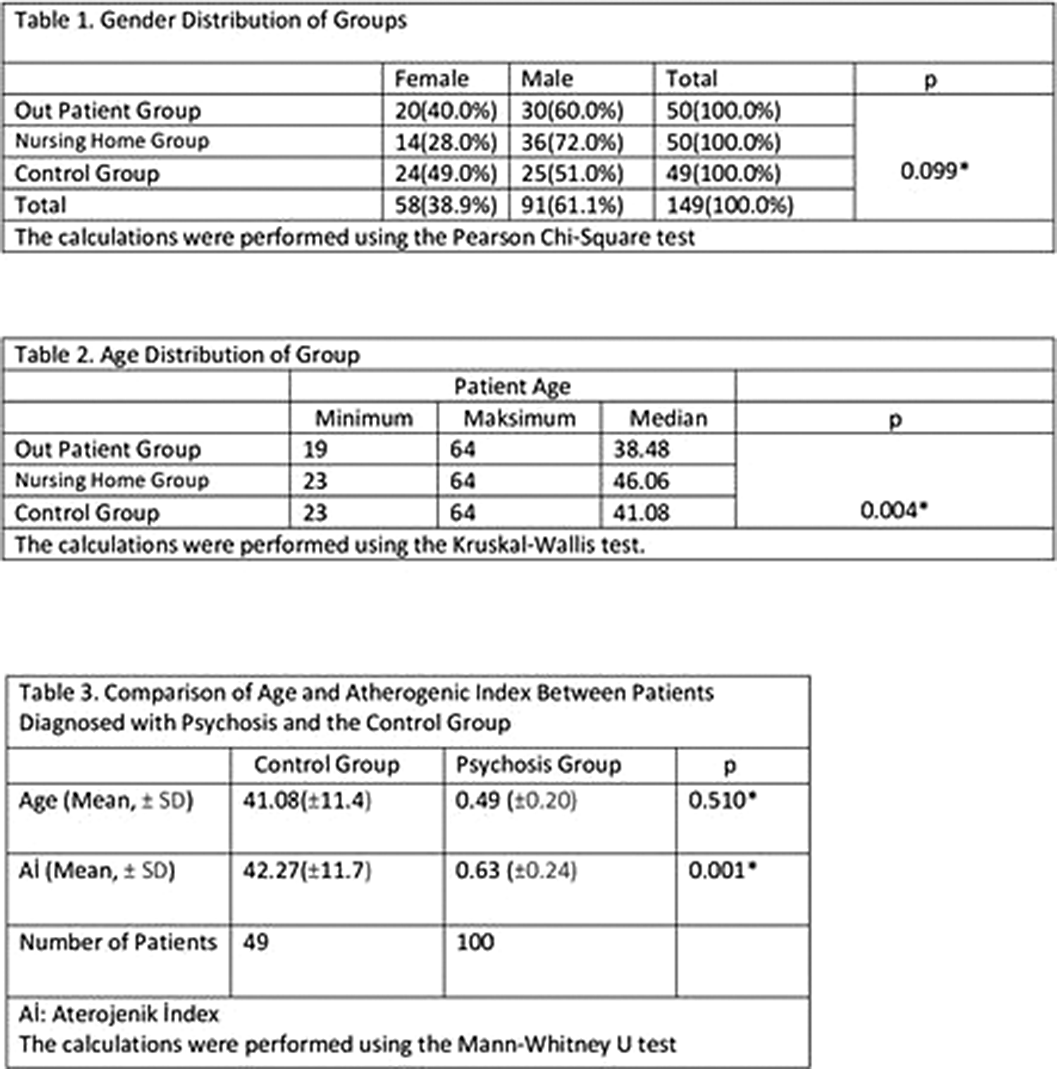
The patient groups were compared in terms of age and gender. While there was no statistically significant difference in gender between the groups, a significant difference was observed in terms of age (p=0.099, p=0.004). When examining the age distribution of the groups, it was observed that the care facility group was older compared to the other groups. The age and gender distributions of the groups are shown in Table 1 and Table 2.
Psychotic patients in the outpatient group and the nursing home group were compared in terms of age and atherogenic index. Age was statistically significant, indicating that thenursing home group was significantly older (p=0.001, p=0.478). In the comparison of the control group with psychotic patients, there was no statistical difference in age, but a significant difference was found in terms of the atherogenic index (p=0.510, p=0.001). The statistical analysis and data between psychotic patients and the control group are presented in Table 3.
Image:
Conclusions
This study, examining the comparison of Plasma Atherogenic Index (PAI) in patients diagnosed with psychosis with healthy controls, represents a significant step in understanding the cardiovascular health profile of this population and developing appropriate treatment strategies. Future research will further contribute to a deeper understanding of the impact of psychiatric disorders on cardiovascular health and aid in the development of effective interventions to minimize these effects.
In recent years, there is a growing interest in microbiota and how certain dietary patterns affect our brain.
We know that diet has an important impact in physical and mental health. The mecanism that underlies is already unknown, but there is emerging evidence that diet modulates brain gut microbiota and has implications in mental problems.
Objectives
The aim of this poster is highlight the importance of diet in mental health and the link with microbiota.
Methods
Review of recent literature about diet, microbiota and psychiatry. The studies were collected of the electronic databases PubMed.
Results
New researches highlight the importance of adequate nutrition for mental health. Several studies link healthy diet with a minor risk of mental illnesses or with the improvement of depressive symptoms. Likewise, poor dietary habits could aggravate cognitive decline and increased risk of developing anxiety, depression or other mental illnesses.
It has been shown that a diet rich in fiber, polyphenols and micronutrients improve gut microbial composition and can reduce metabolic endotoxemia and neuroinflammation, and this has been associated with improvements in brain health. Also, prebiotic and probiotics have positive effects.
Therefore, dietary interventions could be a complementary therapeutic approach for patients with mental problems. This is what nutritional psychiatry focuses on.
Conclusions
Microbiota as a potential therapeutic target for mental illness is a hot topic in psychiatry, but also, its interaction with dietary change or the use of probiotics and prebiotics. This action is easy to implement in our clinical practice and could be part of a biopsychosocial treatment to improve or prevent some psychiatric disorders.
Nutritional psychiatry is a new field that needs to be developed and the knowledge in microbiota, diet and mental health could help. Hopefully, the research about this topic continues expanding.
Self-injurious behavior (SIB) among adolescents has become a hot topic in psychiatry. Despite the consensus that the prevalence of SIB is high, 26-22% among adolescence, there are conflicting results about whether it has increased in the 21st century and about the global distribution of the prevalence.
Objectives
The aim of the current study was to make a systematic search and meta-analysis of publications from the last 5 years on the prevalence of SIB in adolescents and to examine definitions and assessments of SIB, gender, continental, and year differences. The hypotheses were the following: 1) the prevalence of SIB did not change over time between the examined period for both girls and boys; 2) girls reported a higher prevalence of a history of SIB than boys.
Methods
The systematic search was made in June 2020. Six databases were used. The main search terms were “self-injurious behavior”, “prevalence” and “adolescence”. First the titles and abstracts of the relevant articles were checked, then the full texts were read and collected those papers that met the inclusion criteria. The inclusion criteria were the following: published between 01/01/2015, and 06/18/2020, focused on community sample, and written in English. Comprehensive Meta-Analysis software was used to conduct the analyses.
Results
In sum, a total of 97 articles were included in the meta-analysis with data from 439 818 participants. The overall average SIB prevalence was 16.0% in these studies. The first hypothesis was only partially confirmed. When all data that were published between 2015 and 2018 were considered, x significant increase was found in the prevalence of SIB between 1998 and 2018. However, when the analysis was restricted to the time frame between 2013 and 2018, no change in prevalence was found. The second hypothesis was fulfilled, girls reported a significant higher prevalence than boys (19.4% and 12.9%, respectively). A significantly higher prevalence was found when suicidal intent was excluded (18.3%), than when it was not excluded (11.3%) from the definition of SIB. The largest prevalence was found when measurement instruments were used that had been validated for SIB (18.9%). A significantly higher SEB prevalence was found among Asian articles than those from other continents (19.5% and 14.7% respectively).
Conclusions
The current systematic review and meta-analysis draw attention to the high prevalence of SIB among adolescents, especially among girls and those living in Asia. It is important to address this behavior, in terms of prevention and intervention as well.
The development of oxidative stress in patients with schizophrenia is associated with changes in the level of activity of antioxidant enzymes. It is likely that catalytically active antibodies (abzymes) can take on these functions. Abzymes are antibodies with enzymatic activity. Catalase and SOD activity of abzymes was previously detected in patients with schizophrenia. But NADPH-dependent peroxidase activity has not been studied. The present work discusses the protective role of abzymes against reactive oxygen species within the pathogenesis of schizophrenia.
Objectives
The aim of the study was to investigate the NADPH-dependent peroxidase activity of IgG in patients with paranoid schizophrenia in the exacerbation phase and in the remission phase.
Methods
A total of 124 patients were examined during the work. Of them, 82 patients with paranoid schizophrenia (F20.0) had a mean age of 33.6±5.12 years (52 males, 30 females), disease duration averaged 8.9± 4.62 years. Patients with schizophrenia included 42 patients with acute schizophrenia and 40 patients with schizophrenia in therapeutic remission. The control group included 42 sex- and age-matched patients. IgG was purified by affinity chromatography on columns with proteinsepharose on an AKTA purifier chromatograph (GE). The homogeneity of isolated IgG preparations was checked by Lemilly electrophoresis in a gradient of 4-18% PAAG. Gel filtration under pH-shock conditions was performed on a Superdex-200 HR 10/30 column. NADPH-dependent peroxidase activity of IgG was determined on a SPECORD M-40 spectrophotometer (Carl Zeiss) at 340 nm by NADPH oxidation in the conjugated glutathione reductase reaction of tertiary butyl hydroperoxide reduction. Statistical processing of data was performed in Statistica 12.0 program.
Results
It was proved that IgG from patients with schizophrenia had NADPH-dependent peroxidase activity, and this activity is an intrinsic property of the investigated antibodies. The NADPH-dependent peroxidase activity in IgG patients in the exacerbation stage was increased 3-fold (p=0.0001) compared to the studied activity in the group of healthy individuals, and it was increased 2-fold (p=0.017) in the group of patients in therapeutic remission compared to the activity in healthy individuals. Also NADPH-dependent IgG peroxidase activity in patients in remission was 1.7 times lower than in patients during the exacerbation period (p=0.012).
Conclusions
It was established for the first time that abzymes from patients with schizophrenia and healthy individuals have NADPH-dependent peroxidase activity and can decompose lipo and hydroperoxides. We hypothesize that these abzymes help cope with generalized oxidative stress. Under the influence of neuroleptic therapy in patients in remission, the level of oxidative stress and NADPH-dependent peroxidase activity of abzymes decrease.
Older individuals constitute a significant portion of the population, and concerted efforts are underway to enhance the quality of this life stage by minimizing health issues and maximizing opportunities.
Objectives
This study aims to investigate the impact of psychosomatic exercises, including practices like yoga, meditation, and tai chi, as an alternative approach to promoting healthy aging and ultimately enhancing the quality of life among elderly individuals.
Methods
The study comprised 84 participants, with 51 individuals engaging in various forms of psychosomatic exercises and 33 serving as the control group, having no prior exposure to such practices. Data collection was carried out electronically, with the initial section gathering socio-demographic information and health-related details about the participants. The second part consisted of the WHOQOL-BREF quality of life scale, consisting of 26 questions, which assessed six domains: Overall Quality of Life and General Health, Physical Health, Psychological Health, Social Relationships, and Environment. Statistical analysis was performed with SPSS 26.
Results
The average age of the participants was 66.7 years. A statistically significant positive correlation was identified within the first subscale of the tool, “Overall Quality of Life and General Health,” with scores of 74.3/100 for those engaging in psychosomatic exercises and 66.7/100 for those who did not (t(82) = -2.513, p = 0.014). However, no statistically significant differences were observed in the remaining subscales.
Conclusions
Psychosomatic exercises, including yoga, meditation, and tai chi, hold promise as a means to improve the overall quality of life and general health of elderly individuals. These practices could serve as valuable components of strategies aimed at promoting healthy aging. Further research is needed to explore their effects in greater detail and across various dimensions of well-being.
Cannabis use has been increasing among women of reproductive age in the last few decades. In-utero cannabis exposure could be associated with an increased risk of neurodevelopmental disorders such as attention deficit hyperactivity disorder (ADHD), autism spectrum disorder (ASD), and intellectual disability (ID) during childhood and adolescence; however, existing evidence was generated based on maternal self-report of cannabis use in pregnancy. We conducted a large-scale with data linkage cohort study, in which both exposure and outcome of interests were confirmed using diagnostic tools, ICD-10-AM.
Objectives
This study aimed to examine the association between prenatal cannabis use disorder (CUD) and neurodevelopmental disorders in offspring using a large-scale cohort study.
Methods
We conducted an administrative health data-based cohort study of 222,569 mother-offspring pairs using linked data obtained from health registries in New South Wales (NSW), Australia. Data were drawn from the NSW Perinatal Data Collection (PDC), which included all live births in the Australian state of NSW between January 2003 and December 2005. These were linked with the NSW in-patient and ambulatory data collections for mothers and offspring. The prenatal cannabis use disorder (exposure) and neurodevelopmental disorders in offspring (outcomes of interest) were measured by using ICD-10-AM. Generalized linear regression with a binomial family model was used to explore the association. We also carried out a modification/interaction effect of low birth weight (LBW), smoking and premature births (PTB), which enhanced the methodological robustness of the study.
Results
This study found that offspring from mothers with prenatal CUwD had a 98%, 94% and 46% increased risk of ADHD [aRR = 1.98: 95 % CI 1.36 – 2.88], ASD [aRR = 1.94: 95 % CI 1.34 – 2.82], and ID [aRR = 1.46: 95 % CI 1.01 – 2.63] compared to those non-exposed offspring, respectively. We observed a significant interaction effect between CUD during pregnancy and maternal smoking on the risk of childhood ADHD, ASD and ID [CUD*smoking: RR = 5.62: 95 % CI 3.77 – 8.39, RR = 2.72: 95 % CI 1.78 – 4.18, and RR = 2.84: 95 % CI 1.54 – 5.22, respectively]. Furthermore, we also found significant associations between PCUD and ADHD, ASD and ID when interacting with LBW, and PTB.
Conclusions
Maternal prenatal CUD is associated with a higher risk of ADHD, ASD, and ID in offspring. The effect of maternal CUD on neurodevelopmental disorders was also found to be stronger when mothers also reported smoking during pregnancy, compared to the individual effects of cannabis use or smoking alone. The findings highlight the importance of implementing preventive strategies to reduce cannabis use in pregnancy.
Antipsychotics effectively manage psychotic symptoms but may have side effects. Patients with schizophrenia often lack insight into their condition, leading to nonadherence. Long-acting injectable (LAI) antipsychotics aim to overcome this, reducing relapse risks. Paliperidone LAI, a second-generation antipsychotic, has a lower side effect profile when compared to first-generation counterparts. Blood dyscrasias, like neutropenia and lymphopenia, increase infection susceptibility. This case report describes an instance of leukocytopenia arising during paliperidone LAI treatment, which quickly resolved after the discontinuation of the medication.
Objectives
This case report describes an instance of leukocytopenia arising during paliperidone LAI treatment, which quickly resolved after the discontinuation of the medication.
Methods
Results
CASE
A 42-year-old female with schizophrenia, nonadherent to previously prescribed medication was admitted to our acute psychiatric department. She experienced positive symptoms (paranoid delusions), as well as disorganized thinking and behavior. Oral risperidone 4 mg two times a day was recommenced and titrated with mild improvement in her psychotic symptoms with the idea of switching to paliperidone LAI and eventually ceasing oral medication. Oral paliperidone was unavailable for prescription due to local restrictions. At admission her routine laboratory tests showed no abnormalities, but 5 days after receiving paliperidone LAI, routine laboratory tests showed a strong decrease in her WBC and absolute neutrophilic and lymphocytic count ( Lkc 2.89x10⁹/L, Neut 1.57x 10⁹/L, Lym 0.88x 10⁹ /L ). Antipsychotic-induced blood dyscrasia was suspected and paliperidone depot was discontinued. The patient had rapid improvement in her WBC reaching the reference range in 10 days ( Lkc 4.23 x 10⁹/L, Neut 2.51x10 9/L, Lym 0.98x 10⁹/L). Sertindole was introduced consdering her history of a good therapeutic response to the drug, with improvement in psychotic symptoms. She is currently stable taking sertindole 16 mg/day, clonazepam 2 mg/day and alprazolam 0.5 mg/day.
DISCUSSION
The onset of neutropenia and lymphopenia post-paliperidone LAI initiation, resolving in 10 days,, indicate a direct association. Few cases report to date describe paliperidone-induced leukocytopenia, with rapid recovery post-discontinuation. Proposed mechanisms include bone marrow suppression and peripheral WBC destruction. It has been proposed that drug-induced neutropenia is often dose-dependent, which could explain why our patient exhibited tolerability to risperidone but developed cytopenia upon transitioning to depot paliperidone.
Conclusions
While cases of agranulocytosis have been reported in association with the use of other antipsychotics these antipsychotics do not require the same monitoring as clozapine. Our case emphasizes the need for vigilant blood dyscrasia monitoring during antipsychotic therapy.
Hospital employees are at high risk of developing mental health issues during the coronavirus (COVID-19) pandemic. Indeed, several studies have shown increased rates of anxiety, depression, stress, and other mental health issues but existing studies show inconsistencies, and each country has some local specificities.
Objectives
This study aimed to investigate the influence of the COVID-19 pandemic on various aspects of the mental health of hospital employees (health workers and non-health workers) from Croatia.
Methods
This cross-sectional questionnaire study was conducted from February to April 2023 period. A validated, anonymous questionnaire that contained questions regarding demographic data, as well as the Pittsburgh Sleep Quality Index (PSQI), the Zung Self-Rating Anxiety Scale, and the Zung Self-Rating Depression Scale was self-administered to a convenient sample of hospital employees from one general hospital in northwestern Croatia.
Results
The study sample included 360 subjects with a median age of 42 years (interquartile range 35-50), 24.7% males, and 75.3% females. According to the PSQI, 21.1% of subjects presented sleep disturbances. According to the Zung Self-Rating Anxiety Scale, there were 39.4% of subjects with anxiety while according to the Zung Self-Rating Depression Scale, there were 6.4% of subjects with depression. Sleep disturbances were more frequent among subjects who considered their socioeconomic status as under average (p=0.040), and among health workers in comparison to non-health workers employed in hospital (p=0.040). Anxiety was more frequent among females (p=0.010), and subjects with lower levels of education (only elementary school) (p=0.040). Depression was more frequent among females (p=0.030).
Conclusions
The COVID-19 pandemic has a significant negative influence on the mental health of hospital employees where health workers in comparison to non-health workers, females, subjects with lower levels of education, and subjects who considered their socioeconomic status as under average are more prone to the development of investigated mental health issues. The development of appropriate supportive programs that enhance the mental health of all hospital employees during pandemics is needed to address mental health issues in this vulnerable population.
Forensic psychiatry is a subspeciality that encompasses applying scientific and clinical expertise in legal contexts. As a field of psychiatry, forensic psychiatry has continued to evolve in various jurisdictions. Several journal publications continue to highlight the contributions and works of various psychiatry researchers in this area on scientific development and trends in practice. However, a quantitative assessment of these publications using a bibliometric analysis has yet to be done. Thus, the present study.
Objectives
Provide a qualitative assessment of the bibliometrics of peer-reviewed research in forensic psychiatry.
Methods
In this bibliometric analysis, we used Web of Science (the most frequently used database) to identify research articles in forensic psychiatry from inception to December 2023. Analysis was done using citespace and VOSviewer software.
Results
Five thousand six hundred ninety articles were identified with 115 countries, 4144 institutions and universities, and 1660 authors. The articles were published in 1022 journals (most are specific to the field), and 4707 unique keywords were used to identify relevant articles. Risk assessments, violence, recidivism, psychopathy, and schizophrenia are the main areas researched. Sixteen funding agencies have funded ten or more articles in the field. The studies were mainly from high-income countries and a relatively scant number from low-income countries, especially African countries. Publications with themes on risk assessment tools – such as the HCR-20- appeared predominant across the analyzed publications.
Conclusions
Research in forensic psychiatry has continued to grow over time. While many jurisdictions across the globe have embraced the field, more effort is needed to promote forensic psychiatry and research in low- and middle-income countries (LMICs). The themes or keywords that emerged from the publications included in this analysis suggest that forensic psychiatry mainly deals with offenders with schizophrenia or psychopathy.
Anorexia nervosa (AN) is a severe and chronic psychiatric disorder, resulting from a voluntary food restriction, vomiting, use of laxatives and excessive exercises, leading in dramatic weight loss and high mortality. AN is a multifactorial disease involving genetic and epigenetic factors supporting that AN is a metabo-psychiatric disorder. The molecular mechanisms involved in the etiology of AN remain unclear. One work reported gene expression by RNA sequencing in peripheral blood before and after weight restoration in 6 AN patients (Kim 2013), and one RNA sequencing in human iiPSC-derived neurons from 4 patients and 4 controls (Negraes 2017). To date, the profile of expression of genes and proteins in AN is undetermined.
Objectives
In this study, our goal is to identify specific gene expression signatures from circulating blood nuclear cells to decipher the pathophysiology of AN and characterize biomarkers that can be used for diagnostic or prognostic of AN.
Methods
All consented participants are recruited at Sainte-Anne Hospital, Paris, France, using DSM5 criteria. They had a blood draw in Paxgene tube for the collection of RNAs. Total RNA was extracted from peripheral blood mononuclear cells of 15 patients suffering of AN and 15 healthy controls. All messenger RNAs are sequenced on a Novaseq plateform. Reads are aligned to the human genome 19 and statistical analyses on the read counts for differentially expressed genes are computed with DESeq2.
Results
The total RNA sequencing allows us to identify 673 dysregulates genes (p adjusted value <0.01, fold change >1,5). Among them, 248 are down-regulated and 425 are up-regulated genes in AN patients compared to controls. From them, 151 transcripts are annotated as pseudogene and 45 are referenced as antisense RNA. Of the 522 remaining transcripts, 424 correspond to a transcript or protein annotated by HGNC and ENSEMBL and 93 are known pseudogenes. A large number of proteins resulting from the expression of deregulated genes interact with each other and form a statistically enriched network impacting biological processes. They are mainly increased and acting in the cellular machinery allowing protein synthesis (biological process: transcription, ribosome, spliceosome and mitochondria). In contrast, down-regulated genes present an enrichment in genes involved in immunity pathways. Finally, several genes are also expressed in the brain. We observed a significant enrichment of genes expressed in the blood and brain tissues.
Conclusions
We identify specific profiles of gene expression in AN. Several genes are both blood and brain tissue expression. Some genes are good candidates for biomarker of the diagnostic in AN that need to be investigated in a longitudinal study to evaluate their useful as prognostic biomarker of AN.
This work is supported by Fondation de France & Fédération Recherche sur le Cerveau.
Schizophrenia is a chronic mental illness that has a lifetime prevalence worldwide of about 1% regardless of culture, social class and race. This implies that it affects a large number of families. Family therapy has been used for years as a promising approach to intervene with people suffering from such pathology. It has been shown that families with a high level of hostility, critical comments and over-involvement are related to a higher number of relapses in the family member diagnosed with schizophrenia.
Objectives
The objectives are to examine whether systemic interventions could help to decrease the emotion expressed in these family members and thus decrease the number of relapses of patients as an alternative to pharmacological treatment.
Methods
A case report and a literature review on the impact of family therapy in patients with a diagnosis of schizophrenia. The search strategy included keywords such as “family intervention”, “schizophrenia” and “systemic therapy”. Selection criteria included randomized controlled trials (RCTs) and meta-analyses published between 2010 and 2021. Studies focused on the impact of family intervention on symptom management, relapse prevention and general functioning were included.
Results
The findings consistently demonstrated the effectiveness of family intervention in improving outcomes for people with schizophrenia. These interventions generally involved psychoeducation, communication skills training, problem-solving techniques, and emotional support for family members. Results showed significant reductions in symptom severity, decreased relapse rates, improved adherence to pharmacological treatment, and better overall functioning among people who received family intervention compared with those who received only standard care. In addition, family intervention was associated with reduced caregiver burden, improved family communication, as well as increased knowledge about schizophrenia and its management.
Conclusions
Family intervention has become a valuable adjunctive treatment for people with schizophrenia. The findings of this review highlight its positive impact on symptom management, relapse prevention, and overall functioning. Family intervention offers a holistic approach that recognizes the importance of involving and supporting the family system in the treatment process. This intervention provides families with the tools and resources necessary to effectively cope with the challenges associated with schizophrenia and promotes a supportive and nurturing environment for the individual. Future research should focus on long-term outcomes and implementation of the family intervention in routine clinical practice.
Bipolar I disorder (BD-I) is a chronic and recurrent mood disorder characterized by alternating episodes of depression and mania; it is also associated with substantial morbidity and mortality and with clinically significant functional impairments. While previous studies have used functional magnetic resonance imaging (fMRI) to examine neural abnormalities associated with BD-I, they have yielded mixed findings, perhaps due to differences in sampling and experimental design, including highly variable mood states at the time of scan.
Objectives
The purpose of this study is to advance our understanding of the neural basis of BD-I and mania, as measured by fMRI activation studies, and to inform the development of more effective brain-based diagnostic systems and clinical treatments.
Methods
We conducted a large-scale meta-analysis of whole-brain fMRI activation studies that compared participants with BD-I, assessed during a manic episode, to age-matched healthy controls. Following PRISMA guidelines, we conducted a comprehensive PubMed literature search using two independent coding teams to evaluate primary studies according to pre-established inclusion criteria. We then used multilevel kernel density analysis (MKDA), a well-established, voxel-wise, whole-brain, meta-analytic approach, to quantitatively synthesize all qualifying primary fMRI activation studies of mania. We used ensemble thresholding (p<0.05-0.0001) to minimize cluster size detection bias, and 10,000 Monte Carlo simulations to correct for multiple comparisons.
Results
We found that participants with BD-I (N=2,042), during an active episode of mania and relative to age-matched healthy controls (N=1,764), exhibit a pattern of significantly (p<0.05-0.0001; FWE-corrected) different activation in multiple brain regions of the cerebral cortex and basal ganglia across a variety of experimental tasks.
Conclusions
This study supports the formulation of a robust neural basis for BD-I during manic episodes and advances our understanding of the pattern of abnormal activation in this disorder. These results may inform the development of novel brain-based clinical tools for bipolar disorder such as diagnostic biomarkers, non-invasive brain stimulation, and treatment-matching protocols. Future studies should compare the neural signatures of BD-I to other related disorders to facilitate the development of protocols for differential diagnosis and improve treatment outcomes in patients with BD-I.
Paget’s disease is a chronic bone disorder, that is characterized by increased and disorganized bone remodelling, which can lead to bone pain, bone complications such as deformities and fractures, neurological and cardiovascular complications. This physical impact can alter patients ‘mental health and lead to anxiety or depression.
Objectives
This study aimed to assess the mental health in patients diagnosed with paget’s bone disease
Methods
Paget’s disease patients were assessed by The Mental Health Continuum Short Form (MHC-SF) score. It consists of 14 items that were selected to represent each fact of well-being: 3 emotional well-being items (reflects hedonic well-being), 6 psychological well-being items, and 5 social well-being items (when combined, reflects eudemonic well-being). Items scores are summed, yielding a total score ranging from 0 to 70. Higher scores indicate greater levels of positive well-being.
Results
Thirty patients were included. 60% were men and 40% were women. The average age was 65 years. Socio-economic level was low in 3.3%, average in 86.7%, good in 10% of cases. 93.3% were married and 6.7% were single. For the medical history, 80% had a previous history and 20% did not. Clinically, 83.3% had pain and 16.7% had no pain. Concerning the disease location, 4 had involvement of the skull, 15 of the spine, 13 of the sacrum, 13 of the femur, 1 of the tibia, 1 of the calcaneus and 3 of the humerus. As for complications, 36.7% had no complications, 56.7% had osteoarticular complications, 3.3% had neurological complications and 3.3% had cardio-vascular complications. Concerning treatment, 90% received bisphosphonate and 10% did not.
For the mental health questionnaire, the mean score was 36.4.
53.3% of patients had poor mental health, 43.3% were moderately healthy and 3.3% were thriving.
No significant associations were noted between level of mental health and age, pain level, complications, location of the disease, alkaline phosphatase and treatment p>0.05.
Conclusions
The impact of paget’s disease is not only physical but also psychological. The MHC-SF is useful to detect the mental illness.
Neuropsychiatric disorders are the leading cause of disability worldwide, as seen in cases such as depression, anxiety, bipolar mood disorder and schizophrenia, which can be developed or exacerbated by the use of psychoactive substances. Most mental disorders have an early onset, often leading to early and/or permanent disability, increasing the need and cost of healthcare. Therefore, it is necessary to improve the identification of the epidemiological profile of these cases in the South of Brazil in order to enhance the diagnosis and reduce the costs associated with managing these disorders.
Objectives
The present study aimed to analyze statistical data regarding hospitalizations related to mental disorders caused by the use of psychoactive substances and alcohol in the southern region of Brazil, highlighting the pathological scenario and identifying the most prevalent profiles of these disorders in this region.
Methods
A cross-sectional, descriptive, retrospective, and quantitative study was conducted on hospitalizations of individuals diagnosed with mental and behavioral disorders due to the use of psychoactive substances and alcohol in the states of the Southern region of Brazil (Paraná, Santa Catarina, and Rio Grande do Sul) between February 2020 and December 2022. Data of January 2020 were not available. The data used were collected through the Department of Health Informatics of the Brazilian Unified Health System (DATASUS) in the “Hospital Information System of SUS” section, gathering information regarding the nature of the care, age range, gender, and ethnicity of the patients.
Results
The study covers the years 2020 to 2022, indicating a total of 81,608 hospitalizations, with the year 2022 having the highest number of cases (≈ 37.13%), followed by 2021 (≈ 33.30%) and 2020 (≈ 29.55%). The states with the highest number of hospitalizations were Rio Grande do Sul (≈ 54.90%), Paraná (≈ 29.29%), and Santa Catarina (≈ 15.79%). Urgent hospitalizations accounted for ≈ 87.29% of the total. The most affected age group was 30 to 39 years old (≈ 25.61%). Men were more affected than women (≈ 81.70% and ≈ 18.28%, respectively). Caucasians accounted for ≈ 64.29% of the hospitalizations. The average length of stay was 20.8 days, and the mortality rate was 0.32%.
Conclusions
There is a clear increase in the number of hospitalizations related to mental disorders caused by the use of psychoactive substances in the period from 2020 to 2022 in the southern region of Brazil, with the highest number of cases in the state of Rio Grande do Sul. The most affected population consisted of Caucasian men aged 30 to 39 years old. Furthermore, these results may be related to the increasing trend of psychoactive substance use among the Brazilian population and also the COVID-19 pandemic, which led to a period of underreporting due to social isolation.
The northern region of Italy had been the epicenter of the first wave of Covid-19. The youth population residing in this area experienced an extended period of restrictive measures implemented to curb the spread of the virus. Given the adverse effects of social distancing and lockdown measures, there is a concern regarding the mental health of young individuals in this region. However, there remains a notable scarcity of studies exploring the long-term impact of the pandemic on the mental health of this vulnerable population.
Objectives
To assess psychopathological symptoms among adolescents and young adults in order to evaluate the extent of their impact in the context of the Covid-19 pandemic. To explore potential risk factors and resilience factors in youth who have experienced the effects of the pandemic.
Methods
Two studies are performed. Study n1 has observational design and includes 7,146 adolescents and young adults (age range 14–25) evaluated during the fourth wave of the COVID-19 through standardized measures for depression, anxiety, anger, somatic symptoms, resilience, loneliness and post-traumatic growth. Study n2 has prospective design and includes 153 students (mean age 16.1±0.49), evaluated before the Covid-19 pandemic (November 2019–January 2020) and 1 year later (April–May 2021) to measure anxiety, depression, stress, emotional dysregulation, maladaptive behaviours.
Results
Study 1. Clustering methods identifed two groups of students with different psychological features, that we further defined as “poor mental health” and “good mental health”. Those with poor mental health were characterized by higher scores of loneliness and self-harm, followed by being of female gender, presenting binge eating behaviors and, finally, having unsatisfying family relationships.
Study 2. Over the course of one year, significant changes in various psychological parameters were observed: an increase in anxiety, stress for future uncertainty, and higher frequency of maladaptive behaviours.Stress related to social domains (i.e., school attendance, romantic relationships, peer pressure) decreased over the year. Cluster analysis identified three distinct groups of youths based on their changes in psychopathological symptoms over time: those who worsened (N=23; 15%), improved (N=55; 34%), or remained stable (N=75; 46%). Furthermore, adolescents who reported an increase in self-harm (OR=2.61; p<0.001), binge-drinking (OR=3.0; p=0.007), aggressiveness (OR 1.92; p=0.004), and binge-eating (OR 2.55; p=0.003) were more likely to be associated with a worsened mental health condition.
Conclusions
The findings from these studies substantiated the significant psychological distress caused by the COVID-19 pandemic. Furthermore, they yielded valuable further insights regarding into the factors linked to distinct patterns of mental health outcomes.
Autism-spectrum-disorder (ASD) is a heterogenous neurodevelopmental condition with a wide range of symptoms. Typical deficits, such as impairment in social communication and interactions, can lead to violent behaviours. However, ASD is often underdiagnosed and little is known about patients with ASD in forensic institutions.
Objectives
To highlight the diagnostic challenges and offending behaviour of people with ASD in the context of the criminal justice system (CJS) through a case report.
Methods
The case report is based on exploration, third party anamnesis, medical documentations and court files
Results
A 25-year-old man was placed in detention in 2021 after having committed a dangerous threat to unknown persons and was considered not guilty by reason of insanity. Since early childhood the patient presented with extreme mood swings and impulsive-aggressive outbursts that led to criminal mischief later on. During elementary school he developed concentration problems as well as specific learning deficits. Due to his deviant social behaviour, he was rejected from his peer group. Over the course of the years, he showed no significant responses to different psychopharmacological treatment approaches. His social anxiety grew and ultimately, he started experimenting with various drugs and drinking excessive amounts of alcohol, which induced multiple psychotic episodes. Due to the psychotic exacerbations, he was repeatedly admitted to psychiatric units for acute treatment, however the autistic disorder remained untreated. At the time of the crime an independent psychiatric assessor diagnosed schizophrenia simplex and multiple drug abuse. The patient had been in psychiatric treatment since the age of 5 and received multiple diagnoses such as combined personality disorder, different subtypes of schizophrenia, ADHD, Tourette syndrome, depressive disorder and ASD at the age of 14. Nevertheless, prior to his detention he had never received a complex therapy focusing on his ASD. According to the verdict he was admitted to a medium secure forensic ward in Lower Austria, where he was treated with antipsychotic and anxiolytic medication. Furthermore, he participated in the day-structuring treatment program ensuring routine.
Conclusions
Neurodevelopmental disorders such as ASD often impose a diagnostic challenge, particularly without intellectual disability. This can lead to under- and misdiagnosis, inadequate treatment or even criminal behaviour. Impaired theory of mind, poor emotional regulation and problems with moral reasoning should be recognized and treated specifically early on to prevent further damage to both the individual and society.
Various psychotherapeutic approaches could be used for the assessment, formulation, and treatment of the same case. It is of great importance to include cultural evaluation and empathetic reformulation in psychotherapy applications. This case presentation illustrates a female patient in her thirties who was consulted at the psychiatric outpatient clinic with depressive symptomatology, which presented after a psychosocially stressful life event. Following a detailed clinical evaluation, psychotherapeutic treatment was planned with the diagnosis of major depressive disorder. In this case presentation and subsequent discussion, the case-specific advantages, along with standard and differing aspects of different psychotherapeutic methods and treatments, will be evaluated.
In Italy, it was recently estimated that the total economic burden for schizophrenia is € 2.7 billions, of which around 50% is derived from direct costs and 81% of these are due to hospitalization, residential facilities and semi-residential facilities, whereas only 10% of direct costs is derived from pharmacotherapy (Marcellusi et al. BMJ Open 2018; 8, e018359). Considered the high economic burden that schizophrenia has on healthcare systems (estimated to be between 1.4 % and 3 % of the total), a better characterization of the clinical variables that mostly influence the costs represent a topic of great clinical interest (Altamura et al. 2014 Official Journal of the Italian Society of Psychopathology 2014; 20, 223–243).
Objectives
The aim of this study was to analyze whether duration of illness has an impact on the costs derived from the use of services (which account for the majority of the direct costs) in a cohort of subjects living with schizophrenia spectrum disorders (SSD).
Methods
A total of 496 subjects receiving treatment from the Community Mental Health Centers (CMHC) of Brescia (Italy) were included in the study: for each patient demographic data, data regarding the duration of illness (in months), and data related to the use of service between January 1st, 2022 and December 31st, 2022 were derived from the regional database of mental health (“SIPRL”). Data on the use of service were then converted to costs using the regional rate tables for outpatient services, residential and semi-residential facilities, and the Diagnosis-Related Groups (DRG)-driven rate tables for hospitalization data. Partial correlations analyses were performed between duration of illness, corrected for age, and cost-related variables. All analyses were performed through SPSS v28 and p values <0.05 were considered significant.
Results
A higher duration of illness was correlated with higher costs for outpatient non-pharmacological interventions (p=0.010), for residential facilities (p=0.025) and total costs, both including and excluding hospital admissions (p=0.005 and p=0.007, respectively), but not with hospitalization costs (p=0.773).
Conclusions
The total expenditure for people living with SSD is higher for people with a longer duration of illness. These findings raise an important issue, which is that the mental health system in Italy invests more in subjects with a longer history of disease: this is in contrast with the international guidelines which prompt to intervene early in the course of the disease in patients living with SSD with outpatient rehabilitation interventions.
Workplaces can be source of significant stress for employees, leading to a series of mental health problems, such as burnout syndrome. Healthcare professionals and other helping professions are especially vulnerable to work-related stress.
Objectives
The aim of the present review is to assess available intervention aiming at improving work-related stress symptoms.
Methods
We conducted a thorough search of relevant articles on PubMed, APA PsycInfo, and Scopus databases, using specific keywords such as “occupational stress,” “stress,” “anxiety,” “depression,” “health personnel,” “health care facilities, manpower and services,” “prevention,” and “control.”
Results
Although significant methodological heterogeneity has been found among studies, regarding assessment tools, target population, and intervention types, we can still draw some satisfactory results. Healthcare professionals have access to various interventions to manage work-related stress symptoms, which can be classified into three categories: 1) individual cognitive-behavioral therapy approaches, 2) relaxation techniques at the individual level, and 3) organizational-level interventions. Mindfulness techniques, relaxation techniques, emotional freedom techniques, and integrated interventions have demonstrated effectiveness in alleviating work-related stress.
Conclusions
To prevent work-related stress among healthcare professionals, interventions should be targeted towards specific categories of healthcare workers based on factors such as age, tasks, and patient types. Well-structured and reliable randomized controlled trials focusing on the most promising interventions, such as mindfulness, need to be carried out in larger samples and with a solid methodology in order to confirm these evidences.
Little research has been conducted on outcomes in mental health care by intensity of level of service. Mental health care has evolved in the United States to psychiatrists or psychiatric nurse-practitioners overseeing medications in 15-minute appointments while non-physicians provide the psychotherapy.
Objectives
We wished to compare these two models when one psychiatrist worked in two settings, providing the medication management alone model in one setting and the medication + psychotherapy model in the second setting.
Methods
All patients were seen by the same psychiatrist at (1) a community mental health center (CMHC) and (2) a private practice (PP) providing services to the same type of patients over 2 years. Patients were assessed with the My Medical Outcomes Profile (MYMOP2) and the Brief Psychiatric Rating Scale (BPRS). In the CMHC, patients were seen for a 15 – minute visits every 1 to 3 months. Patients were offered psychotherapy, ranging from 1/2 hour monthly to 1 hour every other week. Some patients received weekly psychotherapy due to an interest by the clinician. In the PP, patients were seen every 1 to 4 weeks by the psychiatrist who also provided psychotherapy when that was desired. Visits ranged from 15 to 75 minutes. Other practitioners could have also provided psychotherapy. Analysis was conducted for patients who completed at least four outcome ratings. Multi-level modeling techniques as implemented in SPSS were used to determine if patients improved over time.
Results
There were no differences in age, socioeconomic status, type of insurance, and type of diagnosis among the two groups. Follow-up occurred for two years. On average, no improvement occurred in outcome measurements in the CMHC setting while statistically significant improvement occurred in the PP setting. The cost of care was statistically significantly greater in the CMHC setting, due to the facility fees billed and collected for each patient (and approved by the government) of $176 additional per visit.
Conclusions
Further work can be done on establishing minimal levels of service delivery that can produce improvement for large populations in community settings. Since it is unlikely that we can generate control groups of no treatment, perhaps analyses like this one, comparing treatment models, can establish a benchmark from which we can understand the necessary level of treatment. The PP setting may have afforded more attention for patients than the CMHC setting, though at a lower cost to the government. The psychiatrist believed that he wanted patients to improve equally in both settings, but he could have been more enthusiastic in the setting in which he also did psychotherapy and therefore had better relationships with patients. On the other hand, this may be the point – better relationships with patients may be associated with better outcomes.
