To save content items to your account,
please confirm that you agree to abide by our usage policies.
If this is the first time you use this feature, you will be asked to authorise Cambridge Core to connect with your account.
Find out more about saving content to .
To save content items to your Kindle, first ensure no-reply@cambridge.org
is added to your Approved Personal Document E-mail List under your Personal Document Settings
on the Manage Your Content and Devices page of your Amazon account. Then enter the ‘name’ part
of your Kindle email address below.
Find out more about saving to your Kindle.
Note you can select to save to either the @free.kindle.com or @kindle.com variations.
‘@free.kindle.com’ emails are free but can only be saved to your device when it is connected to wi-fi.
‘@kindle.com’ emails can be delivered even when you are not connected to wi-fi, but note that service fees apply.
The role of the pineal gland in psychiatric disorders is poorly investigated. There are studies, primarily on adult patients, that indicate a higher presence of pineal gland abnormalities in patients suffering from depression, schizophrenia and attention-deficit/hyperactivity disorder (ADHD). When it comes to ADHD, there is speculation about the role of melatonin and the influence of the pineal gland on the dopaminergic system. Data on the association between pineal gland cysts and ADHD in juvenile patients are particularly scarce.
Objectives
Due to all of the above, our goal is to present the case of a nine-year-old male patient who has a confirmed cyst of the pineal gland and is being treated for ADHD.
Methods
The patient was examined by a neuropediatrician, EEG and brain MRI were performed. He was also examined by a psychologist and by a psychiatrist. Endocrinological, hematological, rheumatological, pulmonological treatment and karyotyping were performed.
Results
MRI of the brain revealed a cyst of the pineal gland with an anteroposterior diameter of 1 cm without significant compression. The EEG was mildly slowed and paroxysmally dysrhythmic for the age, ie. paroxysms of high-voltage delta waves were described. The EEG findings after sleep deprivation were paroxysmally altered with rare focal changes in the right temporoparietal region. Through psychological analysis, it was determined that specific deficits persist in the area of verbal understanding, perceptual organization and visual processing, information processing speed, numerical reasoning, attention and short-term memory. On the level of visuomotor perception and coordination, deviations are observed by organic type. He is motorically more active, impulsive, emotionally immature, easily distractible.
Conclusions
The etiology of ADHD is poorly researched, and so is the role of the pineal gland, its cyst and melatonin. There is scant knowledge for other psychiatric disorders, but primarily from researches on adult psychiatric patients. Additional researches are definitely needed on this topic, especially in the field of child and adolescent psychiatry.
The sexual health of the elderly presents certain particularities to be taken into consideration in the doctor-patient rapport. The aim of our study was to assess physicians’ knowledge and attitudes towards sexuality in the elderly in Tunisia and to determine variables associated with the level of knowledge and the nature of attitudes in this population.
Objectives
The aim of our study was to assess physicians’ knowledge and attitudes towards sexuality in the elderly in Tunisia and to determine variables associated with the level of knowledge and the nature of attitudes in this population.
Methods
A descriptive and analytical study was conducted among specialists and medical residents of all specialties, practicing in Tunisia and recruited anonymously online. We included questions on socio-demographic data, medical specialty and medical training of physicians as well as a French translation of the Aging Sexual Knowlesge and Atttidues Scale (ASKAS). We determined correlations between the socio-demographic and medical training variables and the ASKAS score among participants.
Results
We included 74 physicians in the study. Sixty-two percent of the doctors surveyed sometimes asked elderly patients about their sexuality (N=46) and the rest of the doctors never mentioned the subject during a medical consultation (N=28). The major obstacles reported when discussing sexuality with the elderly were: a feeling discomfort related to sexuality considered a taboo subject (77%), lack of information and skills (51%) and the duration and setting of the medical consultation considered inadequate (45%). The mean score for the knowledge subcategory of the Aging Sexual Knowledge and Atittudes Scale (ASKAS) was 68.49±5.5 and for the attitudes subcategory was 83.74±4.2. These results indicated a moderate level of knowledge and moderate to negative attitudes.
There was a significant and negative correlation between age and the ASKAS knowledge subcategory score (r= -0.75, p=0.026), as well as a significant positive correlation between the knowledge and attitudes subcategories scores and sexology training (p<0.001).
The correlation between the knowledge score and the attitudes score was significant, positive, and good (r=0.788, p<0.001): the lower the level of knowledge, the more negative the attitudes regarding elderly sexuality.
Conclusions
There are several gaps in the knowledge and perceptions of Tunisian physicians regarding the sexuality of older subjects. Theoretical teaching and practical anti-ageing training for health professionals are needed.
Suicidal thoughts and behaviors (STB) are a serious public health problem. Suicide prevention programs have been established over the years, but many people who are suicidal do not seek treatment, and when they do, they end up in low-threshold sectors such as the Emergency Department in general hospitals. Previous studies about STB at the ED are mostly narrative, rather than a date-driven approach and limited in sample size .
Objectives
This study describes the prevalence and evolution over time of suicidal ideation (SI) and suicidal attempts (SA) in terms of sociodemographic, clinical and service use variables of the psychiatric patient referred to the Emergency Department of the University Hospital Gasthuisberg (Leuven, Belgium) over a 20 year period.
Methods
During a 20 year period (2002-2022), all patients with a psychiatric referral to the Psychiatric Emergency Department (PED) of the University Hospital Gasthuisberg (Leuven) were included (N˜18.000). We use descriptive statistics to summarize the data set, focusing on STB in terms of sociodemographic, clinical and service use variables.
Results
Around 1/10 patients presents with SA; another 1/5 with SI. Despite several reforms, SI and SA have remained relatively stable over the years. Notably, there is a higher prevalence of referrals for females in both SI and SA compared to males. However, there has been a notable increase in male SA cases over time. In the age group 36-49, both sexes exhibit the highest percentages of SI and SA cases, with exception for women in SI, where the age category 18-25 has the most referrals. Approximately one-third of male patients referred with STB have never accessed outpatient care, underscoring a critical gap in mental health services for this demographic.
Conclusions
Despite several reforms in mental health care, the PED remains a major entry point into mental healthcare for large proportions of STB patients.
Dementia is a common diagnosis in service users seen by Psychiatry of Old Age (POA) Services. This clinical audit was conducted prior to the services engagement with a focus group, which aimed to explore the implementation of the “Appropriate prescribing of psychotropic medication for non-cognitive symptoms in people with dementia” (National Clinical Guideline No. 21) and identify additional resource requirements to be submitted for consideration by the HSE’s estimate process for 2023.
Objectives
Its aims were to evaluate:
• The prevalence of service users with a dementia diagnosis among those seen by the POA Service, from January 2018-June 2022
• The prevalence of co-morbid psychiatric diagnoses among those with a dementia diagnosis.
• The resources needed to manage currently active cases with a diagnosis of dementia, by evaluating MDT member involvement.
Methods
Data is routinely collected on service users treated by the POA service for service evaluation, including service users’ diagnoses, and current MDT member involvement. All service users seen by the POA service between Jan 2018 – June 2022 were included. The total number of service users, and service users with dementia and mild Cognitive impairment were counted, in order to evaluate the prevalence of dementia. We then evaluated the proportion of those with dementia who had co-morbid psychiatric diagnoses. We then looked at currently active cases with dementia, and evaluated how many MDT members were involved in their ongoing care.
Results
392 service users were treated by the service from Jan 2018-June 2022. Of these 104 cases were still active with the service. 152 (39%) of these service users had a diagnosis of dementia. Of those with dementia, 45% (68, n=152) also had another psychiatric co-morbidity. Psychosis was the most common psychiatric co-morbidity, seen in 22% of those with dementia (33, n=152). 12% of active service users with a dementia diagnosis were only seen in outpatients clinics only, 60% were seeing one MDT member, 28% were seeing multiple MDT members (n=25).
Conclusions
Dementia was the most common diagnosis among service users seen by the POA service. 45% of service users with dementia being seen by the POA service also had another psychiatric co-morbidity. Such patients require significant MDT input.
Esketamine, an active Ketamine isomeric form that indirectly inhibits the GABAergic neuronal pathways, has been recently approved to treated severe, resistant depressive disorders. Here, we present the case of a 64 years old woman diagnosed with severe, resistant depression and an initial score of 28 points in the Hamilton Depression Rating Scale who was treated with Esketamine with excellent response and a HDRS of 8 points after 4 months.
Objectives
To expose our experience with the first patient treated with Esketamine in our Hospital.
Methods
Describing the patient’s patobiography and the different treatments lines tried in first place and exposing the experience among Ketamine treatment and the final results.
Results
We present the case of a 64 years old woman, divorced and retired, who lives with her son since the aggravation of the depressive symptomatology, with no medical nor surgical background and no history in Mental Health before her first psychiatric internment in 2020. Between February 2020 and June 2023, 5 different treatments options with supervise intake were tried, including increment of the dose, antidepressant rotation, the combination of Desvenlafaxine + Mirtazapine and adding Topiramate and Lithium, with no improvement. Among this years, 3 psychiatric internments were needed because of the depressive symptoms and 1 more hospitalization in Internal Medicine was required because of the patients severe, malnutritional state. In June 2023 and after two complete analysis, a MR and a score of 28 points in the Hamilton Depression Rating Scale treatment with Esketamine was started with no incidences. She described one dissociative episode during which she assures “she was surrounded by soft, rubbery, yellow bubbles”. After 4 months of treatment the patient has recovered her previous functional rate and has an 8 points score in the HDRS.
Conclusions
In conclusion, we can affirm that Esketamine is an effective and secure option for Resistant Depresion Dissorder. Nevertheless, Before considering a Depressive Episode as “resistant to treatment”, treatment adherence and other medical, surgical and psychiatric comorbidities must be studied.
It is well known that healthcare professionals, in a somewhat generalized manner, work in stressful contexts that embrace emotional overload, highly hierarchical environments, and not always sensitive to the vulnerabilities that arise. Chronic professional stress in institutions, associated with the perception of low control and emotional exhaustion, acts as a trigger for eminently deleterious consequences, significantly affecting the most dedicated and perfectionist professionals.
Objectives
This work aims, through a non-systematic literature review, to analyze the psychosocial risks associated with the practice of healthcare professionals, as well as the mitigation strategies whose practical implementation may depend on and maintenance of a positive and protective occupational environment.
Methods
For the purpose of literature review, a search was conducted on search engines such as Google Scholar, Research Gate, and PubMed, with no date limitations, using the following terms (or combinations): “occupational psychiatry”; “psychosocial risks AND healthcare professionals”; “mitigation strategies”; “occupational risk management.”
Results
Healthcare sector professionals are the ones reporting exposure to higher levels of workload intensity, including parameters related to work speed (under time pressure), combined with prominent emotional demands and psychological suffering. In addition to the most commonly analyzed occupational stressors (workload, job fatigue, particularly draining emotional interactions, marked cognitive demands, complex decision-making, conflicts of a deontological nature), other relevant contextual factors emerge. Among these, predisposing personality traits (such as neuroticism), a sense of personal sacrifice with neglect of self-care, vicarious trauma, which is intimately related to compassion fatigue in the face of frequent and prolonged exposure to traumatic experiences (of various kinds) of the patients they accompany, and occupational violence, which can manifest as verbal or behavioral threats, mobbing, physical harm, and/or sexual abuse based on a tendentially gender-based and deeply hierarchical structure.
Conclusions
Undeniable consequences such as job dissatisfaction, psychological distress, the development of anxiety, depression, burnout, and post-traumatic stress disorder translate into a loss of capacity to perform occupational functions, with a higher risk of medical/clinical errors, conferring risks that should never be neglected to the safety of the users of healthcare institutions. On the darker side of this panorama, and in the face of chronic depletion, occupational suicide emerges. It is therefore urgent to requalify the work environment, aiming at creating and maintaining a positive occupational environment, or alternatively, a preventive approach to the risk of mental health problems originating or exacerbated in the workplace.
Patients with severe mental disorders have a significantly reduced life expectancy than the general population, often resulting from the increased prevalence of cardiovascular and metabolic diseases. Reasons include unhealthy lifestyle behaviours, reduced access to screening programs and adverse effects of many psychotropic drugs.
Objectives
Our goal is to assess the efficacy of a psychosocial group intervention promoting healthy lifestyle behaviors compared to a brief psychoeducational group intervention in terms of improvement of severity of psychiatric symptoms and perceived quality of life, and a series of anthropometric and hematological parameters.
Methods
This is a multicenter randomized controlled trial. Patients between 18 and 35 years of age with a diagnosis of schizophrenia and other primary psychotic disorders, unipolar depression and bipolar disorder were recruited. Exclusion criteria were inability to perform moderate physical activity, pregnancy and breastfeeding and impaired cognitive functions.
Results
401 patients were recruited and randomly assigned to receive the experimental intervention (LIFESTYLE) or a behavioural control intervention. About 57% of the sample were female, with a mean age of 45.8±11.8, and BMI of 32.5±5.5. All of them were receiving almost one psychotropic drug. At one year, we observed a reduction in HOMA-IR index (from 4.3 ± 5.5 to 3.1 ± 2.9, p<0.01) and triglycerides (from 162.5 ± 78.1 mg/dL to 131.4 ± 76.0 mg/dL, p<0.001), as well as an increase in HDL (from 46.2± 14.6 mg/dL to 50.9±26.7 mg/dL, p<0.05). Moreover, a reduction in the values of BPRS “Affectivity” (from 8.7±3.0 to 7.2±2.5, p<0.001), “Activity” (from 4.7±1.9 to 4.2±1.3, p<0.01) and “Negative Symptoms” subscale (from 7.7±3.1 to 7.0±2.7, p<0.001) was also observed, along with an improvement in perceived quality of life (MANSA total score from 4.0 ± 1.0 to 5.3 ± 0.8, p<0.01).
Conclusions
The results support the evidence that the LIFESTYLE intervention has long-lasting positive effects on physical and mental health of people with mental disorders. More efforts need to be done in order to increase the availability of these treatments in routine clinical settings.
Basing on our previous findings of significant additional gain obtained from usage of adjunctive antioxidant medicine added to antipsychotic+antidepressant therapy in late-onset schizophrenia-like psychoses (LOP), the group often suffering of comorbid pathologies and experiencing substantial side-effects of drugs, we spred our approach to try “metabolic” medicines as adjunctives in LOP.
Objectives
To reveal biochemical parameters of the blood cells which might be used for distinguishing subgroups of patients suffering with LOP for whom various adjunctive therapy (antioxidant, metabolic) would be advantageous.
Methods
The study included 59 patients 50-89 years old, with LOP (onset after 40 years), and 38 healthy peoples 51 – 84 years old. The activities of glutamate dehydrogenase (GDH), glutathione reductase (GR), and glutathione S-transferase (GST) were determined spectrophotometrically in erythrocytes and platelets. Scores by PANSS were evaluated twice: before and on the 28-th day of antipsychotic treatment.
Results
Samples from control group were used for determination of the control ranges for levels of studied enzymatic activities. Enzymatic activity levels were analyzed in three groups of patients: group Gr1 (n=16) treated without adjunctive therapy, and two other groups (Gr2 and Gr3) treated with adjunctive medicines: antioxidant 2-ethyl-6-methyl-3-hydroxypyridine succinate (Gr2, n=20), or “metabolic” medicines citicoline/cerebrolysin/cortexin/actovegin/gliatilin (Gr3, n=23).
As compared with controls, activity of erythrocyte GR was decreased at baseline and after the treatment course in all patients’ groups (p<0.01); in Gr2 significant decreases in baseline platelet GDH and GST activities were observed (p=0.005). Different significant links between biochemical parameters and scores by clinical scales before treatment were observed: in Gr1, erythrocyte GST activity positively correlated with scores by PANSS-Neg (R=0.61, p=0.012), by PANSS-Psy (R=0.54, p=0.032), and by PANSS (R=0.62, p=0.010), in Gr2, erythrocyte GST activity positively correlated with scores by PANSS-Pos (R=0.53, p=0.016), by PANSS-Psy (R=0.52, p=0.015), and by PANSS (R=0.60, p=0.005), in Gr3, platelet GR activity positively correlated with PANSS-Pos (R=0.50, p=0.014).
Conclusions
We have confirmed the additional favor (decrease in side-effect severity) obtained by distinct patient groups when treated with adjunctive antioxidant or “metabolic” therapy. Moreover, correlations revealed in the patient subgroups between enzymatic activities and scores by psychometric scales enable revealing those biochemical markers measurement of which facilitate differentiating the patients for whom the adjunctive medicines to antipsychotic+antioxidant treatment can positively influence the treatment outcome.
Test anxiety includes subjective experience of intense physiological, cognitive and/or behavioral symptoms during test-taking situations such as pacing, headaches, excessive feelings of fear, anger, troubles concentrating, sudden forgetfulness and negative self-talk. Especially students who are striving for flawlessness, have overly critical self-evaluations and beliefs that other expect perfection are sensitive to experiencing these feelings. On the contrary, individuals who believe in their ability, are present in the moment and are open to experiences tend to be more resilient to stressors and anxiety symptoms.
Objectives
The aim of this study was to investigate perfectionism, self-efficacy, and mindfulness as predictors of test-anxiety among undergraduate and postgraduate students of different study fields.
Methods
525 undergraduate and postgraduate students from the fields of Natural, Medical Sciences and Engineering, Social Sciences, Humanities and Art, and Economics, Business and Administration Studies participated in the study. A sociodemographic form, the Test Anxiety Inventory (TAI), 15-Item Five Facet Mindfulness Questionnaire (FFMQ-15), Scale of General Self-efficacy (GSES) and Frost Multidimensional Perfectionism Scale-Brief (FMPS-Brief) were used. Descriptive statistics were used to show the sociodemographics of our sample, while correlational analyses were performed to asses the associations between the variables. To further validate the findings, multiple linear regression analyses were performed.
Results
Higher perfectionistic evaluative concerns and lower self-efficacy showed associations with test-anxiety and were proven as predictors among undergraduate and postgraduate students. In addition, being younger and female in postgraduates, and having perfectionistic strivings and being Mindful-Observe in undergraduate students proved to be significant predictors of test-anxiety.
Conclusions
The found associations of perfectionism and self-efficacy, as well as its predictor roles further validate the information we have in literature, but widen the sample to postgraduate students and various study fields which help us generalize the findings more. What adds the most value in theoretical and practical aspects is the findings associated with mindfulness. Mindfulness techniques are very popular intervention methods for anxiety related symptoms, and the positive relationship of Mindful-Observe with test anxiety opens new viewpoints to mindfulness-based interventions. Particularly focusing on Mindful-Observe while treating test-anxiety may yield better outcomes in alleviation of symptoms.
Ketamine, originally an anesthetic, has emerged as a potent tool in the fight against treatment-resistant depression and suicide. Clinical trials have demonstrated its ability to induce remission of severe depressive symptoms, with effects that can extend over several weeks.Furthermore, research highlights Ketamine’s potential to rapidly reduce suicidal ideation. This suggests Ketamine’s role as an intervention in suicide prevention, especially when conventional treatments prove ineffective. While isolated cases report severe respiratory depression, primarily when combined with other medications, most incidents involve temporary apneic episodes following high-dose intravenous administration. Understanding Ketamine’s safety profile is vital for its clinical optimization and ensuring patient well-being during use
Objectives
This presentation serves to describe, and evaluate our clinic’s safety protocol implemented for intravenous (IV) Ketamine infusions at the General Hospital of Corfu. Our primary goal is to rigorously assess the safety and tolerability of IV Ketamine in a clinical setting
Methods
Patients must meet stringent criteria:
- Exclude those over 70.
- MMSE score above 25.
- Controlled blood pressure.
- No cardiac insufficiency, myocardial ischemia, or high intraocular/intracranial pressure.
- Absence of thyrotoxicosis, psychosis, or seizures.
Pre-infusion comprehensive evaluation:
- Includes ECG, blood biochemistry studies, and frequent blood pressure checks.
- Requires a 2-hour fast.
Ketamine infusion:
- IV Ketamine administered at 0.5mg/kg in 100ml N/S.
- Continuous monitoring of oxygen saturation (PO2) and cardiac rhythm.
- Blood pressure checks every 15 minutes.
Treatment typically involves 7 sessions over a span of a month, with an initial test dose of 0.25 mg/kg.
Results
Ketamine infusions were administered to a total of 208 patients. The majority of participants experienced a slight increase in blood pressure, while there were no significant changes in cardiac rhythm. Additionally, almost all patients reported experiencing dizziness or headaches during the infusion. Notably, nearly half of the patients reported an alteration in taste perception as a side effect. It’s important to highlight that all observed side effects, spontaneously resolved within an hour after the conclusion of the infusion. However, in a small subset of cases (six instances), the side effects were severe enough to necessitate the premature termination of the ketamine infusion
Conclusions
Although ketamine demonstrates a favorable safety profile with minimal major side effects when administered following our established safety protocol. However, we want to underscore the critical importance of vigilant patient monitoring during ketamine administration and the prompt addressing of any adverse effects. This proactive approach is paramount to ensure the safety and overall well-being of patients receiving ketamine treatment
A new approach of social therapy for criminal offenders was applied in Penalty Facility in Niš, Serbia. It is based on three month peer-training focusing on recognizing of triggers for anger, understanding emotional manifestation and learning socially acceptable ways of anger expression.
Objectives
To estimate how the impact of pear-based training influences the level of agression of criminal offenders in prison settings.
Methods
One hander and six prisoners were randomly assigned to program. The six previously educated inmates trained the participants through 12 work-shops. An independent professional evaluated change in aggression levels after training using Buss&Perry Aggression Scale. We compared subgroups with shorter versus longer sentences pre and post training using Student’s t test. And univariate logistic regression analysis for impacts of sociodemographic variables on aggression scores.
Results
We found a significant higher scores of anger (6.6 ± 4.7 & 11.8 ± 4.2, p=0,043) hostility (15.5 ± 8 & 20.1 ± 6.5, p=0,029) and total aggression (32 ± 14 & 48 ± 21, p=0,023 in subgroup with longer sentences at baseline. After training anger (12.4 ± 4.8 & 15.5 ± 5.6, p= 0,0167), physical aggression (14.6 ± 51. & 17.2 ± 5.6 ,p=0,024) and total aggression score (55.5 ± 14.1 & 68.2 ± 18, p=0,0152) remained higher in the group with sentences more than five years. Lower education level is associated with undesirable outcome-higher level of aggression after training.
Conclusions
Three months training was not sufficient for adopting skills for better control of aggressive behavior in criminal offenders never the less the length of the sentences.
In the digital age, the landscape of mental health information dissemination and consumption in Tunisia has experienced a profound transformation. As the digital revolution continues to reshape our lives, understanding how individuals seek and interact with mental health information online has become increasingly critical.
Objectives
The primary objectives of this study are as follows:
- To comprehensively investigate the digital mental health literacy of individuals in Tunisia by administering an insightful online questionnaire.
- To delve into the multifaceted aspects of how Tunisians engage with mental health content on digital platforms, unveiling their comfort levels, preferences, and decision-making factors.
Methods
This study conducted an online survey comprising three sections. The first gathered demographic information to profile our diverse participants. The second explored internet usage patterns, unveiling their digital activities. The third delved into perceptions of mental health information on social media, revealing preferences. Our survey reached participants of various ages and locations in Tunisia.
Results
The findings of this study cast a revealing spotlight on the digital mental health landscape in Tunisia. A significant proportion of our respondents frequently engaged with various social media platforms. Notably, Instagram emerged as the favored platform for 80% of our participants, while 72% chose Facebook as their preferred digital sanctuary. Intriguingly, 57% of our respondents actively embarked on quests for mental health information on YouTube, with a distinct preference for video-based content.
In the labyrinth of online mental health information, our participants exhibited a discerning eye. They assigned paramount importance to source credentials, references to reputable sources, and unwavering adherence to established medical guidelines. However, beneath this discernment, a noteworthy 65% harbored doubts regarding the accuracy of online information, reflecting the inherent challenges and complexities of navigating the digital information ecosystem.
Furthermore, our study unearthed areas where social media platforms may still grapple with shortcomings in addressing the multifaceted needs of mental health consumers. Participants eloquently expressed concerns about the accuracy of information, the availability of reliable platforms, and the crucial need for a diverse array of perspectives in mental health content on social media.
Conclusions
This study offers key insights into Tunisia’s digital mental health landscape. It highlights prevalent digital information consumption and preferences. Emphasizing the need for credible and diverse mental health information on social media is vital. This sample lays the foundation for enhancing available content, better supporting mental well-being in Tunisia.
Dementia is a syndrome of high prevalence and health impact. The Montreal Cognitive Assessment (MoCA) questionnaire is a screening tool whose use has increased in recent years, especially in cases of mild cognitive impairment. Some studies suggest that its ability to detect cognitive impairment, especially in early or mild stages, seems to be greater than gold-standard instruments (Ciesielska et al., 2016).
Objectives
We have performed a meta-analysis of reliability generalization to see if different adaptations and use in different contexts show consistent results.
Methods
We performed a literature search in PyscINFO and Medline with the terms “Cognitive impairment” AND “internal consistency” AND “Cronbach”, using the following inclusion criteria:
1. Be a study in which the MoCA scale was applied to a population sample.
2. Studies published in the last 10 years.
3. Studies that provide the reliability coefficient or sufficient data to calculate them.
4. Be written in English or Spanish.
We have limited our study to the last 10 years and the English language has given us a total of 19 results in Medline and 132 results in PsycINFO. Subsequently, we completed this search by snowball sampling.
A random effects model was assumed for the statistical calculations and the transformation of our values using the Hakstian and Whalen (1976) proposal. Statistical analysis was performed with the MAJOR package of the Janovi program, based on the R environment.
Results
We obtained a mean reliability for the transformed test scores of 0.42 (95% CI: 0.38 - 0.45), as well as high heterogeneity measured by Cochran’s Q statistic and the I2 index, which is attributed after analysis of moderating variables to the geographical adaptation of the questionnaire and the type of patient on whom it is applied. Our Funnel Plot graph indicates that we do not appear to have committed a publication bias.
Conclusions
Our meta-analysis shows high heterogeneity, mainly explained by the population of origin, both geographically (continent) and clinically (presence of primary cognitive impairment or not), with special incidence in those with impairment secondary to other pathologies, mainly neurological. However, we should consider the high probability that we have not included important variables in our analysis that could increase the explanatory power of our model.
The diagnostic overlap between Autism Spectrum Disorder (ASD) and Emotionally Unstable Personality Disorder (EUPD), commonly referred to as Borderline Personality Disorder (BPD), presents a considerable challenge in psychiatric practice, particularly for young females. These complexities are amplified by gender biases in the healthcare system and can lead to misdiagnosis, affecting both treatment planning and long-term outcomes.
Objectives
There are differences and similarities between ASD and EUPD/BPD which encompass its own challenges in diagnosis and treatment
The presentation seeks to:
1. Offer an in-depth overview of the relationship between ASD and EUPD/BPD in young females.
2. Evaluate the diagnostic challenges associated with distinguishing between these two conditions.
3. Discuss the practical implications of misdiagnosis on treatment and quality of life.
Methods
Drawing from a rich corpus of evidence, including longitudinal studies (e.g., Kerns et al., 2015; Gunderson et al., 2018), meta-analyses, and patient case studies, the presentation adopts a multidisciplinary approach. It utilises clinical interviews, validated diagnostic tools such as the Autism Diagnostic Observation Schedule (ADOS) and the Structured Clinical Interview for DSM-5 (SCID-5), as well as direct observation to provide a nuanced understanding of ASD and EUPD/BPD characteristics.
Results
Shared Characteristics: Both ASD and EUPD/BPD manifest challenges in social functioning and mood regulation, supported by studies indicating sensory sensitivities and affective dysregulation in both conditions (Zanarini et al., 2019; Happé et al., 2019).
Differentiating Factors: ASD individuals often struggle with verbal and non-verbal communication, whereas those with EUPD/BPD may excel in these areas but display emotional volatility and unstable relationships, substantiated by differing neurobiological markers (King-Casas et al., 2008; Minshew & Williams, 2007).
Misdiagnosis Risks: The failure to correctly diagnose these conditions may lead to ineffective or potentially harmful treatment plans (Zanarini et al., 2013; Solomon et al., 2012).
Necessity for Comprehensive Assessment: A multimodal and culturally sensitive diagnostic approach is essential for accurate clinical evaluation (Mandy et al., 2012; Betancur et al., 2009).
Conclusions
The complexities surrounding the accurate diagnosis of ASD and EUPD/BPD in young females necessitate a thorough and multifaceted approach. An incorrect diagnosis could have long-lasting implications, affecting not just the efficacy of therapeutic interventions but also the overall well-being and quality of life of the individual. This presentation underscores the critical importance of drawing from a robust body of evidence and utilising comprehensive diagnostic approaches to differentiate these conditions.
Little is known about touch hunger (longing for physical contact) during the COVID-19 pandemic, particularly for people with pre-existing mental health disorders.
Objectives
We aim to investigate the dynamics of touch hunger in people with and without depressive, anxiety, or obsessive-compulsive disorders during the COVID-19 pandemic, and the potential predictors for touch hunger during lockdown.
Methods
Data were aggregated from three Dutch ongoing prospective cohorts with similar methodology for data collection. We included participants with pre-pandemic data gathered during 2006–2016, and who completed up to 9 online questionnaires between October 2020 and February 2022. We compared trajectories between subgroups with different pre-pandemic chronicity of disorders and healthy controls using linear mixed models. Sociodemographic, clinical (number and type of mental health disorders, personality traits) and COVID-19-related variables were analysed as predictors of touch hunger using multivariate linear regression analyses.
Results
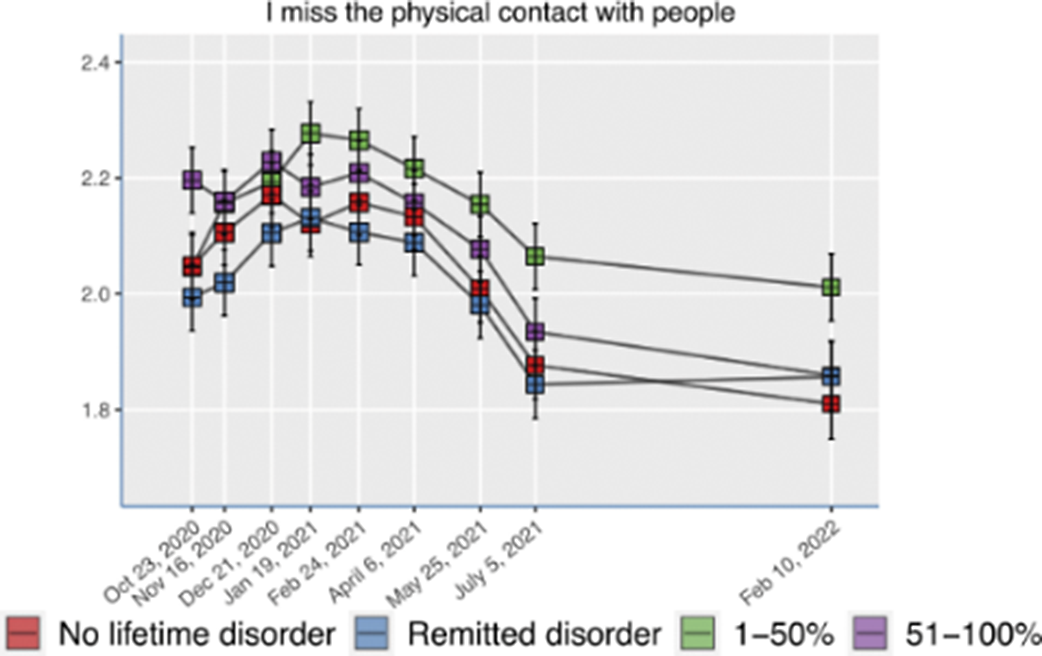
We included 1061 participants with (n = 811) and without (n = 250) mental health disorders. In all groups, touch hunger increased during lockdown (Fig. 1). Extraversion (β = 0.256, P <0.001), social distancing due to COVID-19 anxiety (β = 0.122, P = 0.001) and death of a close contact from COVID-19 (β = 0.073, P = 0.02) predicted higher touch hunger, while living with a partner (β = -0.109, P = 0.004) or with a partner and children (β = -0.147, P <0.001) were protective factors for touch hunger. Remarkably, pre-pandemic mental disorders did not predict touch hunger during lockdown.
Image:
Conclusions
Social distancing measures have important psychological and emotional implications, as our study showed an increase in touch hunger during lockdown, which did not differ between people with and without mental health disorders. Extroverted individuals may benefit most from interventions aimed at addressing their need for physical contact during times of crisis.
New technological trends and access to more information have generated an anxious disorder and the need to obtain everything that the consumer society has to offer, this has increased with the influence of neuromarketing in internet ads.
Objectives
The objective that was raised in the present investigation was to analyze the influence of neuromarketing in the increase of anxiety reflected in compulsive purchases of women in the city of Santa Marta.
Methods
The field research design is non-experimental and cross-sectional, the sample taken was of 500 women with purchasing power of more than three Colombian minimum wages.
The IDARE Ch. Spielberger, R. Díaz Guerrero et al. (1966) checklist was applied; To review the relationship between advertising with neuromarketing, anxiety and compulsive purchases, a Likert-type scale instrument was designed and validated with the Alpha Cronbach Coefficient. Analysis of Covariance ANOVA, inferential statistics and SPSS were performed.
Results
57% of the women meet the criteria for the IDARE clinic. The analysis of the questionnaire showed a goodness of fit of R² = 0.697. The result indicates that the more hours women spend on the internet with access to ads focused on neuromarketing, the more they feel the need to buy, and this generates anxiety processes.
Conclusions
The mental triggers used by neuromarketing accelerate the need in women to buy the solutions that they sell and the same need to buy is evident in the signs of anxiety that is reflected in the women under study. Training that educates women to spend less time connected to the Internet is recommended, but it is also essential that they understand that advertising and marketing exert pressure that increases their anxiety and need to purchase, so it is recommended the implementation of training in personal management and control.
There are more than ten thousand homeless people in Hungary. Earlier studies confirmed the connection between mental health issues and homelessness. Furthermore, homeless care places a significant burden on the healthcare system, with psychiatric departments being no exception.
Objectives
to compare demographic and treatment characteristis of homeless and not homeless inpatients in the psychiatric department of Jahn Ferenc South Pest Hospital (JFSPH), and thus providing a different perspective compared to previous studies, shedding light on the relationships from a different angle.
Methods
In our retrospective study, we analyzed all inpatients’ data treated in the psychiatric department of JFSPH over a 4-month period (03/2023-07/2023). Patients were divided into two groups: those with housing and those who were homeless. We compared the two groups based on the following variables: gender, age, length of inpatient treatment, diagnosis, psychiatric history, employment status; smoking, alcohol and drug use; valid health insurance, invalidity pension and guardianship status; and long-acting injectable antipsychotic treatment.
Results
The percentage of homeless individuals treated in the psychiatric department of JFSPH was 18%. There was a significant difference in the length of inpatient stay between the two groups, homeless patients spent more than 100% longer time under inpatient treatment. Regarding psychiatric history, there was no significant difference between the two patient groups. When examining the employment status of the sample, we found significantly more unemployed patients im the homeless group. Comparing to the control group, there were significantly more alcohol consumers, smokers, and substance users among the homeless. Long-acting antipsychotic injections were administered significantly more frequently to homeless patients. A significantly higher percentage of homeless individuals were declared invalidated, and a significantly higher proportion of them were placed under guardianship compared to the group with housing. Homeless individuals were significantly more likely to have no social insurance compared to the control group.
Conclusions
In summary, we can conclude that significant difference have been found between the homeless and not homeless groups in most of the examined variables. These results implicates that the inpatient care of homeless patients poses significant bourden on the inpatient system. Early prevention and effective rehabilitation of substance use disorders could decrease this burden. Establishing a proper social safety network and enhancing community psychiatric care could potentially also relieve the burden of inpatient care system.
Corticosteroid treatment has been associated with the appearance of psychiatric symptoms such as depression, mania or psychosis. It is believed that manic symptoms appear with lower doses than psychotic ones. Furthermore, manic symptoms are usually associated with brief treatments against depressive ones that often appear with chronic administration of corticosteroids. The symptoms can persist for to 2 months, with an average duration of 3 weeks. The prognosis is favorable with a complete remission of symptoms in more than 90% of patients. Treatment initially consists in reducing or removing corticosteroids. However, sometimes symptomatic treatment with antipsychotics or mood stabilizers is necessary.
Objectives
To review about corticosteroid-induced mania
Methods
We carry out a literature review about corticosteroid-induced mania, accompanied by a clinical description of one patient previously diagnosed of bipolar disorder who presents a manic episode after corticosteroids treatment.
Results
A 25-year-old male was admitted to the short-term hospitalization unit from the emergency department due to manic symptoms. He had a previous diagnosis of attention deficit hyperactivity disorder sin adolescence and also a diagnosis of bipolar disorder established 7 years ago. During the last year he had received treatment with asenapine 10 mg and lamotrigine 200 mg, with good response. Several weeks before his admission he received corticosteroid treatment during several days, due to an respiratory infection. In this context he appeared more nervous, dysphoric, hyperthymic, impulsive, with increased speech pressure, insomnia and tachypsychia. Despite the withdrawal of corticosteroid treatment, manic symptoms persisted. During admission, asenapine´s dose was increased with a complete remission of the manic symptoms.
Conclusions
Corticosteroids are associated in a high percentage with the appearance of manic symptoms. The prognosis is usually favorable after the withdrawal of corticosteroid treatment. However, sometimes the symptoms do not disappear despite withdrawal - mainly due to individual vulnerability - or this one is not possible. In these cases, treatment with antipsychotics or mood stabilizers is indicated.
Anxiety disorders are one of the most common mental disorders, yet only less than 20% of people with anxiety disorders receive adequate treatment. Digital interventions for anxiety disorders can potentially increase access to evidence-based treatment. However, there is no comprehensive meta-analysis study that covers all modalities of digital interventions and all anxiety disorders.
Objectives
A preliminary meta-analysis was conducted to examine the treatment efficacy of digital interventions [e.g., virtual reality (VR)-, mobile application-, internet-based interventions] for anxiety disorders and to identify potential moderators that may lead to better treatment outcomes.
Methods
We searched Embase, PubMed, PsycINFO, Web of Science, and the Cochrane Library for randomized controlled trials examining the therapeutic efficacy of digital interventions for individuals with anxiety disorders from database inception to April 18, 2023. Search keywords were developed by combining the PICOS framework and MeSH terms. Data screening and extraction adhered to PRISMA guidelines. We used a random-effects model with effect sizes expressed as Hedge’s g. The quality of the studies was assessed using the Revised Cochrane risk-of-bias tool for randomized trials (RoB 2). The study protocol was registered in PROSPERO on April 22, 2023 (CRD42023412139).
Results
A systematic literature search identified 19 studies with randomized controlled trials (21 comparisons; 1936 participants) with high overall heterogeneity (Q = 104.49; P < .001; I2 = 80.9%). Digital interventions reduced anxiety symptoms with medium to large effect sizes (g = 0.78; 95% CI: 0.55-1.02; P < .001), with interventions for specific phobia showing the largest effect size (n = 6; g = 1.22; 95% CI: 0.51-1.93; P < .001). VR-based interventions had a larger effect size (n = 6; g = 0.98; 95% CI: 0.39-1.57; P < .001) than mobile- or internet-based interventions, which had medium effect sizes. Meta-regression results exhibited that effect sizes of digital interventions were associated with the mean age of participants (β = 0.04; 95% CI: 0.02-0.06; P < .001).
Conclusions
The results of this study provide evidence for the efficacy of digital interventions for anxiety disorders. However, this also suggests that the degrees of effectiveness in reducing anxiety symptoms can be moderated by the specific diagnosis, the modalities of digital technologies, and mean age, implying that the application of digital interventions for anxiety disorders should be accompanied by personalized guidance.
Sleep disorders vary widely and its treatment are based on a combination of life style changes and pharmacological therapy adapted to the primer health issue. Ketogenic diet has shown not only its efficacy in different health conditions, but it is also becoming a popular health trend. Could the therapeutic spectrum of ketogenic diet cover sleep disturbances ?
Objectives
The aim of our study is to evaluate the effect of ketogenic diet on sleep disorders
Methods
To identify relevant studies ,our literature review was based on the Pubmed interface and adapted for 2 databases : science direct and google scholar. We used the following key words ( ketogenic diet [meSH terms]) and (sleep disorders [meSH terms]).
Results
Our research revealed 14 articles published between 2012 and 2022. We selected 8 which corresponded to the purpose of our review. The ketogenic diet affects sleep hemostasis indirectly. In fact, this diet is associated with weight loss and therefore reduction of metabolic and cardiovascular complications disturbing sleep quality. From a neurobiological perspective, this regimen based on limited carbohydrates is associated with a low Tryptophan intake which is the precursor of melatonin. But on the other hand, Ketone bodies trigger adenosine activity which promotes melatonin liberation, the sleep inducing hormone.
Conclusions
Ketogenic diet modulates melatonin activity therefore affects sleep architecture. Meanwhile, Its impact on sleep disorders is still controversed due to the variation of its pathophysiological mechanisms.
