To save content items to your account,
please confirm that you agree to abide by our usage policies.
If this is the first time you use this feature, you will be asked to authorise Cambridge Core to connect with your account.
Find out more about saving content to .
To save content items to your Kindle, first ensure no-reply@cambridge.org
is added to your Approved Personal Document E-mail List under your Personal Document Settings
on the Manage Your Content and Devices page of your Amazon account. Then enter the ‘name’ part
of your Kindle email address below.
Find out more about saving to your Kindle.
Note you can select to save to either the @free.kindle.com or @kindle.com variations.
‘@free.kindle.com’ emails are free but can only be saved to your device when it is connected to wi-fi.
‘@kindle.com’ emails can be delivered even when you are not connected to wi-fi, but note that service fees apply.
Compulsory mental health care remains a controversial practice. The many difficulties in performing Randomised Controlled Trials (RCT) on the topic means there is limited evidence to support its effectiveness. For ethical and legal reasons, compulsory mental health care should only be used when necessary. Yet, geographical variations, which can indicate both overuse and underuse, have been observed. In the funded research project “Controversies in Psychiatry” we intend to use this variation as a source of knowledge production. We propose that this naturally occurring variation mimics randomisation, and can therefore permit causal inference from registry data.
Objectives
We will estimate the causal effect of compulsory inpatient mental health care on a range of outcomes, including injuries, self-harm, and all-cause mortality; violent crime; employment vs benefit allowance; rehospitalisation and outpatient commitment.
Methods
Observed variation in register data on all episodes of compulsory inpatient mental health care in Norway between 2015-2016 (N ≈ 300 000), will serve as a source of as-random variation. Provider-preference for compulsion usage will be used as an instrumental variable (IV).
Results
Outcomes will be observed from 2017-2025. If assumptions underlying IV-analysis do not hold, the project will still provide important and complete descriptive data on long-term outcomes for a whole population.
Conclusions
Geographical variation is a cause for concern if people are treated differently depending on area of residence. But it also presents an opportunity to use differences in service provider’s preference for using compulsory care as an instrumental variable to estimate the causal effect of compulsory care on multiple short and long-term outcomes. This approach can help resolve controversies that are difficult or even impossible to investigate through RCTs. After presenting the project plan we invite to a discussion of the feasibility of using an instrument variable approach to explore if relatively low versus high rates of compulsory care produce favorable outcomes for patients.
Despite increased political attention to instances of legislative obstruction in recent years, little is known about the public’s attitudes toward these procedural techniques. I evaluate these attitudes in the context of the last two decades of nominations to the U.S. Supreme Court with three complementary analyses. In the first, nationally representative survey evidence reveals an overriding political dimension to Americans’ attitudes over the use of tactics to delay the confirmation process. The president’s copartisans express considerably higher levels of opposition to delayed consideration of a nominee than individuals politically opposed to the president. In the second and third, evidence from observational surveys and a survey experiment shows that these attitudes vary depending on the type of the obstruction under consideration, with Americans less supportive of the use of forms of obstruction that entirely preclude procedural consideration of a nominee, such as refusing to hold hearings, than more established methods that do not, like the filibuster or document requests. These findings reveal that the American public has internalized the political stakes of judicial nominations and suggest that obstruction may have electoral consequences in an era of extreme polarization.
Obstructive sleep apnea hypopnea syndrome (OSAHS) is a chronic source of stress that can alter the emotional state of affected patients.
Objectives
This study aimed to assess the impact of OSAHS severity on depression and anxiety disorders in a Tunisian population of apneic patients.
Methods
We conducted a cross-sectional study, involving 40 patients diagnosed with OSAHS by polysomnography in the Sleep unit, department of Neurophysilogy at Sahloul university hospital in Sousse, Tunisia. Anxiety and depressive disorders were detected using the Arabic version of the HADS (Hospital Anxiety and Depression Scale).
Results
The mean age was 49.7 ± 7.87 years with a sex ratio of 1.1. The mean apnea-hypopnea index (AHI) was 29.72. OSAHS was mild, moderate and severe in 40%, 22.5% and 37.5% of cases respectively. One third (30%) of patients received a treatment with continuous positive airway pressure (CPAP). The prevalence of depression in the study’s patients, according to the HADS, was 56.4% and that of anxiety was 59%. There was a positive linear relationship between AHI and scores of depression and anxiety (p=0.045 and p=0.037 respectively). Similarly, a significant association was found between HAD scores and treatment with CPAP (p<0.05).
Conclusions
These results show a high frequency of anxiety-depressive disorders in patients with OSAHS. Severity of OSAHS and CPAP treatment proved to be determining factors in anxiety and depressive disorders, hence the importance of detecting these disorders in order to improve patients’ quality of life.
The Screen for Disordered Eating/SDE was created as a primary care screening method for eating disorders, including binge eating disorder (Maguen et al. 2018). The SDE comprises five items (yes/no answers), extracted from other validated self-reported questionnaires assessing eating psychopathology. Its validity and reliability has proved in a Portuguese psychometric study, that only included woman (Pereira et al. 2022). It psychometric properties have yet to be evaluated in men.
Objectives
We aim to assess the psychometric properties of the Portuguese version of SDE in males.
Methods
Participants were 227 male individuals with a mean age of 30.41 years (±13.96; range: 14-73). They answered an online survey including the Portuguese preliminary versions of the seven-item Eating Disorder Examination Questionnaire/EDE-Q7; the Body Image Concern Inventory/BICI and the Muscle Dysmorphia subscale of the Eating Disorder Assessment for Men/DM-EDAM.
Results
Confirmatory Factor Analysis showed good fit for the unidimensional model (χ2/df=1.483; RMSEA=.0460; CFI=.980 TLI=.961, GFI=.988). Cronbach’s alpha was .621 which although inferior to .7 can be explained by the small number of items and the fact that each one assesses different dimensions. All items contributed to the internal consistency and presented high internal validity. Pearson’s correlations of SDE with BICI (.317) and EDE-Q7 (.361) were significant and moderate. The correlation with DM-EDAM was non-significant, probably due to its focus on muscle dysmorphia, which is not included in SDE’s items.
Conclusions
The Portuguese version of SDE demonstrated adequate validity (construct and convergent) and reliability.
Several changes to the classification of mental disorders have been made during the past half century to increase the reliability, clinical use and validity of the diagnostic classification. Despite the high expansion of knowledge about mental disorders, understanding of their components and processes still requires fine-tuning. This symposium identifies key issues on different classification systems with different purposes relevant to understanding and classifying mental disorders. We discuss how key issues such as ICD-11, RDoC or Biomarkers correspond or diverge because of their different purposes, and constituencies. Although these approaches have varying degrees of overlap and distinguishing features, they share the goal of reducing the burden of suffering due to mental disorder.
Prosocial behaviors are voluntary behaviors that are performed for the benefit of other people and promote harmonious relationships with others. This type of enhanced behavior could reduce physical and verbal aggressive acts in adolescents.
Objectives
analyze the association between aggressive and prosocial behaviors in adolescents
Methods
The study was non-experimental of a transactional - correlational type, two evaluation instruments validated in the context were applied to 500 adolescents attending school in the department of Córdoba. The type of sampling was non-probabilistic.
Results
A Pearson correlation was performed, previously verifying the normality of the data, which showed a statistically significant, negative association between the prosocial behaviors and the aggressive behaviors of those evaluated (Table 1).Table 1:
Correlation between prosocial behavior and aggressive behavior.
PROSOCIAL BEHAVIOUR
AGGRESSIVEBEHAVIOR
Pearson correlation
-,197**
Sig. (bilateral)
,004
N
500
Conclusions
Negative associations were identified between the two variables under study, that is, as prosocial behavior increases, aggressive behaviors could decrease. This finding serves as a basis for carrying out future intervention strategies in adolescents in the department of Córdoba.
Social support have affected the recovery and adherence with treatment in bipolar patients.
Objectives
This research aims to understand the contribution of social support mechanisms to treatment adaptation processes in individuals struggling with bipolar disorder and the effects of these support mechanisms on recovery. In this way, the importance of the social support factor will be tried to be understood in order to provide more effective and customized support to individuals living with bipolar disorder.
Methods
This study will planned to descriptive correlational design. The data will collect to using the Morisky Treatment Adherence Scale (MTAS), the Multidimensional Scale of Perceived Social Support (MSPSS), the Recovery Process Inventory (RPIS), and the Sociodemographic Data Form from individuals diagnosed with Bipolar disorders. By filling out these scales, participants will evaluate their treatment compliance, perceived social support levels, and recovery processes. The data will be subjected to appropriate methods for statistical analysis and will be used to understand the relationships between social support and treatment compliance and recovery processes.
Results
Data extraction is still on going in detailed style by principal authors. Description of studies and the key findings will be presented.
Conclusions
It is thought that the results obtained from this research will be an important guide in providing more effective support to individuals with the level of social support, treatment adherence and recovery processes in individuals struggling with bipolar disorder
Key Words
bipolar disorder, social support, treatment adherence, recovery.
The very brief presentation will describe the initial approach to the psychiatric assessment of the case presented including the issue of fitness to participate in court proceedings. The use of screening tools at court to identify people with intellectual disabilities will be highlighted along with what support can be provided for vulnerable offenders in attending court. The potential disposal options for the court such as prison or hospital or community will be outlined. Variation in practice across Eurpean countries needs further discussion to ensure the rights of defendants with intellectual disabilities are safeguarded during their participation in court proceedings
In the context of developmental disorders, it is frequently observed that atypical processes may yield seemingly unimpaired behavioural outcomes. Research has shown that children and adults with Autistic Spectrum Disorder (ASD) have intact statistical learning performance. Recent studies have indicated that learning can happen not only during practice but during ultrashort rests between practice blocks (that is, ultrafast offline learning) but no study to date examined these dynamics in ASD.
Objectives
This research aimed to unravel the effect of ASD on learning during and between blocks, also known as online and offline improvement.
Methods
We conducted a series of research with three different samples: 1) ASD children (N = 27), 2) ASD adults (N = 42), and 3) neurotypical adults with distinct positions on the autism spectrum, i.e., the severity of autistic traits (N = 174). Participants performed the Alternating Serial Reaction Time task, allowing us to measure statistical learning (the extraction of statistical knowledge) and general skill learning (speed-up regardless of probabilities) separately.
Results
Individual differences in online and offline improvements were observed. Results of individual studies further confirmed by meta-analysis performed on the three above-mentioned datasets show that neither ASD nor the severity of autistic traits influences the dynamics of learning.
Conclusions
Our findings suggest that, not only learning but also the dynamics of acquisition of statistical knowledge are intact in autism.
Previous research has demonstrated stable patterns of family communication. The Revised Family Communication Pattern Instrument (RFCP) is a common measure of these patterns. It posits two orientations: conformity orientation, characterized by a tendency to seek agreement within the family and by authoritarian decision-making; and conversation orientation, characterized by shared decision-making with the child and frequent family discussion.
Objectives
The primary aim of our research was to adapt the RFCP questionnaire to the Hungarian language. Based on previous research, we hypothesized a negative relationship of conversation orientation and a positive relationship of conformity orientation with parents’ mentalizing problems, parental stress and burnout. According to our hypothesis, conformity orientation would predict both attachment anxiety and avoidance, whereas conversation orientation would decrease attachment anxiety.
Methods
Parents of children aged 6–17 (N=269, female=86,2%, mean age=42,64 [SD=6,10] yrs) completed the following online questionnaires: Child Quality of Life Questionnaire (ILK) parent version, Reflective Function Questionnaire (RFQ-8), Experiences of Close Relationships Questionnaire (ECR-RS), Parent Burnout Questionnaire (PBA-HUN), Perceived Stress Questionnaire (PSS) and the RFCP instrument. We conducted a confirmatory factor analysis. Linear regression analyses predicting attachment anxiety and avoidance included two factors of the RFCP, the RFQ-8, the PBA-HUN, and the PSS total score, as predictors. In addition, two factors of the ECR-R were included in the linear regression analyses predicting quality of life.
Results
The confirmatory factor analysis confirmed the original two-factor structure of RFCP (χ2=5482.21, df=325 p< .001, χ2/df=16.86, CFI=0.91, TLI=0.90, RMSEA=0.075 (90% CI 0.068–0.082)) and their internal reliability (Cronbach’s alpha = .78 and .74). Attachment avoidance (R2=0.12, F(5)=7.38, p< .001) was only predicted by conversation orientation (β=−0.28, p< .001), while attachment anxiety was predicted (R2=25.2, F(5)=17.7, p< .001) by conformity orientation (β=0.24, p< .001), parental mentalization difficulties (ß=0.20, p< .001) and parenting stress (β=0.15, p= .015). Parental report of the child’s quality of life was predicted most strongly by attachment anxiety (β=−0.28, p< .001), followed by conversation orientation (β=0.21, p< .001) and attachment avoidance (β=−0.18, p< .001, R2=28.8, F(7)=15.17, p< .001).
Conclusions
The Hungarian version of the RFCP questionnaire has proven to be a reliable questionnaire. The importance of family communication patterns is demonstrated by the fact that it explains both the quality of parent-child attachment and the parent’s report on the child’s quality of life.
This article introduces a comprehensive framework that effectively combines experience rating and exposure rating approaches in reinsurance for both short-tail and long-tail businesses. The generic framework applies to all nonlife lines of business and products emphasizing nonproportional treaty business. The approach is based on three pillars that enable a coherent usage of all available information. The first pillar comprises an exposure-based generative model that emulates the generative process leading to the observed claims experience. The second pillar encompasses a standardized reduction procedure that maps each high-dimensional claim object to a few weakly coupled reduced random variables. The third pillar comprises calibrating the generative model with retrospective Bayesian inference. The derived calibration parameters are fed back into the generative model, and the reinsurance contracts covering future cover periods are rated by projecting the calibrated generative model to the cover period and applying the future contract terms.
During the COVID-19 pandemic, healthcare professionals worked under critical care conditions and had to adapt quickly to extreme work situations. They were confronted with several occupational stressors.
Objectives
To determine the prevalence and factors associated with post-traumatic stress symptoms among healthcare personnel at Farhat Hached Hospital in Sousse during the COVID-19 pandemic.
Methods
This was a descriptive cross-sectional study conducted among care staff at the Farhat Hached University Hospital in Sousse over a 3-month period during the 4th wave of COVID-19. Data were collected using a questionnaire covering socio-professional and medical data. Post-traumatic stress symptoms were assessed using the Impact of Event Scale-Revised (IES-R). Statistical analysis was performed using SPSS.23 software.
Results
Our study included 326 health professionals from the CHU Farhat Hached. The mean age of our population was 36.38 ±10.19 years. The sex ratio was 0.23. Most healthcare staff were married (61.3%) and had dependent children (60.4%). Nurses were the most represented at 32.2%, followed by health technicians (22.7%) and medical residents (18.4%). Average job tenure was 10.62±10.69 years, with extremes ranging from 1 to 39 years. The prevalence of post-traumatic stress disorder was 32.5%. Paramedics were more likely to develop post-traumatic stress symptoms (OR=2.3 (IC95%: 1.4-3.8), p=0.001). Leisure activities were protective factors against post-traumatic stress symptoms (OR=0.4 (IC95%: 0.2-0.8), p=0.018). The multivariate analytical study revealed that being a paramedic and having a personal history of COVID19 infection were independently associated with post-traumatic stress symptoms.
Conclusions
Our results demonstrated the significant impact of the COVID-19 pandemic on the mental health of healthcare personnel. Lessons learned from this pandemic should help in the development of context-specific strategies to support healthcare workers and promote the protection of their mental health.
Psychiatric patients, and schizophrenia patients in particular, have a lower average life expectancy than the general population, and the high prevalence of physical illnesses contributes to this. In the case of cancer, the incidence seems to be the same or lower compared to the general population, but on the other, the prognosis is frankly worse.
Objectives
We aim to collect evidence about the relationship between cancer and schizophrenia.
Methods
Based on a clinical case of a patient diagnosed with schizophrenia who died of an occult neoplasm, we conducted a narrative review of the literature concerning cancer screening, incidence, mortality and prognosis in patients with schizophrenia.
Results
A 39-year-old male patient was diagnosed with schizophrenia when he was 26 years older. The patient was single, had no children, lived alone and was retired due to his psychiatric condition.
He was admitted to the inpatient ward in January 2023 due to a psychotic relapse after abandoning the prescribed treatment. He remained hospitalised for 14 days, and oral and injectable antipsychotic therapy was reinstated. He was discharged to the psychiatric day hospital unit to promote psychosocial rehabilitation. During this period, he complained about unspecified back pain but did not present any other physical symptoms.
Two months later, he was evaluated by his psychiatrist as an outpatient, and his general condition had become significantly poorer. He had lost over 20 kilograms, his skin was pale, and he complained of back pain. He was referred to an internal medicine consultation. Still, before it was scheduled, he came to the emergency department and was admitted due to digestive bleeding, asthenia and low back pain, with a weight loss of around 25 kilograms.
An abdominal mass was palpated on physical examination, and the chest x-ray showed a “balloon drop” pattern, indicating pulmonary metastases. Two days after being admitted to the internal medicine ward, he died of cardiac arrest.
It is known that the stigma that mentally ill patients suffer often contributes to a delay in diagnosing medical illnesses. In addition, frequent social isolation and poor social family support do not help these patients seek medical care when their physical condition deteriorates. Low adherence to cancer screening and avoidance of routine health care often add to this delay.
Conclusions
As physicians who often deal with individuals with severe mental illnesses, psychiatrists should be extra aware of risk factors and keep a heightened suspicion of medical conditions. They should also promote the adoption of beneficial health behaviours and encourage participation in cancer screening and other relevant health programs.
Psilocybin-assisted therapy (PAT) has demonstrated significant potential in alleviating anxiety, depression, and psychological distress among individuals with terminal illnesses. However, numerous barriers prevent equitable access to this transformative treatment.
Objectives
This study seeks to gather the perspectives of patients on the waitlist of PAT.
Methods
Semi-structured interviews highlight the challenges faced by patients seeking PAT and their care providers and propose recommendations to enhance accessibility.
Results
Through a case study of Roots to Thrive, a non-profit healthcare practice offering group-based PAT, obstacles such as complex application processes, fear of judgement, logistical and financial constraints, and systemic inequities are revealed. Moreover, Health Canada’s stringent control of PAT access via clinical trials and the Special Access Program (SAP) presents challenges for primary care providers and hinders the involvement of trained practitioners. The moral distress experienced by patients and providers due to delayed or denied access further emphasizes the urgency of addressing these barriers.
Conclusions
Advocates are calling for streamlined referral systems, expedited services for end-of-life patients, formal billing infrastructure, practitioner education, expanded coverage, legislative adjustments, post-therapy support, and collaboration with non-profit organizations and Indigenous Healers to promote equitable and effective PAT. By implementing these recommendations, barriers to PAT can be overcome, allowing more individuals to benefit from this therapy and find relief from the psychological distress associated with their conditions.
The COVID-19 pandemic has caused psychological distress in all the communities and through all ages. Some people seemed to be less affected and to be resilient because of a dynamic interaction between individual, relational and environmental factors.
Objectives
We aim on this present study to evaluate the resilience and factors associated with it among a representative sample of Tunisian adolescents during the COVID19 pandemic.
Methods
We conducted a cross sectional, descriptive and analytic study among Tunisian adolescents enrolled in secondary schools, in the Hamma region of the city of Gabes during the period extending from 5 March to 26 May 2021. Students were asked to complete a pre-established questionnaire, which contains questions about socio demographic features, medical history and knowledge about the pandemic of covid-19. The Child and Youth Resilience Measure (CYRM-28) was used to evaluate the global resilience and resources contributing to it. The CYRM-28 contains three resources including individual, relationship with primary caregivers and contextual factors. Higher scores reflect higher levels of factors associated with resilience.
Results
A total of 326 adolescents aged between 14 and 18 years old participated on this study (mean age 16.65 years 1). There were 92 boys and 234 girls. In our sample, 4% of adolescents were infected by the Covid-19. The infection of a family member by this virus was noted in 27.3 % of cases. Adolescents were exposed to the death of a family member by Covid-19 in 22.4% of cases. The Global CYRM28 score was 105 ± 22.39. We found that adolescents who had loosen a family member because of the COVID infection, were less resilient than others (100 vs 107; p=0.023). Adolescents with a moderate to low socioeconomic level were less resilient especially with regard to contextual resilience (35, 57 vs 37, 83; p= 0.019). On the other hand, adolescents keeping means of leisure during this epidemic were significantly more resilient especially in the personal resources (p = 0.024).
Conclusions
Our findings conclude to some individual, relational and contextual factors that contribute or alters the process of resilience. Recognizing the strengths and capacities of adolescents would allow the development of programs and resources that can help these young people develop resilience skills.
Psychiatric drugs, including antipsychotics and antidepressants, are widely prescribed, even in young and adolescent populations at early or subthreshold disease stages. However, their impact on brain structure remains elusive. Elucidating the relationship between psychotropic medication and structural brain changes could enhance the understanding of the potential benefits and risks associated with such treatment.
Objectives
Investigation of the associations between psychiatric drug intake and longitudinal grey matter volume (GMV) changes in a transdiagnostic sample of young individuals at early stages of psychosis or depression using an unbiased data-driven approach.
Methods
The study sample comprised 247 participants (mean [SD] age = 25.06 [6.13] years, 50.61% male), consisting of young, minimally medicated individuals at clinical high-risk states for psychosis, individuals with recent-onset depression or psychosis, and healthy control individuals. Structural magnetic resonance imaging was used to obtain whole-brain voxel-wise GMV for all participants at two timepoints (mean [SD] time between scans = 11.15 [4.93] months). The multivariate sparse partial least squares (SPLS) algorithm (Monteiro et al. JNMEDT 2016; 271:182-194) was embedded in a nested cross-validation framework to identify parsimonious associations between the cumulative intake of psychiatric drugs, including commonly prescribed antipsychotics and antidepressants, and change in GMV between both timepoints, while additionally factoring in age, sex, and diagnosis. Furthermore, we correlated the retrieved SPLS results to personality domains (NEO-FFI) and childhood trauma (CTQ).
Results
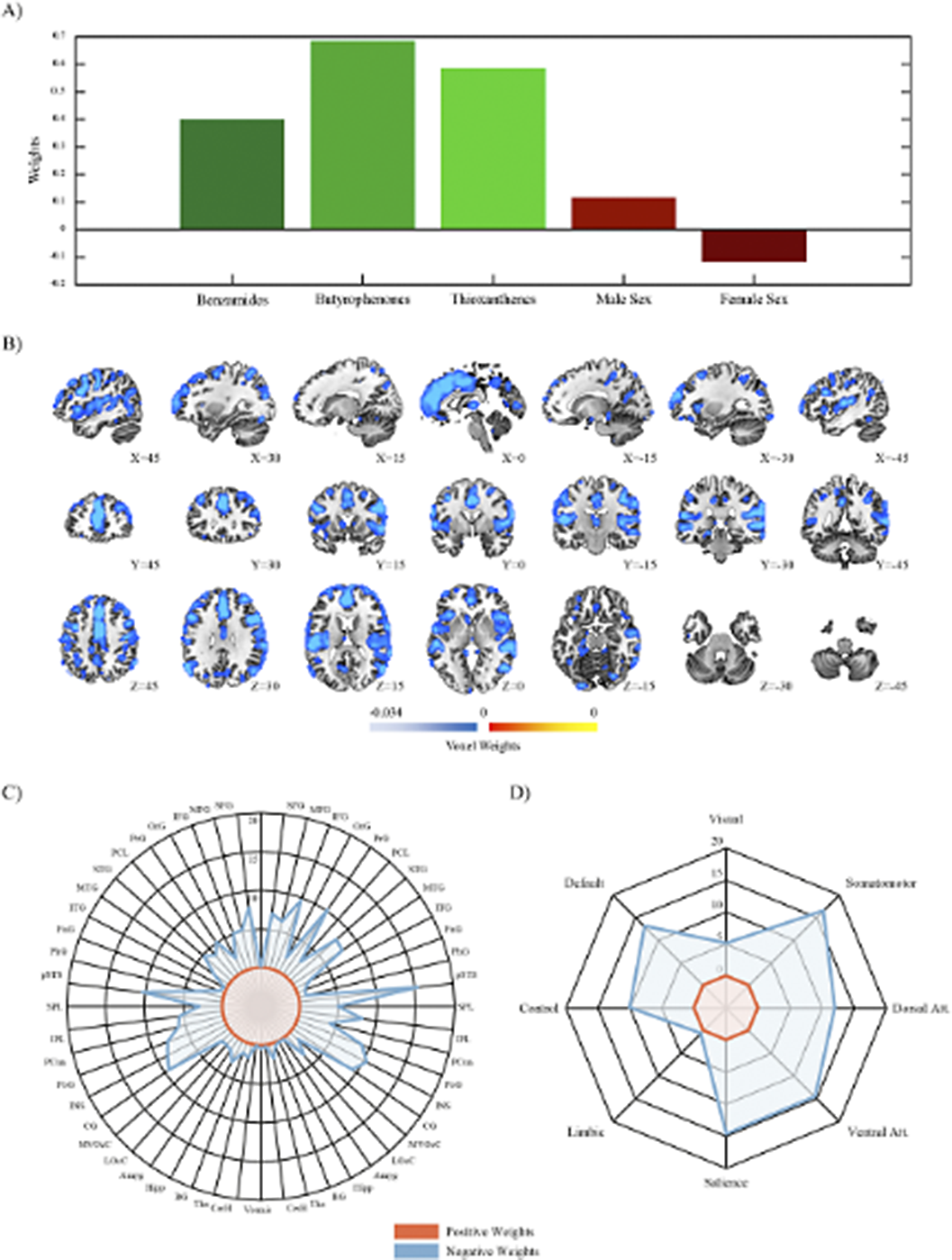
SPLS analysis revealed significant associations between the antipsychotic classes of benzamides, butyrophenones and thioxanthenes and longitudinal GMV decreases in cortical regions including the insula, posterior superior temporal sulcus as well as cingulate, postcentral, precentral, orbital and frontal gyri (Figure 1A-C). These brain regions corresponded most closely to the dorsal and ventral attention, somatomotor, salience and default network (Figure 1D). Furthermore, the medication signature was negatively associated with the personality domains extraversion, agreeableness and conscientiousness and positively associated with the CTQ domains emotional and physical neglect.
Image:
Conclusions
Psychiatric drug intake over a period of one year was linked to distinct GMV reductions in key cortical hubs. These patterns were already visible in young individuals at early or subthreshold stages of mental illness and were further linked to childhood neglect and personality traits. Hence, a better and more in-depth understanding of the structural brain implications of medicating young and adolescent individuals might lead to more cautious, sustainable and targeted treatment strategies.
Buddha Blue, or PTC for “Pète Ton Crâne”, is a synthetic drug particularly popular with young people. It is sold as a liquid to be inhaled in electronic cigarettes.
Objectives
To discuss the clinical manifestations and psychopathology associated with PTC.
Methods
We shed light on PTC addiction through clinical vignettes of patients who were hospitalized in pediatrics at the Gonesse hospital.
Results
We received two male patients with manifestations of PTC intoxication or withdrawal. One of the patients presented with an acute delirious flush requiring long-term treatment, while the second presented with somatic manifestations of pain and vomiting, as well as psychiatric manifestations such as hallucinations, without meeting the criteria for a psychiatric disorder. Both cases required addictological follow-up and child psychiatric therapy.
Conclusions
PTC addiction can lead to life-threatening complications, hence the importance of prevention and screening in order to institute early and effective treatment.
We demonstrate efficient and economical all-solid-state post-compression based on dual-stage periodically placed thin fused silica plates driven by a more than 100 W ytterbium-doped yttrium aluminum garnet Innoslab amplifier seeded by a fiber frontend. Not only is a more than eight-fold pulse compression with 94% transmission achieved, but also the pulse quality and spatial mode are improved, which can be attributed to the compensation for the residual high-order dispersion and the spatial mode self-cleaning effect during the nonlinear process. It enables a high-power ultrafast laser source with 64 fs pulse duration, 96 W average power at 175 kHz repetition rates and good spatiotemporal quality. These results highlight that this all-solid-state post-compression can overcome the bandwidth limitation of Yb-based lasers with exceptional efficiency and mitigate the spatiotemporal degradation originating from the Innoslab amplifier and fiber frontend, which provides an efficient and economical complement for the Innoslab laser system and facilitates this robust and compact combination as a promising scheme for high-quality higher-power few-cycle laser generation.
Measuring carbon monoxide (CO) in exhaled breath with a visual representation can aid in smoking cessation by increasing smokers’ awareness of how smoking negatively affects their health and how many harmful substances they introduce into their bodies. Individuals attempting to quit smoking can regularly measure CO levels to monitor their progress in reducing this gas in their system.
The national „Smoke Out Day” is a day aimed at encouraging smokers to quit smoking in the Republic of Croatia. It is celebrated on the first day of Lent, as it is a period when most people contemplate giving up something they enjoy throughout the year.
The Institute of Public Health of Virovitičko-podravska County sets up a booth in one of the cities in County on that day. There we offer pamphlets to passersby with information about the harmful effects of smoking and provide them with the opportunity to measure carbon monoxide in their exhaled breath.
Objectives
The aim of this study was to explore relationship between smoking status, smoke exposure and the levels of exhaled carbon monoxide.
Methods
For measuring CO we used piCO simple Smokerlyzer. From April 2015 till May 2023, 462 individuals have participated in this measurement. The data were processed using the Python programming language version 3.9 and the statistical library Pingouin version 0.5.3. Data visualization was performed using the Seaborn library version 0.12.2. The statistical analyses employed in this study are partial correlations. The Spearman method was used for partial correlations because it can identify nonlinear relationships and is more accurate and robust when the assumptions for Pearson correlation are not met.
Results
Partial correlation analysis indicates that there is a statistically significant relationship between the level of carbon monoxide and the following parameters:
- Non-smoking status in years (rho = -0.526, p <0.001, two-tailed test).
- Number of cigarettes smoked per day (rho = 0.369, p <0.001, two-tailed test).
- Testing time after 3 PM (rho = 0.234, p <0.001, two-tailed test).
- Number of years as a smoker (rho = 0.230, p <0.001, two-tailed test).
- Age in years (rho = -0.179, p <0.001, two-tailed test).
- Time spent in a smoky area (rho = 0.114, p <0.016, two-tailed test).
Conclusions
In summary, these results provide valuable insights into the factors associated with carbon monoxide levels in humans, with smoking-related variables, age, and testing time showing notable partial correlations. It is important to consider these relationships when assessing and managing carbon monoxide exposure and its potential health implications.
Background: Maternal mental health is increasingly becoming a public health concern in developing countries because of predominant health and socio-economic inequalities. Mental well-being is essential for a woman to cope with daily life stresses and contribute positively to her community. Initiatives that empower women can enhance their well-being and improve the health of their families. However, limited evidence shows how women’s empowerment affects maternal well-being in a rural setting.
Objectives
This paper explores the perspective of women’s economic empowerment in a rural Kenyan community and its effect on women’s mental well-being.
Methods
We purposively sampled women and men from the rural community who met the eligibility criteria (women who were pregnant and or with a child less than two years old and married men and residents in the community. We conducted two focus group discussions with the men and women separately, 11 key informant interviews with community stakeholders, and a four-month participant observation of 20 women participants who were pregnant and or with a child less than one year old.
Results
The study found that economically empowered women had greater decision-making power and self-efficacy. However, cultural expectations and barriers that dictated the role of women prevented them from accessing and controlling resources and participating in important decisions such as land and property ownership. Women faced domestic violence (physical, verbal, and denial of basic needs) and inadequate support (emotional, physical, and financial) from spouses and other family members. These challenges and barriers increased their mental stress. To cope, women engaged in economic activities individually or in groups to meet the basic needs of their families.
Conclusions
Women’s economic empowerment can positively and negatively affect their overall well-being. Positively, women gain greater access to resources, improved decision-making, and the ability to plan and achieve their goals. Negatively, empowerment can lead to reduced spousal and kin support and an increased risk of domestic violence. Furthermore, these negative consequences can also affect women’s mental well-being. To ensure the well-being of mothers, it is crucial to engage men in empowerment programs and raise awareness in communities to address socio-cultural norms that impede women’s economic empowerment and negatively affect the well-being of women. Additionally, mental health support should be incorporated into these empowerment programs to mitigate the negative effects of women’s empowerment and improve resilience.
