To save content items to your account,
please confirm that you agree to abide by our usage policies.
If this is the first time you use this feature, you will be asked to authorise Cambridge Core to connect with your account.
Find out more about saving content to .
To save content items to your Kindle, first ensure no-reply@cambridge.org
is added to your Approved Personal Document E-mail List under your Personal Document Settings
on the Manage Your Content and Devices page of your Amazon account. Then enter the ‘name’ part
of your Kindle email address below.
Find out more about saving to your Kindle.
Note you can select to save to either the @free.kindle.com or @kindle.com variations.
‘@free.kindle.com’ emails are free but can only be saved to your device when it is connected to wi-fi.
‘@kindle.com’ emails can be delivered even when you are not connected to wi-fi, but note that service fees apply.
Democracy faces growing threats from authoritarian ideologies, especially in terrorism-affected regions. We test whether citizen-targeted democracy-promotion intervention can bolster democratic support and resist authoritarian appeals. A randomized online experiment in Burkina Faso exposed participants to educational videos focusing on: (1) introduction of civic rights democracies offer, (2) general discussion of democracy’s advantages in combating terrorism, (3) Burkina Faso–specific discussion of democracy’s advantages in combating terrorism, (4) space exploration (placebo). Democracy-promotion videos increased democratic support. The general terrorism-advantage message produced the largest gains, whereas the country-specific message had little effect. Effects are not contingent on respondents’ proximity to attacks or direct experience. These findings highlight how democratic resilience can be strengthened in conflict-affected societies and inform future efforts to promote democracy.
This article examines the diplomatic strategies of Revolutionary Guatemala between 1944 and 1951, situating them within the broader continental realignments that occurred at the onset of the Cold War. Contrary to prevailing interpretations that emphasize covert warfare or ideological rhetoric, it argues that Guatemala’s revolutionary governments pursued a deliberate, multilateral diplomatic agenda aimed at reshaping inter-American relations. Drawing on research in multiple archives in the Americas and Europe, the article demonstrates how Guatemala engaged in initiatives such as the nonrecognition of coup regimes, support for the Larreta Doctrine, and campaigns against Francoist Spain while forging alliances with Mexico, Venezuela, Cuba, and Southern Cone democracies. These efforts reveal both the agency and the limitations of states seeking to promote democracy amid shifting geopolitical pressures. By reframing Guatemala’s role, the article contributes to ongoing debates about Latin American agency, the contested nature of early Cold War alignments, and the evolution of inter-American diplomacy.
Why does ideological competition between states intensify despite opportunities for coexistence? This article develops a theory of the ideological security dilemma to explain this puzzle. Like the military security dilemma, states may take defensive measures to safeguard the legitimacy of their own ideology, but these actions can be interpreted by others as ideological offensives aimed at weakening the legitimacy of rival ideologies. I test the theory through a process tracing of US–China ideological competition from 1991 to 2024. I find that although the United States initially hoped China would democratize voluntarily, democratizing China was not a central policy goal. Conversely, while China seeks global respect for its “China model,” actively exporting authoritarian ideology is not its goal either. Nevertheless, China perceives US efforts as aimed at regime change, prompting Beijing to promote the “China model” more assertively as a countermeasure to what it sees as a US ideological assault. This intensifies US fears of the global spread of authoritarianism and triggers further counteractions. This study integrates constructivist and realist approaches while drawing on insights from comparative politics on regime legitimacy and democratization.
In the post–Cold War era, many authoritarian regimes engaged in strategic liberalization in response to international norms promoted by Western powers. As US support for democracy and human rights recedes, will this retreat prompt a global rollback of liberal reforms? While pessimistic accounts predict a return to overt repression, we argue that liberal norm adaptation within autocracies is likely to prove more resilient. We highlight two sources of continuity. First, autocrats’ domestic control strategies create incentives to retain certain liberal practices—such as elections, gender reforms, or limited media openness—that bolster legitimacy, co-opt dissent, and help manage opposition. Second, reforms anchored in treaties, international organizations, and domestic bureaucracies have generated expectations and mobilizational platforms, making wholesale reversals politically costly and prone to backlash. Our analysis illustrates how reforms, even when adopted instrumentally, have become sufficiently embedded in domestic politics to persist in the absence of strong external enforcement.
As authoritarianism has spread globally, government efforts to stifle civic space have increased dramatically. Among the most alarming tactics has been the spread of restrictive laws targeting NGOs. While such laws threaten the core objectives of many foreign donors, they have become especially common in aid-dependent nations. How do foreign donors react to this assault on their local and international implementing partners? On the one hand, democracy-promoting donors might push back, ramping up support for advocacy in defiance of draconian measures. Alternatively, when aspiring autocrats make it difficult to work with local partners, donors might back down, decreasing support for democracy promotion. Testing these arguments using dyadic data on aid flows, an original data set of NGO laws, and a variety of research designs, we find that the donors most committed to democracy promotion back down in the face of restrictive NGO laws, reducing democracy aid by 70 percent in the years after laws are enacted. Our findings suggest that donor behavior creates strong incentives for backsliding governments in aid-receiving countries to use legislation to crack down on civil society.
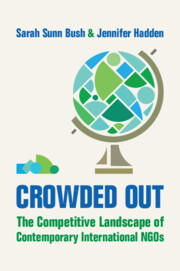
Crowded Out delves into the complex landscape of international non-governmental organizations (INGOs). Bush and Hadden trace INGOs' rise to prominence at the end of the twentieth century and three significant but overlooked recent trends: a decrease in new INGO foundings, despite persistent global need; a shift toward specialization, despite the complexity of global problems; and a dispersal of INGO activities globally, despite potential gains from concentrating on areas of acute need. Assembling a wealth of new data on INGO foundings, missions, and locations, Bush and Hadden show how INGOs are being crowded out of dense organizational environments. They conduct case studies of INGOs across issue areas, relying on dozens of interviews and a large-scale survey to bring practitioners' voices to the study of INGOs. To effectively address today's global challenges, organizations must innovate in a crowded world. This title is also available as open access on Cambridge Core.
Why are American INGO foundings declining while there is still a great deal of unmet social need and available resources? This chapter argues that INGO foundings respond to population density. We test our argument in two ways. First, we use data drawn from tax records on American INGOs to establish that there is a curvilinear relationship between population density and foundings. Second, we present a qualitative case study of civil society and democracy INGOs, drawing on memoirs, document analysis, and interviews with INGO founders and long-time practitioners. The case study uses process tracing to demonstrate how the extent of mutual support vs. competition shifts in a population as density increases. Finally, the chapter concludes by extending our argument about INGO foundings to INGO deaths.
Put simply–although nothing about it is simple–public diplomacy is diplomacy carried out in public, as opposed to most of diplomacy, which is done in private. It is a set of activities that inform, engage and influence international public opinion to support policy objectives or create goodwill for the home country. It is important to understand what public diplomacy is not. It is not an advertising campaign to get foreigners to like your country–even if they dislike it, they can still support, or at least accept, a particular policy or action. It is not a propaganda effort to mislead or lie to audiences for tactical or other advantage. It is a sustained endeavor that advances your country’s policies and reflects a solid understanding of the host-country’s language, culture, history and traditions. Both public diplomacy and propaganda are means to project power.
The study of global politics is frequently organized around fields, but the boundaries of these fields are little understood. We explore the relationship between two proximate fields, human rights (HR) and democracy promotion (DP), in order to understand the emergence and maintenance of field boundaries. The two fields are closely linked in international law and practice, yet they have remained largely separate as fields of action, despite vast changes in global politics over four decades. The disjuncture has been largely maintained by HR organizations who police the boundary to keep DP out. We identify differences in anchoring norms as the key factor driving boundary maintenance. Actors in the two fields hold different foundational ideas about how to protect and advance rights, norms that we describe as cosmopolitan and statist. This account is superior to alternate explanations that emphasize functional demands or resource flows, and complements historical institutionalist accounts. Our research offers a theoretical contribution to the study of fields and practical insight into two important areas of global practice. Our qualitative research is supplemented by digital annotations, supported by the Qualitative Data Repository.
Chapter 6 focuses on how the effects of foreign interventions depend on the identity of the intervener. It shows that in Tunisia and the United States, the presence of capable and unbiased monitors (not any monitors) increased election credibility. In Georgia, an unusually certain electoral environment, the same was true when the analysis focused only on individuals with significant uncertainty in their beliefs about election credibility. Intriguingly, in Tunisia, the monitors perceived as capable and unbiased were those from the Arab League. Returning to meddlers, Bush and Prather find that most respondents did not believe meddling was likely to affect the election results. If they did believe meddlers were capable, however, then they observe the predicted negative relationship with election credibility. Moreover, in a hypothetical scenario in which a foreign actor successfully meddled in a future election in Georgia, they find the expected decrease in election credibility. This chapter shows how dependent the effects of foreign actors are on beliefs about the actor’s capabilities and biases.
Chapter 2 develops the theoretical framework that Bush and Prather test later in the book. It posits that people form their beliefs about election. First, people desire to hold accurate beliefs about an election’s credibility. Second, they desire to hold beliefs about election credibility that are consistent with their partisan attachments. Given the accuracy motive, for foreign actors’ interventions to provide new information to the public about the electoral playing field, citizens must believe that foreign actors are capable and willing to influence it. And both accuracy and directional motivations point to vote choice as an essential moderating factor in terms of the effects of foreign actors on local trust. The predictions Bush and Prather develop contrast sharply with an alternative perspective on foreign interventions around elections that expects citizens to respond with hostility to any outside intervention due to their tendency towards nationalist backlash.
To conclude the book, this chapter considers the implications of the theory and findings for the political behaviors that are important to democracy, including voter turnout, and for scholarship on international relations and democratic backsliding. Bush and Prather discuss how the evidence presented in the book complicates the narratives scholars and others have told about how foreign actors shape local trust in elections. Without taking seriously the psychology of citizens, we cannot understand who the most vulnerable individuals in society are to the influence of foreign actors. This chapter also explores how the book’s theory might be expanded to incorporate the role played by elites and political parties in amplifying or diminishing foreign actors’ effects and the effects of other forms of international interventions on domestic politics. Finally, the authors conclude with thoughts on how foreign interventions in elections contribute to polarization and thus to some of the threats to democracy currently facing our world.
Foreign influences on elections are widespread. In the introduction, Bush and Prather explain how and why outside interventions influence local trust in elections. The chapters introduces the book’s theoretical framework and new survey evidence that will interest scholars, students, and practitioners who want to understand the conditions under which foreign actors enhance or undermine election integrity.
In Chapter 4, Bush and Prather begin testing the theory with respect to election monitoring. After discussing the ecology of international election monitors and showing general public acceptance of them, they find limited support for the hypotheses about average effects of monitors. In none of the book’s cases did information simply about the presence of international monitors increase trust in elections. Bush and Prather find more support for the conventional wisdom about the effects of monitors’ reports, as positive reports increased trust relative to negative reports in Tunisia and the United States. The substantive effect was fairly modest, however, and they do not find evidence that monitors’ reports had the same effect in Georgia.
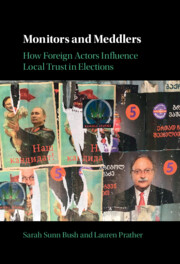
Foreign influences on elections are widespread. Although foreign interventions around elections differ markedly-in terms of when and why they occur, and whether they are even legal-they all have enormous potential to influence citizens in the countries where elections are held. Bush and Prather explain how and why outside interventions influence local trust in elections, a critical factor for democracy and stability. Whether foreign actors enhance or diminish electoral trust depends on who is intervening, what political party citizens support, and where the election takes place. The book draws on diverse evidence, including new surveys conducted around elections with varying levels of democracy in Georgia, Tunisia, and the United States. Its insights about public opinion shed light on why leaders sometimes invite foreign influences on elections and why the candidates that win elections do not do more to respond to credible evidence of foreign meddling.
Chapter 5 describes and explains the state of democracy in contemporary Latin America. It shows that the most common problem of democracy is that democracies are low-quality or medium-quality ones. It stresses that even though Latin America has achieved and stabilized democracy, a notable success, it has not democratized fully. It also notes that democracy has broken down in some countries (e.g., Honduras, Venezuela). It argues that multiple factors account for the state of democracy in contemporary Latin America. Ideological differences over neoliberal economic policies have fueled some problems of democracy, as is shown in the cases of Honduras and Venezuela. Changes in various aspects of the international context have helped to stabilize democracies. Additionally, the region’s problems of democracy are also explained by some enduring features of Latin American politics: the exploitation of advantages that accrue to incumbency in political office, the influence of economic power, and the weakness of the state.
This chapter introduces the argument and organization of the book. I explain the questions motivating the book, focusing on two that are puzzling in different respects. The first asks why democracy aid in the Middle East is seen as ineffective despite billions of dollars allocated for its promotion. The second question is linked to the first: Why would an authoritarian state even allow an outside actor to promote democracy? Examining the construction and practice of democracy aid illuminates why such regimes allow such aid as well as why particular ideas and conceptions about democracy persist even when shown to be ineffective. I introduce and explain the utility of a political economy framework that considers how ideas, institutions, and interests mediate and shape the form and function of democracy aid. I describe the methodology used in the book, which adopts an inductive, interpretative strategy to examine the construction and practice of democracy aid in the Middle East through case studies of US democracy aid in Egypt and Morocco.
To understand how democracy aid works in the Middle East, it is crucial to examine such aid at its origins in Washington, DC. In this chapter, I introduce the actors, institutions, and interests connected to the administration of US democracy aid over the last three decades. The voices and practices of those working on democracy aid seldom feature in most research on such aid. Engaging them illuminates the obstacles and challenges encountered by those working on democracy aid in different capacities within the US government. I trace the evolution of democracy aid from its inception to examine how ideas about democracy emerged, evolved, and were negotiated over time and cast light on the constellation of actors and structures militating against some forms of democracy over others. This chapter incorporates novel new data on the professional histories of nearly 2,000 professionals engaged in democracy promotion to map the influence of individuals in shaping ideas about democracy aid.
In the final chapter, I consider how the 2011 Arab uprisings challenged the strategies adopted by the United States and regimes in Egypt and Morocco. I examine shifting aid strategies from the United States and the response from former regime elites and emergent political actors. Drawing from interviews with diplomats and activists involved in transitional support and unreleased data, I consider how the ideas, institutions, and interests that supported a particular form of democracy aid for twenty-five years adjusted with the promise of political change. The chapter concludes with a discussion on the challenges these changes now pose for activists and emerging political actors in the region as well as policymakers in the United States and those embedded within the democracy bureaucracy in Washington, DC. The chapter’s final section revisits the questions raised at the outset of the book and discusses possible mechanisms for enhancing the effectiveness of democracy aid programs.
In this chapter, I elaborate on the conceptual and methodological framework that I use to examine the construction and practice of US democracy programming in the Middle East. I highlight limitations and weaknesses with recent approaches to studying democracy aid and show that existing research on such aid elides the contested meaning of democracy itself as well as the assumptions underlying democracy aid projects. I argue that a political economy approach to studying democracy aid takes such meaning seriously while also giving us a nuanced understanding of the motivations and intentions of donor and recipient states. I develop a political economy framework that considers how ideas, institutions, and interests can mediate and shape the form and function of democracy aid. This framework allows us to capture the complex interactions between actors engaged in such efforts in what I call the micropolitics of democracy aid.