To save content items to your account,
please confirm that you agree to abide by our usage policies.
If this is the first time you use this feature, you will be asked to authorise Cambridge Core to connect with your account.
Find out more about saving content to .
To save content items to your Kindle, first ensure no-reply@cambridge.org
is added to your Approved Personal Document E-mail List under your Personal Document Settings
on the Manage Your Content and Devices page of your Amazon account. Then enter the ‘name’ part
of your Kindle email address below.
Find out more about saving to your Kindle.
Note you can select to save to either the @free.kindle.com or @kindle.com variations.
‘@free.kindle.com’ emails are free but can only be saved to your device when it is connected to wi-fi.
‘@kindle.com’ emails can be delivered even when you are not connected to wi-fi, but note that service fees apply.
This article explores the Royal Navy’s unique use of enslaved labour in its naval yards in Jamaica during the eighteenth and early nineteenth centuries, highlighting how the Crown’s pursuit of naval supremacy was built in part on the forced labour and skills of the African diaspora. Beginning in 1729, under the direction of Rear Admiral Charles Stewart, the Royal Navy shifted from hiring enslaved workers from local populations to purchasing them outright for Crown use, establishing a workforce that included both men and women. Stewart’s pronatalist policy aimed to secure a self-replenishing labour supply by encouraging the birth of children who would also be enslaved in service to the navy. Over more than a century, these “King’s Negros” were trained in European shipbuilding and maintenance, transferring valuable technical knowledge while enduring harsh conditions and a life of bondage. The article provides a microhistorical lens on the Atlantic world, focusing on the lived experiences of these enslaved individuals and their unintended role in bolstering Britain’s naval power. By examining the origins, conditions, and legacies of this workforce, the article contributes to broader discussions on slavery, imperialism, and the global reach of military-industrial enterprises in the Atlantic era.
Chapter 1 explores travel writing about Wales to show how, as Britishness became an increasingly important cultural category, so too did written accounts of “ancient Britain” become more invested in representing Wales not only as beautiful, but also as infinitely productive. Early and mid-century writers like Daniel Defoe and Samuel Johnson cast Wales as sublimely foreboding and suffused with a masculine classical cultural heritage, but later writers reimagined the country as exemplifying a timeless and quintessentially British type of beauty: namely, the aesthetic they named the picturesque. Later, Welsh writers like Richard Llwyd drew attention to the erasures and contradictions inherent to picturesque view-making, articulating an incipient critique of imperialist landscape aesthetics.
At the beginning of the long eighteenth century, the adjective 'British' primarily meant Welsh, in a narrow and exclusive sense. As the nation and the empire expanded, so too did Britishness come to name a far more diffuse identity. In parallel with this transformation, writers sought to invent a new British literary tradition. Timothy Heimlich demonstrates that these developments were more interrelated than scholars have yet realized, revealing how Wales was both integral to and elided from Britishness at the same historical moment that it was becoming a vitally important cultural category. Critically re-examining the role of nationalism in the development of colonized identities and complicating the core-periphery binary, he sheds new light on longstanding critical debates about internal colonialism and its relationship to the project of empire-building abroad.
Popular support for war is widely understood to solidify Britain’s sense of itself in the eighteenth century. This chapter argues that objections to war shape Britain’s identity in the closing decades of the century, as the people are called upon to evaluate the justness of the nation’s acts in war. These acts are understood to be public acts, authored by each and every individual, including those who do not directly wage war. The attention to public responsibility coincides with renewed scrutiny of war’s harms, and the moral urgency of recognising and halting war’s killing animates philosophical essays, sermons, and poems, including works by Jeremy Bentham and Anna Letitia Barbauld. The period’s anti-war arguments foreground concepts of injury and responsibility that anticipate later developments in international law and ongoing discussions in moral philosophy.
Edited by
Martin Nedbal, University of Kansas,Kelly St. Pierre, Wichita State University and Institute for Theoretical Studies, Prague,,Hana Vlhová-Wörner, University of Basel and Masaryk Institute, Prague
Throughout most of the seventeenth and eighteenth centuries, the Habsburg court resided predominantly in Vienna. Consequently, the Habsburg monarchs of Bohemia rarely visited Prague, and visits of the entire court were even rarer because they were expensive both for the monarch and the city. Therefore, each coronation of a Habsburg emperor as the Bohemian king was a significant event reflecting both the immediate political context and more general cultural and historical trends, such as the role of music in court ceremonies and the relationship between Bohemian and Viennese musical practices. This chapter sketches the relationship between coronation music and music and operatic developments in Prague in general, particularly in connection to the coronations of Charles VI (1723), Maria Theresa (1743), Leopold II (1791), and Francis II (1792).
The War of Jenkins’ Ear (from 1739 to 1748), more accurately known in Spanish as the “Guerra del Asiento,” marked the end of the Spanish Crown’s authorization of the British monopoly of the South Sea Company to deliver captive Africans to the Spanish Americas. The end of the British Asiento led to four decades of experimentation by various actors within the Spanish Empire trying to reestablish and expand the slave trade, which many Spanish political economy leaders increasingly saw as vital to the future of both the metropolis and the colonies. This article examines certain currents, undercurrents, and countercurrents of the deregulation of the slave trade, linking these debates to the evolving policies on colonial commerce within the Spanish Empire, as authorities in Iberia and the Americas recognized the interconnectedness of these issues and their relationship to the actual slave trading in the colonies. Besides focusing on colonial elites and reforms in colonial governance, this article demonstrates that the timelines of reforms in overall trade policy and measures regarding the slave trade were closely connected.
In 1770, the Rohilla chief Ḥāfiz̤ Raḥmat Ḵẖān wrote a text called Ḵẖulāṣat ul-Ansāb, focusing on the genealogical and ancestral history of the Rohilla Afghans. This article analyses the text as a glimpse into the emotions he went through—such as anxiety, uncertainty, confidence, determination, and strength—as the ruler of a small principality founded by a new political group in the competitive political milieu of eighteenth-century South Asia. It studies the textual expression of these emotions he experienced during a period that brought both challenges and opportunities for the Rohilla Afghans. It firstly shows how the text served as a means of creating unity among the Rohilla Afghans by elaborating an origin story, adapting them to new circumstances, and legitimising the emerging Rohilla state. Secondly, it discusses how Ḥāfiz̤ Raḥmat aimed to rectify the negative portrayals of the Afghans by Mughal chroniclers and enhance Afghan prestige in northern India by creating a haloed genealogy. Finally, it explains how the text claimed religious legitimacy for the Rohilla Afghans by linking them to the prophets, Muslim invaders of the past, and local religious figures. Overall, this textual analysis contributes to the historiography of eighteenth-century South Asia by studying the political anxieties associated with Rohilla Afghan state formation.
This collection profiles understudied figures in the book and print trades of the eighteenth century. With an explicit focus on intervening in the critical history of the trades, this volume profiles seven women and three men, emphasising the broad range of material, cultural, and ideological work these people undertook. It offers a biographical introduction to each figure, placing them in their social, professional, and institutional settings. The collection considers varied print trade roles including that of the printer, publisher, business-owner, and bookseller, as well as several specific trade networks and numerous textual forms. The biographies draw on extensive new archival research, with details of key sources for further study on each figure. Chronologically organised, this Element offers a primer both on individual figures and on the tribulations and innovations of the print trade in the century of national and print expansion.
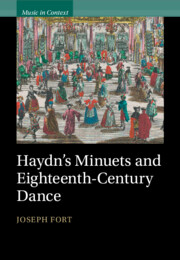
Audiences in eighteenth-century Vienna attended the city's popular public balls, where they danced the minuet. This book explores the public dance culture of Vienna in the late eighteenth century as an essential context in which to understand minuet composition from this period, focusing on the music of Haydn, and restores the array of kinaesthetic associations and expectations that eighteenth-century audiences brought to the listening experience through their knowledge of the dance. It reconstructs the choreography of the minuet as it was performed in the Viennese dance halls and examines the repertoire of minuets composed specifically for dancing, bringing new perspectives to the minuet genre. This recovered bodily knowledge allows the author to put forward an analytical method of 'somatic enquiry' and apply it to Haydn's symphonic minuets from the 1790s, revealing previously hidden features in this music that come to light when listening with an understanding of the dance.
John Carter’s fervour as a recorder and polemicist for Gothic architecture has been debated since his lifetime, but his classical designs have attracted less interest. However, these give some insight into the influences upon aspiring young Georgian architects, as Carter was in the 1770s. His two sets of designs for Bywell Hall, Northumberland, the first published in the Builder’s Magazine in 1776, and a more detailed portfolio now in a private collection, are presented together for the first time. This is an opportunity to examine Carter’s early ideas and his thoughts on the appropriate styles to be employed for public, domestic and ecclesiastical buildings. Analysis of Carter’s designs demonstrates his desire to create impressive interior spaces, but poor consideration of the practicalities for family and servant life in country houses. Carter’s preference for Gothic over classical architecture, combined with humble origins and personality traits, prevented his aspiration to be an architect, but his drawing skills secured fame as one of the foremost architectural draughtsmen.
In the late eighteenth century, the viceroyalty of New Spain extended its control over Alta California, introducing secular cultural practices like music, dance, and drama which gained popularity among traders, soldiers, and hybrid communities, blurring the traditional boundaries of race, gender, and class. These societal shifts foreshadowed the forthcoming wars of independence (1810–1821) and clashed with missionary liturgy, accentuating the growing divide between monastic orders and secular society. This chapter focuses on the censorship of Fermín de Reygadas’s play, Astucias por heredar, un sobrino a un tío ("Tricks to Inherit: a Nephew and His Uncle"). Initially censored in the viceroyalty, the play was later transported and performed in Alta California, only to be concealed by Hubert Bancroft, who omitted all references to it in his History of California. This play survived two forms of censorship: Spanish colonial moral censorship and Anglo-American disregard towards a text and a performance that did not fit his racialized historiographic narratives. The chapter also explores the play’s staging in Villa de Branciforte near the Santa Cruz mission and concludes by comparing two performances of the play, considering the role of language, location, and early Californio history in contemporary decolonial reenactments.
White cultural elites in the US capital of Philadelphia in the 1780s and 1790s depicted Native Americans (or “Indians”) as vanishing peoples, soon to be replaced by Anglo culture. The fledgling nation’s premier naturalist Bejamin Smith Barton and the consecrated poet of the American Revolution Philip Freneau turned to Spanish American antiquarianism to invent a glorious antiquity for North America. They learned from Antonio de Ulloa’s Noticas Americanas (1772) and Francisco Javier Clavijero’s Storia Antica del Messico (1781) how to practice antiquarian materialism, then chose early Republican literary and scientific periodicals to disseminate their conquest of the Native American past. Those two americanistas in particular showed how to collect Indigenous artifacts, assemble them, and invest them with European meanings, which inspired the first generation of US Americanists to relegate Native American life to the dustbin of prehistory and at once fabricate their own Whiteness.
For all that scholars have challenged the notion that the novel rose in conjunction with Enlightenment individualism, empiricism, and the modern nation-state, it’s still largely seen as an essentially Eurocentric form that can tell us much about how authors and readers thought about the rest of the world but little about the world itself. Ultimately turning to Samuel Johnson’s Rasselas as an example, this chapter makes a case for how decentralizing Europe from our perceptions of eighteenth-century geographical discourse changes what literary scholars might see and say about the continuities between the realist novel and the global contexts from which it grew.
Eighteenth-century literature is weirder than we realize. A Funny Thing invites readers to be taken by its oddities, its silliness, and its absurdities – both because reading this way is fun, and because this challenges colonialism's disciplinary epistemes of propriety that have consistently bound liberal selfhood to extractive capitalism. Focusing on three aesthetic modes largely unnamed in existing studies of the period's literature – the anamorphic, the ludic, and the orificial – this book offers fresh readings of work by Haywood, Walpole, Bentley, and Burney that point to unexpected legacies from the so-called Age of Reason. This book is for any reader curious about the wilder flights of fancy in eighteenth-century fiction, the period's queer sense of humour, and how writing and art of the time challenge colonial reality. This title is part of the Flip it Open Programme and may also be available Open Access. Check our website Cambridge Core for details.
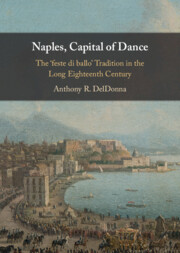
Renowned as a city of entertainment, Naples was unequaled in eighteenth-century Italy for the diversity of its musical life. During the reigns of Carlo di Borbone and his heir Ferdinando IV, the sponsorship of feste di ballo, elaborate celebratory balls featuring social dance such as the minuet and contradance, grew increasingly lavish. Organized for carnevale, occasions of state, and personal celebrations in the lives of the royal family, the feste di ballo fostered both a public agenda and a personal rapport between the monarchs and local aristocracy. As the century progressed, the frequency of and resources accorded to the feste di ballo and its showcasing of social dance came to match those of stage drama and instrumental music. Based on extensive archival research, this book reveals the culture of social dance at the Bourbon court and how these spectacular events served to project images of authority, power, and identity.
The most prestigious musical ensemble of early-modern Naples remained the Royal Chapel or Cappella Reale di Palazzo. Conceived to serve directly the ruling authority of the capital city – whether the viceroy (Spanish or Austrian) or monarchs (Carlo di Borbone then Ferdinando) – membership in this elite organization offered prestige, financial security, and access to the broader networks of music culture in Naples, attracting the best musicians within and beyond the physical confines of the capital. This Element introduces readers to the largely unknown history of the Neapolitan Cappella Reale in the second half of the eighteenth century. It is based on primary sources, reconstructing the entire personnel of the ensemble (1750–99), recovering previously unstudied contractual agreements, offering details about the musicians while also examining the original music of the principal musicians of the orchestra.
Bringing illustration studies, the history of reading and transnational book history together, the Element offers an original micro-history of illustrated editions and iconic interpretations of Daniel Defoe's Robinson Crusoe. Unlike earlier accounts, it takes into account not only the copyright holder's editions but also studies Continental visualizations alongside a lower-end London abridgment issued by Edward Midwinter and illustrated by twenty-nine woodcuts. The Element covers the period from 1719 (the year of the work's first publication by William Taylor) to 1722 (the year Midwinter published his abridgment) and examines the illustrated editions published during that time, including those featuring translations of the work issued in Amsterdam (where Dutch and French translations were published) and in Germany. It recovers a hitherto unexplored archive of illustrations that played an essential role in the reading history – in Britain and abroad – of Robinson Crusoe. This title is also available as Open Access on Cambridge Core.
Although a product of his time – the literary traditions of Pope, Addison, and Swift; the Toryism and churchmanship of the eighteenth century – Samuel Johnson also transcended it through his own gifts and forceful character. After a difficult early life, marked by melancholy, a troubled relationship with his family, and an early departure from Oxford University, Johnson began to find his way in the 1730s. He married Elizabeth Porter, moved to London, and began to make his mark through work at the Gentleman’s Magazine and works such as the Life of Savage. He achieved renown as an essayist and fame as the compiler of the Dictionary but also suffered from bereavement and continuing financial insecurity. After the award of a government pension in 1762, Johnson’s works have a more relaxed style, and his final major work, the Lives of the Poets, helped to establish this era as the Age of Johnson.
Interregional and global economic connections continued to grow in the eighteenth century, but we know less about consuls’ impact on commodity chains that were stretched thin across large distances. Using a microhistorical approach, we look at the activities of a Swedish consul in Cadiz, Hans Jacob Gahn, who supplied large amounts of copper sheets to the Spanish navy. It was Gahn’s position as an official representative, not merely his networks in Spain and Sweden, that was crucial for winning and executing the contract: his consular post enabled him to leverage his social, political, and financial capital to drastically alter trade flows for the years he held the contract. As contractors, consuls had a significant economic function for both their sending and receiving states.
This Element has three objectives. First, it highlights the diversity of the nature of Jacobitism in the long eighteenth century by drawing attention to multi-media representations of Jacobitism and also to multi-lingual productions of the Jacobites themselves, including works in Irish Gaelic, Latin, Scots, Scots Gaelic and Welsh. Second, it puts the theoretical perspectives of cultural memory studies and book history in dialogue with each other to examine the process through which specific representations of the Jacobites came to dominate both academic and popular discourse. Finally, it contributes to literary studies by bringing the literature of the Jacobites and Jacobite Studies into the purview of more mainstream scholarship on eighteenth- and nineteenth-century literatures, providing a fuller perspective on the cultural landscape of that period and correcting a tendency to ignore or downplay the presence of Jacobitism. This title is also available as Gold Open Access on Cambridge Core.