To save content items to your account,
please confirm that you agree to abide by our usage policies.
If this is the first time you use this feature, you will be asked to authorise Cambridge Core to connect with your account.
Find out more about saving content to .
To save content items to your Kindle, first ensure no-reply@cambridge.org
is added to your Approved Personal Document E-mail List under your Personal Document Settings
on the Manage Your Content and Devices page of your Amazon account. Then enter the ‘name’ part
of your Kindle email address below.
Find out more about saving to your Kindle.
Note you can select to save to either the @free.kindle.com or @kindle.com variations.
‘@free.kindle.com’ emails are free but can only be saved to your device when it is connected to wi-fi.
‘@kindle.com’ emails can be delivered even when you are not connected to wi-fi, but note that service fees apply.
This article discusses the formational qualities of Byzantine church decoration, especially icons. It proposes that the iconographic programs of Byzantine churches had a profound effect on the viewers by offering them models for faithfulness and virtue and facilitating their transformation into ideal Christian subjects. My intention is to show that icons in the church do not simply interact with the viewers, but also form and transform them. I explore how iconic subjects worked in Byzantine churches in light of Ivan Drpić’s important insight about the Byzantine self as fundamentally relational and as ‘a replicable likeness’. I wish to show how mosaics and frescoes in Byzantine churches could provoke transformational experiences for their viewers by inviting identification with models of faithfulness and virtue.
bishop, heresy, liturgy, martyr, orthodoxy, patriarch, procession. Byzantine Christology—the views about Christ developed in the Christian East in between the Council of Chalcedon (451) and the fall of Constantinople (1453)—continues and intensifies the creative adoption and adaptation of Greek philosophical terms, and the forging of a sophisticated theological glossary for Christianity understood as ‘true philosophy’. This conceptualisation of the faith occurs as a result of two concurrent phenomena: first, the assumed need for increasingly precise definitions of doctrinal orthodoxy to meet the challenge of perceived heresies; second, the ongoing transformation of Christianity from an apocalyptic and messianic Jewish sect of the Second Temple Era into the cosmopolitan faith of the post-Constantinian Empire. The Christological reflections of learned expositors of the Christian dogma and the formulations put forth by the councils cannot be understood, however, without keeping in mind the specifically ‘religious’ factor.Its unique and elusive parameters are revealed in practices of prayer and ascetical exertion, reading and interpreting sacred texts, liturgical worship and artistic creation. The present essay suggests that homilies, hymns and icons, generally, and their underlying Christian exegesis of theophanies, in particular, offer the proper entry-point and framework for understanding Byzantine Christology.
This chapter examines what the designs of coins may tell us about the communities that commissioned them. Religious designs featured predominantly, often the presiding deity of a city or a design which referred to it. Mythology and topography also played an important role, often rooting coinages in their localities, and there were references to events or contemporary personalities. Comparisons can be made in relation to artistic work in other fields, such as gems, with a special reference to those who were involved in their creation – the engravers of the dies from which the coins were struck. The engraving of coin dies appears to have been regarded as an artistic exercise, and the appearance of signatures on coins offers a window onto part of the chaîne opératoire of coin production.
The altars Vasari built in the Pieve for the Aretine lawyer Onofrio (Nofri) Camaiani and the important local confraternity known as the Fraternita dei Laici count among his least known commissions. Both altar tabernacles were destroyed, and the Camaiani Altarpiece was removed along with the other works of art in the Pieve during the church’s renovation in the nineteenth century. There was no Vasari altarpiece to relocate from the Fraternita’s chapel, for although he designed the architectural aedicule that was to hold it, Vasari failed to complete its altarpiece before he died in 1574. This chapter substantially expands our understanding of the patronage, history, precedents, original appearance, and iconography of those altars. Despite their differences, the Camaiani and Fraternita altars were important elements of Vasari’s artistic and architectural vision for the Pieve and integral parts of its Marian decorative program.
Prior to the Pieve’s radical renovation in the nineteenth century, Vasari’s Albergotti altarpiece decorated an altar at the end of the church’s left aisle. Its main panel depicts the Coronation of the Virgin and was originally commissioned by the Florentine Filippo Salviati for the church of San Vincenzo in Prato. This chapter investigates that early commission and the painting’s subsequent purchase by the Aretine lawyer Nerozzo Albergotti, thus providing a deeper understanding of the Albergotti altarpiece’s conception and complicated patronage history, as well as of its iconography and the ways in which Vasari adapted it to the altar in the Pieve on which it was installed.
Mortuary traditions offer a wealth of insights into the social landscapes of human communities. Here, the author examines anthropomorphic representations in the decorated tombs of Kyushu Island, Japan, dating from the Late Kofun period (sixth–seventh centuries AD). The consistently subordinate scale, strategic architectural placement and systematic anonymity of these figures suggest that they did not function as portraits of the dead but were likely symbolic agents embodying a collective rather than individual identity. By demonstrating that the human figure is not consistently the protagonist in these funerary contexts, this study reframes our understandings of Late Kofun deathways.
Reconstructions of Moche ritual sacrifice have relied heavily on iconographic depictions of elaborate rituals conducted on mountains and sacrifices at adobe temples. Scholars have categorized mountain scenes, proposed that Huaca de la Luna symbolized sacred mountains, and argued that one of the main mountain scenes entails the liberation of a figure known as Dios A. However, the large corpus of mountain iconography remains underanalyzed, and few existing publications incorporate data from mountainside sites. In this article, I propose a more specific Mountainside Sacrifice and Cave Opening mythic narrative encoded in these scenes, comparable to the Presentation Theme / Sacrifice Ceremony. I argue that future surveys and excavations must include thorough investigations of north coast mountains of Peru.
Mycenae’s LH IIIA2-IIIB palatial stonework was spectacular, and attention is given here to the innovative construction processes and specialized stonecutting tools that elicited awe. A fresh look at Mycenae’s final three tholoi illustrates the strategy of conveying power through stonework. The chapter also assesses the semiotics of the site’s architectural sculpture.
This chapter considers the role of memory and archaizing traits at Mycenae during the LH IIIA2-IIIB period. Particular attention is paid to poros ashlar masonry, the monumentalization of Grave Circle A, and a visual tie between the Lion Gate relief and the carved shaft grave stelae.
This chapter provides a survey of iconographic themes found in the pottery, figurines, fibulas, terracotta, metalwork, jewelry, and seals produced across Greek-speaking communities. Rejecting a traditional assumption of close ties with the Homeric epics, the study combines two approaches to offer a more socially embedded understanding of image-making in early Greece. Examining the iconography within multiple contexts, from the types of objects on which imagery appears to their archaeological contexts and the material behavior associated with their use, reveals that not just politics but also social reproduction lay behind artistic development. Second, it demonstrates how expanding the discussion to the larger world of representations adds further dimensions to the ways in which the Greeks projected an imagined ideal society. Themes discussed include mourning, warriors and weapons, battle, hunting, horse culture, dance, abduction, divinities and religious iconography, animals, hybrid monsters, and mythic narrative. The developments of Geometric art can be understood as responses to the new complexities of social hierarchy and gender, access to the wider world, the growing integration of religious institutions into community life, and political alliances that constituted the experience of the city-state.
Edited by
Rosa Andújar, Barnard College, Columbia University,Elena Giusti, University of Cambridge,Jackie Murray, State University of New York, Buffalo
This chapter reflects on modern and contemporary narratives surrounding the modern ‘racing’ of the inhabitants of Hellenistic and Roman Egypt by focusing on two cases, each of which pertains to a local woman. Both of these women’s bodies have become, two millennia or so after their death, a racial canvas at best, and a battlefield at worst. The first woman is the one portrayed on a funerary portrait on display at the Louvre Museum in Paris. The second woman needs no introduction: She was Cleopatra VII, the last pharaoh of Macedonian-ruled Egypt.
The Franks Casket contains an unconventional depiction of the Romulus and Remus myth: a recumbent she-wolf poised above an inverted runic label ᚹᚣᛚᛁᚠ (wylif). The twin boys suckle her in an aerial manner. Above them, a second wolf hovers; both creatures lick the boys with elongated tongues. Several studies have pointed to Book 8 of the Aeneid, which describes how the mother-wolf ‘shapes’ the boys with her tongue. But mysteries remain: why is the mother-wolf reclining rather than upright in this image? And what about the presence of the second wolf? This essay argues that there are further details in the Aeneid and its late antique commentary tradition that can shed light on this panel’s artistry. The artist’s adaptation of nuanced classical allusion is furthermore strong enough to shed light on the circulation of Virgilian commentaries in early medieval Northumbria and reveal aspects of the intellectual milieu that helped produce the casket.
Chapter 5 tackles the meanings and emotions an image can afford through its contents and form. The body of the image refers to the characteristics of the image, its visual features, pictorial composition, and material form, and how those together afford certain meanings and interpretations of the image in a specific moment in its life trajectory. The visual interpretation method is presented then applied on a case example of street poster images.
Arthurian topics feature in medieval mural painting and sculpture in architecture from the early twelfth century onwards. The ‘spatial’ aspects of these art forms were ideal for medieval patrons to represent and promote themselves to others. They competed through monumental art – be it in their own residence, a town hall, or a church – to show their identity and status. This chapter traces the main trends, iconographical topics, and influences, with consideration of the social and political function of the representation of Arthur and his knights in medieval monumental art.
It has often been considered that the representations of the gods in Ancient Central Mexico were purely symbolic and that we should not look for the presence of glottograms, i.e. signs that encode linguistic units pronounced in the Nahuatl language. This article intends to demonstrate that we should reject the image/writing dichotomy in this context. In order to understand the identity of the Nahua gods, it is necessary to combine symbolic deciphering with a reading of the names embedded in their bodies and ornaments. This article takes the example of several representations of gods in codices of the Aztec tradition. It shows that this embedded script used the main scriptural techniques known in Nahuatl writing: logograms, phonograms, and indicators. In this way, the identity of the god, and therefore its ritual effectiveness, was expressed simultaneously visually and phonically.
This chapter examines glass production in Late Antiquity, with a particular focus on technological advancements, economic significance and regional variations. Drawing on archaeological evidence, chemical analyses, typological studies and historical texts, it traces the evolution of glass manufacturing and distribution across the Roman and Byzantine worlds. The authors argue that glass production in Late Antiquity was highly adaptable, responding to shifts in economic structures, raw material availability and technological innovations. A key factor in this development was the dominance of large-scale glass furnaces in Egypt and the Levant, which supplied raw glass to secondary workshops throughout the empire. The chapter also explores how glassmakers refined shaping and decorating techniques, incorporating blown glass, engraved patterns, gold-leaf applications and coloured blobs. In terms of function, it demonstrates that glass was used across a wide range of contexts, from everyday tableware to luxury drinking vessels, lamps and even windowpanes. Regional differences are evident, with eastern Mediterranean workshops favoring elaborate embellishments, while western traditions drew inspiration from ceramic and metal vessels. A key conclusion is that glass was not only a practical commodity but also a marker of status and innovation.
This chapter explores late antique wall painting, with special emphasis on its stylistic transformation, evolving iconography and the challenges of preservation and interpretation. It traces the shift from illusionistic Roman painting to the more abstract, linear styles that characterised Late Antiquity. A central argument is that late antique wall painting represents not a decline in artistic quality but rather an adaptive response to new cultural, religious and spatial demands. The chapter examines the rise of Liniendekoration (linear decoration), a geometric style that became dominant in funerary contexts, particularly in Roman catacombs, Egyptian monasteries and Mediterranean hypogea. It also explores the coexistence of early Christian imagery with traditional pagan motifs, emphasising continuity rather than abrupt change. In analysing these shifts, the chapter highlights how late antique painters simplified classical techniques in response to changing workshop practices, economic factors and environmental constraints. It also addresses key methodological challenges, including dating wall paintings, identifying regional styles and assessing the influence of early Christian and Jewish artistic traditions. This study stresses the crucial role of wall painting in Late Antiquity as a medium for shaping religious and social identities, demonstrating its artistic innovation and cultural significance.
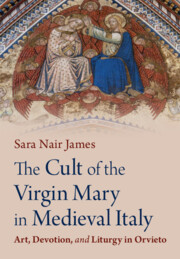
Late medieval Italy witnessed the widespread rise of the cult of the Virgin, as reflected in the profusion of paintings, sculptures, and fresco cycles created in her honor during this period. The cathedral of papal Orvieto especially reflects the strong Marian tradition through its fresco and stained-glass window narrative cycles. In this study, Sara James explores its complex narrative programs. She demonstrates how a papal plan for the cathedral to emulate the basilica of S. Maria Maggiore in Rome, together with Dominican and Franciscan texts, determined the choices and arrangement of scenes. The result is a tour de force of Marian devotion, superior artistry, and compelling story-telling. James also shows how the narratives promoted agendas tied to the city's history and principal religious feasts. Not only are these works more interesting, sophisticated, and theologically rich than previously realized, but, as James argues, each represents the acme in their respective media of their generation in central Italy.
In terms of the grand narrative of Upper Egypt’s expansion into, and unification with, Lower Egypt in the second half of the fourth millennium BC, substantial debate surrounds the processes of state formation. Referring to a recently discovered engraving near Aswan, the author argues that rock art has much to contribute to these discussions. Typological and comparative analyses of the engraving, which is interpreted as a processional boat bearing a seated human figure, are used to suggest that it was created at the dawn of the First Dynasty, thus adding to the limited corpus of political authority expressed in Protodynastic rock art.
Superadas las crisis sociales y políticas que tuvieron lugar en las décadas finales del período Preclásico, nuevas entidades comienzan a emerger en el panorama geopolítico de las tierras bajas mayas. En el caso del Petén campechano, el descubrimiento de sitios arqueológicos con vestigios de estructuras defensivas y monumentos pétreos permite inferir la configuración de una nueva realidad en la que entidades como Oxpemul parecen comenzar a despuntar. En este sitio destacan dos monumentos que preservan registro iconográfico de cautivos, las Estelas 22 y 23; estas exhiben patrones iconográficos típicos del Clásico temprano, entre los que destacan tres figuras desnudas e hincadas. Con la toma de nuevas fotografías diurnas y nocturnas de las estelas y la utilización de la herramienta computacional Reflectance Transformation Imaging, se presentan nuevas interpretaciones de los monumentos de Oxpemul; además, a través de los nuevos análisis iconográficos se proponen nuevas consideraciones sobre las dinámicas sociopolíticas regionales durante los contextos tempranos en los que Oxpemul parece jugar un papel destacable.