To save content items to your account,
please confirm that you agree to abide by our usage policies.
If this is the first time you use this feature, you will be asked to authorise Cambridge Core to connect with your account.
Find out more about saving content to .
To save content items to your Kindle, first ensure no-reply@cambridge.org
is added to your Approved Personal Document E-mail List under your Personal Document Settings
on the Manage Your Content and Devices page of your Amazon account. Then enter the ‘name’ part
of your Kindle email address below.
Find out more about saving to your Kindle.
Note you can select to save to either the @free.kindle.com or @kindle.com variations.
‘@free.kindle.com’ emails are free but can only be saved to your device when it is connected to wi-fi.
‘@kindle.com’ emails can be delivered even when you are not connected to wi-fi, but note that service fees apply.
Chapter 4 focuses on the impact of the settlement laws on local community life. A rare personal diary by a Sussex village shopkeeper (1754–1765), records his activity as a parish officer and helps to paint a detailed canvas and to connect the history of parish administration with studies of gender and the social order. This chapter also returns to the legal framework to explore further the responsibilities of the overseer of the poor and the parish vestry.
The introduction traces the history of legal discrimination against women in the UK, from exclusion in university education and voting rights to the legal profession. Courts presumed sex-based distinctions as default, requiring parliamentary intervention for reforms including women’s suffrage, equal pay, and the protection of women from sex discrimination and sexual harassment in the workplace. The Sex Discrimination Act 1975 prohibited discrimination while allowing exceptions for protection of women, including single-sex spaces. These legal developments operated on a tacit understanding of sex as biological sex, which can be distinguished from emerging concepts of gender as a system of social norms overlayed on biological sex and gender identity as an individuals internalised experience of these norms. The chapter then provides a descriptive overview of the Equality Act 2010 as a resource for readers unfamiliar with its structure and core principles.
The fifth chapter turns to war and peace. The role of England’s poor relief system in assisting war efforts has been suggested by scholars. This chapter argues that were it not for the development of settlement laws, one can only wonder whether the ‘fiscal-military state’ would have enjoyed such support. The chapter shows how the responsibilities of the parish officer expanded to assist the fiscal-military state, and the roles taken by the county administration. It also explains how the New Militia, established at the start of the Seven Years’ War, relied on the parish’s administrative apparatus and employed the settlement legislation in sophisticated ways. However, as time went by complexities arose. The greater the needs of recruitment and disbandment, the more the eighteenth-century state relied on the mechanisms of parish settlement; at the same time, military needs also led to partial suspension of the settlement laws.
This article considers the adequacy of the tests for identifying delegated legislation and highlights limitations in these tests relating to instruments made under ambiguous powers. This article, accordingly, proposes a new two-stage test for identifying delegated legislation. The long-standing source-based test should be expanded to become a “source-and-form” test as the primary or first-stage test. However, where this fails to identify the nature of the instrument because the powers granted in the enabling Act are ambiguous, this article proposes a new second-stage test: the “legislative-character” test. This article then applies the new test to three types of instruments of an ambiguous nature, revealing that they should be understood as examples of what this article identifies as a new category of “innominate” delegated legislation.
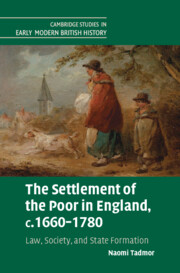
In 1662, in the aftermath of the Restoration, parliament passed new legislation for the settlement and removal of the poor. Important provisions were finalised in no more than a few days. But once the settlement of the poor was set in law it became an agent of historical change that affected society, state formation, and the lives of millions in Britain and beyond for centuries to come. Within a few decades, practices of local government were transformed. In towns and villages hierarchies of social status and gender were affected. The rising empire employed the settlement administration to mobilise forces for large-scale international wars and to deal with soldiers' wives and children left behind. The huge number of bureaucratic forms generated following the new policies made a lasting impact on administrative culture. The Settlement of the Poor in England is about social change and about history's unintended consequences. It is also about the struggles and experiences of individuals and communities. It reminds us how the settlement legislation still resonates today. This title is part of the Flip it Open Programme and may also be available Open Access. Check our website Cambridge Core for details.
This article explores the Chicago School Board’s 1915 union-busting effort against the Chicago Teachers’ Federation, a union of women teachers co-founded by two Catholics. This article argues that newspaper coverage reveals that the gender identities and religious affiliations of the CTF members made them doubly intolerable. Not only did their very presence in public schools threaten to introduce Catholicism into a space that Protestants viewed as their domain, but these women also had the temerity to expect just compensation for their work. The Catholicism of the CTF’s leaders attracted nativist prejudice, and the press’s fixation on religious difference reframed the Loeb Affair from a conflict over salaries, pensions, and union membership into an endeavor to wrest the schools from Catholic control. Whatever the initial motivation of the Loeb Rule, anti-Catholicism became a weapon to defeat the economic and equality claims of women who demanded to be treated as professionals rather than as proxy mothers. From this viewpoint, the Loeb Affair figures not only as a loss for organized labor and teacher organizing, but it also illustrates Progressive Era beliefs about competing ways of performing womanhood, the role of religion in public schools, and the fear of Catholic power.
It was a turning point in the history of European integration and a unique moment for the first President of the European Commission, Walter Hallstein. On 16 June 1965 in the afternoon, Hallstein appeared before the European Parliament (EP) to express his strong support for the constitutional interpretation of European law launched by the European Court of Justice (ECJ) in the new Van Gend en Loos (1963) and Costa v ENEL (1964) judgments. Here the ECJ had controversially assumed the competence to define the relationship between European law and national constitutional orders. By doing so the ECJ sidestepped the respective constitutional clauses of the member states on how to receive international (and European) law. Primary legal norms from the founding treaties, when clear and unambiguous, would have direct effect inside the legal order of the member states as well as primacy vis-à-vis national legislation, whether precedent or antecedent. This was a remarkable breakthrough for a constitutional interpretation of European law.
Why did the nineteenth century see so little progress in addressing smoke pollution, even as smoke was increasingly recognised as a problem and economical technological solutions were identified? This article argues that efforts to abate smoke were impeded by the antagonistic class relationship between stokers and manufacturers, which prevented the emergence of a mutually beneficial compromise around smoke abatement. Employers sought to reduce smoke by compelling their stokers to take greater care under the threat of punishment. Law played an important role, siding with employers to impose liability for smoke pollution on stokers. Even when stokers were not prosecuted directly, employers often demanded indemnities as compensation for careless stoking. This reinforced mistrust between the two classes, undermining efforts to bring stokers on board with the goal of abating smoke. These findings may offer lessons today, as climate policy continues to be opposed despite the availability of green technologies and the existence of a scientific consensus on climate change.
Roman law is justly famous, but what was its relationship to governing an empire? In this book, Ari Z. Bryen argues that law, as the learned practice that we know today, emerged from the challenge of governing a diverse and fractious set of imperial subjects. Through analysis of these subjects' political and legal ideologies, Bryen reveals how law became the central topic of political contest in the Roman Empire. Law offered a means of testing legitimacy and evaluating government, as well as a language for asking fundamental political questions. But these political claims did not go unchallenged. Elites resisted them, and jurists, in collaboration with emperors, reimagined law as a system that excluded the voices of the governed. The result was to separate, for the first time, 'law' from 'society' more broadly, and to define law as a primarily literate and learned practice, rather than the stuff of everyday life.
This formative period of EU law witnessed an intense struggle over the emergence of a constitutional practice. While the supranational institutions, including the European Commission, the European Court of Justice and the European Parliament, as well as EU law academics helped to develop and promote the constitutional practice, member state governments and judiciaries were generally reluctant to embrace it. The struggle resulted in an uneasy stalemate in which the constitutional practice was allowed to influence the doctrines, shape and functioning of the European legal order that now underpins the EU, but a majority of member state governments rejected European constitutionalism as the legitimating principle of the new EU formed on basis of the Treaty of Maastricht (1992). The struggle and eventual stalemate over the constitutional practice traced in this book accounts for the fragile and partial system of rule of law that exists in the EU today.
In the years 1803–1807, a dramatic triple murder case in Shouzhou, Anhui, convulsed officialdom in the Jiangnan region and drove the Jiaqing emperor to exasperation. At a time when many in power felt a sense of crisis as “High Qing” imperial ambitions receded, each stone turned over in this meandering investigation revealed another source of anxiety fitted to the age: incest, poisoning, negligent and corrupt officials, amoral and abusive local gentry, misbehaving yamen runners, pettifogging litigators, and, to top it all off, deadly serious rumors of a subversive opera. This article traces the investigations into both the murders and the theater rumor. What made the former so convoluted and vexing, while the latter was alarming yet easier to resolve? Surprisingly, the Imperial Household’s carefully cultivated relationship with the theater world of Jiangnan realized, in miniature, a level of state–society coordination Qing rulers wished for but which often escaped them elsewhere.
In many European countries, sodomy statutes institutionalized the scrutiny of homosexual acts. Magistrates’ reliance on forensic experts to explain sexual deviance in terms of criminal responsibility stimulated the emergence of a medical concept of homosexuality. Belgian courts, however, displayed no such ‘will to know’ about the nature of ‘perversion.’ A comparison of German and Belgian legal logics pertaining to indecency demonstrates how the former was preoccupied with a perpetrator’s motives, while the latter deliberately ignored them. German courts often had recourse to medical expertise to understand what drove (homo)sexual offenders, whereas the Belgian judiciary preferred to omit these hard-to-prove intricacies by stubbornly sticking to the facts of the matter. Belgian trials pertaining to homosexual acts of public indecency were therefore mostly bereft of any special interest in the psychological significance of the acts in question. Unlike elsewhere, they did not stimulate forensic physicians to account for such ‘unnatural acts’ in terms of a medico-psychiatric ‘condition.’
This chapter analyses the historical transformation from ritualistic and therapeutic use of mind-altering substances to their global regulation and criminalisation. Focusing on the colonial and industrial eras, it highlights how opium, coca, and alcohol were recontextualised as economic commodities and instruments of empire. The chapter tracks the emergence of international drug control regimes, moral panics, and racialised legislation — particularly the British Opium Wars, US Harrison Narcotics Act, and global treaties. The intersection of state regulation, corporate profit, and public health is critically examined through case studies including the US opioid crisis. In parallel, sugar and caffeine are discussed as ‘soft’ stimulants that escaped moral scrutiny despite their neurochemical effects. The chapter concludes with a comparative look at regulation and commodification, showing how different substances became entangled in legal, moral, and economic narratives.
This article examines case studies and anecdotal narratives in which murderers used poisoned food as a weapon, and government officials used their epistemic authority to solve these crimes and bring the perpetrators to justice. Drawn from Zheng Ke’s 鄭克 (fl. 1124–1149) legal compendium Tortoise and Mirror for Judging Cases (Zheyu guijian 折獄龜鑑) and Hong Mai’s 洪邁 (1123–1202) anecdote collection Record of the Listener (Yijian zhi 夷堅志), these narratives reflected the violent threat that poisoners posed to the preservation of gender, familial, social, and political hierarchies. In the Mirror’s legal realm, astute officials used abductive reasoning to expose poisoning plots, thereby restoring the moral fabric of society; in Hong Mai’s Record poisoners are punished by imperial judges as well as by retributive mechanisms of cosmic justice. These six selected case narratives illustrate the permeability of the boundaries that divide the conceptual categories of food, medicine, and poison, and the connections amongst medical, legal, and socio-moral systems of knowledge.
This chapter moves from the semi-privacy of homes to the more public arena of urban courts. It looks at the surprising role of the pox in two different kinds of legal cases involving unlawful sex: suits for separation and rape cases. In both types of case, the disease served as a proxy for sex, material evidence of otherwise unprovable acts. Yet its role in court was much more complex than this. Marks of the disease were visible and long-enduring, an early form of medical forensics, and women could talk about the disease more freely than they could talk about sexual matters. Mothers of rape victims could bear witness to the horrifying effects of disease and disgruntled wives could frame their husbands’ abuse as contagion stemming from illicit sex. The disease allowed women to speak the unspeakable. What is more, cases did not rest wholly on women’s words, which were accorded little value in courts. Confirming the existence and transmission of disease called for the allegedly more trustworthy testimony of medical men. The disease centered legal cases about sex on to the words and bodily inspections that the court deemed reliable.
This essay examines how Law and Society approaches have transformed historical analysis by reconceptualizing law as constitutive of social reality rather than as an isolated formal system. Tracing this methodological revolution from 1960s American legal history through scholars like J. Willard Hurst and Lawrence Friedman to 1990s legal consciousness studies by Patricia Ewick, Susan Silbey and Sally Engle Merry, the essay demonstrates how these frameworks reveal law as lived experience operating through documentary practices and administrative procedures rather than overt coercion. Through examples from British colonial Singapore and Hong Kong, the analysis shows how legal mechanisms normalized authority, how marginalized subjects strategically navigated plural legal systems and how legal transformations eventually became invisible within naturalized landscapes. Law and Society approaches provide historians with three crucial innovations: revealing agency through strategic legal engagement, reconceptualizing power as operating through capillary networks of documentation, and reframing historical transformation as gradual reconfiguration of legal categories that denaturalizes what appears inevitable.
What did it mean to possess something – or someone – in eighteenth-century Britain? What was the relationship between owning things and a person's character and reputation, and even their sense of self? And how did people experience the loss of a treasured belonging? Keeping Hold explores how Britons owned watches, bank notes and dogs in this period, and also people, and how these different 'things' shaped understandings of ownership. Kate Smith examines the meaning of possession by exploring how owners experienced and responded to its loss, particularly within urban spaces. She illuminates the complex systems of reclamation that emerged and the skills they demanded. Incorporating a systematic study of 'lost' and 'runaway' notices from London newspapers, Smith demonstrates how owners invested time, effort and money into reclaiming their possessions. Characterising the eighteenth century as a period of loss and losing, Keeping Hold uncovers how understandings of self-worth came to be bound up with possession, with destructive implications.
The ancient world existed before the modern conceptual and linguistic apparatus of rights, and any attempts to understand its place in history must be undertaken with care. This volume covers not only Greco-Roman antiquity, but ranges from the ancient Near East to early Confucian China; Deuteronomic Judaism to Ptolemaic Egypt; and rabbinic Judaism to Sasanian law. It describes ancient normative conceptions of personhood and practices of law in a way that respects their historical and linguistic particularity, appreciating the distinctiveness of the cultures under study whilst clarifying their salience for comparative study. Through thirteen expertly researched essays, volume one of The Cambridge History of Rights is a comprehensive and authoritative reference for the history of rights in the global ancient world and highlights societies that the field has long neglected.
Rights are at home in law-courts. In popular understanding, they seem like attributes attached to individuals who are found in isolation. When carefully examined, however, they can be characterised as aspects of relations in the sight of a tribunal (which may, of course, be conscience or public opinion or God). They have their being, it might be said, within a field of vision - the version of reality that the tribunal sees - in which a right apparently located in one person must have a dissimilar correlate located in another. If, when the information that counts as fact in, a court is in principle willing to do X for A against B, it cannot simultaneously have the same willingness to do X for B against A. On the account definitively worked out by Wesley Hohfeld, my claim must have its correlate in someone else’s duty, but even the simplest privilege (my right against the world to take a walk into the park) has correlates in ‘no-rights’ attaching to the indefinite range of other individuals who might take legal action with a view to stopping me.
This book benefits from weaving together intellectual history and political and legal history, illuminating legal practices through the lens of philosophical ideas and re-examining philosophical ideals within the tapestry of historical experience. As the title From Utopia to Serfdom suggests, this approach uncovers profound paradoxes within the political and legal practices of early Chinese empires. Contemporaries keenly observed the hardships these legal practices imposed on the population and called for change. However, reforms either were never initiated or failed to fundamentally alter the core practices. The legal practices of early Chinese empires, which often distorted the concept of justice, were not arbitrarily devised to serve the absolute power of the throne, as some scholars have claimed. Rather, they were frequently grounded in a utopia complex and perfectionism in classical Chinese thought. A deeper exploration of these ideals, along with the evolving notions of justice and sovereignty, is essential to fully grasp their impact on Chinese history, particularly on its political and legal culture and practices.