To save content items to your account,
please confirm that you agree to abide by our usage policies.
If this is the first time you use this feature, you will be asked to authorise Cambridge Core to connect with your account.
Find out more about saving content to .
To save content items to your Kindle, first ensure no-reply@cambridge.org
is added to your Approved Personal Document E-mail List under your Personal Document Settings
on the Manage Your Content and Devices page of your Amazon account. Then enter the ‘name’ part
of your Kindle email address below.
Find out more about saving to your Kindle.
Note you can select to save to either the @free.kindle.com or @kindle.com variations.
‘@free.kindle.com’ emails are free but can only be saved to your device when it is connected to wi-fi.
‘@kindle.com’ emails can be delivered even when you are not connected to wi-fi, but note that service fees apply.
This chapter analyzes historical declamation as an advanced stage of fiction training in the Roman rhetorical curriculum. It argues that rhetorical exercises, especially controversiae and suasoriae, fostered the skills of fictionalization through revisionist reimaginings of the Greek past. Exploring a wide corpus of exercises about Alexander the Great, the chapter demonstrates how students were trained to compose plausible fictions within recognizable historical frameworks. Drawing on rhetorical handbooks, school papyri, and declamations, it reconstructs four dominant themes: impersonations of Alexander and his circle; inter-polis disputes in the shadow of Macedonian conquest; “travel advisories” debating the limits of Alexander’s empire; and “postmortem” scenarios reflecting Alexander’s legacy. These exercises strengthened students’ command over the techniques of impersonation, pseudo-documentarism, and meta-exemplarity. The chapter also shows how historical declamations modelled indirect reflection on imperial power. Rather than transmitting historical truth, revisionist fictions taught students how to manipulate exempla and construct immersive alternatives to the Roman present.
How did the state become Christian in late antiquity? Many scholars have traced the Christianization of the Roman world in the centuries following the conversion of the emperor Constantine in 312 CE. Robin Whelan, however, turns his attention away from the usual suspects in such accounts-emperors, empresses, bishops, ascetics, and other holy people-to consider a surprisingly understudied set of late ancient Christians: those who served the state as courtiers, bureaucrats, and governors. By tracing the requirements of regimes, the expectations of subjects, and patterns of engagement with churches and churchmen, he argues that that those who served the state in late antiquity could be seen-and indeed, could see themselves-as distinctly Christian authority figures-just as much as the emperors and kings whom they served, and the bishops and ascetics whom they governed. This title is also available as Open Access on Cambridge Core.
The expansion of the Roman Empire into the Mediterranean in the early second century BCE represented a gradual diminution of the independence and autonomy of the Greek cities. At the same time, processes internal to the poleis were moving them in a more elitist direction, as the “big benefactors,” ultrawealthy men who bestowed ever-greater favors on their cities, moved toward monopolizing participation in civic magistracies. The council and other political bodies became off-limits to citizens who were not among the euergetistic elite. Still, democratic institutions and ideas of the previous period persisted, especially in the popular assembly. Christianity, the centralization of administrative power in the Roman Empire under Constantine, and various crises combined to deprive the cities of the last vestiges of dēmokratia in the fourth century CE, when popular assemblies largely disappear from the poleis.
Chapter 6 (Mishnah ‘Abodah Zarah 3:4 and the Bad Faith Argument): In this chapter, I analyze the existing scholarship on the much-discussed narrative of Rabban Gamliel in the Bathhouse of Aphrodite in m. ‘Abodah Zarah 3:4. I then propose that Rabban Gamliel’s response to Proclus within the story is, in fact, best understood as a deployment of the “Bad Faith Argument.”
Roman law is justly famous, but what was its relationship to governing an empire? In this book, Ari Z. Bryen argues that law, as the learned practice that we know today, emerged from the challenge of governing a diverse and fractious set of imperial subjects. Through analysis of these subjects' political and legal ideologies, Bryen reveals how law became the central topic of political contest in the Roman Empire. Law offered a means of testing legitimacy and evaluating government, as well as a language for asking fundamental political questions. But these political claims did not go unchallenged. Elites resisted them, and jurists, in collaboration with emperors, reimagined law as a system that excluded the voices of the governed. The result was to separate, for the first time, 'law' from 'society' more broadly, and to define law as a primarily literate and learned practice, rather than the stuff of everyday life.
An examination of the identity of the ancient Britons as described, and largely invented, first by the Romans and then by subsequent generations of medieval writers, including Gildas, Nennius, Geoffrey of Monmouth and Thomas Malory. That identity proved both long-lasting and influential, especially among literary figures, down to the twentieth century.
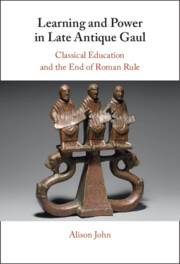
This chapter situates classical education in late antique Gaul in its historical context, positioning the work within the current scholarly debates, and building on recent scholarship on late antique Gaul. Arranged thematically, Chapter 2 considers key developments in the political and military relationships between the western Roman empire, Gallo-Romans and barbarian groups, the prospects and prosperity of Gallo-Roman aristocrats, the increasing dominance of the Church and bishops in daily life, and the vitality and continuity of Gallo-Roman cities. It considers the conditions necessary for classical education to thrive and function and discusses how the structures that fostered education were affected by the political, military, religious, and cultural transformations of fifth-century Gaul.
The concluding chapter reflects upon how the themes and questions explored in the book speak to familiar concerns of families, communities, and societies across time. What is the purpose of education? What do we expect of our education, and in what ways does our pursuit of knowledge and our learning define who we are? The conclusion draws together the arguments from the preceding chapters, considering in what ways the ‘fall’ of Rome meant the end of the schools of grammar and rhetoric in Gaul. Without the superstructure of the Roman empire, the socio-political culture that valued literary education disappeared, and the schools soon followed suit; it was not primarily material changes caused by the political, cultural, and religious upheavals of the fifth century that led to the decline of the schools, but rather marked changes in the attitudes and mindset towards education and learning of the emerging power brokers of post-imperial Gaul – the barbarian kingdoms and the Church.
This chapter focuses on the practical aspects of education, such as the organisation and funding of the classical schools. It traces the status of classical education as a public institution in the late imperial period, during the transformations of the fifth century, and within the early barbarian successor kingdoms. The chapter begins by establishing the extent of direct involvement of the imperial government in education, arguing that cities and individuals had always played a far more important role in patronising and funding classical schools. It then considers opportunities for ‘graduates’ of classical schools in late and post-imperial Gaul, the crucial difference between literacy and literary education, and emphasises the important connection between classical education and structures of power that promote and demand literary training.
The introduction sets out the approaches, sources, and scope of the book. It acquaints the reader with the main features of classical education and places the book within the modern historiography.
This book traces the changing political and social roles of classical education in late antique Gaul. It argues that the collapse of Roman political power in Gaul changed the way education was practiced and perceived by Gallo-Romans. Neither the barbarian kingdoms nor the Church directly caused the decline of classical schools, but these new structures of power did not encourage or support a cultural and political climate in which classical education mattered; while Latin remained the language of the Church, and literacy and knowledge of law were valued by barbarian courts, training in classical grammar and rhetoric was no longer seen as a prerequisite for political power and cultural prestige. This study demonstrates that these fundamental shifts in what education meant to individuals and power brokers resulted in the eventual end of the classical schools of grammar and rhetoric that had once defined Roman aristocratic public and private life.
Macella, specialized market structures built in various urban centers in Roman Italy and the provinces between the Middle Republic and the Late Antique period, have been interpreted widely as urban symbols of elite prestige and conspicuous consumption. While it is true that elites often acted as benefactors of these buildings and written sources emphasize the sale of luxury foods, documentary and archaeological evidence suggest that bureaucratic incentives played a crucial role in their initial establishment. This article presents a new interpretation of the development of macella and argues, in contrast to traditional views, that these markets were not primarily designed as spaces of luxury consumption catering exclusively to elite customers. Rather, they were conceived as physical and permanent institutional control mechanisms over urban food trade in an increasingly complex and integrated Roman economy.
The study of lead artifacts and anthropogenic lead exposure in human remains can provide valuable insights into health, migration, trade, and societal instability. This review examines the uses of lead and its impacts on ancient Roman populations by exploring and integrating evidence from the textual, archaeological, and bioarchaeological records. Considering written texts and material evidence together challenges some of the persistent modern notions that sapa and adulterated wine were key sources of lead exposure during this time. Using a matrix-based framework to examine domestic lead exposure helps us to assess the frequency of and risk associated with lead objects recovered in published domestic assemblages. We provide a comprehensive synthesis of the bioarchaeological evidence for enamel and bone lead concentrations in Roman populations and conclude with recommendations for future research in this area.
Palmyra is usually studied for one of three reasons, either its role in the long-distance trade between Indian Ocean and Mediterranean, its distinctive cultural identity as visible in the epigraphic and material record from the city or its rise as an independent regional power in the Near East in the third quarter of the third century AD. While Palmyra was indeed a special place, with a private sorte, or destiny of its own, as Pliny famously expressed it (HN 5.88), the city’s ability to maintain its distinctiveness arguably rested on deep entanglements with her local and regional surroundings. This chapter addresses how the city engaged with its neighbours and its Roman imperial overlords. Actions, events and policies attested in the epigraphic record from the city and from the Palmyrene diaspora in the Roman Empire are discussed in light of theoretical insights from archaeology, sociology and economics. It is argued that Palmyra’s remarkable success built on the city’s ability to connect with the range of social networks that constituted the Roman Empire.
This article uses amphora quantification and regression analysis to trace economic changes in the Mediterranean between the Principate (27 bc to ad 284) and Late Antiquity. It indicates that, during the Principate, there was a clear pattern of amphora distribution across the Mediterranean, which can be explained by the predominance of market forces among the factors governing trade. In contrast, the weak correlation between exports and prices observed in Late Antiquity suggests a significant shift in the underlying principles of trade during this period.
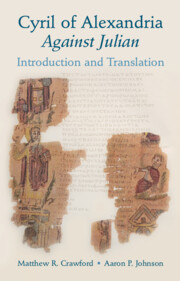
In 362/363 the Roman emperor Julian composed a treatise titled Against the Galileans in which he set forth his reasons for abandoning Christianity and returning to devotion to the traditional Greco-Roman deities. Sixty years later Cyril, bishop of Alexandria, composed a response. His resulting treatise Against Julian would dwarf the size of Julian's original work and in fact serves as our primary source for the fragments of it that have survived. Julian's treatise was the most sophisticated critique of Christianity to have been composed in antiquity and Cyril's rebuttal was equally learned. The Christian bishop not only responded directly to Julian's own words but drew upon a wide range of ancient literature, including poetry, history, philosophy, and religious works to undermine the emperor's critiques of the Christian Bible and bolster the intellectual legitimacy of Christian belief and practice. This is the first full translation of the work into English.
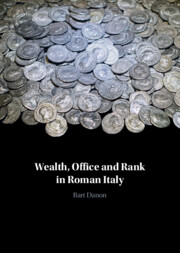
Dismantling the simplistic equation of wealth, political power and social rank in the Roman empire, this study presents a new reconstruction of the distribution of elite wealth in Roman Italy based on an innovative combination of economic modelling and archaeological and epigraphic evidence. Bart Danon follows a quantitative approach to show that the Roman economic elite was in fact much larger than the political and social elites. The many wealthy households outside the socio-political orders fuelled intense competition for junior political offices, while paradoxically strengthening the resilience of the Roman political system. By challenging long-held assumptions, this book offers fresh perspectives on the complexities of wealth and power in ancient Rome. This title is also available as Open Access on Cambridge Core.
The Introduction sets out the theme of the book. It discusses the census qualifications (wealth minimum requirements) that prevailed in the Roman timocratic political system.
In the main, critics have regarded Gabriel de la Concepción Valdés (also known as Plácido) as a tragic mulatto detached from enslaved black people yet unable to join the ranks of the white literary elite. This essay takes an innovative approach to Plácido by reading his poetry as transculturated colonial literature rather than a poor imitation of European aesthetics. Plácido produced poems situated at the crossroads between classical European deities and enigmatic African spiritual practices. I argue that Plácido transculturated Mars, the Roman god of war, with the Yoruba principles of the divine masculine most often attributed to the orisha Oggún. In Oggún philosophy, the divine masculine is the capacity to exploit the powers of devastation and dissension either to ensure the survival of a given polity or to remake it entirely. Plácido appropriated Aeolus, the Greek god of the wind, Jupiter, the supreme Roman god, and most prominently Mars, the Roman god of war to reimagine Cuban resistance as a just war between good and evil. Plácido’s portrayal of ancient deities divested of sacred authority enabled him to convey an alternative God concept without contravening censorship guidelines that forbade any criticism of Catholicism, the official religion of the empire.
Emperor Theodosius II commissioned and published the Codex Theodosianus, or Theodosian Code, in 439. It is a large anthology of legal issuances and statements from as far back as the era of Constantine, sole ruler of the empire from 324 to 337, and the latest sources come from the time of Theodosius II himself. The selections translated here were, in their own times, written in different contexts and sent to different audiences. There are edicts, made for a more general audience and applicable to many; there are decrees, which arise from the adjudication of a specific case; and there are letters written to specific city, provincial, and imperial officials, containing orders from one or another emperor. Yet as parts of this anthology, they are presented as having equal weight and equal applicability; they are statements by emperors, which establish a precedent of law, presented in this “Code” and accessible to officials and judges for consultation.