To save content items to your account,
please confirm that you agree to abide by our usage policies.
If this is the first time you use this feature, you will be asked to authorise Cambridge Core to connect with your account.
Find out more about saving content to .
To save content items to your Kindle, first ensure no-reply@cambridge.org
is added to your Approved Personal Document E-mail List under your Personal Document Settings
on the Manage Your Content and Devices page of your Amazon account. Then enter the ‘name’ part
of your Kindle email address below.
Find out more about saving to your Kindle.
Note you can select to save to either the @free.kindle.com or @kindle.com variations.
‘@free.kindle.com’ emails are free but can only be saved to your device when it is connected to wi-fi.
‘@kindle.com’ emails can be delivered even when you are not connected to wi-fi, but note that service fees apply.
In 1915, the Panama–Pacific International Exposition announced San Francisco’s recovery from the 1906 earthquake that had devastated the city. This chapter examines why the fair organizers and architects used classical architecture to promote San Francisco’s economic success and to articulate the continued narrative of American progress. Roman architectural forms were used extensively in many of the fair’s courts, including the Court of the Universe. The neo-antique architecture and sculpture of the Court of the Universe was also a crucial way for the fair organizers to demonstrate San Francisco’s unique position (due to its West Coast geography) to develop economic ties with Asia. Neo-antique architecture helped to prove that San Francisco was a modern city, fully recovered from the catastrophic 1906 earthquake and poised for cultural and economic greatness. This chapter also examines why other state and national pavilions were erected in a classicizing style, demonstrating the potency and flexibility of ancient architecture in conveying different aims. Bernard Maybeck’s Palace of Fine Arts was the fair’s architectural hallmark. His decision to evoke the ruins of ancient Rome for his Palace was a strikingly modern choice and stands in contrast to the celebratory architecture of the rest of the fair.
The traditional narratives of Austrian constitutional law are evolving. Long decried by scholars and practitioners to be ‘in ruins’, the Austrian Constitution has recently been lauded as ‘elegant and beautiful’ by Austria’s President, thus attempting a paradigm shift in the Austrian public’s perception of its constitution. While some textbooks claim it (still) is a merely formal, ‘value neutral constitution of game rules’ much in the spirit of Hans Kelsen, the Austrian Constitution and its interpretation show more and more signs of converging into a principled, value-oriented and purposive approach common in many other countries. The multinational legal legacy of the Habsburg Empire and its potential for understanding the European integration have been recognized as an asset, just as the ensuing creation of the world’s first constitutional court is of pride and the Austrian Constitution’s leading export.
Rather than static traces of the past, ruins and ancient material objects represent dynamic and important generative components of communities. A relational ontology views objects and matter as animate; here we focus on their collaborative potential with humans to inspire memory practices that bring together ancestors and living humans, things, and landscapes in recursive relationships. Situated at Etlatongo in the Mixteca Alta of Oaxaca, Mexico, our research interrogates broader Mixtec and Mesoamerican perspectives on things, which indicates certain materials and ruined places could be especially potent, imbued with cosmogonic energy from previous eras. Such material had animating properties as well as inspiring memorial narratives. Continuously occupied for more than 3,500 years, Etlatongo illustrates dynamic and varied interactions with past places and things. We present two precontact archaeological case studies that highlight these persistent engagements with the past: the first focuses on the reuse and reincorporation of earlier public architecture while the second features the selection and generative power of ancient ceramic figurine heads in two later domestic settings.
Frieze, an everyday woollen fabric of domestic manufacture, serves in the Afterword as an image of resilience. Setting the more familiar images of romantic ruin to one side, the book ends by arguing for an Irish romanticism that scripts its own terms and knows its own strength.
The book’s final chapter turns to questions of spolia and converted buildings. Its discussion reorients conventional approaches to these debated topics by exploring architectural reuse through the lens of lived experience. Focusing on evidence for original doorways blocked in later phases of a building’s occupation at a series of repurposed sites, a case is made for studying conspicuous traces of a building’s former use as a window into social and somatic modes of temporality not captured by official commemorative inscriptions or building histories.
This chapter examines the “verse politics” of eighteenth-century Asia. It explores how Anglophone authors used epics and ruin poetry to advance imperialism, assess governmental policy, and reimagine the role of India in the British Empire. To demonstrate poetry’s role in politics and imperial policymaking, this chapter focuses on the career of Eyles Irwin, a colonial administrator stationed in Madras during the 1770s and 1780s and one of the earliest authors to publish English poetry while in India. The chapter analyzes his collection of travel poems, the Occasional Epistles (1783), and his lengthy poetic epistle, “The Ruins of Madura, or, the Hindoo Garden” (c. 1785–92), which versifies the holy sites and gardens of an ancient southern Indian city, Madura (Madurai), and the decayed palace of one of its Hindu rulers, Tirumala Nayaka. From these details, and Madura’s ruins, Irwin reanimates a South Indian culture and polity. Epics and ruin poetry reimagined writing about empire not as an attempt at personal fame but as an extension of imperial policy, and in ruin poetry Anglophone authors sought to reconcile the obvious oppression of India with the supposed liberty of Britain’s empire.
This article examines two ruined monumental architectural complexes in ancient Oaxaca: the Main Plaza of Monte Albán and the acropolis of Río Viejo. I consider how the material vibrancy of these ruins differed in ways that both brought together and destabilized communities. After its abandonment, the ruins of the Main Plaza, as well as the mountain on which it was built, continued to assemble substances important to human well-being, including rain, clouds, sky, mountains, ancestors, and deities. People periodically journeyed to the plaza to make offerings and bury their revered dead, thereby constituting a broader identity and community. In contrast, the earthen architecture of the acropolis, located in the center of Río Viejo, rapidly decayed in the tropical lowland climate. The reemergence of hierarchy at Río Viejo in the Late Classic period activated material memories of rupture held in the ruins that threatened and resisted new forms of community and political authority.
In this book, Ann Marie Yasin reveals the savvy and subtle ways in which Roman and late Roman patrons across the Mediterranean modulated connections to the past and expectations for the future through their material investments in old architecture. Then as now, reactivation and modification of previously built structures required direct engagement with issues of tradition and novelty, longevity and ephemerality, security and precarity – in short, with how time is perceived in the built environment. The book argues that Roman patrons and audiences were keenly sensitive to all of these issues. It traces spatial and decorative configurations of rebuilt structures, including temples and churches, civic and entertainment buildings, roads and aqueducts, as well as theways such projects were marked and celebrated through ritual and monumental text. In doing so, Yasin charts how local communities engaged with the time of their buildings at a material, experiential level over the course of the first six centuries CE.
Volume I offers a broad perspective on urban culture in the ancient European world. It begins with chronological overviews which paint in broad brushstrokes a picture that serves as a frame for the thematic chapters in the rest of the volume. Positioning ancient Europe within its wider context, it touches on Asia and Africa as regions that informed and were later influenced by urban development in Europe, with particular emphasis on the Mediterranean basin. Topics range from formal characteristics (including public space), water provision, waste disposal, urban maintenance, spaces for the dead, and border spaces; to ways of thinking about, visualising, and remembering cities in antiquity; to conflict within and between cities, economics, mobility and globalisation, intersectional urban experiences, slavery, political participation, and religion.
This article considers people’s relations with ruins in the Mesoamerican past from the perspective of two approaches within the ontological turn. The first examines ruins drawing on Indigenous ontologies, while the second involves the application of a new materialist perspective that incorporates Peircean semiotics. Both approaches view matter as animate and share a relational, nonbinary, and nonessentializing position. Research drawing on ethnographic and ethnohistoric accounts of Native American perspectives considers ruins as living entities often inhabited by divinities, ancestors, or pre-Sunrise beings, which could require propitiation and reverence or provoke denigration and erasure. A new materialist perspective allows archaeologists to better recognize what ruins did beyond holding meanings imposed on them by people. Ruins in ancient Mesoamerica had the vibrancy and power to gather people, offerings, shrines, and the dead in ways that constituted community and temporality, contested or legitimated authority, and invoked the cosmic creation.
This Element discusses the presence of ruins in contemporary environmental imagination. Contemporary ruins, much more than those that served as constituents of Romantic and Gothic aesthetics, simultaneously express a fascination with and a dread of the non-human agencies at play in the world, while also countering the nostalgic dimension of traditional representations of ruins. The contemporary success of ruins can be connected to the sense of planetary precarity induced by anthropogenic climate change, and to the widespread presence of eco-anxiety in the public conscience. Moreover, at the centre of ruins' aesthetic power is the interaction of human and non-human forces, and in the process of ruination, buildings and monuments find new meaning thanks to the intervention of external agents that human civilization has long attempted to tame or eliminate and that make a disturbing return as soon as anthropic activity ceases.
Avowing that love awakens one’s attention to the material world and to one another, Corinne provides a theory for establishing human–nonhuman connection, the energizing and curative praxis of belonging with. The heroine’s thing therapy positively associates women with materiality and, while exercising her right to connect with things, she sustains her élan vital. This chapter argues that she harnesses her feminist thing theory to teach her lover to respect the female body’s integrity and rights and to challenge his repressive politics: If Oswald could belong with materiality by sensuously responding to things, he could remedy his commitment to abstraction and his nationalistic gender proscriptions. Diagnosing Oswald’s melancholy as also emerging from his identification with “modern” (post Renaissance) art, associated with Napoleon’s tyranny and a self-absorptive grief that paralyzes creative potential, Corinne offers a remedy: companionship with classical art. Her thing theory has political ramifications, for it provides a workshop for practicing an embodied cosmopolitanism that itself ameliorates nationalism’s intolerances.
As a Palestinian archaeologist whose work is focused on the geopolitics of Palestinian archaeology practice and theory, I reflect in this provocation article on the current devastation of the Gaza Strip by Israel and how archaeology can be incorporated into Gaza’s current situation. Pertinent questions include the following: How should archaeologists treat the ruins of the Baptist Hospital or any ruins in Gaza? What should be done with all these ruins? When does democide become genocide? Is an ex situ analysis possible? Is there such a thing as archaeology without a place? What kind of ‘regime of truth’ does it establish? What ethical implications does this form of analysis have? What kind of accountability does it possess? In what ways does it shape our memories of events?
This chapter charts the rise and fall of Virgil’s Carthage to explore some of the ways in which the paradoxical resonances of this city are productive of a sublimity that expresses its ambivalent status in the Aeneid. Under construction in Book 1, Carthage surges up before us offering a glimpse of the city’s glorious Augustan refoundation, but also a vision of the nascent Punic menace that would become Rome’s greatest enemy. In Book 4, Carthage has lapsed into an almost ruinous state threatening imminent collapse, a threat partly realised in the image of the city’s destruction that is a fantasy of its Roman conquest (4.669–70). From the start of the poem, though, it is clear that this city is not just Carthage, it is also Troy and Rome, so the vision of its destruction is not only a reassuring affirmation of Rome’s eventual triumph but a disturbing reminder of vulnerability. Virgil’s paradoxical Carthage encapsulates the Burkean sensation of the sublime ‘delight’ that ‘turns on pain’, its Augustan space sublime and thrillingly unstable.
Revivals of public interest in the Neolithic Near East have generally coincided with the emergence of powerful imagery, such as the discovery of Çatalhöyük’s striking wall paintings in the 1960s. Now, sixty years later, the sculptures of Göbekli Tepe are ensuring the period’s widespread appeal. The capacity of these well-preserved buildings to carry such imagery until today has made them, in turn, an image of the supposed achievements of Neolithic sedentism. But the popularity of these images depends on their decontextualization. This modernist notion that permanent architecture represents the conquest of spatial forms over time is in contradiction with the early Neolithic experience of settled life, which had more to do with the unstable duration of places than with an emancipation from motion. This essay explores the Neolithic preference for earth architecture over more stable construction materials such as stone, its influence on visual culture, and how it contributed to building new living relations to the inhabited landscape. Instead of the sense of fixity and completeness that we, moderns, desperately seek in plans, reconstructions, and monumentality, it is the very transience, repetitiveness, and cumulativeness of earth that determined the transformations of the archaeological record. In other words, rhythms are key to understanding Neolithic sedentism in ways that differ wildly from the static images we have substituted for it.
Chapter 3 begins with a reading of A House for Mr Biswas (1961), a work that marks an epistemic shift in Naipaul’s thinking. The novel does for the plantation diaspora what Balzac did for France. After a careful reading of this triumphal novel, the chapter shows Naipaul’s fascination with modernist compositional features in his much-neglected Mr Stone and the Knights Companion (1963). Then, suddenly uncompleted mourning creeps in. The product of that deepening melancholic imagination is his “placid” and poetic The Mimic Men (1967). It is a compulsion towards aesthetic design, to qualities by which a work of art is judged, that take him to a very personal engagement with Englishness where Naipaul takes on the challenging discourse of Romanticism (a poetic register co-existing with the high point of British imperialism). In Wordsworth there is the memorable account of the poet meeting a leech gatherer; in The Enigma of Arrival Naipaul encounters his own version of the leech gatherer even as he begins to understand that “Englishness” was always a learning process for both the colonial and the colonized.
The appreciation, conservation, and reconstruction of ruins, deteriorating buildings, and archaeological sites of historical, religious or cultural value, as well as their safeguarding, lead to a complex set of issues and considerations. This brief paper suggests that a deeper understanding of the various models of heritage management can enhance acceptance of the different practices of heritage care. The fragility of heritage sites and of heritage models urges us to look for viable answers to global ethical and aesthetic questions regarding the management of heritage sites.
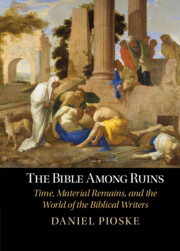
Biblical writers lived in a world that was already ancient. The lands familiar to them were populated throughout by the ruins of those who had lived two thousand years earlier. References to ruins abound in the Hebrew Bible, attesting to widespread familiarity with the material remains by those who wrote these texts. Never, however, do we find a single passage that expresses an interest in digging among these ruins to learn about those who lived before. Why? In this book, Daniel Pioske offers the first study of ruination in the Hebrew Bible. Drawing on scholarship in biblical studies, archaeology, contemporary historical theory, and philosophy, he demonstrates how the ancient experience of ruins differed radically from that of the modern era. For biblical writers, ruins were connected to temporalities of memory, presence, and anticipation. Pioske's book recreates the encounter with ruins as it was experienced during antiquity and shows how modern archaeological research has transformed how we read the Bible.
This chapter opens by considering the vexed relationship between Romantic poetic practices that were increasingly interested in the powers and perceptions of individuals and the Romantic period’s burgeoning metropolitan profusion. The first sections explore the ambivalent or outright negative attitudes towards cities and their populations expressed by poets such as William Wordsworth, Samuel Taylor Coleridge and Robert Southey and considers how distancing perspectives are employed in writings by Walter Scott and Letitia Landon. The later parts of the essay consider alternative versions of the urban sublime, touching on topographical and statistical representations by Thomas Malton and Patrick Colquhoun; celebrations of multiplicity by Pierce Egan and William Hazlitt; readings against the grain by Charles Baudelaire, Thomas De Quincey and Charles Lamb; and considerations of ruination by John Martin, Anna Laetitia Barbauld and Mary Shelley.
Pablo Neruda’s Macchu Picchu and Octavio Paz’s Tenochtitlán determine how the modern city in twentieth-century Latin American poetry is conceptualized as one shaped by its ruins. This chapter explores how these earlier visions of the city are reconsidered in Latin American poetry from the 1960s and 1970s. It analyzes Rosario Castellanos’ Poesía no eres tú (1948-71) and José Emilio Pacheco’s Irás y no volverás (1973), and how their poems about the Tlatelolco massacre shed light on how Neruda’s Macchu Picchu and Paz’s Tenochtitlán shape modern poetics and their political critique to contemporary violence. Pacheco’s allusions to the icnocuícatl in “La visión de los vencidos” and the use of multiple voices in “Manuscrito de Tlatelolco” link the political ruins of the Mexican state after the massacre to the violent legacy of its colonial past. Castellanos’ defiant response to the massacre in “Memorial de Tlatelolco” problematizes the Aztec historical past and the moral decay of the Mexican state. These poems underscore an ethical and political critique of modernity through a representation of economic, ecological, and political disasters. The urban space in ruins stirs a poetic meditation on the torn self, shaped by a society in crisis.