To save content items to your account,
please confirm that you agree to abide by our usage policies.
If this is the first time you use this feature, you will be asked to authorise Cambridge Core to connect with your account.
Find out more about saving content to .
To save content items to your Kindle, first ensure no-reply@cambridge.org
is added to your Approved Personal Document E-mail List under your Personal Document Settings
on the Manage Your Content and Devices page of your Amazon account. Then enter the ‘name’ part
of your Kindle email address below.
Find out more about saving to your Kindle.
Note you can select to save to either the @free.kindle.com or @kindle.com variations.
‘@free.kindle.com’ emails are free but can only be saved to your device when it is connected to wi-fi.
‘@kindle.com’ emails can be delivered even when you are not connected to wi-fi, but note that service fees apply.
Nearly thirty sculpted and painted images decorate Vasari’s high altar for the Pieve. The subjects of some of its paintings relate to saints whose relics were kept in its crypt, whereas that of others was tied to the dedication of the Pieve and local devotions, as well as to the Eucharist that was stored in its sacrament tabernacle. Still others depicted name saints and portraits of Vasari and his family members. This chapter comprises the first systematic analysis of each of the Pieve altar’s images and how they relate to each other, as well as to the altar’s multiple functions and some of Vasari’s other sacred works. It demonstrates the care that went into the conception and execution of Vasari’s high chapel and funerary monument and sets the stage for its contextualization with the other altars and paintings he made for the Pieve, as well as its afterlife as Vasari’s place of burial.
In recent years, as material culture has become more central to the study of all aspects of the ancient Mediterranean and new materialism has gained greater traction across a variety of academic disciplines, growing numbers of scholars have begun to explore how material objects and notions of materiality feature in Pindar’s work. This chapter offers an introduction to some of the main tendencies of such work. It discusses Pindar’s propensity to speak about his songs in terms normally applied to material crafts, such as weaving or carpentry; the role of tools and instruments in Pindar’s conception of composition and creation, both as applied to song and in a broader sense; the materials of the built environment; Pindar’s relationship with the contexts of his musical performances, real and imaginary; and the earth itself as a significant facet of Pindar’s conception of the material world.
Although clinically framed as a public health concern, the meanings of suicide are fundamentally shaped by cultural narratives and visual representations.
Aims
To examine the evolution of sculptural representations of suicide from antiquity to the present, and to interpret these works through psychiatric and sociological lenses relevant to contemporary clinical and public health discourse.
Method
A structured search across PubMed, Scopus and Web of Science (up to August 2025) was integrated with museum archives and art-historical catalogues. Selected sculptural works were analysed as interpretive case studies using iconographic, semiotic and contextual approaches. Interpretation focused on affective and relational processes such as psychological pain (psychache), shame, entrapment and social disconnection prioritising cultural formulation over retrospective diagnostic attribution in historical cases.
Results
Sculptural representations frame suicide through shifting moral and social logics: from honour-bound self-death in antiquity and virtue-coded narratives in the early-modern period to interiority and estrangement in modernity. Contemporary public installations shift this focus towards visibility, urban space and prevention. These works externalise private suffering and structural conditions (e.g. isolation, stigma), actively shaping collective imaginaries of self-destruction.
Conclusions
Sculpture provides a unique medium for the translation of individual suffering and the collective meanings of suicide into public form. An interdisciplinary reading of these works supports culturally informed clinical reflection and contributes to ethically attentive public communication and prevention strategies.
Chapter 6 further explores Blake’s anti-historicist inclinations in the contexts of his artistic theory and practices. During the late eighteenth century, the injection of organicist language into neoclassical aesthetics produced a new cult of original genius. This chapter examines discussions and depictions of statuary, particularly the famous Laocoön fragment, as well as debates around copying and imitation (involving, notably, Sir Joshua Reynolds and others) to demonstrate how Blake used preformationist ideas to resist the adulation of self-sufficiency, formal autonomy, and cultural autochthony in late eighteenth-century criticism. This chapter situates Blake in opposition to Johann Joachim Winckelmann, whose highly influential developmental history of art relied heavily on organic metaphors of autopoiesis. Winckelmann encouraged the modern artist to become, like the Greeks, ‘inimitable’, original. This chapter, however, shows Blake turning the emerging Romantic discourse of originality (found in Goethe and Herder) on its head. The artist’s task is not one of creation but regeneration, not of producing something wholly new but of giving new life to the preformed visions found in works of old.
Arthurian topics feature in medieval mural painting and sculpture in architecture from the early twelfth century onwards. The ‘spatial’ aspects of these art forms were ideal for medieval patrons to represent and promote themselves to others. They competed through monumental art – be it in their own residence, a town hall, or a church – to show their identity and status. This chapter traces the main trends, iconographical topics, and influences, with consideration of the social and political function of the representation of Arthur and his knights in medieval monumental art.
Quarries are information-rich anthropic landscapes, but their unique characteristics often limit the effectiveness of traditional archaeological documentation strategies. Here, the authors present a novel interdisciplinary method for the documentation and analysis of these landscapes, focusing on two ancient marble quarries on the Mediterranean island of Naxos. The workflow, combining lidar, photogrammetry, sculptural and architectural study, geoscience, ecological study and archaeological survey, provides a means for the systematic documentation of quarry landscapes in the Mediterranean and beyond, and aims to promote an understanding of premodern extractive activities not as isolated occurrences but as important aspects of interconnected, evolving landscapes.
This introduction opens the volume by considering the inherent multiplicity of the idea of relief, which even in the limited purview of the visual arts crosses boundaries of material, form, technique, genre, scale, and style. As a technical term referring to art, moreover, relief is not an ancient idea but a modern one, which first emerged from specific discourses surrounding Italian Renaissance art. The introduction briefly surveys the significance of the historiography of relief in discussions of ancient art before turning to three case studies of ancient vessels decorated in relief – an Archaic Greek pithos from Mykonos, the Derveni krater, and the Townley Vase – which concretely articulate the complexity and variety of ancient relief practices. It then concludes by introducing and offering a synopsis of the ten chapters that follow.
This chapter analyzes the aesthetic strategies of the funerary portraits of ancient Palmyra, examining how their status as relief sculptures – the relationship between the sculpted image and the stone slab that supports it – mediates their messaging. Taking the portrait of a Palmyrene woman in the Kelsey Museum of Archaeology as a starting point, I demonstrate that the purposes of these works cannot be recognized unless their status as a corporate body of relief sculptures is further held in view. I reinsert these portraits into an original tomb context of display, reconstructing the powerful visual effects these works were designed to create when operating together as an ensemble: at once concealing and revealing, affectively engaging and emotionally withdrawn, individual and defined by group dynamics. Palmyrene funerary sculptures emerge as both participating in many of the broader discourses of Greco-Roman artistic production, as well as in a Parthian visual tradition, while ultimately achieving a highly distinctive and semantically complex localized visual impact. The chapter underscores the visual strategies of these reliefs as a creation of the Syrian desert oasis of Palmyra.
This chapter explores young children’s semiosis (meaning-making) and transformations when immersed with artworks that were made by professional artists. Paintings and sculptures (static, moving and sound-making) ‘resided’ (were installed) in their classroom for two school terms. The first part of the chapter provides a brief context for how artworks as mediating tools elicited children’s meaning-making through individual and social activity and describes how the children’s communication and representation of meaning was multimodal. The second part of the chapter delves into Illustration of Practice 7.1 based on recent research, where semiosis was studied through two key processes: (1) noticing, or becoming aware of signs within artworks, based on an individual’s perceptions, knowledge and emotions; and (2) immersion into the artworks. Immersion involved mediating signs through perezhivanie (a cognitive-embodied-emotive encounter that requires working-through) and transmediating (translating meaning from one mode of expression to another). Illustration of Practice 7.1 highlights how young children’s representation and communication of meaning are socially mediated, cognitive, affective and embodied.
This chapter explores key works by sculptor and painter Lygia Clark and author Clarice Lispector. The chapter notes that although these women came from very different backgrounds, with Clark a daughter of the Catholic provincial elite and Lispector arriving in Brazil as a penniless, Jewish refugee escaping the pogroms of Eastern Europe, their careers had similar trajectories and explored similar themes of female interiority. The chapter compares their innovative works of the early 1960s and the artistic context that allowed them to emerge.
Virtually all countries affected by the Holocaust, and many of those only indirectly implicated, have made efforts to commemorate and memorialize the murder of European Jewry. This encompasses not only physical monuments, but also alternate approaches such as Memorial Books, rituals, liturgy, and memorial days. Many of these started as grassroots initiatives, only to be turned into state-sponsored events. Looking across the postwar decades and comparing memorials from Germany and the USA, this chapter analyzes the complex interplay between artistic choices, educational missions, and political agendas that shaped memorials and their representational strategies and spaces.
The question concerning the adequacy of mimetic representation raised by the Holocaust, of how to best convey the vast suffering, the enormity of extermination, the tragedy of loss, has profoundly shaped the history of the visual arts since 1945. Focusing mainly on painting and sculpture, this chapter argues that Holocaust art largely rejected the turn to abstraction otherwise so characteristic of postwar modernism, in favor of an ongoing engagement with figurative representation. For many artists, this was a way to retain the human dimension of the Holocaust. The shared an underlying ethical and aesthetic commitment to the human figure with its myriad complexities and configurations. At the same time, they sought to avoid falling into the trap of kitsch and sentimentality. This created ineluctable aesthetic dilemmas – to combine beauty and terror – that led to a series of heterogeneous responses, not a “school of art,” but a struggle with aesthetics in the face of catastrophe.
This chapter examines the ways in which Shelley’s works and reputation were mediated to Victorian audiences. It argues that the Victorians’ Shelley was to a large extent the Victorians’ creation; his reception in this period differed from both earlier and later understandings of his life and work. The chapter pays particular attention to the role of women such as Mary Shelley and Lady Jane Shelley in shaping the poet’s posthumous reception. It surveys several sites of reception, including editions, anthologies, sermons, statues, and Chartist meetings, to show how Shelley and his writings were appropriated, reimagined, and redeployed in a variety of new contexts by people with divergent aims and concerns. It briefly examines sculpted memorials to Shelley by Henry Weekes and Edward Onslow Ford. The chapter concludes that the Victorian understanding of Shelley was no more monolithic than the ‘Victorians’ themselves.
Percy Shelley’s interest in the visual arts (painting and sculpture, but also monuments and landscapes) was much heightened by the years spent in Italy, where in letters and notebooks, he records a wide range of encounters and sharpened his powers of observation, perception, and description. This chapter presents several important contexts and instances, from accounts in his letters to Thomas Love Peacock of the paintings in Bologna that particularly moved him (such as Raphael’s St. Cecilia), to his ekphrastic verses on a painting of the head of Medusa, to his wide-ranging descriptive notes on sculptures in Rome and in the Uffizi Gallery in Florence. These are situated historically in terms of increased access to, and engagement with, the visual arts in the period, and as important sites for Shelley to work through the imaginative transmutation of the visual into the visionary in his own poetry and poetic theory.
Papal tombs are a primary source for the study of papal politics. This chapter gives a chronological overview of papal burials, from early Christendom to the end of the fifteenth century. It addresses questions of burial preferences, church topography (especially in St. Peter’s and St. John Lateran in Rome), as well as the individual appearance of each monument. For the late Middle Ages, the importance of artists to formal innovation is underlined (Arnolfo di Cambio) and set in relation to the patron’s choice of traditions the monument is meant to refer to in its placement and appearance – to antique, French, or Italian models. The increasing number of funeral monuments for members of the Church hierarchy, as well as for laymen, kings, and nobles, starting in the thirteenth century, stiffened the competition in monumental burial and increased the need to develop appropriate papal features.
Avowing that love awakens one’s attention to the material world and to one another, Corinne provides a theory for establishing human–nonhuman connection, the energizing and curative praxis of belonging with. The heroine’s thing therapy positively associates women with materiality and, while exercising her right to connect with things, she sustains her élan vital. This chapter argues that she harnesses her feminist thing theory to teach her lover to respect the female body’s integrity and rights and to challenge his repressive politics: If Oswald could belong with materiality by sensuously responding to things, he could remedy his commitment to abstraction and his nationalistic gender proscriptions. Diagnosing Oswald’s melancholy as also emerging from his identification with “modern” (post Renaissance) art, associated with Napoleon’s tyranny and a self-absorptive grief that paralyzes creative potential, Corinne offers a remedy: companionship with classical art. Her thing theory has political ramifications, for it provides a workshop for practicing an embodied cosmopolitanism that itself ameliorates nationalism’s intolerances.
This chapter examines how the Venus de Medici entered the historical storylines of eighteenth-century models of gender, and – once plundered by Napoleon and whisked to Paris – the narrative of artistic restoration and political liberty. The statue generated complex thing–human interactions, for viewers collapsing boundaries between marble and human flesh imagined the Venus as both a withdrawn ideal yet intimately connected to them: touching her, they measured her proportions and gauged her sexual “motives” while debating whether she met British standards of female modesty. Belinda, which alludes to the Venus, also engages in these activities as characters “measure” each other; the novel, however, incorporates those travelers’ debates about the Venus’s modesty, sexuality, and virtue to emancipate female characters from calculating standards that produce negative consequences such as racism and gender stereotyping. Embedded in Belinda, the Venus obliquely restores the right for Lady Delacour to her body and to invoke nonperfection and nonconformity as a just privilege.
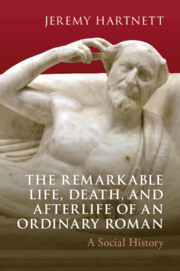
When we think of Romans, Julius Caesar or Constantine might spring to mind. But what was life like for everyday folk, those who gazed up at the palace rather than looking out from within its walls? In this book, Jeremy Hartnett offers a detailed view of an average Roman, an individual named Flavius Agricola. Though Flavius was only a generation or two removed from slavery, his successful life emerges from his careful commemoration in death: a poetic epitaph and life-sized marble portrait showing him reclining at table. This ensemble not only enables Hartnett to reconstruct Flavius' biography, as well as his wife's, but also permits a nuanced exploration of many aspects of Roman life, such as dining, sex, worship of foreign deities, gender, bodily display, cultural literacy, religious experience, blended families, and visiting the dead at their tombs. Teasing provocative questions from this ensemble, Hartnett also recounts the monument's scandalous discovery and extraordinary afterlife over the centuries.
This article examines the significance of a highly unusual stone statue discovered at Teynham, Kent, depicting a triton and a ketos. It discusses the context of the find in what appears to be a mausoleum complex adjacent to Watling Street. It provides a detailed description of the statue itself, alongside a petrological study, and places this in the context of other depictions of marine deities, particularly of tritons, in Britain and beyond. The article considers how the sculpture might have been placed on the exterior or interior of the tomb. It also discusses the possible occupant of the mausoleum (perhaps a villa owner or sailor), taking into account the possible symbolic value of the triton, either as signifier of afterlife beliefs or biographical achievement, as well as the ritual treatment of the statue after the tomb was dismantled. The wider context of the Teynham mausoleum is then analysed in terms of its location and form in relation to comparable monuments found in south-east England and better preserved tombs on the continent.
In 2018, the AOC Archaeology Group unearthed a unique Roman figurine in Sandy, Bedfordshire, likely an offering in a domestic shrine or lararium. The figurine features a distinctive Gallic cloak, similar to those found on copper-alloy figurines in Trier and Cambridgeshire and on numerous relief sculptures. It may be related to the hooded garment known as the birrus mentioned in Diocletian's Edict on Maximum Prices of a.d. 301, including the expensive Birrus Britannicus.