To save content items to your account,
please confirm that you agree to abide by our usage policies.
If this is the first time you use this feature, you will be asked to authorise Cambridge Core to connect with your account.
Find out more about saving content to .
To save content items to your Kindle, first ensure no-reply@cambridge.org
is added to your Approved Personal Document E-mail List under your Personal Document Settings
on the Manage Your Content and Devices page of your Amazon account. Then enter the ‘name’ part
of your Kindle email address below.
Find out more about saving to your Kindle.
Note you can select to save to either the @free.kindle.com or @kindle.com variations.
‘@free.kindle.com’ emails are free but can only be saved to your device when it is connected to wi-fi.
‘@kindle.com’ emails can be delivered even when you are not connected to wi-fi, but note that service fees apply.
Over the past thirty years, the anti-corruption agenda has been integrated into dominant discourses of development, good governance, and democracy, reshaping political practices and knowledge production. This involved redefining concepts, operationalizing measures, and legitimizing policies. While academics have renewed focus on corruption, emphasizing global convergences and institutional designs, limited attention is given to how anti-corruption expertise is constituted and mobilized. Gaps remain in understanding the approaches shaping anti-corruption knowledge and how inequalities in knowledge production influence public policy. Recognizing its embeddedness requires examining historical roots, key actors, methods, and mobilization channels. This chapter uncovers the historical origins of anti-corruption conceptions, identifies experts by epistemological and methodological approaches, and interprets their positions. The study identifies three dominant poles of power: American academics, quantitative economists, and media-exposed practitioners. These poles reflect disparities in professional stability, autonomy, and proximity to international financial institutions. Using a historic, reflexive, and relational perspective, the investigation maps the social forces and structures shaping the field, offering insights into the production and mobilization of anti-corruption knowledge.
How has the CPC maintained its organizational strength over time, especially during the period of economic reform? This chapter argues that the several important measures taken since the 1990s have reinforced the party as a strong organization. The personnel management reform since the 1990s has standardized the elite recruitment and provided a relatively fair channel of social mobility within the regime. The CPC has monopolized both the allocation of critical economic resources and appointments of key political, economic, and other societal offices through the Nomenklatura system, so that the party can distribute spoils of China’s economic growths to its key members and supporters in exchange of their loyalty. Since the beginning of Xi’s rule in 2012, the party has expanded the anticorruption and disciplinary body, committed more resources to campaigns of ideological indoctrination, increased the party’s involvement in daily policymaking and the private sector, and diversified channels of elite recruitment. These measures appear to have reinforced the party’s organizational capacity, but their long-term effects are yet to be assessed.
Following a socially embedded approach to the study of corruption, this chapter shows how corruption, its meaning, and the battle against it are deeply local and temporal. Relying primarily on original party documents and news reports, this chapter traces the chronological order of anti-corruption practices between 1949, when the People’s Republic of China was established, and 2020 to illustrate how the meanings of corruption, types of misbehavior to address, and the type of selected punishment were all articulated temporally.
Despite widespread interest in corruption and how to root it out, the problem continues to grow. Anti-corruption strategies and methods have proved ineffective in achieving lasting reductions in corruption. Anti-corruption academic research has not been free of criticism, and part of the problem is its emphasis on macro-level analysis. The case studies in corruption and anti-corruption in this symposium focus on specific areas that have received surprisingly little attention in the literature: the effectiveness of political finance supervisory bodies; the impact of European Union post-conditionality on anti-corruption efforts; and the increased use of the Foreign Corrupt Practices Act (FCPA) in shaping the way that corruption is conceptualised and combated on a global scale. Together, the articles in this symposium offer some novel insights and approaches to the issue of how best to understand and assess different ways of addressing corruption in specific sectors which have received insufficient attention in the literature to date.
How do Chinese courts punish corruption? This paper demonstrates how China strategically leverages its court system to signal anti-corruption resolve by transferring high-level corruption cases to local courts in distant jurisdictions. Assigning cases to distant courts insulates the judiciary from local political interference through geographic recusal and prevents the formation of a focal point for elite coordination by creating uncertainty about which court will be designated. Using an original dataset of high-ranking officials convicted of corruption since the 18th Party Congress, this paper finds that: 1) during the court designation stage, the more severe the case, the more distant the court, and the specific location of the court cannot be easily inferred from previous assignment records or case profiles; and 2) at the conviction stage, given the same case severity, courts that are farther away tend to impose longer sentences. These findings suggest that despite the prevalence of local judicial capture and protectionism, the local court system can still be strategically employed as an institutional tool for punishing corruption.
This concluding chapter outlines the contours of the Party-state and develops a conceptual framework to explain its distinctive mode of governance. At its core is a dual normative system: a legal system grounded in popular sovereignty is overseen and constrained by a power-based normative system designed to uphold the absolute authority of the Party Center—an organizing principle essential to maintaining the structural integrity of the Party-state. The chapter argues that the governance logic of the Party-state is best captured by the theory of Normalized Political Prerogative (NPP). According to this theory, governance unfolds through a three-step process: operationalization, normalization, and regulation. Together, these constitute the formal institutional foundation of Party-state rule. The NPP framework elucidates the systemic proliferation of corruption as an inherent byproduct of this mode of governance, the role of the Party’s disciplinary apparatus as a self-correcting mechanism to mitigate its adverse effects, and the evolving dynamics between institutions and leadership that shape politicking and power struggles within the Politburo.
Unlike anticorruption institutions elsewhere, China’s anticorruption practices follow a self-regulatory model: it is regulated by the very institution that is targeted by anticorruption. Compared with its role in judicial affairs, the Party’s involvement in anticorruption investigation is much more forefront, direct, and prominent. In this chapter, I track the origin and institutional evolution of the Party’s disciplinary system during 1927-2012. I point out that the Party’s institutional design is founded on the cardinal principle to preserve the unified (absolute) command of the Party Center. Thereby, how to reconcile between the imperative to uphold this principle and the need to provide a measure of autonomy for disciplinary institutions to avoid capture has been the main theme of the disciplinary institution-building process. The introduction of a tiered interlocking disciplinary decision-making structure, the segmented investigation process, and the “dual-leadership” model are the direct outcomes of the Party’s efforts to balance the conflicting needs mentioned above. These arrangements had fueled the rise of the CCDI but also brought several problems and challenges, including legal deficiency, jurisdictional frictions, resource shortage, incentive issues, and abuse, which had set the stage for Xi Jinping’s unprecedented anti-corruption campaign and disciplinary reform upon his taking power in 2012.
In this chapter, I survey major historical cases to examine different paradigms under which a disciplinary action against a Politburo member could be launched and how these paradigms were observed, abandoned, or changed over time. I find two prominent paradigms. One is a highly ideologized model developed during the Yan’an Rectification Campaign in 1941-1942. This model enables the winning party to conduct a purge of its adversaries with broad scope and impact, while reinforcing Party unity. It also has several disadvantages, including heightened social disruption, excessive purging, and the exposure of divisions in the Party leadership. The other is the de-ideologized corruption model. The paradigm shift was spurred by the political crisis of 1989, attributed at least in part to the exposure of an ideological split at the Party Center. Another reason for the shift was the introduction of the age-limit norm, which provided an alternative mechanism to facilitate peaceful exits of Politburo members in a regular and predictable manner. Under Xi Jinping's rule, the utility of the corruption model has been maximized. At the same time, the resulting power shakeup led to widespread political resentment, which, in turn, triggered the politicization of the corruption model.
Ling Li unveils the often-hidden inner workings of China's Party-state. The Chinese Communist Party has crafted and relied on an integrated regulatory system, where politics and law are fused, to govern both its internal operations and its relations with the state. Drawing on two decades of in-depth research, Li delves into the 'black box' of decision-making in the Party-state, analyzing the motivations and strategies that drive individual and institutional choices in corruption, anti-corruption investigations, and power struggles at the Politburo. This insightful book reveals the critical role of rules and institution-building within the Party, illuminates the complex relationship between corruption and regime stability, and captures the evolving dynamics of Party-state relations. A must-read for students, academics, business leaders, and policymakers alike, this book is an indispensable guide for anyone seeking a deeper understanding of law, politics, and governance in China and its global implications.
This article examines the Puerto Rican legal mobilisations for the right to access public information through the lenses of activist-scholarship. Based on ethnographic research with Puerto Rican scholars, lawyers and civil society organisations, the article explores how they have used the legal system to demand greater transparency and accountability from the Puerto Rican government and the Federal Oversight and Management Board (FOMB). First, it engages with the efforts of Proyecto de Acceso a la Información, a law clinic and civil society organisation initiative aimed at securing access to public information, transparency and accountability in government. Second, it reflects on Sembrando Sentido’s efforts, an anti-corruption and transparency civil society organisation, to draft and enact a series of anti-corruption laws. These case studies illustrate how activist-scholarship shapes Puerto Rican society by using legal tools to challenge colonial legality and resist the imposition of neoliberal policies that exacerbate inequality and corruption.
Recent elections around the globe have seen politicians increasingly adopt anti-corruption rhetoric, yet little is known about the conditions under which such appeals are effective. While existing literature has focused on the factors that mitigate electoral sanctions for corrupt politicians, it has often overlooked the relevance of anti-corruption efforts. This paper investigates the impact of anti-corruption promises on electoral support and perceived effectiveness in cleaning up government. Using an unforced conjoint experiment in corruption-prone Paraguay, I vary candidate profiles with different anti-corruption platforms, genders, and disciplinary records. The results reveal that anti-corruption appeals significantly influence electoral support. Concrete anti-corruption promises with specific policies are more persuasive, indicating citizens prefer substance over vague rhetoric. Surprisingly, a clean disciplinary record does not substantively enhance a candidate’s anticorruption appeal, and male candidates appear to benefit more from adopting anticorruption platforms. These findings illuminate under what conditions anti-corruption platforms are more effective. They highlight the importance of specific policy stands and reveal that having a history of corruption surprisingly does not damage the credibility of anticorruption advocates.
The scholarly and popular commonsense about corruption in the Philippines is that the country has always been corrupt. Seventy-eight years of corruption as an independent state (1946–2024) may as well have been a thousand. Lay and scholarly accounts explain this continuity with respect to traditional values and premature democratization. In both accounts, corruption is all but genetic to Philippine culture or politics. To be sure, continuity is self-evident if we are looking only at corruption scandals—but scandals have been accompanied by anti-corruption movements, broadly speaking. The two have gone hand-in-hand historically, suggesting that we need to understand them together. Taking them together, that is, focusing on their dialectic, produces, as I will show, a history of change. Specifically, how Filipinos relate to corruption has changed. They have become less tolerant of it in general and learned to embrace an anti-corruption model of politics. How scholars and policymakers conceive of corruption has changed. They have come to adopt a view of corruption as a generic social problem, effectively disembedding it from society. These developments have enabled a more intolerant approach such that, today, the greater danger lies in an anti-corruption “fundamentalism” leading to the rejection of politics altogether. Viewed as a whole, the history of corruption/anti-corruption has been a popular struggle over what politics should look like, and thus we might read their dialectic as driving the progress of political modernization from below.
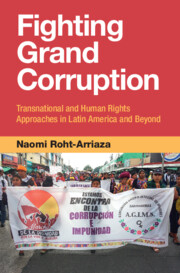
Grand corruption-systemic, large-scale, and top-down misappropriation of public resources for private gain-remains a pervasive problem around the world. It affects the ability of governments to educate, feed, and care for their people. It undermines human rights, perpetuates impunity, and erodes trust in government and the judiciary. It strengthens disgruntlement, authoritarianism, and insurgency. Corruption, however, is not a static force. In this work, Naomi Roht-Arriaza explores how corruption has changed, and how new anti-corruption thinking, especially in Latin America, centers human rights, victims' access to justice, and reparations. Roht-Arriaza shows how activists have used outside pressure and support for local actors where state institutions have been captured and foregrounds anti-corruption considerations in dealing with transitional justice and atrocity crimes. Written with engaging stories and examples, this book will appeal to lawyers, scholars of Latin America, and anyone else interested in fighting kleptocrats with the goal of reclaiming the common good.
This chapter addresses how the pathways of legal strategy can be applied in practice. The first part of this chapter presents three case studies that show how firms can respond to common legal challenges. The mandate to stop sexual harassment, the protection of intellectual property rights, and the prohibitions related to anti-corruption are all used as examples of how each pathway can be applied with varying levels of effectiveness. The second part of the chapter explores how a firm can elevate its implementation of legal knowledge from one pathway to another. This part shows how companies can evolve their legal practices from avoidance to conformance, conformance to prevention, prevention to value, and value to transformation. Although not every legal issue is transformative, understanding how the pathways work in practice can help firms deploy their legal knowledge as effectively as possible.
This chapter discusses corruption in Brazil. I provide a comprehensive overview of relevant facts, with a focus on the economy and the distribution of economic resources. This understanding will be crucial in examining the role of corruption in the political landscape of Brazilian society, which is marked by pronounced inequality. Brazil shares similarities and differences with Russia. In both countries, there is a close, often corrupt relationship between political power and state-controlled enterprises. In contrast to Brazil, the anti-corruption movement in Russia has not only failed to seriously challenge the government, but also has been confronted by brutal repression. Unlike in Russia, Brazil’s judiciary has been highly proactive. Moreover, the Brazilian government participated actively to the anti-corruption global regime, while Russia mostly pays lip service to it.
This chapter provides an introduction to the book. A focus on the social construction of corruption leads to the two main conclusions. First, corruption is a tool of government, because it offers reasons for elites to remain cohesive. These incentives may be in the form of both benefits and punishments. To the first type belong the enticements of corruption, and they are reinforced whenever the ruler has the possibility to assign at will the label “corrupt” and the ensuing punishments. This helps rulers solve a problem of control, which is a prerequisite for political order and a vital necessity of any political system. However, corruption as a tool of government has fundamental flaws. The second broad conclusion is that anti-corruption is a tool of politics, because it can be used to pursue a political agenda. Additionally, corruption is a tool of politics which is available more widely, because it is a powerful “valence issue,” that is, one of those issues on which most people agree, either negatively (as for corruption) or positively (as it would be, e.g., for “competence”). However, as a tool of politics anti-corruption has many shortcomings.
Anti-corruption efforts struggle against the perverse aptness of corruption in satisfying that prerequisite of government which is control. Anti-corruption efforts also fall victim to the function it serves as a tool of politics. From this perspective, this chapter derives a pessimistic view on the prospects of anti-corruption efforts that are narrowly defined, on which I present some concluding considerations. They vouch for a broader approach to the question of corruption, and they touch upon the idea of modernity and one of its key ingredients: the possibility of human agency.
Separation of powers or, more exactly, the rule of law, due process or, in Europe, the right to a fair trial influence the institutional setting of antitrust or regulatory authorities and law enforcement. An increased role given to specific regulation or antitrust in order to tackle some fundamental issues posed by the concentration of economic-political power does not go without independent and impartial decision-making from an institutional and procedural, a personal or a financial and lobbying perspective.
There are many ways in which to examine the current Israeli constitutional crisis. This article uses the lens of anti-corruption, a global movement which has changed politics in many countries. The long empowerment of the legal system in Israel arguably has its origins in policing corruption, which may be a particularly powerful motivator for the current governing coalition's efforts to assert more control over the Supreme Court. The dynamics of anti-corruption in Israel are somewhat distinct from those of other countries in ways that may bode well for the Court in its confrontation with the government.
Research that examines the impact of economic, social, and political factors on political corruption uses expert’ and citizen’ perceptions for measuring corruption and testing arguments. Scholars argue that the perception of corruption is a good proxy for actual corruption because data on actual corruption are limited and not entirely trustworthy. However, perception indexes do not allow for testing separate mechanisms driving citizen’ perceptions of corruption from actual levels of corruption in different government branches. To address this issue, I introduce a new index based on Latin American countries to measure the risk of corruption in political parties. Using a de jure analysis of laws and regulations, the Risk of Corruption (ROC) index evaluates the likelihood of political parties engaging in corrupt activities. Instead of measuring corrupt activities or perception directly, the ROC measures the risks of involving in corruption. The index has important implications for academics and practitioners in anti-corruption issues. First, it allows us to test arguments about the role of political parties and legislatures in reducing political corruption. Second, it helps to understand how political parties could improve their internal organization to decrease the risk of corrupt activities. Finally, it is a valuable instrument for cross-national studies in diverse fields that study political parties.