To save content items to your account,
please confirm that you agree to abide by our usage policies.
If this is the first time you use this feature, you will be asked to authorise Cambridge Core to connect with your account.
Find out more about saving content to .
To save content items to your Kindle, first ensure no-reply@cambridge.org
is added to your Approved Personal Document E-mail List under your Personal Document Settings
on the Manage Your Content and Devices page of your Amazon account. Then enter the ‘name’ part
of your Kindle email address below.
Find out more about saving to your Kindle.
Note you can select to save to either the @free.kindle.com or @kindle.com variations.
‘@free.kindle.com’ emails are free but can only be saved to your device when it is connected to wi-fi.
‘@kindle.com’ emails can be delivered even when you are not connected to wi-fi, but note that service fees apply.
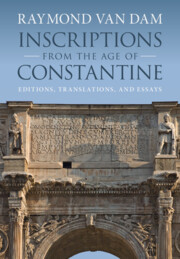
Although emperor for over thirty years (306-337), Constantine always shared imperial rule with colleagues, first fellow Tetrarchs, then his sons. During his reign he traveled thousands of miles along the northern and eastern frontiers. But he still relied on senators and municipal notables as administrators. Cities flourished, and traditional cults were still common. Inscriptions provide the most revealing evidence about provinces, cities (including Rome), senators, local notables, and cults.
The reign of Constantine, Roman emperor from 306 to 337, was one of the most important periods in world history. Although literary texts often represented him as the first Christian emperor, the inscriptions engraved on monuments, statue bases, and milestones offer alternative perspectives. Inscriptions highlight the influence of the other emperors, the prominence of senators at Rome, the civic traditions for praising benefactors in provincial cities, the logistics of the economy, and the abiding importance of traditional cults. This book includes the Greek and Latin texts of over 800 inscriptions from the early fourth century, with translations and critical annotations. An extended Introduction and almost 200 short essays provide context by explaining the issues and problems, correlating the literary texts, and comparing the legends and images of coins. Without the emperor as the constant focus, the Age of Constantine becomes all the more fascinating.
In 1974, É. Masson divided Cypro-Minoan inscriptions into four different scripts based on how their signs were drawn. Her divisions still persist, but have become increasingly controversial: are they really different scripts, or are they just variants of one script? In Chapter 10, the corpora of Masson’s three main divisions of Cypro-Minoan are analyzed against each other in an effort to determine whether they all encode the same language. As a control, three analogous corpora of Cypriot Syllabic inscriptions are analyzed against each other in the same way, with the results demonstrating an overwhelming probability that they all encode the same language (which we know they do, as Cypriot Syllabic is deciphered: it encodes Greek). The analysis of Masson’s three main divisions of Cypro-Minoan demonstrates a similarly overwhelming probability that they all encode the same language, and thus are simply variants of the same written language, not different scripts. The Cypro-Minoan and Cypriot Syllabic corpora are also analyzed against each other, demonstrating an overwhelming probability that the two scripts encode different languages—that is, that Cypro-Minoan does NOT encode Greek.
The Phaistos Disk is an enigmatic object, imprinted with a text in a script found on no other object, though the script does contain a number of signs in common with Linear A. In Chapter 8, the text on the Disk is analyzed against Linear A in an effort to determine whether the two scripts encode the same language. As a control, a Cypriot Syllabic text analogous in size to the one on the Disk is analyzed against Linear B in the same way, with the results demonstrating an overwhelming probability that both scripts encode the same language (which we know they do, as both scripts are deciphered: they both encode Greek). The Cypriot Syllabic text is also analyzed against Linear A, demonstrating an overwhelming probability that the two scripts encode different languages—that is, that Linear A (for a second time) does NOT encode Greek. The analysis of the text on the Disk against Linear A, however, demonstrates a similarly overwhelming probability that both scripts do encode the same language.
Cretan Hieroglyphic has so far proven especially resistant to decipherment, because its corpus is rather small, and most inscriptions consist of just a word or two. In Chapter 9, the Cretan Hieroglyphic corpus is analyzed against Linear A in an effort to determine whether the two scripts encode the same language. As a control, a set of Cypriot Syllabic inscriptions analogous in size to the Cretan Hieroglyphic corpus is analyzed against Linear B in the same way, with the results demonstrating an overwhelming probability that both scripts encode the same language (which we know they do, as both scripts are deciphered: they both encode Greek). The set of Cypriot Syllabic inscriptions is also analyzed against Linear A, demonstrating an overwhelming probability that the two scripts encode different languages—that is, that Linear A (for a third time) does NOT encode Greek. The analysis of the Cretan Hieroglyphic corpus against Linear A, however, demonstrates a similarly overwhelming probability that both scripts do encode the same language.
In the past, those who have looked for linguistic patterns in Linear A by comparing inscriptions from different parts of Crete have been met with a common objection: “How do you know Linear A encodes the same language across the island?” In Chapter 7, Crete is divided into five regions centered around the five main Minoan palaces, and the corpus of Linear A is likewise divided into five corpora, each containing the inscriptions from a single region. These five corpora are analyzed against each other in an effort to answer this question. As a control, five analogous corpora of Linear B inscriptions are analyzed against each other in the same way, with the results demonstrating an overwhelming probability that they all encode the same language (which we know they do, as this script is deciphered: all Linear B inscriptions encode Greek). The analysis of the Linear A corpora demonstrates a similarly overwhelming probability that Linear A encodes the same language everywhere in Crete. The Linear A and B corpora are also analyzed against each other, demonstrating an overwhelming probability that the two scripts encode different languages—that is, that Linear A does NOT encode Greek.
Although Cypriot Syllabic was mostly used to write in Greek, it was sometimes used to write in an unknown indigenous language now conventionally called “Eteocypriot.” Many have wondered whether Eteocypriot could be a descendant of the language behind the earlier Cypro-Minoan script. In Chapter 11, Cypro-Minoan is analyzed against Linear A and Eteocypriot in an effort to determine whether any of them encode the same language. As a control, Cypriot Syllabic is analyzed against Linear B in the same way, with the results demonstrating an overwhelming probability that both scripts encode the same language (which we know they do, as both scripts are deciphered: they both encode Greek). Cypriot Syllabic is also analyzed against Linear A and Eteocypriot, demonstrating an overwhelming probability that none of them encode the same language—that is, that Linear A (for a fourth time) does NOT encode Greek, and neither does Eteocypriot. The analysis of Cypro-Minoan against Linear A and Eteocypriot, however, demonstrates a similarly overwhelming probability that (a) though Cypro-Minoan and Linear A clearly encode different languages, (b) Cypro-Minoan and Eteocypriot do encode the same language.
This chapter explores the relationships between regulations (laws, senatorial decrees) and female visibility in Republican Rome. The focus is on the earliest epigraphic and literary evidence for regulations mentioning women, citizen and non-citizen. Key examples include the senatus consultum de Bacchanalibus (186 BCE), one of the Clusium Fragments (late second to early first century BCE), the lex Osca Tabulae Bantinae (100–91 BCE), the Tabula Heracleensis (post-Social War), the lex Coloniae Genetivae (59 to 44 BCE), as well as Cicero’s references to a lex on female mourning from the XII Tabulae (Twelve Tables), the lex Voconia of 169 BCE and the pontifical responsum and senatus consultum on the Vestal Licinia in 123 BCE. These are compared with Republican regulations attested in later sources. This chapter argues that these regulations rendered some women visible, both physically and symbolically, and that they offer us valuable insight into women’s agency, authority and property in the Roman Republic.
This chapter discusses the terms in which collective exile experienced by Constantinopolitan refugees was rendered in architecture, by analyzing how Nicaea was renovated into a new exilic capital, replacing Constantinople (New Rome). Extensive fortifications were built around Nicaea, Nymphaion, Heraclea Pontica, Prousa, Smyrna, Tripolis, and Philadelphia. In analyzing their architectural form and the dedicatory inscriptions embedded in their walls and towers, I describe how Nicaea and its surrounding landscape evoked a collective exilic experience for the refugees it protected. As attested by the built environment, these experiences at times align with but also contrast with literary tropes on exile written about by the period’s chronicler, Niketas Choniates. The era of exile is commemorated in the unusual appearance of Jewish exilic leaders and prophets in several dome mosaics of newly renovated works in Constantinople.
Antiquities in the Middle East region face various threats, including illicit trade, theft, and forgery. This research examines a leather manuscript obtained by the Palestinian Tourist Police following the arrest of an antiquities smuggler. The manuscript contains Phoenician inscriptions along with symbols such as the Menorah, Shofar, and a plant branch. Radiocarbon dating using accelerator mass spectrometry (AMS) techniques determined the manuscript’s date to be post-1950 CE. Therefore, the results indicate that the manuscript is a modern forgery, likely created for commercial purposes. Additionally, the text contains several grammatical errors, further supporting the conclusion that it is not an authentic historical artifact.
In 1926, Roberto Bartoccini excavated a late-antique tomb at Sirte, Libya. Fifty-three inscriptions in Latin, Greek and Latino-Punic have been recorded and used as evidence of a thriving Christian community. This article reassesses these inscriptions, paying particular attention to the Latino-Punic texts, and discusses the persistence of a Punic identity that can be placed in the context of the wider archaeological landscape.
This chapter examines glass production in Late Antiquity, with a particular focus on technological advancements, economic significance and regional variations. Drawing on archaeological evidence, chemical analyses, typological studies and historical texts, it traces the evolution of glass manufacturing and distribution across the Roman and Byzantine worlds. The authors argue that glass production in Late Antiquity was highly adaptable, responding to shifts in economic structures, raw material availability and technological innovations. A key factor in this development was the dominance of large-scale glass furnaces in Egypt and the Levant, which supplied raw glass to secondary workshops throughout the empire. The chapter also explores how glassmakers refined shaping and decorating techniques, incorporating blown glass, engraved patterns, gold-leaf applications and coloured blobs. In terms of function, it demonstrates that glass was used across a wide range of contexts, from everyday tableware to luxury drinking vessels, lamps and even windowpanes. Regional differences are evident, with eastern Mediterranean workshops favoring elaborate embellishments, while western traditions drew inspiration from ceramic and metal vessels. A key conclusion is that glass was not only a practical commodity but also a marker of status and innovation.
This chapter explores the transformation of epigraphy in Late Antiquity, examining how inscriptions evolved in form, function and visibility between the third and seventh centuries. It discusses a wide range of inscriptional materials, including monumental inscriptions, funerary epitaphs, dedicatory plaques and graffiti, emphasising how changes in literacy, religious practices and political structures influenced their production and use. A key argument is that inscriptions in Late Antiquity shifted from primarily verbal communication to a more visual, symbolic and performative role. This transition is particularly evident in the increasing prominence of monograms, Christograms and abbreviated script, which prioritised recognisability over readability. The study also highlights the growing integration of religious elements in epigraphic practice, showing how Christian inscriptions, often featuring biblical quotations or crosses, became dominant in both private and public spaces. Additionally, the chapter explores regional variations in epigraphic density, noting that while inscriptions declined in some western provinces, they remained widely used in the Eastern Mediterranean. The digitisation of inscriptions has greatly expanded access to this material. The chapter concludes that epigraphy in Late Antiquity reflected broader cultural transformations, evolving from an elite-driven practice to a medium deeply connected to religious identity and social cohesion.
An overview of the physical state of Rome in the year 900, followed by an introduction to each of the major categories of material culture to be discussed: architecture, painting, icons, sculpture, inscriptions, manuscripts, ceramics, and coins. A rationale is provided for the format of the book: not a diachronic chronological survey as such, but instead organized around four overarching themes.
The introduction serves three main purposes. First, I present the topic of the book and its main goal: to identify the Greek tragedies that ancient actors continued to stage from the fourth century BC to the third century AD. In addition to surveying the relevant scholarly literature, I also introduce the terminology used in the book. Second, I describe the four types of ancient sources that allow us to reconstruct the repertoire of ancient actors: inscriptions, literary records, tragedy-related vases and Roman tragedies. I discuss each category of records separately, presenting previous studies and addressing their contribution to my own work. Third, I summarise the four chapters making up the book and I describe how I have arranged the two Appendices collecting ancient sources, one related to identifiable Greek tragedies (Appendix I) and the other to their unidentifiable counterparts (Appendix II).
The development of runic writing (the early Germanic alphabetic script) and the practice of inscribing runes on stone are difficult to trace, particularly as rune-stone inscriptions are rarely found in original and/or datable contexts. The discovery of several inscribed sandstone fragments at the grave field at Svingerud, Norway, with associated radiocarbon dates of 50 BC–AD 275, now provide the earliest known context for a runestone. An unusual mixture of runes and other markings are revealed as the fragments are reconstructed into a single standing stone, suggesting multiple episodes of inscription and providing insight into early runic writing practices in Iron Age Scandinavia.
Considering the sources and material evidence available from Rome, this chapter focuses on the evidence of women’s associations with these soldiers of the different units stationed in the capital. These women were often labeled as “wives” in written documentation. By analyzing the available evidence, predominantly on funerary monuments, the authors expand the discussion of the social expectations and realities of women associated with the military in the context of the Empire’s center. The evidence gives us a rich image of an aspect of society that has not yet been explored, while at the same time providing a new perspective on the life of Roman soldiers. The origin of the women and their social background is treated as a relevant factor for their integration in the military community and – as inhabitants of Rome – in the community of the city. In this context it is interesting to consider the origin of personal relationships. In some cases, it seems that women accompanied soldiers to Rome from a provincial location and other cases suggest the relationship began in the capital itself.
Between the late second and the early fourth century CE, several empresses received the title Mater Castrorum, either in official documents, inscriptions, and coinage or in unofficial honorific or dedicatory inscriptions erected by subjects. Scholars have assumed the title was indicative of a tight-knit relationship between the empresses and the soldiers. Recent studies of the numismatic and epigraphic evidence, however, have demonstrated that, at least in the cases of the early Matres Castrorum, the title was not descriptive of an actual relationship with the military. These studies argue it was the product of dynastic propaganda that prepared a smooth path for successors. Given this new, demonstrated understanding of the title’s original purpose this chapter investigates how the title fits into ideologies that emperors “negotiated” with the constituencies in the Empire. Based on the evidence, we conclude that the meaning and use of the Mater Castrorum title changed over time according to the agenda of those who employed it. The evolution of the title is not surprising, but as with so many aspects of investigations into women and the military, the complexities of its use have not previously been conceived of in this way.
Religious practice in the Roman world involved diverse rituals and knowledge. Scholarly studies of ancient religion increasingly emphasise the experiential aspects of these practices, highlighting multisensory and embodied approaches to material culture and the dynamic construction of religious experiences and identities. In contrast, museum displays typically frame religious material culture around its iconographic or epigraphic significance. The author analyses 23 UK museum displays to assess how religion in Roman Britain is presented and discusses how museums might use research on ‘lived ancient religion’ to offer more varied and engaging narratives of religious practices that challenge visitors’ perceptions of the period.
This chapter examines a series of athletic dedications to trace both the evolution of the epigrammatic representation of the angelia - the herald’s proclamation of victory at an athletic festival - and to define the particular characteristics of the epigram as an athletic dedication. While a continuity exists between modes of athletic verse, epigrams – as inscriptions – and epinikian songs – as choral performances – function differently and interact with different audiences. Epigrams do not, for example, use large-scale mythic narratives to bestow glory on their patrons, but they do circumscribe the movements and voices of their audiences and use the religiously and culturally important sites of their dedication to add to their meaning.