To save content items to your account,
please confirm that you agree to abide by our usage policies.
If this is the first time you use this feature, you will be asked to authorise Cambridge Core to connect with your account.
Find out more about saving content to .
To save content items to your Kindle, first ensure no-reply@cambridge.org
is added to your Approved Personal Document E-mail List under your Personal Document Settings
on the Manage Your Content and Devices page of your Amazon account. Then enter the ‘name’ part
of your Kindle email address below.
Find out more about saving to your Kindle.
Note you can select to save to either the @free.kindle.com or @kindle.com variations.
‘@free.kindle.com’ emails are free but can only be saved to your device when it is connected to wi-fi.
‘@kindle.com’ emails can be delivered even when you are not connected to wi-fi, but note that service fees apply.
Al-Ghazali (al-Ghazālī), Abū Ḥāmid Ibn Muḥammad Ibn Muḥammad al-Ṭūsī (1058–1111), a towering figure in the history of Islamic religious thought, was trained in Islamic law (fiqh) and Islamic theology (kalām). A severe logical critic of the philosophers al-Farabi (d. c.950) and Avicenna (Ibn Sina, d. 1037), condemning them as infidels for some of their philosophical theories, he nonetheless reinterpreted some of Avicenna's ideas and incorporated them within his theology. At the age of thirty-seven, he abandoned a prestigious teaching post in Baghdad to follow an ascetic mystic path. He became a noted Islamic mystic, a Sufi, and endeavoured to reconcile Sufism with traditional Islamic belief.
LIFE AND WORKS
Born in the city of Ṭūsī, or its environs, in northeast Persia, al-Ghazali was educated in madāris (singular, madrasa). He studied first in Ṭūsī, and then in Jurjān on the Caspian Sea. His big educational move took place around 1077, when he went to the madrasa in Nīshāpūr, where he studied with Imām al-Ḥaramayn al-Juwaynī, a jurist of the school of al-Shāfiʿī (d. 820) and the leading theologian of the Ashʾarite school, named after its founder, al-Ashʿarī (d. 935). There are indications that during his study with al-Juwaynī, al-Ghazali had an exposure to philosophy. His intensive study of it, however, came later in Baghdad.
In the late modern period, western powers began to study eastern cultures, religions, languages, and territories other than their own under the label of orientalism. In his groundbreaking book, Edward Said (1978) came to eventually redefine what orientalism really was. In his understanding it was the rationalization of a Eurocentric worldview within which the ‘others’ (eastern civilizations) were depicted as inferior, intellectually inadequate, and regressive as a means of justifying the political, cultural, and intellectual superiority of the west. While much can be critiqued of Said’s project, it is nonetheless not absolutely untrue.
The writings of al-Ghazālī (d. 1111) mark a critical stage in the history of Arabic philosophy. He is noted for his classic, The Incoherence of the Philosophers (Tahāfut al-falāsifa), an incisive critique largely of the metaphysics and psychology of Avicenna (d. 1037). At the same time, he is also noted for adopting Avicennian philosophical ideas. This at first sight seems paradoxical, if not downright inconsistent. In fact, he adopted them after reinterpreting them in terms of his Ash'arite occasionalist perspective (to which we will shortly turn), rendering them consistent with his theology. This reinterpretation is not without intrinsic philosophical interest.
Al-Ghazālī was a renowned Islamic lawyer (faqīh), speculative theologian (mutakallim), but above all an Islamic mystic (sūfī). In his autobiography, written a few years before his death, he states that it was the quest after certainty that motivated his intellectual and spiritual journey and that he finally found this certainty in direct mystical experience, dhawq, a technical Sūfī term that literally means “taste.” Although trained in the Ash‘arite school of speculative theology, kalām, to which he contributed two works, he was also critical of this discipline. This has raised the question of whether his mysticism was at odds with his theology, which included the reinterpreted, assimilated, Avicennian philosophical ideas.
One of the greatest thinkers of the classical Islamic age and the man who influenced Islamic thought after the sixth/twelfth century more than any other was Abū Ḥāmid al-Ghazālī. Led by Muʾtazilites and philosophers such as Muḥammad b. Muḥammad al-Fārābī and Ibn Sīnā, Islamic thought had maintained certain modes of rationalism for 300 years; al-Ghazālī redirected it towards mysticism.
Today there are signs of al-Ghazālī's influence in the works of his successors including those of the great shaykh, Muḥyī ʾlDl-Dīn b. al-ʿArabī (560–638/1165–1240) who seems, at first glance, to have little in common with al-Ghazālī's conservatism. Al-Ghazālī's book Iḥyāʾ ʾulūm al-dīn (“The Revival of the Religious Sciences”), exceptional for its exalted tone of moral instruction, is still widely read in religious and learned circles and is occasionally reprinted in Cairo and Beirut. Of particular interest also is a shorter work called al-Munqidh min al-ḍalāl (“The Deliverer from Error”), which was written towards the end of his life and in which he describes certain periods of his life and summarizes his ideas on philosophy, mysticism and Ismacilism. In both these works, and in others also written in the last years of his life such as Ayjuhā ʾl-walad and al-Qisṭās al-mustacīm (“The Correct Balance”), al-Ghazālī blends mysticism with jurisprudence and theology with philosophy.
PUPIL AND TEACHER
Poor but well-educated, the young al-Ghazālī visited the great cities of his time: Jurjān, Naysābūr, Baghdad and Damascus, in order to gain more knowledge which he could share with others.
In his al-Munkidh min al-Ḍalāl al-Ghazālī states that he studied the works of al-Muḥāsibī, together with those of Abū Ṭālib al-Makkī, al-Junayd, Shiblī, and Abū Yazīd al-Bisṭāmī, and of these Ḥārith b. Asad al-Muḥāsibī (ob. 243/857) was the earliest and the most prolific writer, and to him al-Ghazālī owes more of his teaching than has been generally realized, and much that has been attributed to al-Ghazālī as representing his original ideas, is in fact based upon the earlier teaching of al-Muḥāsibī and, in many instances, is directly borrowed from him.
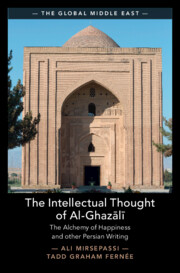
Abu Hamid Muhammad al-Ghazālī (1058–1111) was one of the most influential philosophers of the classical Islamic period, with his intellectual innovations spanning the fields of theology, logic, and law. Despite this, contemporary assessments of Ghazālī often present him as hostile to rationality, and a guardian of dogma and orthodoxy. This study provides an innovative reassessment of Ghazālī's legacy, offering a compelling depiction of a reformer in his own time with increasing relevance to the issues gripping multicultural and globalized societies today. Ali Mirsepassi and Tadd Graham Fernée closely study Ghazālī's major Persian-language text Kīmīyā-e saʿādat (The Alchemy of Happiness) and its scholarly reception, alongside his lesser-read works, arguing that Ghazālī shared a message of reform, and critique of Abbasid institutions. Ghazālī's critical stance is revealed as both pragmatic and cosmopolitan in its recognition of autonomy from religion in many aspects of life, and in the value placed upon scientific contribution.
This essay seeks to show that contemporary interreligious dialogue, like contemporary theology, best proceeds by way of philosophically erudite ressourcement. As regards Christian‐Muslim dialogue, this requires tapping into the major classical exponents of Muslim philosophy and theology, as exemplified in the work of David Burrell. Inspired by Burrell, the present essay focuses on the contribution of al‐Ghazali to Muslim thinking about predestination, a central theme in the Qur’an and arguably in the Bible as well. In order to set the stage for the engagement with al‐Ghazali, the essay begins by comparing Joseph Ratzinger's concerns that predestination as commonly understood implies a ready‐made web according to which God saves some and damns others, with ‘Umar al‐Ashqar's interpretation of the Qur’an along these lines. Al‐Ghazali's view, while advocating a strong version of predestination, is more philosophically and theologically nuanced, and it provides a basis for Christian and Muslim dialogue about how to characterize the relationships between divine and human agency, faith and reason, and divine wisdom and will. This ongoing dialogue will find in classical Christian theology valuable ways of addressing, with contemporary import, the same problems that concern al‐Ghazali.
The main lines of this exploration are quite simply drawn. That the God whom Jews, Christians, and Muslims worship outstrips our capacities for characterization, and hence must be unknowable, will be presumed as uncontested. The reason that God is unknowable stems from our shared confession that ‘the Holy One, blessed be He’, and ‘the Father almighty, creator of heaven and earth’, and certainly ‘Allah, the merciful One’ is one; and just why God's oneness entails God's being unknowable deserves discussion, though that will occur as we move along. The issue facing us is the one which preoccupied al-Ghazali: how does a seeker respond to that unknowability?
The root meaning of the Arabic word for ‘student’ (tawlib) means ‘seeker’, and that attitude of ‘seeking the face of God’, along with the indescribability of the face, will be presumed throughout our discussion. That's why we are struck with the clumsy term ‘unknowable’ rather than its more euphonious Greek form ‘agnostic’. For Western agnostics are such largely because they cannot find God sufficiently compelling, while they ‘would not have the impudence to claim to be atheists’ – as one contemporary seeker puts it. So theologians feel it necessary to enclose the term in quotation marks when discussing, say, Aquinas' ‘agnosticism’ regarding divinity. Yet a genuine unknowing does lie at the heart of the inquiry of the Jew, Christian or Muslim seeking after God; indeed, it is the unknowing which distinguishes a search for God from lusting after idols. So let us follow al-Ghazali in an effort to discover the lineaments of both search and seeker after an unknowable God.
[77] Praise be to God, with whose praise every epistle and treatise begins, and blessings upon Muḥammad, the chosen one, prophet, and messenger, and upon his kin and companions who guide one from error.
You have asked me, my brother in religion, to convey to you the aim and secrets of the sciences, as well as the confusing intricacies of creeds, and to relate what I have endured in extricating truth from the mayhem of factions, with their differing approaches and methods, and how I have ventured to raise myself from the depths of conformity to the heights of insight. You have also asked me to relate, first, what I gleaned from theology; second, what I gathered from the methods of the Instructionists, who hold that truth is apprehended solely by conforming to the instruction of the imām; third, what I criticized of the methods of philosophizing; and finally, what I endorsed of [78] the method of mysticism. You have asked me to convey the nuggets of truth that I uncovered in the midst of my investigation into the doctrines of humanity, what diverted me from the spread of knowledge in Baghdād despite the large number of students, and what led me to resume teaching in Nishapur after a long absence. Therefore, I will hasten to comply with your demand, having determined the sincerity of your request, and will relate this to you, asking God for assistance, support, success, and refuge.
Before the invention of printing, when copies of a book were few, it was common to find works falsely attributed to an author. The person of unorthodox opinions, like the PseudoDionysius, assigned his works to someone of unimpeachable reputation in order to avoid censorship or other obstacles to circulation. Or a man might insert heretical material into a rival's book to discredit him. Of al-Ghazali's Maḍnūn (? aṣ-Ṣaghīr), D. B. Macdonald wrote: —
“Of course it is quite possible and in accordance with the rules of Muslim polemic that there should also have been in circulation a false Maḍnūn teaching these heretical doctrines. Many such cases occur. A book against the belief in saints was ascribed to Abū Bakr ar-Rāzī (d. cir. 290–320) … and, it was suspected, falsely, in order to bring him into discredit. The same thing happened to ash-Sha'rānī. One of his enemies obtained a copy of his Al-Baḥr al-Mawrūd, left out parts and inserted others of a heretical nature, and then spread it as the original work. In defence ash-Sha'rānī was compelled to lay before the ‘Ulamā’ of Cairo his original copy signed by themselves, and so demonstrate the spuriousness of the other. Again, ash-Sha'rānī had to defend Ibn al-'Arabī against a similar injury. Some hostile theologians interpolated his Futūḥāt with heresy. Even Fakhrad-Din ar-Rāzī suffered from this; and there were enough suchcases for ‘Alī b. Muḥammad al-Miṣrī to make up a list of them. So we need not be at all surprised if this befell al-Ghazālī also …”
This book studies the interplay of economic philosophy and moral conduct as reflected in the writings of one of the most renowned scholars in Islamic history, Abū Ḥāmid al-Ghazālī (d. 1111). Al-Ghazālī contributed to Islamic theology, philosophy, and Sufism but is also regarded as one of the forerunners of classical economic thought in Islamic tradition.
In this chapter I shall attempt to place al-Ghazālī's political thought in the context of the Seljuq sultanate and the late Abbasid caliphate, starting from two premises: firstly, that al-Ghazālī's political thought is as significant as his mystical or theological thought; and secondly, that it is understandable only in the light of the political developments of his time.
I should like to begin to formulate an answer to the question raised in the title of the conference whose proceedings are collected in this volume: did the Seljuqs revitalise Islam? Probably they did or at least they brought a measure of order to a Muslim world in turmoil, but in so doing they sacrificed the prestige and the very role of the caliphate. There has been a wide debate about whether the Seljuqs were the defenders or the enemies of the caliphate. In a sense, they defended the caliphate insofar as they allowed it to endure a few centuries longer. But from another point of view, they were enemies of the caliphate in that they imposed a secular image of power against the religious legitimisation of the caliphal power. In other words, while, on the one hand, the Seljuqs protected the institution of the caliphate against its many adversaries, like the Ismaʿilis, on the other hand they made it evident that the management of power in Islam was no longer a question of the Islamic state but rather of an Islamic model of the state. Let us examine these contentions more closely.
One of the most striking features of speculative theology (kalāam) as it developed within the Ash'arite tradition of Islam is its denial of causal power to creatures. Much like Malebranche in the seventeenth century, the Ash'arites saw this denial as a natural extension of monotheism and were led as a result to embrace an occasionalist account of causality. According to their analysis, causal power is identical with creative power, and since God is the sole and sovereign creator, God is the only causal agent. To assert anything else is to compromise monotheism. This position, of course, was in direct opposition to the prevailing accounts of causality within the philosophical tradition of Islam at the time. The philosophers (falāasifa) had by and large taken over accounts of causality from Aristotle and the Neoplatonists and adapted them in accordance with their own set of concerns. In such accounts, while God stands as the first cause, secondary causation—the causative action of agents other than God—is unambiguously affirmed, even if variously understood. Thus, as they offered a sophisticated account of causal action in direct opposition to the occasionalist thesis, the falāasifa posed something of challenge to the theologians.
The muslim judgement against apostates has in recent years been applied in cases of publicly expressed conviction that contradict generally accepted foundations of the Muslim faith. This situation is, however, only the outcome of a theological and legal development in the 5th/11th century. Until that time, the judgement of apostasy (irtidād) could not have been applied against Muslims who voiced opinions that were regarded as unbelief. The rules for this earlier period were written down by al-Shāfi‘ī in his Kitāb al-Umm. His interpretation of the legal institution of istitāba leads to the acknowledgement that the judgement of irtidād is applicable only in a very small number of cases. This reflects legal sensitivity in the period of mass conversions when the secret practice of pre-Islamic religious rites amongst newly converted Muslims might have been widespread. Al-Shāfi‘ī's guidelines, based on earlier judgements within the Kufan tradition, gained widespread acceptance in the Hanafī, Hanbalī, and Shāfi‘ī schools of law. A first change can be noted in the middle of the 5th/11th century when authors such as al-Māwardī and Abū Ya‘lā argued for a less generous application of the istitāba. Two generations later, al-Ghazālī (d. 555/1111) and his contemporaries such as Ibn ‘Aqīl (d. 513/1119) did not restrict the judgement of irtidād to cases of openly declared apostasy. Al-Ghazālī develops a reasoning which is fully aware of the change in law and of the deviation from long-established principles. His own condemnation of three key statements of the falāsifa, expressed in his Tahāfut al-falāsifa, would be impossible without his identification of kufr with irtidād in earlier works.
The Emergence of Neoclassical and the Rise of Heterodox Economics
This chapter outlines the variations of neoclassical economics in order to set forth an engagement with contemporary debates on economic thought and the locale of Islamic economic postulates that have been forgotten, underresearched, or cast as unscientific. The fundamental idea of reinvigorating classical scholars such as al-Ghazālī connotes that economic doctrine cannot be studied on its own terms and has to be reshaped in relation to other human fields, including ethical principles. Such a standpoint also asserts that ethics as virtuous traits of character have to be brought back to the table in contemporary economic discourse.
Despite the significant variations of and within neoclassical economics, it is widely accepted as part of the so-called mainstream or orthodox economic theories taught at universities across the world. Following rational choice theory and supply and demand, neoclassical economics favors an individual's rationality and one's ability to maximize utility or profit, while also resorting to mathematical equations and evolutionary methods in the study of the economy. Neoclassical economics was developed in the late nineteenth century, based on the theories of William Stanley Jevons (d. 1882), Léon Walras (d. 1910), Carl Menger (d. 1921), and Alfrid Marshall (d. 1924), and became popularized in the early twentieth century. It is widely believed that Thorstein Veblen (d. 1929) first used the term neoclassical economics as it sprang out of demand and supply theory or the so-called Marginal Revolution.6 Despite diverse theories and approaches within neoclassical economics, its philosophy primarily focuses on consumers’ maximization of personal satisfaction, which also employs mathematical deductivism. This theory coincides with the objectives of rational behavior theory that man's economic decisions are rationally induced. While classical economists maintain that a value of a commodity is the result of the cost of material and the cost of labor, neoclassical economists hold there is also a perceived value of a commodity by a consumer that has a direct effect on price and demand. Furthermore, generally neoclassical economists advance competition in the market, oppose governmental involvement, and uphold that savings determine investment and its economic equilibrium.
The integration of South Asia into a Persianate world or “Persianate cosmopolis” has proven to be a particularly popular framing of the study of South Asian history. In Venture of Islam, Marshall Hodgson describes the Persianate as follows:
The rise of Persian had more than purely literary consequences: it served to carry a new overall cultural orientation within Islamdom. Henceforth, while Arabic held its own as the primary language of the religious disciplines and even, largely, of natural science and philosophy, Persian became, in an increasingly large part of Islamdom, the language of polite culture; it even invaded the realm of scholarship with increasing effect. It was to form the chief model for the rise of still other languages to the literary level … Most of the more local languages of high culture that later emerged among Muslims likewise depended upon Persian wholly or in part for their prime literary inspiration. We may call all these cultural traditions, carried in Persian or reflecting Persian inspiration, “Persianate” by extension.
Much of the subsequent theorization and conceptualization of the “Persianate” owes a significant debt to Hodgson's framing. Scholars have emphasized different aspects of the “Persianate,” with some choosing to frame it as a cultural milieu and others as a linguistically connected region. Here, “Persianate cosmopolis” refers to a geographical area whose major cultural foundation are the stories, ideas, and motifs expressed in New Persian literature. The circulation of such New Persian texts has supplied the primary content of the “Persianate cosmopolis.”
The Risālat al-Laduniyya is a short treatise giving an account of al-Ghazālī's religious philosophy, in a compact form. It includes his theory of Knowledge, which is discussed very fully in regard to its nature, its different types, and the means by which it is acquired. The author gives special attention here to Revealed Knowledge and distinguishes between Revelation (), which was limited to the prophets and ceased with them, and Inspiration (), which is granted also to the saints and is, in fact, the awakening of the individual, human soul, by Universal Soul.
This chapter begins in part with a linear examination of the events of al-Ghazālī's life that structured his ethical-economic worldview. Pinpointing some crucial moments in his life may explain how the eminent scholar came to understand the concept of divine knowledge and the political-intellectual environs in which he lived. On some level, his biography assists the reader in navigating what might appear to be contradictory views on philosophy, Sufism, and ethics, which are directly correlated to his views on economic subjectivity. In the second section of this chapter, I delve into al-Ghazālī's own intellectual-autobiographical work, focusing on how he constitutes philosophical reasoning and ṣūfī introspection, while in the third section, I introduce his major work Iḥyā’ ‘Ulūm al-Dīn. This monumental text is both a work of science of praxis or ʿilm al-muʿāmala and a science of unveiling or ʿilm almukāshafa, rooted in the theory of eternal happiness (sa‘āda) and encompassing also his major ethical-economic teachings.
Abū Ḥāmid al-Ghazālī, or simply Imām al-Ghazālī, was born in AD 1058 in the town of Tābarān in Khorāsān, Persia. His father was a pious man who raised him and his brother, Aḥmad; however, it was al-Juwaynī (d. 1085), his teacher— a prominent poet who mastered rhetoric in Persian and Arabic, a Sunni Shāfi‘ī jurist, and a theologian— who passed his acquired knowledge on to his disciple. Al-Juwaynī was a respected authority in Islamic jurisprudence and theology who had escaped persecution under the Ash‘arīte Muslims, who were officially recognized and expanded under the Saljūq Empire (1037– 1194). Al-Juwaynī received a teaching position at the Niẓāmiyya madrasa in Nīshāpūr, where he studied Greek philosophy and its epistemological significance in relation to Islamic theology. By that time, Aristotelian philosophy was well known to Muslim scholars, especially to al-Farābi (d. 951) and Ibn Sīnā (d. 1037), while al-Juwaynī was the first to seriously engage Ibn Sīnā's works on the great philosopher.
Al-Ghazālī's madrasa studies infused in him a strong desire for knowledge, and he pursued studies in Islamic sciences, including Qur’ān, Ḥadīth, and Islamic jurisprudence.
This article intends to review William Dembski's recent monograph entitled Being as Communion: A Metaphysics of Information, in which he establishes an entire information-centric metaphysics. This viewpoint is compared with al-Ghazālī’s perspective, a Muslim philosophical theologian from the Medieval period. It is concluded that what Dembski defines as information, which for him is the ontological basis of the natural world, seems remarkably close to al-Ghazālī’s notion of God's will and omnipotence. This article is an explorative comparison of their metaphysical frameworks that are discussed in light of modern scientific developments, highlighting their differences and similarities.
Know that Knowledge can be divided into two types, one religious knowledge () and the other intellectual (), and most of the branches of religious knowledge are intellectual in the opinion of him who knows them, and most of the branches of intellectual knowledge belong to the religious code, in the opinion of him who understands them. “And he, to whom God does not commit light, has no light.”