To save content items to your account,
please confirm that you agree to abide by our usage policies.
If this is the first time you use this feature, you will be asked to authorise Cambridge Core to connect with your account.
Find out more about saving content to .
To save content items to your Kindle, first ensure no-reply@cambridge.org
is added to your Approved Personal Document E-mail List under your Personal Document Settings
on the Manage Your Content and Devices page of your Amazon account. Then enter the ‘name’ part
of your Kindle email address below.
Find out more about saving to your Kindle.
Note you can select to save to either the @free.kindle.com or @kindle.com variations.
‘@free.kindle.com’ emails are free but can only be saved to your device when it is connected to wi-fi.
‘@kindle.com’ emails can be delivered even when you are not connected to wi-fi, but note that service fees apply.
In this article the name of the Sumerian god Isimu is analysed as “who brings the shoots forth” and explained by the chthonic character of his master Enki. Investigated is as well the ratio behind the complex writing of his name and the names of other servants of Enki. Beside this it is shown that Isimu must have been known at least since the time of the archaic texts from Ur. There was also another Janus like mythical being, the male and female Ara, at one point identified with Isimu.
Painted portraits on wood and cloth were common in the ancient world and prized as authentic and lifelike images. Affordable, portable, and desirable, they were an important form of representation, but rarely survive in the archaeological record outside Egypt. This article approaches the study of painted portraiture in a way that does not necessitate the survival of the images themselves. It analyzes evidence for the use, reuse, and imitation of painted portraits in the catacombs of 4th-c. Rome by examining the remains of settings and attachments for portraits, the shadows left by them on walls, and portraits in other media which imitate panel paintings. The article considers why painted portraits were so effective in funerary contexts and what connection they may have had to domestic portraiture. It also explores the development of panel portrait imitation through the phenomenon of the “square nimbus.”
Terrestrial environments tend to be characterized by an incomplete record of past conditions. For the MIS 3–2 periods, there is only one known site in Poland—Horoszki Duże—in which a probably continuous record of climate change has been preserved. However, this site does not have any high precision multi-proxy analyses. In the absence of continuous high-resolution records, we decided to gather and analyze scattered information. We assembled data originating from various sites in Poland and checked whether the available results of 14C and luminescence dating presented in the form of probability density distributions (PDF) and kernel density estimation (KDE) models would allow their reinterpretation. The data were compared to the Greenland isotope curve to see whether they were consistent with the hypothesis that the number of “warming-cooling” cycles recorded in the examined sediments was of the same order as in those ice-core records. Previously in Poland, usually only two interstadial periods (i.e., Hengelo and Denekamp, 36–38.6 and 28–32 14C kBP, respectively) have been identified in the discussed period. The joint analysis of data from a larger area revealed more warming-cooling events than recorded from individual sites.
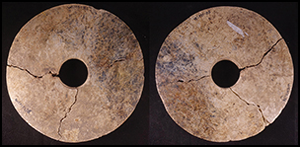
Oracle bone inscriptions of the late Shang Dynasty (1250–1046 BC) record the burning of jade as a ceremonial sacrifice, a practice now corroborated archaeologically. The origins of ceremonial jade burning, however, are unclear. Using archaeometric methods and experimental archaeology, the authors examine an assemblage of jade objects from the late Liangzhu-period (2600–2300 BC) cemetery of Sidun. The cause of the jades’ variable surface colours has been long debated. The results presented here demonstrate that the colour changes relate to alterations in chemical composition due to exposure to fire. The evidence from Sidun confirms that the burning of jade in China commenced more than a millennium earlier than previously documented.
In this chapter, the literary, documentary, and archaeological evidence pertaining to horticulture and arboriculture in eastern Gallia Cisalpina and in Campania is investigated. The chapter argues that these two regions of Roman Italy played an important role for horticultural developments in the late Republic and early imperial era, both as producers of fruit and vegetables and possibly also as developers of new cultivars. The archaeobotanical record of Gallia Cisalpina also clearly shows that, from the Augustan era throughout the whole of the first century AD, the frequency and diversity of recovered remains of fruit greatly increased. These two regions had very important ports, Puteoli and Aquileia, which handled a large amount of trade coming from the rest of the Mediterranean and it is possible that these ports were entry routes into the wider region first, and the rest of Italy later, for new fruit trees coming from the eastern Mediterranean regions such as the peach, the apricot, and the citron/lemon.
This chapter discusses the appearance of the peach in Roman Italy as a locally cultivated plant. The peach, a plant originating from the East, had reached the eastern Mediterranean sometime in the Hellenistic period via Persia, but it was introduced to Italy only in the late first century BC/start of the first century AD. The chapter discusses the archaeobotanical and other archaeological evidence related to the cultivation of the peach and examines a large early imperial fruit farm discovered in Rome in recent years as an example of financial investment in large-scale fruit cultivation. The archaeological evidence provided by this site suggests how Rome’s aggregate demand for fresh products created the right conditions in the early Julio-Claudian period for financial investment in irrigation technology and in recent horticultural introductions such as the peach.
This chapter focuses on the appropriation and transplantation of new plants encountered during military campaigns abroad. This phenomenon, which was not exclusive to Roman generals but had various antecedents in earlier civilizations, forcefully entered Roman discourse on imperialism when even trees were displayed as spoils of war during triumphal celebrations. In elite versions of agricultural history such as Pliny’s, both the horticultural products of Roman Italy and of its new ‘imperial’ imports were considered as somehow instances of Roman civilizing processes of so-called barbarian landscapes. The chapter also discusses the possible modes of diffusion of new plants and cultivars around the empire: wealthy landowners who had properties in Italy and in various provinces, the military, who had notable geographic mobility, and traders.
This book has investigated Roman fruit cultivation from a dual perspective: the ‘idea’ of arboriculture that can be found in the ancient literary texts and the ‘reality’ of arboriculture and horticulture more generally, as revealed by archaeological data. The various sections of this study have led the reader from the examination of how plants became means of elite self-representation and how literary texts discuss the engagement with the cultivation of fruit trees and transplantation of plants, to the archaeological and archaeobotanical record for arboriculture and the arrival and diffusion of new plants in Italy and the West. This journey has revealed the distinct and charged way in which arboriculture was used in elite discourse and the notable advances in horticultural practices that characterize the first century ad.
This chapter examines the changes in agricultural practices and the dispersal of new plants in the Iberian Peninsula and in the Gallic provinces after their incorporation into the Roman empire. It investigates the effects colonization may have had on agricultural practices. The provinces chosen as case studies were the object of large colonization programmes organized by Caesar and Augustus.Although the available archaeobotanical data for these regions is uneven, it is possible to detect in these provincial territories similar trends to those observed for Roman Italy: an increase, in the late first century BC, with notable peaks in the early first century AD, in the number and variety of horticultural produce available. The evidence from northern and northeastern France and the western Netherlands suggests a connection between the presence of the army and the import of new plant foods first, and the local cultivation of some of these new plants later. Such evidence offers a compelling picture for the diffusion of cultivation techniques and dietary changes that took place in the early empire.
The introduction presents the topic of the book, its aims and type of primary material examined, discussing the problems and limitations inherent to the archaeobotanical data available. It then gives an overview of the book structure and chapter content.
Chapter 8 discusses the archaeological evidence for cultivation choices made on provincial estates, trying to establish when large-scale arboriculture was a viable and appealing choice for growers. The case study of two farms in southern France suggests that even for modest colonial famers cultivating the grapevine and making wine for the market were attractive commercial choices. The fact that these cultivated a combination of wild and cultivated vines might be indicative of the limited opportunities they had in accessing plant cuttings and young vines from nurseries. The chapter concludes by comparing the Iberian and Gallic evidence with that available for Roman Britain, a region for which rich archaeobotanical datasets exists. The Roman era increased the range of plant foods consumed and allowed the acclimatization of certain plants into Britain; here, large-scale fruit cultivation seems to have occurred on larger estates, whose proprietors had access to capital, technical knowledge and markets with sufficient aggregate demand. Roman Britain shows quite clearly that the overall pattern in the distant provinces was not so different from the heartland of Roman agriculture.
This chapter focuses on grafting of fruit trees and the development of new cultivars of fruits, exploring the ways in which grafting came to occupy a prominent metaphorical and symbolic place in elite intellectual discourse. It is argued that such ideological constructs ultimately rested on the fact that grafting is a fundamental technique in arboriculture (since propagation of plants to maintain them true to type occurs by grafting). Grafting lent itself easily to be used as the symbol of the ingenuity and control humans could exercise over nature, but also as a possible source of hubris. The emphasis literary texts give to the involvement of prominent Roman families in the development and naming of new fruit varieties suggests that this symbolic discourse was rooted in practical considerations about the economic implications of running agricultural estates for market-oriented arboriculture.