Refine search
Actions for selected content:
125539 results in Asian Studies
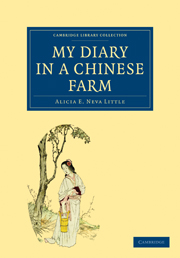
My Diary in a Chinese Farm
-
- Published online:
- 01 June 2011
- Print publication:
- 10 June 2010
- First published in:
- 1898
Mirabilia Descripta
- The Wonders of the East
-
- Published online:
- 01 June 2011
- Print publication:
- 08 April 2010
- First published in:
- 1863
Shifting Languages
-
- Published online:
- 01 June 2011
- Print publication:
- 10 December 1998

The China-Hong Kong Connection
- The Key to China's Open Door Policy
-
- Published online:
- 01 June 2011
- Print publication:
- 29 November 1991

The Sole Spokesman
- Jinnah, the Muslim League and the Demand for Pakistan
-
- Published online:
- 01 June 2011
- Print publication:
- 18 April 1985
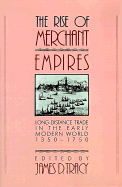
The Rise of Merchant Empires
- Long Distance Trade in the Early Modern World 1350–1750
-
- Published online:
- 01 June 2011
- Print publication:
- 27 April 1990
Law and Legal Institutions of Asia
- Traditions, Adaptations and Innovations
-
- Published online:
- 01 June 2011
- Print publication:
- 25 January 2011
Inside China's Grand Strategy: The Perspective from the People's Republic. Ye Zicheng (edited and translated by Steven I. Levine and Guoli Liu) Lexington: University of Kentucky Press, 2011. xii + 301 pp. $35.00. ISBN 978-0-8131-2645-6
-
- Journal:
- The China Quarterly / Volume 206 / June 2011
- Published online by Cambridge University Press:
- 20 June 2011, pp. 426-428
- Print publication:
- June 2011
-
- Article
- Export citation
From Dispute to Decision: Suing Polluters in China*
-
- Journal:
- The China Quarterly / Volume 206 / June 2011
- Published online by Cambridge University Press:
- 20 June 2011, pp. 294-312
- Print publication:
- June 2011
-
- Article
- Export citation
China Safari: On the Trail of Beijing's Expansion in Africa. Serge Michel and Michel Beuret. New York: Nation Books, 2009. vii + 306 pp. $17.50; £9.99. ISBN 978-1-5685-9614-4
-
- Journal:
- The China Quarterly / Volume 206 / June 2011
- Published online by Cambridge University Press:
- 20 June 2011, pp. 430-431
- Print publication:
- June 2011
-
- Article
- Export citation
La révolution fourvoyée: Parcours dans la Chine du XXe siècle. Lucien Bianco. Aix en Provence: Editions de l'Aube, 2010. 231 pp. €22.00. ISBN 978-2-8159-0054-6 - Les origines de la révolution chinoise, 1915–1949. Lucien Bianco. Paris: Gallimard, 2007 (revised edition). 528 pp. €10.50. ISBN 978-2-07-030642-8
-
- Journal:
- The China Quarterly / Volume 206 / June 2011
- Published online by Cambridge University Press:
- 20 June 2011, pp. 432-434
- Print publication:
- June 2011
-
- Article
- Export citation
Books Received: (January–March 2011)
-
- Journal:
- The China Quarterly / Volume 206 / June 2011
- Published online by Cambridge University Press:
- 20 June 2011, pp. 462-466
- Print publication:
- June 2011
-
- Article
- Export citation
Malyn Newitt (ed.): The Portuguese in West Africa, 1415–1670: A Documentary History. xviii, 246 pp. Cambridge: Cambridge University Press, 2010. £19.99. ISBN 978 0 521 15914 2.
-
- Journal:
- Bulletin of the School of Oriental and African Studies / Volume 74 / Issue 2 / June 2011
- Published online by Cambridge University Press:
- 24 June 2011, pp. 342-344
- Print publication:
- June 2011
-
- Article
- Export citation
Cultural Governance and Place-Making in Taiwan and China*
-
- Journal:
- The China Quarterly / Volume 206 / June 2011
- Published online by Cambridge University Press:
- 20 June 2011, pp. 372-390
- Print publication:
- June 2011
-
- Article
- Export citation
Helen Philon (ed.) (with photographs by Clare Arni): Silent Splendour: Palaces of the Deccan, 14th–19th Centuries. 148 pp. Mumbai: Marg Publications on behalf of the National Centre for the Performing Arts, 2010. $68. ISBN 978 81 85026 96 1.
-
- Journal:
- Bulletin of the School of Oriental and African Studies / Volume 74 / Issue 2 / June 2011
- Published online by Cambridge University Press:
- 24 June 2011, pp. 330-332
- Print publication:
- June 2011
-
- Article
- Export citation
Turning Rurality into Modernity: Suzhi Education in a Suburban Public School of Migrant Children in Xiamen*
-
- Journal:
- The China Quarterly / Volume 206 / June 2011
- Published online by Cambridge University Press:
- 20 June 2011, pp. 313-330
- Print publication:
- June 2011
-
- Article
- Export citation
Quarterly Chronicle and Documentation: (January–March 2011)
-
- Journal:
- The China Quarterly / Volume 206 / June 2011
- Published online by Cambridge University Press:
- 20 June 2011, pp. 467-516
- Print publication:
- June 2011
-
- Article
- Export citation
Constructing China's Jerusalem: Christians, Power and Place in Contemporary Wenzhou. Nanlai Cao. Stanford, CA: Stanford University Press, 2011. xii + 216 pp. $21.95. ISBN 978-0-8047-7360-7
-
- Journal:
- The China Quarterly / Volume 206 / June 2011
- Published online by Cambridge University Press:
- 20 June 2011, pp. 444-446
- Print publication:
- June 2011
-
- Article
- Export citation
Hyun Jin Kim: Ethnicity and Foreigners in Ancient Greece and China. vi, 217 pp. London: Duckworth, 2009. £50. ISBN 978 0 7156 3807 1.
-
- Journal:
- Bulletin of the School of Oriental and African Studies / Volume 74 / Issue 2 / June 2011
- Published online by Cambridge University Press:
- 24 June 2011, pp. 334-336
- Print publication:
- June 2011
-
- Article
- Export citation
Agricultural Technology Extension and Adoption in China: A Case from Kaizuo Township, Guizhou Province*
-
- Journal:
- The China Quarterly / Volume 206 / June 2011
- Published online by Cambridge University Press:
- 20 June 2011, pp. 412-425
- Print publication:
- June 2011
-
- Article
- Export citation
