To save content items to your account,
please confirm that you agree to abide by our usage policies.
If this is the first time you use this feature, you will be asked to authorise Cambridge Core to connect with your account.
Find out more about saving content to .
To save content items to your Kindle, first ensure no-reply@cambridge.org
is added to your Approved Personal Document E-mail List under your Personal Document Settings
on the Manage Your Content and Devices page of your Amazon account. Then enter the ‘name’ part
of your Kindle email address below.
Find out more about saving to your Kindle.
Note you can select to save to either the @free.kindle.com or @kindle.com variations.
‘@free.kindle.com’ emails are free but can only be saved to your device when it is connected to wi-fi.
‘@kindle.com’ emails can be delivered even when you are not connected to wi-fi, but note that service fees apply.
'In this rich history of everyday encounters between US soldiers and Chinese civilians, Chunmei Du explores their entangled relations from the end of World War II to the founding of the People's Republic of China. Drawing upon official, popular and personal accounts from both countries, Du examines the sensorial, material, and symbolic exchanges that took place between GIs and ordinary Chinese people-stall vendors, pedestrians, rickshaw pullers, 'Jeep girls,' and suspected thieves. Through the conceptual lens of the everyday, this book reveals how interactions such as traffic accidents, sexual relations, theft, and black-market dealings, impacted larger political dynamics during this pivotal era. Du shows how mundane struggles made imperialism and sovereignty tangible, fueling anti-American sentiment. Meanwhile, these encounters fostered informal diplomacy, shaping identities and forging new bonds that left a lasting imprint on both countries. This title is also available as Open Access on Cambridge Core.'
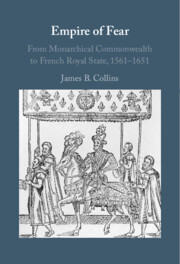
While French political discourse in the late Middle Ages had been based on ancient Roman ideas that government existed for the common good (le bien public, or la chose publique, a French translation of the Latin res publica), these ideas began to evolve in the 1570s. Although references to the common good continued to be used right up to the French Revolution, they were gradually overtaken by a focus on the good of the State (le bien de l'État). James B. Collins demonstrates how this evolution in language existed at every social level from the peasant village up to the royal court. By analysing the language used in scores of local, regional and national lists of grievances presented to provincial estates and the Estates-General, Collins demonstrates how the growth was as much a bottom-up process as a top-down enforcement of royal power.
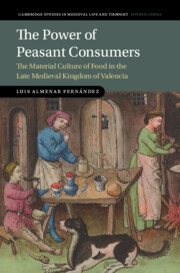
The long-held view of the peasantry as a passive social group has gradually been replaced by a positive narrative that stresses peasant agency in economic, social, and even political terms. Contributing to this shift, Luis Almenar Fernández explores the objects that peasants used to store, cook, and serve their food in late medieval Valencia. Drawing on a range of archival, visual, material, and literary evidence from c. 1280 to c. 1460, the book examines the materiality of food to shed light on the consumer behaviour of agriculturalists during pivotal economic, social, and material transformation. It builds on discussions about changes in living standards, consumption patterns, and material culture in pre-industrial European societies. The materiality of food improved significantly among Valencian peasants during this period. This phenomenon had widespread implications for the economy and underpinned the development of new industries, contributing to the economic growth of this prominent Mediterranean polity.
Small linguistic tricks can have big footprints. This book examines how India's current Hindu nationalist government uses language as a weapon against its Muslim citizens. Each chapter provides a discursive history of matters that have been a source of conflict between Hindus and Muslims in India, highlighting the potent relationship between language and politics. The book explores four issues, Ramajanmbhoomi temple, Muslim Personal Law as it pertains to Indian Muslim women, Kashmir and revocation of Article 370, and Citizenship (Amendment) Act/National Registry of Citizens, whose histories in courts and legislative bodies are written in linguistic trickery. Offering novel ways of understanding why the Hindu right has claimed victories on these legislative and judicial matters that impact the lives of minority citizens, it is essential reading for key insights for academic researchers and students in sociolinguistics, as well as South Asia studies, gender studies and Indian politics and culture.
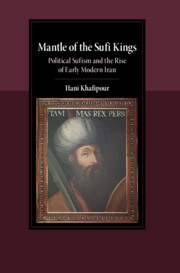
The rise and establishment of Safavid rule in Iran is a clear and momentous event in the wider history of the Middle East and Islamic world. In this study, Hani Khafipour explores how loyalty, social cohesion, and power dynamics found in Sufi thought underpinned the Safavid community's sources of social power and determination. Once in power, the Safavid state's patronage of art, literature, and architecture, turned Iran into a flourishing empire of culture, influencing neighboring empires including the Ottomans and Mughals. Examining the origin and evolution of the Safavid order, Mantle of the Sufi Kings offers fresh insights into how religious and sociopolitical forces merged to create a powerful Shi'i empire, with Iran remaining the only Shi'i nation in the world today. This study provides a bold new interpretation of Iran's early modern history, with important implications for the contemporary religio-political discourse in the Middle East.
Chapter 4 turns to legal maxims, the second core element of Ibn ʿAbd al-Salām’s legal philosophy. Beginning with a survey of the evolution of maxim terminology in Shāfiʿī law from the third/ninth to the fifth/eleventh century, I show that Ibn ʿAbd al-Salām was influenced by maxim-based legal reasoning in the works of prominent Khurasani Shāfiʿī jurists. He applied their analytic method to develop his own maxims, which he extracted from substantive law and then used them to analyze the purposes and values of the law discursively. Within Ibn ʿAbd al-Salām’s legal philosophy, maxims constitute a bridge between the established body of legal precedents and the abstract discourse about the telos of the law as the realization of human well-being.
This article examines the evolution of a political order built on its citizens’ ambitious self-government and achievement and how the fit body became key to this order. In the first part, the article traces the origins of our current understanding of fitness back to the writings of John Locke and the invention of human agency and an ambitious pursuit of achievement as political paradigms. The second part moves on to the nineteenth century and shows how the body moved to the center of ambitious attention and how working on one’s body indicated a desire and responsibility for achievement. In the United States in particular, improving one’s physical ability meant living up to the demands of good citizenship. The article argues that fitness is a liberal political practice, and at the same time it means voluntary submission to the normative ideal of achievement and successful subjecthood.
Panama’s authorities identified and combatted unmarried cohabitation or "amancebamiento" as a threat to the social order. This chapter discusses marriage’s lack of popularity on the isthmus, due to non-Catholic cultural traditions as well as the convenience and potential advantages of “living in sin.” In particular, it notes a proliferation of young widows described as “single” but free from paternal and conjugal authority. Alongside legal and fiscal measures to promote marriage, cases for marital separation or annulment provide insights into gendered obligations associated with the sacrament. Such cases’ success at court depended upon family support and alleged compliance with gender obligations. Other women turned to magic to shape their marital, affective, and economic relations. Inquisitorial trails, recorded in the summaries sent from Lima or Cartagena to Madrid, detail the experiences of Afro-descendants whose amatory and divinatory techniques garnered them prominent clienteles or merged with indigenous traditions in nocturnal revelries. Finally, Portugal’s separation from the crown of Castile disrupted the slave trade more than Portuguese residents in Panama.
Chapter 3 focuses on Ibn ʿAbd al-Salām’s theorization of maṣlaḥa, one of the two core features of his legal philosophy. I first sketch the evolution of maṣlaḥa in the Shāfiʿī school in the centuries before Ibn ʿAbd al-Salām and then analyze his own theory of maṣlaḥa, its underlying moral philosophy, its legal normativity, and its debt to Ibn ʿAbd al-Salām’s Khurasani Shāfiʿī predecessors. The chapter also considers the challenges to the law’s rationality and morality in the Damascene milieu that likely motivated Ibn ʿAbd al-Salām’s development of his theory of maṣlaḥa.
Panama’s most important festivity, the annual Corpus Christi processions, featured the performance of gender and ethnicity. Celebrations involved Congo, Biafara, Bran, and other Black confraternities, as well as a longstanding dispute for precedence between members of the ship-builders’ and the stocking-makers’ guilds, who struggled for proximity to the monstrance. The most dramatic dispute in the Cathedral, however, entailed a battle for precedence between the wives of the city councilors and the spouses of the royal judges. Controversy over seating arrangements enabled the judges and city councilors to submit conflicts over their respective status to the king, who eventually allowed the judges’ wives, and even their mothers, to receive communion in the main chapel.
The introduction explores the idea of an Islamic legal philosophy within the broader history and historiography of Islamic thought. It situates Ibn ʿAbd al-Salām’s career and reputation in historical and contemporary sources and situates his contribution in the fields and debates of Islamic intellectual and legal history. It explains the importance of the study and the key contributions it makes. Finally, it presents an overview of the sources used in the study and an outline of each of the book’s chapters.