To save content items to your account,
please confirm that you agree to abide by our usage policies.
If this is the first time you use this feature, you will be asked to authorise Cambridge Core to connect with your account.
Find out more about saving content to .
To save content items to your Kindle, first ensure no-reply@cambridge.org
is added to your Approved Personal Document E-mail List under your Personal Document Settings
on the Manage Your Content and Devices page of your Amazon account. Then enter the ‘name’ part
of your Kindle email address below.
Find out more about saving to your Kindle.
Note you can select to save to either the @free.kindle.com or @kindle.com variations.
‘@free.kindle.com’ emails are free but can only be saved to your device when it is connected to wi-fi.
‘@kindle.com’ emails can be delivered even when you are not connected to wi-fi, but note that service fees apply.
Developing Consumers: A History of Wants and Needs in Postwar South America offers a comparative social and economic history of South America’s developmental decades, from the 1950s to the mid-1970s. In the aftermath of World War II, Argentina, Brazil, and Chile implemented state-led strategies to secure economic sovereignty, raise living standards, and expand domestic markets. These policies made durable goods such as refrigerators, automobiles, and televisions increasingly available, yet access remained uneven across class, gender, and racial lines. By the 1960s, these commodities had become powerful symbols of modern well-being.
The dissertation examines how people experienced this transformation and how new forms of consumption reshaped ideas of welfare, citizenship, and inequality. By the decade’s end, it was clear that the developmental state could not deliver social mobility or universal access to modern comforts, leading to widespread frustration. Policy makers, marketing experts, and intellectuals debated how to “rationalize” consumption—deciding which needs should be guaranteed for all and which reflected elite privilege.
Building on the premise that etiquette (adab-ı muaşeret) is a crucial component in understanding Turkish cultural modernization, this article examines how the Turkish military incorporated Western manners during the Republican era. While the military’s role in supporting Westernization is well documented, less scholarly attention has been paid to the internalization and practice of Western cultural norms, particularly etiquette, within military circles. Conceptualizing manners as a disciplined and refined mode of conduct, this study investigates how Western etiquette was transmitted to military officers and integrated into their personal and professional lives. The article argues that, although military texts on etiquette presented Western manners as essential to social status and modernization, their implementation was characterized by selective adoption, ambiguity, and even resistance. These texts, often compiled by officers themselves, reflect both a desire to assert cultural authority and the complex, negotiated process of Westernization. Drawing on two primary sources – etiquette manuals and officers’ self-narratives – the study illuminates the contested and dynamic nature of adopting Western norms. This dual approach highlights the formation of a cultural identity among officers marked by eclecticism and ambivalence, revealing broader tensions within the Turkish modernization project.
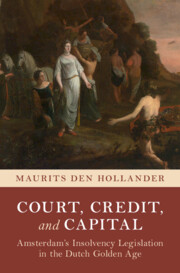
Seventeenth-century Amsterdam was a city of innovations. Explosive economic growth, the expansion of overseas trade, and a high level of religious tolerance sparked great institutional, socioeconomic and legal changes, a period generally known as 'the Dutch Golden Age.' In this book, Maurits den Hollander discusses how insolvency legislation contributed to the rise of a modern commercial order in seventeenth-century Amsterdam. He analyzes the procedure and principles behind Amsterdam's specialized insolvency court (the Desolate Boedelskamer, 1643) from a theoretical perspective as well as through the eyes of citizens whose businesses failed. The Amsterdam authorities created a regulatory environment which solved insolvency more leniently, and thus economically more efficiently, than in previous times or places. Moving beyond the traditional view of insolvency as a moral failure and the debtor as a criminal, the Amsterdam court recognized that business failure was often beyond the insolvent's personal control, and helped restore trust and credit among creditors and debtors.
This article examines why, beginning in 1946, the Brazilian government under President Eurico Dutra supplied arms to Dominican dictator Rafael Trujillo, fuelling a regional arms race and reshaping Caribbean Basin dynamics at the onset of the Cold War. It argues that these transfers bypassed conventional diplomatic channels, reflected radical anti-communist currents within Dutra’s inner circle and undercut US non-proliferation efforts. Far from a passive ally, Brazil emerged as a pivotal, if under-recognised, actor in the continental polarisation that led to democratic collapse in Venezuela (1948), Cuba (1952) and Guatemala (1954). The article challenges assumptions of Brazil’s limited Latin American engagement and repositions Dutra’s foreign policy within broader continental strategies of ideological alignment and regional influence. Drawing on Brazilian diplomatic and press sources, as well as archival and printed materials from across Latin America, Europe and the United States, it addresses historiographical gaps around Dutra’s agency and reveals the material underpinnings of Trujillo’s aggression, contributing to a revised understanding of Brazil’s Cold War trajectory.
Huainanzi 淮南子 contributes a model of sage rulership as, among other things, rule through wuwei 無為, or “non-action.” Through analysis of several concepts core to the text’s political cosmology of governance by wuwei—qi 氣 (vital breath, energy-matter), resonance (gan-ying 感應), and sincerity (cheng 誠)—this article suggests that Huainanzian sagely wuwei refers to an act that seemingly straddles a patterned level of reality of distinct forms, on the one hand, and a primordial, chaos-like reality, beyond the bounds of form, on the other. In an effort to grasp, first, how a singular Huainanzian cosmos may present two seemingly structurally antithetical faces, and second, how the sage-ruler’s program may not only embrace, but put to powerful political effect, the paradoxical union of these two “faces,” this paper draws on a heuristic of fractal and Euclidean geometries, simplified from modern mathematics. The article thereby contributes a further representational modality for thinking through Huainanzi’s extensive, multi-faceted political cosmology, joining in discourse a recent swell of research interested in the same.
This study chronicles the major discovery of textual evidence about the eastward diffusion of two major world religions, Christianity and Manichaeism, along the Silk Road, and their eventual arrival in Tang China. It begins with the well-known discovery of the Xi’an Monument (once called the Nestorian Monument) in the seventeenth century and the controversy it stirred up in European scholarship because it was a relic of the (Christian) Church of the East. The study then focuses on discoveries of both Christian and Manichaean material made at the eastern end of the Silk Road, especially at Kaochang (medieval Qočo) and Dunhuang, which authenticated the Monument and inaugurated the study of the history of these two religions in pre-Modern China. The final part of the study chronicles the survival of these two Near-Eastern religions in China and asks whether our knowledge of Christianity in China under the Mongols contributes to the ongoing debate on the historicity of Marco Polo’s visit to China proper.
Pregnancy scams or fraudulent representations of pregnancy – a situation where a woman who knows that she is not pregnant, or has no reason to suspect that she is, deceives her spouse or sexual partner into believing that she is, usually for her own self-interest – have become a common phenomenon in Ghana, and the media is replete with such episodes. However, even though these media publications are useful in bringing this practice to the attention of the public, an analysis of the legal ramifications of, and the criminal justice response to, the phenomenon is virtually non-existent in the academic literature. Drawing on pertinent judicial decisions, statutes and academic literature, the present study offers an exposition of the legal implications of the pregnancy scam phenomenon in contemporary Ghana. It explores the extent to which this type of fraud is (un)actionable, highlighting important legal principles and controversies.
For decades, the study of Chartism has been one of the most vibrant fields of modern British history. Indeed, this nineteenth-century radical movement was a major empirical focus for proponents of the so-called linguistic turn that has exerted such a major influence on the discipline. Interest in the Chartists does not abate, with valuable recent studies all combining—to greater or lesser extent—close attention to Chartist verbal and symbolic forms of communication with novel thematic concerns. However, more remains to be said about the language of Chartism, the topic that provided the original impetus for so much subsequent work. Specifically, the generally accepted argument that languages of constitutionalism and democracy were inextricably intertwined can be questioned, a task made easier by digitization of key organs of the Chartist press. This article revisits this intertwining in the pages of the Northern Star from the movement’s beginnings in the late 1830s to its disintegration in the late 1840s. It commences with results of a quantitative analysis of Chartist discourse and reconsideration of the relationship between the constitutional and democratic idioms in the movement’s early phase. Four factors are then discussed, which help explain the increasing prevalence of the language of democracy through the 1840s: heightened social conflict during the general strike of 1842; Chartist engagement in formal politics; international developments; and the crisis of 1848. However, despite the dominant linguistic trend, connections between democracy and social class, forged in the early 1840s, were not immutable but contingent.
In this book, Ann Marie Yasin reveals the savvy and subtle ways in which Roman and late Roman patrons across the Mediterranean modulated connections to the past and expectations for the future through their material investments in old architecture. Then as now, reactivation and modification of previously built structures required direct engagement with issues of tradition and novelty, longevity and ephemerality, security and precarity – in short, with how time is perceived in the built environment. The book argues that Roman patrons and audiences were keenly sensitive to all of these issues. It traces spatial and decorative configurations of rebuilt structures, including temples and churches, civic and entertainment buildings, roads and aqueducts, as well as theways such projects were marked and celebrated through ritual and monumental text. In doing so, Yasin charts how local communities engaged with the time of their buildings at a material, experiential level over the course of the first six centuries CE.
Anchoring an Empire is a bottom-up exploration of how gender and ethnicity shaped the lived experience of Spanish subjects across the sixteenth- and seventeenth-century isthmus of Panama. Focusing on understudied historical actors, Bethany Aram sheds light on how indigenous Americans, Afro-descendants, and Europeans contributed to critical debates on race and gender. From the Caribbean port cities of Nombre de Díos and Portobello, to Panama Viejo on the Pacific coast, free, enslaved, and in-between women and men managed to become arbiters of Spanish and competing interests. Those who lived and died in these cities sustained them as hubs of interaction, communication, and commerce. Whether victims, beneficiaries – or both – of the slave trade, these individuals found ways to meet and to exploit the region's episodic demand for housing, provisions, and other services. Their expertise grounded global transport and trade, with a lasting impact on processes of mobility and globalization.
This paper proposes constructing a new series of Brazilian sugar imports to Portugal between 1761 and 1807. The new customs data collected provides quantities, Brazilian origin, quality and taxes of the sugar. Based on the results of the empirical research, we demonstrate and corroborate the Brazilian sugar renaissance in the second half of the eighteenth century, a period of crisis in the colony’s mining industry and in the Portuguese trade balance. The growth of the sugar economy in the colony contributed to the adjustment of Portugal’s external accounts. The new information has allowed us to verify the increase in Brazilian sugar exports, especially after the early 1770s, despite the stagnation of the Portuguese economy.
Author of Il Regno del Sud (1946), an influential first-hand history of the Kingdom of Italy that was set up in Allied territory after the 1943 armistice, Agostino degli Espinosa did much to shape Italian memory of the Allied occupation of Italy. In this article I examine for the first time degli Espinosa’s doubts about Italy’s postwar future, which appear in the margins of his history, and which come to the fore in his fiction. I argue that the critical re-evaluation of the work of this emblematic but understudied figure can shed light on Italy’s divided memories of the Second World War and the Allied occupation.
This article examines Himizu (2012) by Sono Shion, analyzing the protagonist’s classroom and shanty house as key sites in post-3/11 Japan. Drawing on Foucault’s concept of heterotopia, the study shows how these spaces function as zones where discourses of reconstruction, wa, sontaku, kizuna, and gaman are enforced and contested. While the classroom shifts from ideological apparatus to heterotopia of deviation, the shanty house enables care amid exclusion. Overall, the article advances debates on post-disaster cinema and spatialized trauma.
This article examines women’s storytelling and nanga (harp) performances in nineteenth- and twentiethcentury western Uganda to investigate how these songs shaped community identity and norms. Drawing on musical recordings, archival sources, and interviews, this article demonstrates that these performances functioned as important public histories, teaching audiences about past famines, droughts, climate change, and cattle events. These narratives both chronicled regional histories and provided the shared intellectual material from which community norms and a shared identity could be articulated. Extant scholarship has focused overwhelmingly on how male intellectuals contributed to ideas of race, nation, or ethnicity. This article thus provides an important alternative by showing how women produced histories that contributed to group identity—yet this historical production occurred through musical performances rather than in books, tracts, or petitions. In doing so, this article reintegrates western Ugandan women into narratives of imperial encounters and intellectual history.
In 1782, Zhang Peifang, then serving as magistrate in Sizhou, Anhui, returned briefly to his family home in a small village in central Shanxi. While there, he visited a local temple, the Guangyu Shrine, where villagers typically made prayers concerning childbirth, and then penned an inscription in which he makes an elaborate argument about the identity of the temple goddess. Zhang’s stele inscription is an interpretive powerhouse of classical erudition, but moves to a surprising conclusion that reveals complex issues of agency imbricated into the scholar-official’s role as negotiator between the canonical values of the imperial state and the informal institutions and practices of local communities. The inscription records valuable details concerning local religious practices and gender roles, analysis of which can provide nuance to our understanding of the dynamic social tensions below the surface of Watson’s “standardization model.”
This article examines the experiential and perceptual environment in which social encounters between soldiers and civilians occurred in Allied-occupied Italy (1943–45) and its enduring impact on the lives of those who experienced it. It does so by applying Mary Louise Pratt’s theoretical framework of the ‘contact zone’ to the case of occupied Italy and by exploring it through the lens of oral history sources. The critical analysis of interviews with Antonio Taurelli, an Italian teenager in 1944 who fought with American soldiers, and Harry Shindler, a British veteran who married an Italian woman during the war, sheds light on how ordinary individuals shaped their own experience of occupation within the contact zone as well as on the life-changing impact of their encounters with ‘otherness’. This article aims to contribute to our understanding of the social experience of the Allied occupation of Italy and the impact of military-civilian encounters in occupation environments more broadly.
This article presents the first study of an oath-letter (sawgand-nāma) from medieval Anatolia. It is drawn from the recently rediscovered Qiṣṣa-yi Salāṭīn, an anonymous inshāʾ work from the mid-thirteenth century. This text exemplifies a typical bottom-up oath in which the oath-taker pledges loyalty to Sultan Ghiyāth al-Dīn Kay-Khusraw II (d. 644/1246), while the oath also ensures a clear line of dynastic succession in favour of his son, ʿAlāʾ al-Dīn Kay-Qubād II (d. 655/1257). A comparison with similar texts from Iran reveals the extent to which Turkish states in Anatolia adhered to the norms established under the Great Saljuqs, although the Rum Saljuq version is noted to be more severe in ideological terms in cases of perjury, yet less demanding in practical aspects. This sawgand-nāma also highlights how the Qiṣṣa-yi Salāṭīn might have functioned as a sort of “para-archive”, potentially supporting the claims of ʿAlāʾ al-Dīn, who was sidelined after his father’s death.