To save content items to your account,
please confirm that you agree to abide by our usage policies.
If this is the first time you use this feature, you will be asked to authorise Cambridge Core to connect with your account.
Find out more about saving content to .
To save content items to your Kindle, first ensure no-reply@cambridge.org
is added to your Approved Personal Document E-mail List under your Personal Document Settings
on the Manage Your Content and Devices page of your Amazon account. Then enter the ‘name’ part
of your Kindle email address below.
Find out more about saving to your Kindle.
Note you can select to save to either the @free.kindle.com or @kindle.com variations.
‘@free.kindle.com’ emails are free but can only be saved to your device when it is connected to wi-fi.
‘@kindle.com’ emails can be delivered even when you are not connected to wi-fi, but note that service fees apply.
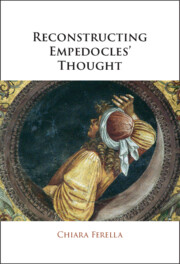
By first providing a summary of the main arguments in each chapter and then highlighting the ways, elaborated in this study, in which Empedocles’ physics is consistent with his religious interests in rebirth and purification, Chapter 8 sets out the main conclusion of this book, namely that rebirth and purification are an integral part of Empedocles’ physical system; indeed, that rebirth seems to be a premise of some of his physical principles and theories. In doing so, in addition to a new textual reconstruction of the proem of the physical poem, this book offers new insights into pivotal concepts and much debated issues of Empedocles’ thought, such as the conceptualization of rebirth and the notions of daimon, soul and personal survival, the purpose and role of physical doctrine for release from rebirth, the reconstruction of the cosmic cycle and the analysis of its moral significance. Finally, it is emphasized that this novel reconstruction of Empedocles’ thought, together with the book’s methodological standard, can provide a key to approaching and re-evaluating the character and aims of the thought of other early thinkers and of fifth-century natural philosophy in general.
Aiming at reconstructing the prologue to On Nature, the first part of this chapter focuses on the collocation of the demonological fragments which, by expanding on Empedocles’ exile introduced in B 115, depict his katabasis into the realm of the dead. The narrative of this extraordinary journey serves Empedocles as authorial legitimation on matters beyond ordinary human knowledge. The second part of Chapter 2 reconstructs the rest of the proem by interweaving traditionally introductory themes, such as the dedication to Pausanias and the invocation to the Muse, with novel topics concerning the rejection of ritual sacrifice based on Empedocles’ concept of rebirth. The proem thus reconstructed presents a coherent programmatic structure and makes sense of several Empedoclean fragments that are essential for a comprehensive and impartial understanding of his thought. Moreover, by showing that religious concerns inform the entire introductory section, the new proem indicates that the concept of rebirth is central to Empedocles’ physical system and thus offers a new basis to rethink the interplay of myth, religion, and physics in his natural philosophy.
In the Introduction I set out the main argument of the book, namely the demonstration that Empedocles’ doctrine of rebirth is not only a positive doctrine within On Nature, but is central to his physical system. Then, after briefly tracing the history of the reception of Empedocles’ thought up to the modern era and showing thereby the importance of this thinker in the history of ancient philosophy, I discuss the state of the art related to the book’s main argument. Building on Kahn’s fundamental reappraisal of Empedocles’ doctrinal unity, my book considers the Strasbourg papyrus as evidence for a new reconstruction of Empedocles’ physical poem and thus for a rethinking of his philosophy in terms of a unified system of thought. Therefore, by aiming to demonstrate the ways in which Empedocles’ physics integrates, on a textual and contextual basis, the details of his doctrine of rebirth, sometimes even giving the impression of being premised on it, it is argued that this study is also relevant to a reassessment of the nature and intent of ancient Greek philosophy in general.
Chapter 3 focuses on δαίμων and its significance in Empedocles’ concept of rebirth. I show that the demonological fragments and the term δαίμων, in particular, emphasize Empedocles’ divine nature in contrast to the rest of humankind and cannot represent, as is generally believed, the place where his personal vicissitude becomes exemplary of every soul’s destiny, thus grounding his doctrine of rebirth. To define what Empedocles intended when he called himself a reincarnated δαίμων, I analyze Plato’s myths of the soul’s otherworldly journeys and some fragments attesting to Pythagoras’ demonology. While Plato, in his concept of rebirth, conceptualized the δαίμονες as deities who guide souls during and beyond this life, Pythagoras articulated the idea that a god could exceptionally undergo rebirths, but these are usually reserved for ordinary souls. Following Pythagoras and anticipating Plato, Empedocles constructs his demonology which is linked, but does not overlap, with his doctrine of rebirth. Finally, addressing the issue of the ‘physical’ δαίμων in B 59 I argue that δαίμων is a predicative notion which, in all Empedoclean occurrences, is still intimately connected to the traditional sense of ‘god’.
To understand Empedocles' thought, one must view his work as a unified whole of religion and physics. Only a few interpreters, however, recognise rebirth as a positive doctrine within Empedocles' physics and attempt to reconcile its details with the cosmological account. This study shows how rebirth underlies Empedocles' cosmic system, being a structuring principle of his physics. It reconstructs the proem to his physical poem and then shows that claims to disembodied existence, individual identity and personal survival of death(s) prove central to his physics; that knowledge of the cosmos is the path to escape rebirth; that purifications are essential to comprehending the world and changing one's being, and that the cosmic cycle, with its ethical import, is the ideal backdrop for Empedocles' doctrine of rebirth. This title is part of the Flip it Open Programme and may also be available Open Access. Check our website Cambridge Core for details.
The Stoics distinguish two forms of eros. In vicious agents eros is indeed a passion and thus born out of a defective rational judgment about what is needed for happiness. But there is also a positive form of erotic love, practiced by the Sage on the basis of knowledge, which aims to reproduce his virtuous condition in others. In this Element, the author shows how the Stoics' wider theoretical commitments in ethics, epistemology, aesthetics, and psychology support their duplex account of eros. They also consider the influence of Plato's Symposium on the Stoic account, arguing for hitherto unrecognized links with Socratic moral psychology. The Element concludes with an assessment of how the Stoic erotic ideal fares in relation to our intuitions about the non-egoistic and particularized nature of love.
Chapter 6 centres on Galen’s longest moral work, the Affections and Errors of the Soul, and explores the features of Galenic practical philosophy from a number of angles. The first section provides an analysis of the work’s programmatic preface and shows that Galen exploits the dynamics of polemic, self-promotion and self-effacement to cast himself as a prominent contributor in this intellectual area. The next section discusses Galen’s emphasis on self-knowledge, which is often blocked by self-love. It claims that in order to generate feelings of revulsion with regard to the latter, Galen works on ‘class fraction’ as a tactic with moralising intent. Another strand of special importance in the essay is the figure of the moral adviser, which Galen elaborates on so as to highlight the need for welcoming and indeed enduring moral criticism. Even though the moral adviser features in other authors of the Second Sophistic, in Galen it points to the applicability of ethics to a broad range of social contexts, thus credentialing his situational ethics. A separate section of Chapter 6 focuses on the concept of free speech (parrhēsia). While Galen debates the challenges of social and political interaction, he advises frankness at all costs. A genuine friend should never be reluctant to express the truth of someone’s moral situation and this makes him strikingly different from the flatterer, a disgusting stock figure in Imperial works on moralia, particularly in Plutarch, whom Galen seems to follow here. Another shrewd device that Galen uses to good effect to achieve the moral rectification of readers is the description of the pathology of anger (its origins and results), particularly in the episode featuring Galen’s Cretan friend, which is framed, I suggest, as an ‘ethical case history’, sharing characteristics with Galen’s medical case histories.
This Chapter explains in detail how Galen endows medical science with moral probity. In broad outline, he extrapolates moral principles from his ethical programme to feed into his medical accounts and thus reveal his personal responses to what he represents as the immorality of other doctors. Assigning praise and blame or stressing social shame and fear are central moral-didactic devices here, as is reproach with a view to moral amendment or Galen’s attempts at self-deprecation in order to affect his readers’ moral activity.
The Introduction familiarises the reader with Galen, his life and work, and offers essential information on his engagement with ethical philosophical writings. It also provides a brief introduction to practical ethics in antiquity, and foregrounds the contribution of the present study and the methodology through which the study will explore the topic under investigation. Finally, the Introduction gives an overview of the main chapters of the book.
This Chapter discusses some of Galen’s technical works, especially those dealing with physiological psychology to show that Galen’s resourceful combination of popular philosophy and medicine is intended to promote mental alertness in his readers in various aspects of their personal and social lives, such as the symposium or the area of maintaining good health (hygiene). The control of emotions and the social embeddedness of ethics that Galen emphasises in these passages while at the same time describing the physical basis of character formation, make him stand out from other medical authors inasmuch as they reveal his proposed vision of a moral form of medicine.
Chapter 1 provides a systematic account of the main moral themes and types of moralism in Galen. Among these, the most general level is represented by an unparticularised moralism, in which the author pronounces ethical verdicts with universal application. Galen’s aim here is not to override moral relativism (in the modern sense of the term) nor restrain moral freedom. Rather, he seeks to delimit what he wishes to stigmatise as deviant behaviour as lucidly as possible, so as to be able to offer rudimentary directives for goodness effectively. In this model of basic moralism, even though there are instances where the author’s moral viewpoint features in a commanding fashion, reference is made to an astute reader who either embraces, upon reflection, Galen’s viewpoint or judiciously considers what is at stake when the former goes astray.