Refine search
Actions for selected content:
7008 results in Algorithmics, Complexity, Computer Algebra, Computational Geometry
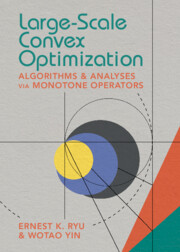
Large-Scale Convex Optimization
- Algorithms & Analyses via Monotone Operators
-
- Published online:
- 12 December 2022
- Print publication:
- 01 December 2022
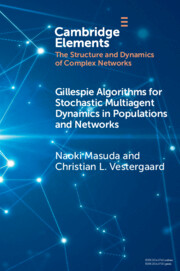
Gillespie Algorithms for Stochastic Multiagent Dynamics in Populations and Networks
-
- Published online:
- 12 December 2022
- Print publication:
- 05 January 2023
-
- Element
-
- You have access
- Open access
- HTML
- Export citation
A bipartite version of the Erdős–McKay conjecture
- Part of
-
- Journal:
- Combinatorics, Probability and Computing / Volume 32 / Issue 3 / May 2023
- Published online by Cambridge University Press:
- 09 December 2022, pp. 465-477
-
- Article
-
- You have access
- Open access
- HTML
- Export citation
-
An old conjecture of Erdős and McKay states that if all homogeneous sets in an $n$-vertex graph are of order $O(\!\log n)$ then the graph contains induced subgraphs of each size from $\{0,1,\ldots, \Omega \big(n^2\big)\}$. We prove a bipartite analogue of the conjecture: if all balanced homogeneous sets in an $n \times n$ bipartite graph are of order $O(\!\log n)$, then the graph contains induced subgraphs of each size from $\{0,1,\ldots, \Omega \big(n^2\big)\}$.


Fluctuations of subgraph counts in graphon based random graphs
- Part of
-
- Journal:
- Combinatorics, Probability and Computing / Volume 32 / Issue 3 / May 2023
- Published online by Cambridge University Press:
- 09 December 2022, pp. 428-464
-
- Article
- Export citation
-
Given a graphon $W$ and a finite simple graph $H$, with vertex set $V(H)$, denote by $X_n(H, W)$ the number of copies of $H$ in a $W$-random graph on $n$ vertices. The asymptotic distribution of $X_n(H, W)$ was recently obtained by Hladký, Pelekis, and Šileikis [17] in the case where $H$ is a clique. In this paper, we extend this result to any fixed graph $H$. Towards this we introduce a notion of $H$-regularity of graphons and show that if the graphon $W$ is not $H$-regular, then $X_n(H, W)$ has Gaussian fluctuations with scaling $n^{|V(H)|-\frac{1}{2}}$. On the other hand, if $W$ is $H$-regular, then the fluctuations are of order $n^{|V(H)|-1}$ and the limiting distribution of $X_n(H, W)$ can have both Gaussian and non-Gaussian components, where the non-Gaussian component is a (possibly) infinite weighted sum of centred chi-squared random variables with the weights determined by the spectral properties of a graphon derived from $W$. Our proofs use the asymptotic theory of generalised $U$-statistics developed by Janson and Nowicki [22]. We also investigate the structure of $H$-regular graphons for which either the Gaussian or the non-Gaussian component of the limiting distribution (but not both) is degenerate. Interestingly, there are also $H$-regular graphons $W$ for which both the Gaussian or the non-Gaussian components are degenerate, that is, $X_n(H, W)$ has a degenerate limit even under the scaling $n^{|V(H)|-1}$. We give an example of this degeneracy with $H=K_{1, 3}$ (the 3-star) and also establish non-degeneracy in a few examples. This naturally leads to interesting open questions on higher order degeneracies.


Acknowledgments
-
- Book:
- Large-Scale Convex Optimization
- Published online:
- 12 December 2022
- Print publication:
- 01 December 2022, pp xiv-xiv
-
- Chapter
- Export citation
Appendix A - Miscellaneous
-
- Book:
- Large-Scale Convex Optimization
- Published online:
- 12 December 2022
- Print publication:
- 01 December 2022, pp 271-272
-
- Chapter
- Export citation
Preface
-
- Book:
- Large-Scale Convex Optimization
- Published online:
- 12 December 2022
- Print publication:
- 01 December 2022, pp xi-xiii
-
- Chapter
- Export citation
12 - Acceleration
- from Part Two: - Additional Topics
-
- Book:
- Large-Scale Convex Optimization
- Published online:
- 12 December 2022
- Print publication:
- 01 December 2022, pp 233-241
-
- Chapter
- Export citation
13 - Scaled Relative Graphs
- from Part Two: - Additional Topics
-
- Book:
- Large-Scale Convex Optimization
- Published online:
- 12 December 2022
- Print publication:
- 01 December 2022, pp 242-270
-
- Chapter
- Export citation
Contents
-
- Book:
- Large-Scale Convex Optimization
- Published online:
- 12 December 2022
- Print publication:
- 01 December 2022, pp vii-x
-
- Chapter
- Export citation
10 - Maximality and Monotone Operator Theory
- from Part Two: - Additional Topics
-
- Book:
- Large-Scale Convex Optimization
- Published online:
- 12 December 2022
- Print publication:
- 01 December 2022, pp 197-206
-
- Chapter
- Export citation
11 - Distributed and Decentralized Optimization
- from Part Two: - Additional Topics
-
- Book:
- Large-Scale Convex Optimization
- Published online:
- 12 December 2022
- Print publication:
- 01 December 2022, pp 207-232
-
- Chapter
- Export citation
8 - Admm-Type Methods
- from Part Two: - Additional Topics
-
- Book:
- Large-Scale Convex Optimization
- Published online:
- 12 December 2022
- Print publication:
- 01 December 2022, pp 160-189
-
- Chapter
- Export citation
7 - Stochastic Optimization
- from Part Two: - Additional Topics
-
- Book:
- Large-Scale Convex Optimization
- Published online:
- 12 December 2022
- Print publication:
- 01 December 2022, pp 147-159
-
- Chapter
- Export citation
5 - Randomized Coordinate Update Methods
- from Part One: - Monotone OPerator Methods
-
- Book:
- Large-Scale Convex Optimization
- Published online:
- 12 December 2022
- Print publication:
- 01 December 2022, pp 105-119
-
- Chapter
- Export citation
6 - Asynchronous Coordinate Update Methods
- from Part One: - Monotone OPerator Methods
-
- Book:
- Large-Scale Convex Optimization
- Published online:
- 12 December 2022
- Print publication:
- 01 December 2022, pp 120-144
-
- Chapter
- Export citation
References
-
- Book:
- Large-Scale Convex Optimization
- Published online:
- 12 December 2022
- Print publication:
- 01 December 2022, pp 273-298
-
- Chapter
- Export citation
1 - Introduction and Preliminaries
-
- Book:
- Large-Scale Convex Optimization
- Published online:
- 12 December 2022
- Print publication:
- 01 December 2022, pp 1-20
-
- Chapter
- Export citation
2 - Monotone Operators and Base Splitting Schemes
- from Part One: - Monotone OPerator Methods
-
- Book:
- Large-Scale Convex Optimization
- Published online:
- 12 December 2022
- Print publication:
- 01 December 2022, pp 23-65
-
- Chapter
- Export citation
Part One: - Monotone OPerator Methods
-
- Book:
- Large-Scale Convex Optimization
- Published online:
- 12 December 2022
- Print publication:
- 01 December 2022, pp 21-22
-
- Chapter
- Export citation
