To save content items to your account,
please confirm that you agree to abide by our usage policies.
If this is the first time you use this feature, you will be asked to authorise Cambridge Core to connect with your account.
Find out more about saving content to .
To save content items to your Kindle, first ensure no-reply@cambridge.org
is added to your Approved Personal Document E-mail List under your Personal Document Settings
on the Manage Your Content and Devices page of your Amazon account. Then enter the ‘name’ part
of your Kindle email address below.
Find out more about saving to your Kindle.
Note you can select to save to either the @free.kindle.com or @kindle.com variations.
‘@free.kindle.com’ emails are free but can only be saved to your device when it is connected to wi-fi.
‘@kindle.com’ emails can be delivered even when you are not connected to wi-fi, but note that service fees apply.
The conditions on early Earth prior to four billion years ago (Hadean Earth), which shaped the origin(s) and early evolution of life, are discussed in this chapter. It begins with a summary of the various sources of internal heat on terrestrial planets and the types of heat transport (e.g., conduction), as these factors influenced the habitability of early Earth and its temporal evolution. This is followed by an exposition of the characteristics of Hadean Earth: the Moon-forming impact, oceans, landmasses, and atmosphere, including the faint young Sun paradox – how did Earth stay unfrozen despite the Sun’s lower luminosity? The chapter concludes with sketching the putative Late Heavy Bombardment (a potential spike in the impactor rate) about four billion years ago, and a general treatment of the positives and downsides of large impacts.
The fundamental process of oceanic subduction is explored in this chapter. It discusses subduction at global scale, including how subducted lithosphere sinks into the mantle, to the transition zone between the upper and lower mantle, and sometimes all the way to the core, creating subduction slab graveyards. These graveyards are linked to velocity variations near the mantle-core boundary. The subduction zone itself is explored at crustal levels from the slab to the top. This includes the bending, fracturing and serpentinization of the oceanic slab itself, the volcanic arc, the forearc basin. The chapter discusses hydration of the downgoing slab in the context of fluid circulation and melt formation, and how melting produces shallower magmatism. It also discusses the geochemical signature of arc magmatism and the associated back-arc heat flow. It also explores trench advance and trench retreat and consequences for subduction zone processes. Oblique subduction is covered together with strain partitioning into strike-slip and orthogonal motion along convergent plate boundaries. Examples from Central America, the Sunda trench (Sumatra), and from other location around the Pacific Ocean. Toward the end of the chapter, the complicated subject of subduction initiation is discussed.
Edited by
Ottavio Quirico, University of New England, University for Foreigners of Perugia and Australian National University, Canberra,Walter Baber, California State University, Long Beach
This chapter maintains that the International Court of Justice (ICJ) may usefully intervene in the complex and multifaceted litigation that has developed before national and international tribunals, as well as human rights treaty bodies, concerning national climate policies adopted to implement international obligations. By considering the rationale and nature of climate litigation, the chapter seeks to point out what international law rules the ICJ should take into account (especially clarifying their existence and scope) in order to make a real contribution to national and international jurisprudence.
This chapter is devoted to a foundational question in astrobiology: how and where did life originate? The narrative commences with a brief description of the four major categories of biomolecules (proteins, nucleic acids, carbohydrates, and lipids) on Earth and their associated functions. Partly based on this knowledge, biophysical and biochemical constraints on the minimum size of a viable cell are derived. The various origin(s)-of-life hypotheses are discussed next – like the replication-first (e.g., RNA world) and metabolism-first paradigms – along with their attendant strengths and weaknesses. The pathways by which the building blocks of life (e.g., amino acids) could be synthesised through non-biological avenues, such as the famous Miller experiments, are elucidated. Subsequently, the abiotic channels that may facilitate the polymerisation of these molecules to yield biomolecules are delineated. The focus of the chapter is then shifted to the specialised environments that might have enabled the origin(s) of life to readily occur. Two candidates are reviewed in detail (submarine hydrothermal vents and hydrothermal fields), with others mentioned in passing. Finally, the concept of entropy and its subtle connections with living systems are sketched.
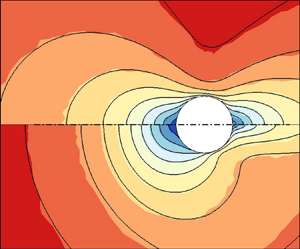
The simulation of rarefied gas flow based on the Boltzmann equation is challenging, especially when the gas mixtures have disparate molecular masses. In this paper, a computationally tractable kinetic model is proposed for monatomic gas mixtures, to mimic the Boltzmann collision operator as closely as possible. The intra- and inter-collisions are modelled separately using relaxation approximations, to correctly recover the relaxation time scales that could span several orders of magnitude. The proposed kinetic model preserves the accuracy of the Boltzmann equation in the continuum regime by recovering four critical transport properties of a gas mixture: the shear viscosity, the thermal conductivity, the coefficients of diffusion and the thermal diffusion. While in the rarefied flow regimes, the kinetic model is found to be accurate when comparing its solutions with those from the direct simulation Monte Carlo method in several representative cases (e.g. one-dimensional normal shock wave, Fourier flow and Couette flow, two-dimensional supersonic flow passing a cylinder and nozzle flow into a vacuum), for binary mixtures with a wide range of mass ratios, species concentrations and different intermolecular potentials. Pronounced separations in species properties have been observed, and the flow characteristics of gas mixtures in shock waves are found to change as the molecular mass ratio increases from 10 to 1000.
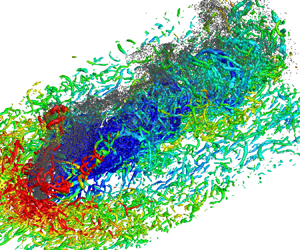
In this study, direct numerical simulation of the particle dispersion and turbulence modulation in a sonic transverse jet injected into a supersonic cross-flow with a Mach number of 2 was carried out with the Eulerian–Lagrangian point-particle method. One single-phase case and two particle-laden cases with different particle diameters were simulated. The jet and particle trajectories, the dispersion characteristics of particles, and the modulation effect of particles on the flow were investigated systematically. It was found that large particles primarily accumulate around shear layer structures situated on the windward side of the jet trajectory. In contrast, small particles exhibit radial transport, accessing both upstream and downstream recirculation zones. Moreover, small particles disperse extensively within the boundary layer and large-scale shear layers, evidently influenced by the streamwise vortices. The particles increase the mean wall-normal velocity near the wall in the wake region of the transverse jet, while reducing the mean streamwise and wall-normal velocities in outer regions. Particles significantly alter the flow velocity adjacent to shock fronts. In particular, the turbulent fluctuations near the windward barrel shock and bow shock are reduced, while those around the leeward barrel shock are increased. An upward displacement of the bow shock in the wall-normal direction is also observed due to particles. In the regions away from the shocks, small particles tend to amplify the Reynolds stress, while large particles attenuate the turbulent kinetic energy.
Active collisional orogens represent the most impressive topographic features on Earth, with enormous masses of rocks being uplifted, exposed to surface erosion and sculptured into lofty mountains and deep valleys that show vast diversity in terms of climate, biodiversity, natural resources. In this chapter the modern Himalaya is presented in more detail, together with the Alpine system and the older Grenvillan orogenic belt that provides a deeper level of orogenic erosion. Differences are discussed and related to tectonic setting, duration of collisional phase, rigidness of colliding continents, synorogenic crustal heating and precollisional accretionary history. This chapter demonstrates that while the convergent Himalayan-Tibetan system generates a regime of thrust tectonics along its margins, the Tibetan plateau is dominated by extensional tectonics and strike-slip deformation. This is related to orogenic collapse and lateral extrusion linked to flow of partially molten middle to lower crust. Geophysical data are presented that give support to this interpretation. The Scandinavian Caledonides are presented as an example of a relatively short lived but major collisional orogen with deep continental subduction and a strong phase of extensional collapse.
Edited by
Ottavio Quirico, University of New England, University for Foreigners of Perugia and Australian National University, Canberra,Walter Baber, California State University, Long Beach
The lawfulness of carbon border adjustment measures (CBAMs) under general international economic law and particular economic agreements is explored; specifically, if their international lawfulness can be determined by thinking of them as countermeasures necessary to implement climate change obligations. As there are no non-discriminatory obligations under customary international law, it is argued that CBAMs are lawful under general international law, but under particular international economic agreements they can be seen as countermeasures lawfully taken in response to breaching the obligation to curb GHG emissions, allowing their justification as a breach of primary non-discriminatory economic obligations, particularly the national treatment principle under the GATT and GATS. This shifts the burden of proving necessity/proportionality to the State in breach of the obligation. CBAMs are fundamentally lawful measures and can only give rise to compensation if it they are unnecessary/disproportionate. This chapter also assesses whether they can be thought of as erga omnes contractantes obligations under international economic agreements, particularly the GATT and the GATS.
The total 1pN gravitoelectric mass quadrupole orbital precessions of the Keplerian orbital elements are calculated in their full generality for an arbitrary orientation of the primary’s spin axis and a general orbital configuration of the test particle. Both the direct effects, due to the 1pN gravitoelectric mass quadrupole acceleration, and the mixed effects, due to the simultaneous action of the 1pN gravitoelectric mass monopole and Newtonian quadrupole accelerations, are calculated.
Edited by
Ottavio Quirico, University of New England, University for Foreigners of Perugia and Australian National University, Canberra,Walter Baber, California State University, Long Beach
This chapter discusses the building blocks of the European Union’s strategy for climate neutrality. Carbon pricing in the EU is described, focusing on the EU ETS and on the forthcoming CBAM. Then the roles of electrification and clean molecules in the future European energy system are discussed. Finally, sustainable finance priorities, capacities, and regulatory instruments put forward by the EU are reviewed, before a brief conclusion.
The motion of plates is called plate kinematics. It can be relative or absolute, and both are explained in this chapter. Surface movements can be measured from space, and the results show that active deformation, volcanism and seismicity are focused along plate boundaries. This chapter emphasizes that the Earth‘s inner seismic structure confirms that the mantle is dynamic and in constant motion. Convective mantle flow has been suggested for a century and are a major field of research because of its indirect association with plate motions. Plumes represent more localized columns of upward moving hot mantle that generate crustal magmatism and volcanoes. They work together like a big internal machinery with implications for many geologic, geophysical and biologic processes. This chapter summarizes plate tectonics and the deeper plume and hotspot processes, and how it is possible to constrain and reconstruct plate motion into the past and, to some extent, also into the future.
Edited by
Ottavio Quirico, University of New England, University for Foreigners of Perugia and Australian National University, Canberra,Walter Baber, California State University, Long Beach
Edited by
Ottavio Quirico, University of New England, University for Foreigners of Perugia and Australian National University, Canberra,Walter Baber, California State University, Long Beach
It is, by now, beyond dispute that climate change presents the single greatest environmental challenge of our times. It is equally likely that this challenge will only be met by sustained and iterative cycles of global policy formation, administrative rule-making, regulatory action, and impact assessment. The second and third of these steps, broadly speaking, constitute the process of policy implementation. While the scholarly study of policy implementation is not new, it has yet to receive serious attention in the area of climate change regulation. The reasons for this are relatively simple.
First, the policy formation stage is still ongoing. As the recent meeting of the Conference of the Parties to the United Nations Framework Convention on Climate Change (UNFCCC) in Dubai vividly demonstrates, major outstanding disagreements on the basic structure of global climate policy remain.1
Edited by
Ottavio Quirico, University of New England, University for Foreigners of Perugia and Australian National University, Canberra,Walter Baber, California State University, Long Beach
This chapter aims to inform reflection on business self-regulation (or corporate social responsibility, CSR) in addressing climate change by drawing on developments in ‘business and human rights’ and the experience accumulated in the European Union (EU). Despite dissimilarities in addressing the environmental and human right impacts of business operations, there are commonalities around incentives, impacts and regulatory dynamics of CSR that help clarify its expected place in global governance. This analysis revisits long-standing claims about CSR in light of current legal and market evolutions. The main finding is that the notion of CSR has been fundamentally transformed in the last 20 years. What is the change, what are the drivers enabling such change, and what are the expected impacts on corporate compliance and sustainability performance? The analysis contributes to the regulatory governance area, including regarding climate change, and promotes cross-fertilisation among the social and environmental areas in CSR.