Refine search
Actions for selected content:
178607 results in Earth and Environmental Sciences
JOG volume 69 issue 278 Cover and Front matter
-
- Journal:
- Journal of Glaciology / Volume 69 / Issue 278 / December 2023
- Published online by Cambridge University Press:
- 11 December 2024, pp. f1-f3
-
- Article
-
- You have access
- Open access
- Export citation
Marine biological responses to abrupt climate change in deep time
-
- Journal:
- Paleobiology / Volume 51 / Issue 1 / February 2025
- Published online by Cambridge University Press:
- 11 December 2024, pp. 97-111
-
- Article
-
- You have access
- Open access
- HTML
- Export citation
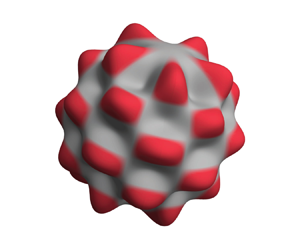
Unsteady motion of nearly spherical particles in viscous fluids: a second-order asymptotic theory
-
- Journal:
- Journal of Fluid Mechanics / Volume 1001 / 25 December 2024
- Published online by Cambridge University Press:
- 11 December 2024, A23
-
- Article
- Export citation
-
The motion of small non-spherical particles is often studied using the unsteady Stokes equations. Zhang & Stone (J. Fluid Mech., vol. 367, 1998, pp. 329–358) reported an asymptotic treatment for nearly spherical particles, to first order in particle non-sphericity, i.e. $O(\epsilon )$, where $\epsilon$ quantifies the shape deviation from a sphere. Importantly, key physical phenomena are absent at $O(\epsilon )$, including (1) coupling between the torque experienced by the particle and its linear translation, (2) coupling between the force the particle experiences and its rotation and (3) the effect of non-sphericity on the orientation averages of these forces and torques. We present an explicit asymptotic theory to second order in particle non-sphericity, i.e. $O(\epsilon ^2)$, for the force and torque acting on a particle in a general unsteady Stokes flow. The derived analytical formulae apply to particles of arbitrary shape, providing the leading-order asymptotic theory for the three above-mentioned phenomena. The theory is demonstrated for several example nearly spherical particles including a spheroid, a ‘pear-shaped’ particle and a simple model for a SARS-CoV-2 virion. This includes formulae for force and torque as a function of particle orientation and their corresponding orientation averages. Our study reveals that the orientation-averaged forces and torques experienced by a nearly spherical particle cannot be generally represented by a perfect sphere. The reported formulae are validated using finite-amplitude three-dimensional direct numerical simulations of the Navier–Stokes equations. A Mathematica notebook is also provided, facilitating implementation of the theory for particle shapes of the user's choosing.


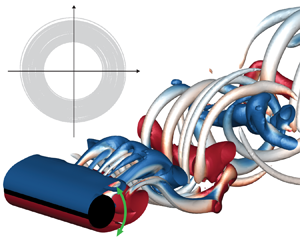
Influence of three-dimensionality on wake synchronisation of an oscillatory cylinder
-
- Journal:
- Journal of Fluid Mechanics / Volume 1001 / 25 December 2024
- Published online by Cambridge University Press:
- 11 December 2024, A24
-
- Article
-
- You have access
- Open access
- HTML
- Export citation
-
We investigate the effect of three-dimensionality on the synchronisation characteristics of the wake behind an oscillating circular cylinder at ${\textit {Re}} = 300$. Cylinder oscillations in rotation, transverse translation and streamwise translation are considered. We utilise phase-reduction analysis, which quantifies the phase-sensitivity function of periodic flows, to examine the synchronisation properties. Here, we present an ensemble-based framework for phase-reduction analysis to handle three-dimensional wakes that are not perfectly time-periodic. Based on the phase-sensitivity functions, synchronisability to three types of cylinder oscillations is evaluated. In spite of similar trends, we find that phase-sensitivity functions involving three-dimensional wakes are lower in magnitude compared with those of two-dimensional wakes, which leads to narrower conditions for synchronisation to weak cylinder oscillations. We unveil that the difference between the phase-sensitivity functions of two- and three-dimensional flows is strongly correlated to the amplitude variation of the three-dimensional flow by the cylinder motions. This finding reveals that the cylinder motion modifies the three-dimensionality of the wake as well as the phase of vortex shedding, which leads to reduced phase modulation. The synchronisation conditions of three-dimensional wakes, predicted by phase-reduction analysis, agree with the identification by parametric studies using direct numerical simulations for forced oscillations with small amplitudes. This study presents the potential capability of phase-reduction to study synchronisation characteristics of complex flows.

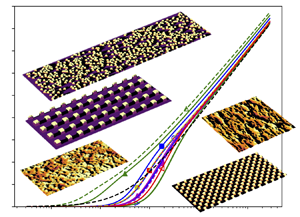
The wind-shade roughness model for turbulent wall-bounded flows
-
- Journal:
- Journal of Fluid Mechanics / Volume 1001 / 25 December 2024
- Published online by Cambridge University Press:
- 11 December 2024, A3
-
- Article
-
- You have access
- Open access
- HTML
- Export citation
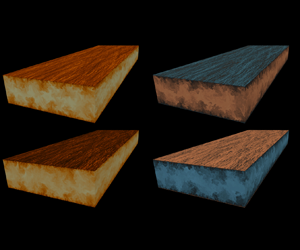
Friction and heat transfer in forced air convection with variable physical properties
-
- Journal:
- Journal of Fluid Mechanics / Volume 1001 / 25 December 2024
- Published online by Cambridge University Press:
- 11 December 2024, A27
-
- Article
-
- You have access
- Open access
- HTML
- Export citation
-
We establish a theoretical framework for predicting friction and heat transfer coefficients in variable-property forced air convection. Drawing from concepts in high-speed wall turbulence, which also involves significant temperature, viscosity and density variations, we utilize the mean momentum balance and mean thermal balance equations to develop integral transformations that account for the impact of variable fluid properties. These transformations are then applied inversely to predict the friction and heat transfer coefficients, leveraging the universality of passive scalars transport theory. Our proposed approach is validated using a comprehensive dataset from direct numerical simulations (DNS), covering both heating and cooling conditions up to a friction Reynolds number $\textit {Re}_\tau \approx 3200$. The predicted friction and heat transfer coefficients closely match the DNS data with accuracy margin 1–2 %, representing a significant improvement over the current state of the art.

JOG volume 69 issue 278 Cover and Back matter
-
- Journal:
- Journal of Glaciology / Volume 69 / Issue 278 / December 2023
- Published online by Cambridge University Press:
- 11 December 2024, pp. b1-b2
-
- Article
-
- You have access
- Open access
- Export citation
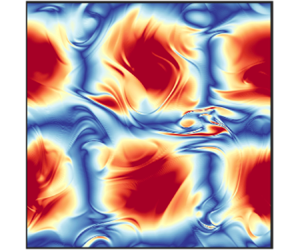
Time-dependent low-rank input–output operator for forced linearized dynamics with unsteady base flows
-
- Journal:
- Journal of Fluid Mechanics / Volume 1001 / 25 December 2024
- Published online by Cambridge University Press:
- 11 December 2024, A22
-
- Article
-
- You have access
- Open access
- HTML
- Export citation
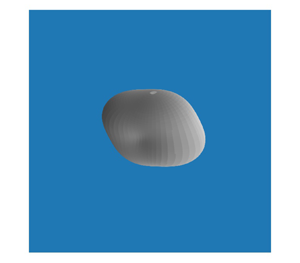
Bubble shape oscillations in a turbulent environment
-
- Journal:
- Journal of Fluid Mechanics / Volume 1001 / 25 December 2024
- Published online by Cambridge University Press:
- 11 December 2024, A26
-
- Article
- Export citation
-
We study single bubble deformation statistics in an homogeneous and isotropic turbulent flow by means of direct numerical simulations. We consider bubbles at low Weber number ( $We <3$) that have not been broken. We show that we can reproduce bubble deformations with a linear dynamics for each spherical harmonic mode. Inferring the coefficients of the linear model from the DNS data, we find that the natural frequency corresponds to the Rayleigh frequency, derived in a quiescent flow. However, the effective damping increases by a factor 7 compared with the quiescent case, at Taylor Reynolds number $\textit {Re}_\lambda = 55$. Looking at the flow structure around the bubble, we argue that the enhanced damping originates from a thick boundary layer surrounding the bubble. We demonstrate that the effective forcing, originating from the turbulent flow forcing on the bubble surface, is independent of bubble deformability. Therefore, the interface deformations are only one-way coupled to the flow. From this model we conclude that bubbles break rather from turbulent fluctuations than from a resonant mechanism. Eventually, we investigate the pressure modes’ statistics in the absence of bubbles and compare them with the effective forcing statistics. We show that both fields share the same probability distribution function, characterized by exponential tails, and a characteristic time scale corresponding to the eddy turnover time at the mode scale.


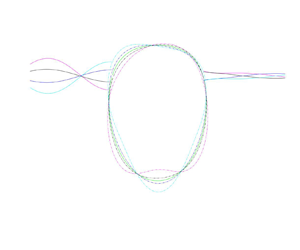
Hydrodynamic performance of a floating fluid-filled membrane breakwater: experimental and numerical study
-
- Journal:
- Journal of Fluid Mechanics / Volume 1001 / 25 December 2024
- Published online by Cambridge University Press:
- 11 December 2024, A21
-
- Article
- Export citation
Beyond the ice: exploring Antarctic soils research through spatial and scientometrics analysis – CORRIGENDUM
-
- Journal:
- Antarctic Science / Volume 36 / Issue 6 / December 2024
- Published online by Cambridge University Press:
- 11 December 2024, p. 528
-
- Article
-
- You have access
- HTML
- Export citation
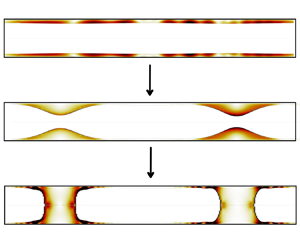
Plateau–Rayleigh instability in a capillary: assessing the importance of inertia
-
- Journal:
- Journal of Fluid Mechanics / Volume 1001 / 25 December 2024
- Published online by Cambridge University Press:
- 11 December 2024, A15
-
- Article
-
- You have access
- Open access
- HTML
- Export citation
Inferring their minds and analysing our beliefs: on the contribution of (exo)psychology to the search for extraterrestrial intelligence
-
- Journal:
- International Journal of Astrobiology / Volume 23 / 2024
- Published online by Cambridge University Press:
- 10 December 2024, e24
-
- Article
-
- You have access
- Open access
- HTML
- Export citation
Negotiation, adoption and domestic implementation of the annex on liability to the Protocol on Environmental Protection to the Antarctic Treaty
-
- Journal:
- Antarctic Science / Volume 36 / Issue 5 / October 2024
- Published online by Cambridge University Press:
- 10 December 2024, pp. 419-438
-
- Article
- Export citation
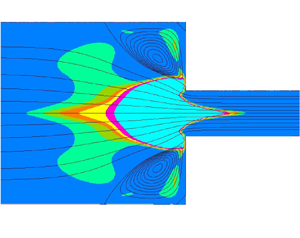
A shear and elongational decomposition approach of the rate-of-deformation tensor for non-Newtonian flows with mixed kinematics
-
- Journal:
- Journal of Fluid Mechanics / Volume 1001 / 25 December 2024
- Published online by Cambridge University Press:
- 10 December 2024, A17
-
- Article
- Export citation

Resilient urbanization for water limited environments
-
- Journal:
- Cambridge Prisms: Drylands / Volume 2 / 2025
- Published online by Cambridge University Press:
- 10 December 2024, e2
-
- Article
-
- You have access
- Open access
- HTML
- Export citation
Quantifying the rise of animals during the Ediacaran–Cambrian using ichnodissimilarity
-
- Journal:
- Paleobiology / Volume 50 / Issue 4 / November 2024
- Published online by Cambridge University Press:
- 10 December 2024, pp. 532-547
-
- Article
- Export citation
The category-modifier system: a hierarchical classification scheme for vertebrate tooth marks
-
- Journal:
- Paleobiology / Volume 50 / Issue 4 / November 2024
- Published online by Cambridge University Press:
- 10 December 2024, pp. 513-531
-
- Article
-
- You have access
- Open access
- HTML
- Export citation
Geometric morphometrics as a tool for evaluating Eublastoidea morphological variation
-
- Journal:
- Paleobiology / Volume 50 / Issue 4 / November 2024
- Published online by Cambridge University Press:
- 10 December 2024, pp. 548-562
-
- Article
-
- You have access
- Open access
- HTML
- Export citation
Turtle species extinction across the Cretaceous/Paleogene boundary
-
- Journal:
- Paleobiology / Volume 50 / Issue 4 / November 2024
- Published online by Cambridge University Press:
- 10 December 2024, pp. 641-647
-
- Article
- Export citation
