Refine search
Actions for selected content:
178607 results in Earth and Environmental Sciences
Morphological variation of the endemic reef-building genus Mussismilia in the Bahia State (Tropical northeastern Brazilian coast)
-
- Journal:
- Journal of the Marine Biological Association of the United Kingdom / Volume 104 / 2024
- Published online by Cambridge University Press:
- 13 December 2024, e113
-
- Article
- Export citation
On species of genus Byblis Boeck, 1971 (Amphilochidea, Ampeliscidae) reported from India with the description of one new species
-
- Journal:
- Journal of the Marine Biological Association of the United Kingdom / Volume 104 / 2024
- Published online by Cambridge University Press:
- 13 December 2024, e115
-
- Article
- Export citation
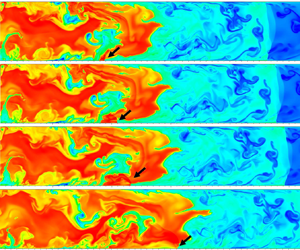
Flame acceleration and detonation transition in premixed and inhomogeneous supersonic flows
-
- Journal:
- Journal of Fluid Mechanics / Volume 1001 / 25 December 2024
- Published online by Cambridge University Press:
- 13 December 2024, A36
-
- Article
- Export citation
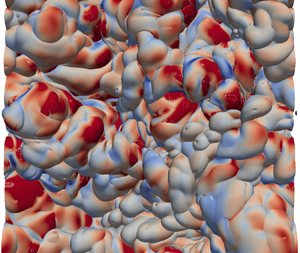
Temporal evolution of the turbulence interface of a turbulent plane jet
-
- Journal:
- Journal of Fluid Mechanics / Volume 1001 / 25 December 2024
- Published online by Cambridge University Press:
- 13 December 2024, A39
-
- Article
- Export citation
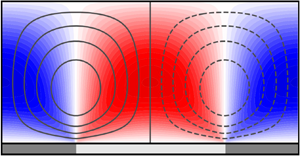
Linear models of strip-type roughness
-
- Journal:
- Journal of Fluid Mechanics / Volume 1001 / 25 December 2024
- Published online by Cambridge University Press:
- 13 December 2024, A38
-
- Article
-
- You have access
- Open access
- HTML
- Export citation

Plastic waste management strategies toward zero waste: Status, perspectives and recommendations for Ethiopia
- Part of
-
- Journal:
- Cambridge Prisms: Plastics / Volume 3 / 2025
- Published online by Cambridge University Press:
- 13 December 2024, e1
-
- Article
-
- You have access
- Open access
- HTML
- Export citation
A local climate perspective on possible development pathways for Longyearbyen, Svalbard
-
- Journal:
- Polar Record / Volume 60 / 2024
- Published online by Cambridge University Press:
- 13 December 2024, e23
-
- Article
-
- You have access
- Open access
- HTML
- Export citation
A new species of Paramphiascella (Harpacticoida: Miraciidae) from a brackish-water estuary in north-western Mexico, supported with molecular phylogenetic analyses
-
- Journal:
- Journal of the Marine Biological Association of the United Kingdom / Volume 104 / 2024
- Published online by Cambridge University Press:
- 13 December 2024, e118
-
- Article
-
- You have access
- Open access
- HTML
- Export citation

Climate Activism, Digital Technologies, and Organizational Change
-
- Published online:
- 12 December 2024
- Print publication:
- 02 January 2025
-
- Element
- Export citation
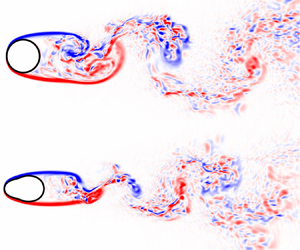
Large-eddy simulation-based shape optimization for mitigating turbulent wakes of a bluff body using the regularized ensemble Kalman method
-
- Journal:
- Journal of Fluid Mechanics / Volume 1001 / 25 December 2024
- Published online by Cambridge University Press:
- 12 December 2024, A31
-
- Article
- Export citation
Turbulent flow over random sphere packs – an investigation by pore-resolved direct numerical simulation
-
- Journal:
- Journal of Fluid Mechanics / Volume 1001 / 25 December 2024
- Published online by Cambridge University Press:
- 12 December 2024, A29
-
- Article
-
- You have access
- Open access
- HTML
- Export citation
-
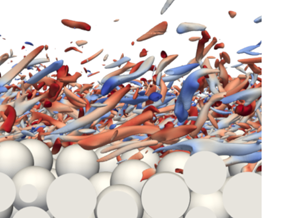
Pore-resolved direct numerical simulations have been performed to investigate the turbulent open-channel flow over a rough and permeable sediment bed, represented by a mono-disperse random sphere pack. After a careful validation, eleven cases were simulated to systemically sample a parameter space spanned by a friction Reynolds number $Re_\tau \in [150, 500]$ and a permeability Reynolds number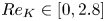 $Re_K \in [0, 2.8]$. By varying the ratio of flow depth to sphere diameter within a range of $h/D \in \{ 3,5,10,\infty \}$, the influence of both Reynolds numbers on the flow field and the turbulence structure could be investigated independently. The simulation results are analysed within a time–space double-averaging framework, whereas flow visualizations provide insight into instantaneous fields. Based on the drag distribution, we propose a consistent interface description, which can be used to define both near-interface and outer-flow coordinates. In these near-interface coordinates, the profiles of the mean velocity and the total shear stress collapse. Furthermore, the proposed interface definition yields outer-layer coordinates, in which the flow and turbulence statistics over a rough and permeable bed reveal similarity to a smooth-wall flow at a similar $Re_\tau$. Within the parameter space, $Re_\tau$ has a strong influence on the wake region of the velocity profile. In contrast, $Re_K$ changes the wall-blocking effect and the shear intensity, which is reflected by the turbulence structure and vortex orientation in the near-interface region. As streamwise velocity streaks disappear and the vortex inclination increases with higher $Re_K$, differences between near-interface and outer-layer turbulence structure are reduced.


The first record of the appearance of green turtles in the winter in a summer-to-autumn habitat in northeast Japan
-
- Journal:
- Journal of the Marine Biological Association of the United Kingdom / Volume 104 / 2024
- Published online by Cambridge University Press:
- 12 December 2024, e111
-
- Article
-
- You have access
- Open access
- HTML
- Export citation
Hindered settling of a log-normally distributed Stokesian suspension
-
- Journal:
- Journal of Fluid Mechanics / Volume 1001 / 25 December 2024
- Published online by Cambridge University Press:
- 12 December 2024, A30
-
- Article
-
- You have access
- Open access
- HTML
- Export citation
-
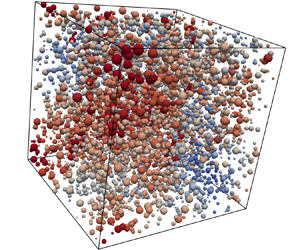
Settling velocity statistics for dilute, non-Brownian homogeneous suspensions of polydisperse spheres having a log-normal size distribution are generated from Stokesian dynamics simulations, as a function of the total volume fraction $\phi$ and normalised width $\alpha$ of the particle size distribution. Several hundred instantaneous configurations are averaged to obtain reliable statistics. The paper reports data for the average and fluctuating settling velocity of each particle class in a suspension that is widely polydisperse – previous work was limited to only two or three classes, and the average settling velocity of each particle class was in most cases not reported – and provides an assessment of the accuracy of the analytical models proposed by Batchelor, Richardson & Zaki, Davis & Gecol and Masliyah–Lockett–Bassoon in predicting the simulation data. A limited comparison with dynamic simulations in which the particle microstructure is allowed to evolve in time is also included.


Biodiversity and distribution of sea anemones (Cnidaria, Anthozoa, Actiniaria) in Peru
-
- Journal:
- Journal of the Marine Biological Association of the United Kingdom / Volume 104 / 2024
- Published online by Cambridge University Press:
- 12 December 2024, e112
-
- Article
-
- You have access
- Open access
- HTML
- Export citation
Environmental constraints on the origin of life based on membrane formation: the role of salinity
-
- Journal:
- International Journal of Astrobiology / Volume 23 / 2024
- Published online by Cambridge University Press:
- 12 December 2024, e25
-
- Article
-
- You have access
- Open access
- HTML
- Export citation
First report of the pygmy slipper lobster Biarctus sordidus (Crustacea, Decapoda) in the Red Sea following the finding of its phyllosoma larva
-
- Journal:
- Journal of the Marine Biological Association of the United Kingdom / Volume 104 / 2024
- Published online by Cambridge University Press:
- 12 December 2024, e110
-
- Article
- Export citation
Single-snapshot machine learning for super-resolution of turbulence
-
- Journal:
- Journal of Fluid Mechanics / Volume 1001 / 25 December 2024
- Published online by Cambridge University Press:
- 12 December 2024, A32
-
- Article
-
- You have access
- Open access
- HTML
- Export citation
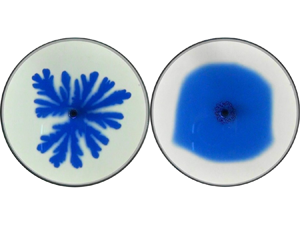
Opposite effects of a reaction-driven viscosity decrease on miscible viscous fingering depending on the injection flow rate
-
- Journal:
- Journal of Fluid Mechanics / Volume 1001 / 25 December 2024
- Published online by Cambridge University Press:
- 11 December 2024, A25
-
- Article
-
- You have access
- Open access
- HTML
- Export citation
-
When a less-viscous solution of a reactant $A$ displaces a more-viscous solution of another reactant $B$, a fast bimolecular $A + B \rightarrow C$ reaction decreasing locally the viscosity can influence the viscous fingering (VF) instability taking place between the two miscible solutions. We show both experimentally and numerically that, for monotonic viscosity profiles, this decrease in viscosity has opposite effects on the fingering pattern depending on the injection flow rate. For high flow rates, the reaction enhances the shielding effect, creating VF patterns with a lower surface density, i.e. thinner fingers covering a smaller area. In contrast, for lower flow rates, the reaction stabilises the VF dynamics, i.e. delays the instability and gives a less-deformed displacement, reaching in some cases an almost-stable displacement. Nonlinear simulations of reactive VF show that these opposite effects at low or high flow rates can only be reproduced if the diffusivity of $A$ is larger than that of $B$, which favours a larger production of the product $C$ and, hence, a larger viscosity decrease. The analysis of one-dimensional viscosity profiles reconstructed on the basis of a one-dimensional reaction–diffusion–advection model confirms that the VF stabilisation at low Péclet number and in the presence of differential diffusion of reactants originates from an optimum reaction-driven decrease in the gradient of the monotonic viscosity profile.


A revised chemical weathering and sediment provenance history for the Late Miocene to recent Laxmi Basin, Arabian Sea
-
- Journal:
- Geological Magazine / Volume 161 / 2024
- Published online by Cambridge University Press:
- 11 December 2024, e20
-
- Article
-
- You have access
- Open access
- HTML
- Export citation
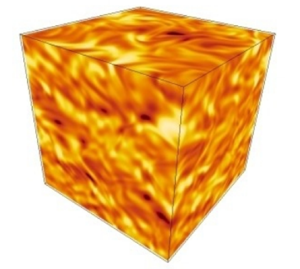
Waves and non-propagating modes in stratified MHD turbulence subject to a weak mean magnetic field
-
- Journal:
- Journal of Fluid Mechanics / Volume 1001 / 25 December 2024
- Published online by Cambridge University Press:
- 11 December 2024, A28
-
- Article
- Export citation
-
In this study we consider a freely decaying, stably stratified homogeneous magnetohydrodynamic turbulent plasma with a weak vertical background magnetic field ( $\boldsymbol {B}_0=B_0\hat {\boldsymbol {z}}),$ aligned with the density gradient of strength $N$ (i.e. Brunt–Väisälä frequency). Both linear theory and direct numerical simulations (DNS) are used to analyse the flow dynamics for a Boussinesq fluid with unitary magnetic and thermal Prandtl numbers. We implemented a normal mode decomposition emphasizing different types of motions depending on whether both the Froude $F_r$ and Alfvén–Mach $M$ numbers are small or only $F_r$ is small but $M$ is finite. In the former case, there is a non-propagating (NP) mode and fast modes: Alfvén waves with frequency $\omega _a$ and magnetogravity waves with frequency $\omega _{ag}$. In the latter case, there are fast gravity waves with frequency $\omega _g$ and slow modes: NP mode and slow Alfvén waves. The numerical simulations carried out are started from initial isotropic conditions with zero initial magnetic and density fluctuations, so that the initial energy of the NP mode is strictly zero, for $0< B_0/(L_iN)\leqslant 0.12$ and a weak mean magnetic field ( $B_0=0.2$ or $B_0=0.4),$ where $L_i$ denotes the isotropic integral length scale. The DNS results indicate a weak turbulence regime for which $F_r$ is small and $M$ is finite. It is found that the vertical magnetic energy as well as the energy of the NP mode are drastically reduced as $N$ increases, while there is instead a forward cascade even for the magnetic field. The contribution coming from the energy of fast (gravity) waves does not exceed $50\,\%,$ while that coming from the energy of the NP mode does not exceed $10\,\%.$ Vertical motions are more affected by the effect of stratification than by the effect of the mean magnetic field, while it is the opposite for horizontal motions. We show that the spectrum of slow (Alfvén) waves and fast (gravity) waves tends to follow the power law $k_\perp ^{-3}$ for a wide range of time, $3< t<20$. At high vertical (or horizontal) wavenumbers, the main contribution to total energy comes from the energy of slow Alfvén waves. At large and intermediate horizontal (or vertical) scales, the spectra of the energy of NP mode exhibit a flat shape.


