Refine search
Actions for selected content:
178607 results in Earth and Environmental Sciences
Developing land-use planning scenarios in Türkiye to reduce water-induced soil erosion
-
- Journal:
- Environmental Conservation / Volume 52 / Issue 1 / March 2025
- Published online by Cambridge University Press:
- 16 December 2024, pp. 31-40
-
- Article
- Export citation
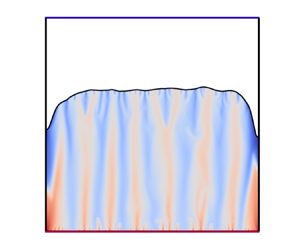
Vibration-induced morphological evolution of a melting solid under microgravity
-
- Journal:
- Journal of Fluid Mechanics / Volume 1001 / 25 December 2024
- Published online by Cambridge University Press:
- 16 December 2024, A43
-
- Article
- Export citation
-
We study the melting process of a solid under microgravity, driven solely by lateral vibrations that are perpendicular to the applied temperature gradient due to the absence of gravity-induced convection. Using direct numerical simulations with the phase-field method, we examine two-dimensional vibration-induced melting in a square cavity over four orders of magnitude of vibrational Rayleigh numbers, $10^5\le Ra_{{vib}}\le 10^9$. Our results show that as melting progresses, the flow structure transitions from a periodic-circulation regime with diffusion-dominated heat transfer to a columnar regime with vibroconvection. The mean height of the liquid–solid interface follows a power-law dependency with time, $\bar {\xi } \sim \tilde t^{1/(2-2\alpha )}$, where $\alpha = 0$ in the periodic-circulation regime and $\alpha = 1/2$ in the columnar regime. We further observe that within the columnar regime, the morphological evolution of the liquid–solid interface is influenced by the interaction of columnar thermal plumes in the central regions and the peripheral flow near the sidewalls. Specifically, we offer a comprehensive analysis of the plume merging behaviour, which is governed by the aspect ratio ( $\bar {\xi }$) of the liquid layer and the intensity of vibration, quantified by the effective vibrational Rayleigh number $Ra_{vib}^{eff}$. We identify the relationship between the number of columnar plumes $K_m$ and $Ra_{vib}^{eff}$, finding that $K_m \sim \bar {\xi }^{-1} (Ra_{vib}^{eff})^{\gamma }$ with the fitting scaling exponent $\gamma = 0.150 \pm 0.025$. We subsequently quantify the characteristics of the interface roughness amplitude evolution in microgravity vibroconvection. Our results indicate that the roughness amplitude exhibits a power-law dependence on the mean height of the liquid layer. Drawing from the Stefan boundary condition, we theoretically deduce this dependence under the assumption of a non-uniform heat flux distribution at the interface, where the theory is corroborated by our numerical simulations.


Radiocarbon dates from the Iapodes collection at the Archaeological Museum in Zagreb, Croatia
-
- Journal:
- Radiocarbon / Volume 67 / Issue 1 / February 2025
- Published online by Cambridge University Press:
- 16 December 2024, pp. 215-219
- Print publication:
- February 2025
-
- Article
-
- You have access
- Open access
- HTML
- Export citation
A case study of payments for ecosystem services and the need for integrated catchment management: experiences from the Westcountry Rivers Trust
-
- Journal:
- Cambridge Prisms: Water / Volume 2 / 2024
- Published online by Cambridge University Press:
- 16 December 2024, e14
-
- Article
-
- You have access
- Open access
- HTML
- Export citation
Dating the beginning of urbanization in Central Mexico: a high-resolution chronology of the Middle Formative Period at Tlalancaleca
-
- Journal:
- Radiocarbon / Volume 67 / Issue 1 / February 2025
- Published online by Cambridge University Press:
- 16 December 2024, pp. 88-110
- Print publication:
- February 2025
-
- Article
-
- You have access
- Open access
- HTML
- Export citation
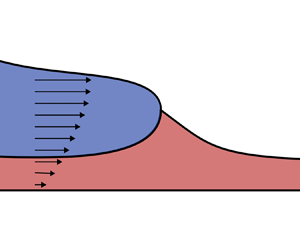
Dynamics of a thin film of fluid spreading over a lubricated substrate
-
- Journal:
- Journal of Fluid Mechanics / Volume 1001 / 25 December 2024
- Published online by Cambridge University Press:
- 16 December 2024, A47
-
- Article
-
- You have access
- Open access
- HTML
- Export citation
FLM volume 1000 Cover and Front matter
-
- Journal:
- Journal of Fluid Mechanics / Volume 1000 / 10 December 2024
- Published online by Cambridge University Press:
- 16 December 2024, p. f1
-
- Article
-
- You have access
- Export citation
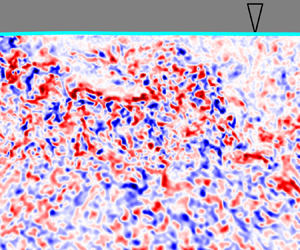
Structure and energy transfer in homogeneous turbulence below a free surface
-
- Journal:
- Journal of Fluid Mechanics / Volume 1001 / 25 December 2024
- Published online by Cambridge University Press:
- 16 December 2024, A46
-
- Article
-
- You have access
- Open access
- HTML
- Export citation
Plant taxonomic turnover and diversity across the Cretaceous/Paleogene boundary in northeastern Montana
-
- Journal:
- Paleobiology / Volume 50 / Issue 4 / November 2024
- Published online by Cambridge University Press:
- 16 December 2024, pp. 608-626
-
- Article
-
- You have access
- Open access
- HTML
- Export citation
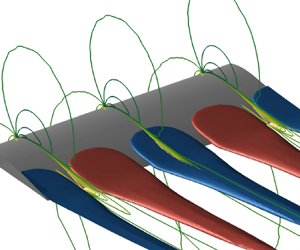
Linear stability analysis of turbulent mean flows based on a data-consistent Reynolds-averaged Navier–Stokes model: prediction of three-dimensional stall cells around an airfoil
-
- Journal:
- Journal of Fluid Mechanics / Volume 1001 / 25 December 2024
- Published online by Cambridge University Press:
- 16 December 2024, A41
-
- Article
-
- You have access
- Open access
- HTML
- Export citation
-
Stall cells are transverse cellular patterns that often appear on the suction side of airfoils near stalling conditions. Wind-tunnel experiments on a NACA4412 airfoil at Reynolds number ${Re}=3.5 \times 10^5$ show that they appear for angles of attack larger than $\alpha = 11.5^{\circ }\ (\pm 0.5^{\circ })$. Their onset is further investigated based on global stability analyses of turbulent mean flows computed with the Reynolds-averaged Navier–Stokes (RANS) equations. Using the classical Spalart–Allmaras turbulence model and following Plante et al. (J. Fluid Mech., vol. 908, 2021, A16), we first show that a three-dimensional stationary mode becomes unstable for a critical angle of attack $\alpha = 15.5^{\circ }$ which is much larger than in the experiments. A data-consistent RANS model is then proposed to reinvestigate the onset of these stall cells. Through an adjoint-based data-assimilation approach, several corrections in the turbulence model equation are identified to minimize the differences between assimilated and reference mean-velocity fields, the latter reference field being extracted from direct numerical simulations. Linear stability analysis around the assimilated mean flow obtained with the best correction is performed first using a perturbed eddy-viscosity approach which requires the linearization of both RANS and turbulence model equations. The three-dimensional stationary mode becomes unstable for angle $\alpha = 11^{\circ }$ which is in significantly better agreement with the experimental results. The interest of this perturbed eddy-viscosity approach is demonstrated by comparing with results of two frozen eddy-viscosity approaches that neglect the perturbation of the eddy viscosity. Both approaches predict the primary destabilization of a higher-wavenumber mode which is not experimentally observed. Uncertainties in the stability results are quantified through a sensitivity analysis of the stall cell mode's eigenvalue with respect to residual mean-flow velocity errors. The impact of the correction field on the results of stability analysis is finally assessed.


Optimisation of hardware setups for time-efficient HEC-RAS simulations
-
- Journal:
- Cambridge Prisms: Water / Volume 2 / 2024
- Published online by Cambridge University Press:
- 16 December 2024, e13
-
- Article
-
- You have access
- Open access
- HTML
- Export citation
Spatiotemporal fluctuations in surface copepods community structure in Chabahar Bay, Gulf of Oman, Iran
-
- Journal:
- Journal of the Marine Biological Association of the United Kingdom / Volume 104 / 2024
- Published online by Cambridge University Press:
- 13 December 2024, e114
-
- Article
- Export citation
First record of two cardinalfishes (Teleostei: Apogonidae) from northwestern India
-
- Journal:
- Journal of the Marine Biological Association of the United Kingdom / Volume 104 / 2024
- Published online by Cambridge University Press:
- 13 December 2024, e117
-
- Article
- Export citation
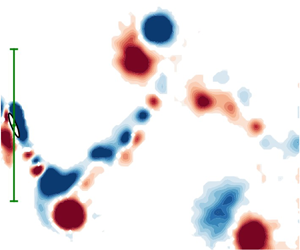
Data-driven active control of a thin elliptical cylinder undergoing transverse flow-induced vibrations
-
- Journal:
- Journal of Fluid Mechanics / Volume 1001 / 25 December 2024
- Published online by Cambridge University Press:
- 13 December 2024, A35
-
- Article
-
- You have access
- Open access
- HTML
- Export citation
-
This experimental study employs Bayesian optimisation to maximise the cross-flow (transverse) flow-induced vibration (FIV) of an elastically mounted thin elliptical cylinder by implementing axial (or angular) flapping motions. The flapping amplitude was in proportion to the vibration amplitude, with a relative phase angle imposed between the angular and transverse displacements of the cylinder. The control parameter space spanned over the ranges of proportional gain and phase difference of $0 \leq K_p^* \leq 5$ and $0 \leq \phi _d \leq 360^\circ$, respectively, over a reduced velocity range of $3.0 \leqslant {U^*} = U/({{f_{nw}}} b) \leqslant 8.5$. The corresponding Reynolds number range was $1250 \leqslant {{Re}} =(U b)/\nu \leqslant 3580$. Here, $U$ is the free stream velocity, $b$ is the major cross-sectional diameter of the cylinder, ${{f_{nw}}}$ is the natural frequency of the system in quiescent fluid (water) and $\nu$ is the kinematic viscosity of the fluid. It was found that the controlled body rotation extended the wake-body synchronisation across the entire ${U^*}$ range tested, with a larger amplitude response than the non-rotating case for all flow speeds. Interestingly, two new wake-body synchronisation regimes were identified, which have not been reported in previous studies. As this geometry acts as a ‘hard-oscillator’ for ${U^*} \geqslant 6.3$, an adaptive gain (i.e. one that varies as a function of oscillation amplitude) was also implemented, allowing the body vibration, achieved for a non-rotating cylinder using increasing ${U^*}$ increments, to be excited from rest. The findings of the present study hold potential implications for the use of FIV as a means to efficiently extract energy from free-flowing water sources, a topic of increasing interest over the last decade.


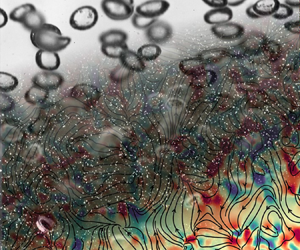
Velocity fluctuations for bubbly flows at small Re
-
- Journal:
- Journal of Fluid Mechanics / Volume 1001 / 25 December 2024
- Published online by Cambridge University Press:
- 13 December 2024, A34
-
- Article
-
- You have access
- Open access
- HTML
- Export citation
-
We experimentally investigate the effect of Reynolds number ( $Re$) on the turbulence induced by the motion of bubbles in a quiescent Newtonian fluid at small $Re$. The energy spectra, $E(k)$, are determined from the decaying turbulence behind the bubble swarm obtained using particle image velocimetry. We show that when $Re \sim O(100)$, the slope of the normalized energy spectra is no longer independent of the gas volume fraction and the $k^{-3}$ subrange is significantly narrower, where $k$ is the wavenumber. This is further corroborated using second-order longitudinal velocity structure function and spatial correlation of the velocity behind the bubble swarm. On further decreasing the bubble Reynolds number ( $O(1) < Re < O(10)$), the signature $k^{-3}$ of the energy spectra for the bubble-induced turbulence is replaced by $k^{-5/3}$ scaling. Thus, we provide experimental evidence to the claim by Mazzitelli et al. (Phys. Fluids, vol. 15, 2003, pp. L5–L8) that at low Reynolds numbers the normalized energy spectra of the bubble-induced turbulence will no longer show the $k^{-3}$ scaling because of the absence of bubble wake and that the energy spectra will depend on the number of bubbles, thus being non-universal.


Incisocalliope aestuarius (Crustacea: Amphipoda: Pleustidae), an old introduced species in the Gironde Estuary (SW France)
-
- Journal:
- Journal of the Marine Biological Association of the United Kingdom / Volume 104 / 2024
- Published online by Cambridge University Press:
- 13 December 2024, e116
-
- Article
-
- You have access
- Open access
- HTML
- Export citation
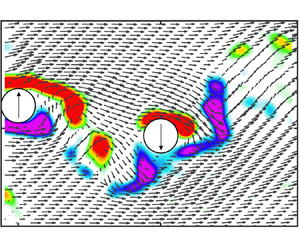
Mapping the properties of wake-induced vibration on a circular cylinder
-
- Journal:
- Journal of Fluid Mechanics / Volume 1001 / 25 December 2024
- Published online by Cambridge University Press:
- 13 December 2024, A33
-
- Article
- Export citation
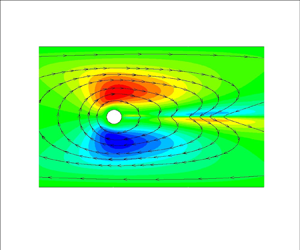
Viscoelastic flow around a confined cylinder: 2-D linear stability analysis leading to asymmetric flow
-
- Journal:
- Journal of Fluid Mechanics / Volume 1001 / 25 December 2024
- Published online by Cambridge University Press:
- 13 December 2024, A40
-
- Article
-
- You have access
- Open access
- HTML
- Export citation
Stratigraphy and faunas of the Durness Group (Cambrian–Middle Ordovician) of Northwest Scotland: constraints on tectonic models and the development of the Great American Carbonate Bank
-
- Journal:
- Geological Magazine / Volume 161 / 2024
- Published online by Cambridge University Press:
- 13 December 2024, e21
-
- Article
-
- You have access
- Open access
- HTML
- Export citation
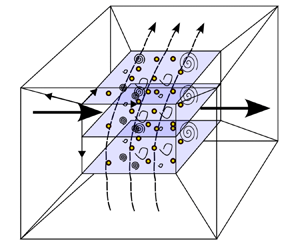
Developing a non-Newtonian fluid model for dust, for application to astrophysical flows
-
- Journal:
- Journal of Fluid Mechanics / Volume 1001 / 25 December 2024
- Published online by Cambridge University Press:
- 13 December 2024, A37
-
- Article
-
- You have access
- Open access
- HTML
- Export citation
