To save content items to your account,
please confirm that you agree to abide by our usage policies.
If this is the first time you use this feature, you will be asked to authorise Cambridge Core to connect with your account.
Find out more about saving content to .
To save content items to your Kindle, first ensure no-reply@cambridge.org
is added to your Approved Personal Document E-mail List under your Personal Document Settings
on the Manage Your Content and Devices page of your Amazon account. Then enter the ‘name’ part
of your Kindle email address below.
Find out more about saving to your Kindle.
Note you can select to save to either the @free.kindle.com or @kindle.com variations.
‘@free.kindle.com’ emails are free but can only be saved to your device when it is connected to wi-fi.
‘@kindle.com’ emails can be delivered even when you are not connected to wi-fi, but note that service fees apply.
Edited by
Ottavio Quirico, University of New England, University for Foreigners of Perugia and Australian National University, Canberra,Walter Baber, California State University, Long Beach
Edited by
Ottavio Quirico, University of New England, University for Foreigners of Perugia and Australian National University, Canberra,Walter Baber, California State University, Long Beach
Russia is one of the main oil and gas producers and one of the biggest emitters of carbon dioxide globally. Its energy policies are still underpinned by the necessity of establishing ‘spheres of influence’ and are not on track to achieve the objectives of the United Nations Framework Convention on Climate Change (UNFCCC) and the Paris Agreement. Politically, war in Ukraine is arguably a consequence of this approach and discloses for the European Union (EU) the possibility of a diversification of its energy sources to achieve security of supply, which unlocks the opportunity of accelerating the green transition envisaged in the European Green Deal. Legally, given that they are not at war with Russia, the EU and its Member States could invoke the energy supply crisis and the political misalignment between the Russian energy policy and the Green Deal, rather than war per se, as a justification to abandon consolidated long-term energy contracts and accelerate the green transition.
This last chapter of the book focuses on the Archean and Proterozoic part of the Earth’s history, bridging the rapidly changing processes of early Earth with modern plate tectonics as dealt with in Chapters 1-14. It discusses the common Archean (4-2.5 billion years) granite and greenstone terranes and how they may reflect specific tectonic conditions associated with gravitational instabilities and tectonic accretion. Although different from today’s subduction-related accretion systems, these tectonic processes allowed for crustal accretion and amalgamation into (super)cratons. Proterozoic (2.5-0.54 billion years) terranes are widespread as accretionary complexes between or along Archean cratons. The chapter discusses how Paleomagnetic techniques and stratigraphic correlations constrain continental drift throughout the Proterozoic, and how their paths define cycles of supercontinent assembly, tenure, and dispersal. Evidence of modern plate tectonics are also discussed, and a lot of Proterozoic geology seems to be linked to plate tectonics, even though high-pressure rocks (eclogite, blueschist) are rare. It is concluded that the age and mechanism of onset of plate tectonics remains a controversial and fascinating topic that will continue to evolve into the future.
The theme of how life and its environment have coevolved together for about four billion years on Earth is explored in this chapter. The major evolutionary events that unfolded in the Archean eon (4 to 2.5 billion years ago), Proterozoic eon (2.5 to 0.539 billion years ago), and the Phanerozoic eon (0.539 billion years ago to present) are outlined, such as the origin(s) of multicellularity, eukaryotes, complex multicellular organisms, and humans. By drawing on this evolutionary timeline, theoretical paradigms for understanding and grouping the notable evolutionary events are sketched (e.g., major transitions in evolution). The next part of the chapter illustrates the intricate interplay between life and its environment by chronicling the rise in molecular oxygen levels, its possible causes and profound consequences, and its potential connections with key geological changes like the putative Snowball Earth episodes. Lastly, the ‘Big Five’ mass extinctions that transpired in the Phanerozoic, along with their triggers and ramifications, are described.
Life-as-we-know-it harnesses carbon for the scaffolding in biomolecules and liquid water as the solvent. This chapter delineates the beneficial properties of carbon and water, and then investigates whether viable alternatives to this duo exist (i.e., ‘exotic’ life). With regard to the latter, the likes of ammonia, sulfuric acid, and liquid hydrocarbons are expected to have some physical and/or chemical advantages relative to water, while also exhibiting certain downsides. In contrast, it is suggested that few options appear feasible aside from carbon, with silicon representing a partial exception. The chapter subsequently delves into the habitability of the clouds of Venus and the lakes of Titan, because the alternative solvents sulfuric acid and liquid hydrocarbons (methane and ethane) are, respectively, documented therein. Both these environments might be conducive to hosting exotic life, but it is cautioned that they are likely subjected to severe challenges.
This chapter deals with the strike-slip fault zones that systematically offset midocean spreading ridges such as the mid-Atlantic ridge. Transform faults are one of three types of plate boundaries and are the active part connecting spreading ridge segments. The chapter investigates these in terms of size, distribution, dynamics, kinematics and seismicity. It looks at how transform faults relate and contrast to their mostly inactive extensions called fracture zones. Fracture zones can typically be traced across the ocean and record information about spreading direction and relative plate motions through geologic time. The chapter also discusses the origin of transform faults and how they provide a link to the mantle and their role as vertical conduits in terms of fluid flow between the mantle and the ocean floor. Several examples are shown where structural and seismic details are shown. This chapter also discusses complications caused by changes in opening direction, creating both transpressional and transtensional deformation along transform faults, and over time, curved fracture zones.
Edited by
Ottavio Quirico, University of New England, University for Foreigners of Perugia and Australian National University, Canberra,Walter Baber, California State University, Long Beach
While most sovereign entities have committed to greening their economies and investment under the United Nations Framework Convention on Climate Change (UNFCCC), several of them are also bound by obligations contracted under the Energy Charter Treaty (ECT), which protects investors in renewables and fossil fuel alike. Arguably, such a situation triggers a ‘regulatory clash’ that has the potential to impede the implementation of net zero carbon policies, such as the European Green Deal. This contribution contextualises the ECT within the framework of the UNFCCC and scopes the potential conflict between such regulatory regimes. Particularly, in light of the so-called ‘sunset’ clause, the contribution concludes that a suitable avenue to resolve the clash is establishing a preferential track for investment in clean energy under the ECT. On this basis, fundamental solutions are envisaged for greening investment, by applying model de lege ferenda proposals for a substantive and procedural modernisation of the ECT.
The impact of the 1pN gravitomagnetic Lense–Thirring acceleration, generalized also to the case of two massive spinning bodies of comparable masses and angular momenta, is calculated for different types of observation-related quantities (Keplerian orbital elements, anomalistic, draconitic, and sidereal orbital periods, two-body range and range rate, radial velocity curve and radial velocity semiamplitude of spectroscopic binaries, astrometric angles RA and dec., times of arrival of binary pulsars, characteristic timescales of transiting exoplanets, and their sky-projected spin-orbit angle). The results are applied to a test particle orbiting a primary, a Sun–Jupiter exoplanet system, and an S star in Sgr A*.
Edited by
Ottavio Quirico, University of New England, University for Foreigners of Perugia and Australian National University, Canberra,Walter Baber, California State University, Long Beach
Carbon sequestration has become indispensable to achieving the sustainability objectives set out in the United Nations Framework Convention on Climate Change (UNFCCC) and the Paris Agreement, within the framework of the concept of ‘net zero’ emissions targets. It includes different prospective techniques, which are nonetheless still in their infancy and not easy to implement. This contribution focuses specifically on carbon sequestration at sea as a test case, aiming to underscore the pros and cons of these measures. It is argued that implementing carbon sequestration at sea requires a cooperative approach, within a context whereby climate change necessitates a synergic rethinking of the Law of the Sea.
Edited by
Ottavio Quirico, University of New England, University for Foreigners of Perugia and Australian National University, Canberra,Walter Baber, California State University, Long Beach
The Latin America and the Caribbean (LAC) region is a distinct geographic, economic and cultural area with a distinct place in the climate change landscape. Climate policy implementation to meet such Paris Agreement commitments is still incipient, with some of its countries serving as models, some as laggards and the rest positioned somewhere in between. For this reason, partnerships with regions that have advanced more in this area can prove useful. The European Union (EU)–Community of Latin American and Caribbean States (CELAC, per the acronym in Spanish) summits and the Euroclima programme are two examples. Due to its high levels of inequality and social unrest, the key challenge to implementing climate policies in LAC will be the strengthening of a political atmosphere where human rights, the rule of law and democratic values prevail.
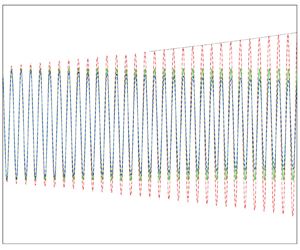
The combined effects of heater position, mean flow parameters and flame models on thermoacoustic instability in a one-dimensional Rijke tube are studied systematically by classic linear stability analysis (LSA) and lattice Boltzmann method (LBM) simulation. In the former, the stability range of the linear flame model under low Mach number assumption is solved analytically, while in the more general case, it is obtained by numerically solving the dispersion relation. Both the linear and nonlinear flame model cases are studied using the LBM with a spectral multiple-relaxation-time collision model and a newly developed heat source term. With the linear flame model, the LBM is in good agreement with LSA in predicting the transition point and growth rates, while with the nonlinear flame model, LBM simulations are consistent with solutions of limit cycle theory in the fully developed state. These results demonstrate the applicability of the LBM in solving complex thermoacoustic problems.
Edited by
Ottavio Quirico, University of New England, University for Foreigners of Perugia and Australian National University, Canberra,Walter Baber, California State University, Long Beach
The People’s Republic of China’s Belt and Road Initiative (BRI) was launched in 2013 and has officially involved 140 countries as of 2021. This paper reviews a total of 11 Chinese policies that can be considered part of the efforts to the ‘greening’ of the Belt and Road. It analyses how, among the wide variety of principles, targets and tasks to ‘green’ the BRI, the connotation of ‘green’ has evolved over time. In particular, priority has transitioned from ecological and environmental protection and pollution control in the early days of the BRI to climate change and conservation of biodiversity since 2020. The chapter shows a progression towards more concrete greening Belt and Road implementation measures, including guidance for key industries, life-cycle management of projects, and stopping building new coal-fired power stations since decarbonisation became a domestic policy priority in 2020.
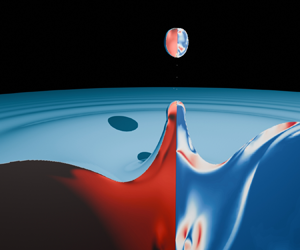
A gas bubble sitting at a liquid–gas interface can burst following the rupture of the thin liquid film separating it from the ambient, owing to the large surface energy of the resultant cavity. This bursting bubble forms capillary waves, a Worthington jet and subsequent droplets for a Newtonian liquid medium. However, rheological properties of the liquid medium like elastoviscoplasticity can greatly affect these dynamics. Using direct numerical simulations, this study exemplifies how the complex interplay between elasticity (in terms of elastic stress relaxation) and yield stress influences the transient interfacial phenomenon of bursting bubbles. We investigate how bursting dynamics depends on capillary, elastic and yield stresses by exploring the parameter space of the Deborah number ${{\textit {De}}}$ (dimensionless relaxation time of elastic stresses) and the plastocapillary number $\mathcal {J}$ (dimensionless yield-stress of the medium), delineating four distinct characteristic behaviours. Overall, we observe a non-monotonic effect of elastic stress relaxation on the jet development while plasticity of the elastoviscoplastic (EVP) medium is shown to affect primarily the jet evolution only at faster relaxation times (low ${{\textit {De}}}$). The role of elastic stresses on jet development is elucidated with the support of energy budgets identifying different modes of energy transfer within the EVP medium. The effects of elasticity on the initial progression of capillary waves and droplet formation are also studied. In passing, we study the effects of solvent–polymer viscosity ratio on bursting dynamics and show that polymer viscosity can increase the jet thickness apart from reducing the maximum height of the jet.
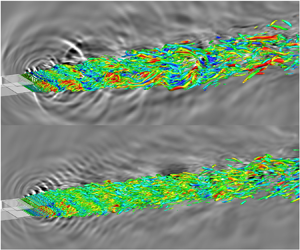
This study is dedicated to achieving efficient active noise control in a supersonic underexpanded planar jet, utilizing control parameters informed by resolvent analysis. The baseline supersonic underexpanded jet exhibits complex wave structures and substantial high-amplitude noise radiations. To perform the active control, unsteady blowing and suction are applied along the nozzle inner wall close to the exit. Employing both standard and acoustic resolvent analyses, a suitable frequency and spanwise wavenumber range for the blowing and suction is identified. Within this range, the control forcing can be significantly amplified in the near field, effectively altering the original sound-producing energetic structure while minimizing far-field amplification to prevent excessive noise. A series of large-eddy simulations are further conducted to validate the control efficiency, demonstrating an over 10 dB reduction in upstream-propagated screech noise. It is identified that the present unsteady control proves more effective than steady control at the same momentum coefficient. The controlled jet flow indicates that the shock structures become more stable, and the stronger the streamwise amplification of the forcing, the more likely it is to modify the mean flow characteristics, which is beneficial for reducing far-field noise radiation. Spectral proper orthogonal decomposition analysis of the controlled flow confirms that the control redistributes energy to higher forcing frequencies and suppresses large-scale antisymmetric and symmetric modes related to screech and its harmonics. The findings of this study highlight the potential of resolvent-guided control techniques in reducing noise in supersonic underexpanded jets and provide a detailed understanding of the inherent mechanisms for effective noise reduction through active control strategies.