To save content items to your account,
please confirm that you agree to abide by our usage policies.
If this is the first time you use this feature, you will be asked to authorise Cambridge Core to connect with your account.
Find out more about saving content to .
To save content items to your Kindle, first ensure no-reply@cambridge.org
is added to your Approved Personal Document E-mail List under your Personal Document Settings
on the Manage Your Content and Devices page of your Amazon account. Then enter the ‘name’ part
of your Kindle email address below.
Find out more about saving to your Kindle.
Note you can select to save to either the @free.kindle.com or @kindle.com variations.
‘@free.kindle.com’ emails are free but can only be saved to your device when it is connected to wi-fi.
‘@kindle.com’ emails can be delivered even when you are not connected to wi-fi, but note that service fees apply.
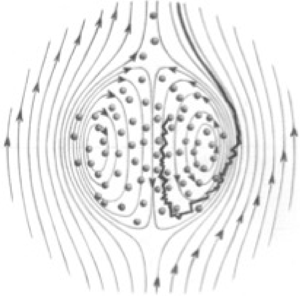
The featured article ‘Break-up of a falling drop containing dispersed particles’ (Nitsche and Batchelor, J. Fluid Mech., 1997, vol. 340, pp. 161–175) is G. K. Batchelor's last published paper with his former postdoctoral associate J. M. Nitsche. The objective of the study was to investigate the randomness of the velocities of interacting rigid particles falling under gravity through a viscous fluid at a small Reynolds number and its consequence for the breakup of a falling cloud of particles. The study focused on a quintessential problem of the collective dynamics of interacting particles and has been an inspiration for subsequent work.
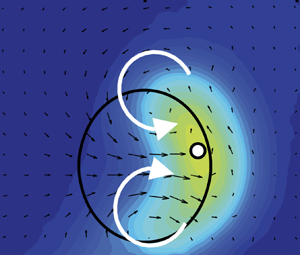
Losses due to wake interactions between wind turbines can significantly reduce the power output of wind farms. The possibility of active flow control by wake deflection downstream of yawed horizontal-axis wind turbines has motivated research on the fluid mechanics involved. We summarize the findings of a wind tunnel study (Bastankhah & Porté-Agel, J. Fluid Mech., vol. 806, 2016, pp. 506–541) of the flow associated with a yawed model wind turbine, and the insights and modelling developments that have followed this important study.
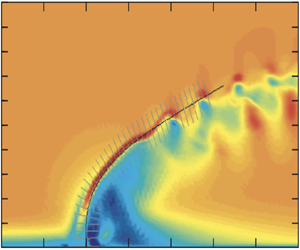
Since its publication in 2010, the paper by Schmid (J. Fluid Mech., vol. 656, 2010, pp. 5–28) has wielded considerable influence, an impact we examine here. That seminal work introduced dynamic mode decomposition, a method for performing flow-field spectral analysis of snapshot sequences of data. As a data-driven approach aimed at uncovering spatial and temporal patterns or modes within datasets, its applicability has extended far beyond fluid mechanics, reaching into a wide array of fields.
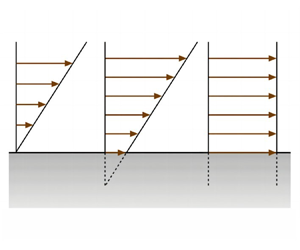
Boundary layers are present in many natural and industrial fluid flows. The concept of boundary layers can be traced back to Leonardo da Vinci's paintings of pipe flow, where he was aware of a higher velocity away from the walls. During the 19th century, the physics of boundary conditions had been extensively debated, and the well-known Maxwell–Navier slip length was proposed in 1823. In most cases, the no-slip boundary condition is valid at a fluid–solid interface. However, with the advancement of measurement techniques, slip lengths ranging from nanometre to micrometre scales were experimentally measured, raising questions regarding the applicability of the no-slip condition. In 2003, Lauga & Stone (J. Fluid Mech., vol. 489, 2003, pp. 55–77) proposed a simple model to elucidate the effect of surface heterogeneities on the slip length, elegantly bridging the microscopic structure of the wall-boundary conditions to the macroscopic effective slip length.
The entrainment hypothesis states that the mean inflow velocity across the boundary of a turbulent flow is proportional to a characteristic velocity of the flow. Proposed by G. I. Taylor approximately 80 years ago, it is still a common model of turbulence closure widely used in environmental engineering and geophysical fluid mechanics. Although it is a very simple concept and mathematical model, it has proven to be able to predict the entrainment in a variety of geophysical flows, e.g. convective clouds and plumes from erupting volcanoes in the atmosphere; dense water overflows and turbidity currents in the ocean; magma injection in a magma chamber in the interior of the Earth, to name just a few. In a seminal paper, Turner (J. Fluid Mech., vol. 173, 1986, pp. 431–471) presents a variety of laboratory and geophysical flows to illustrate the success of the entrainment hypothesis and discusses why such a simple hypothesis works so well even when the original assumptions are no longer valid.
This guide illuminates the intricate relationship between data management, computer architecture, and system software. It traces the evolution of computing to today's data-centric focus and underscores the importance of hardware-software co-design in achieving efficient data processing systems with high throughput and low latency. The thorough coverage includes topics such as logical data formats, memory architecture, GPU programming, and the innovative use of ray tracing in computational tasks. Special emphasis is placed on minimizing data movement within memory hierarchies and optimizing data storage and retrieval. Tailored for professionals and students in computer science, this book combines theoretical foundations with practical applications, making it an indispensable resource for anyone wanting to master the synergies between data management and computing infrastructure.
Methods for solving the various population balance formulations are presented and explained. The methods are presented progressively based on the kinetic and transport processes involved. In terms of methodology, the solution methods for the kinetic part of the population balance equation (PBE) are classified into several families: analytical/similarity, moment, discretisation and Monte Carlo methods. Methods for solving coupled computational fluid dynamics (CFD) – PBE problems are also presented. For each method, the advantages and disadvantages that determine its suitability for certain classes of problems are discussed.
Resolvent analysis provides a framework to predict coherent spatio-temporal structures of the largest linear energy amplification, through a singular value decomposition (SVD) of the resolvent operator, obtained by linearising the Navier–Stokes equations about a known turbulent mean velocity profile. Resolvent analysis utilizes a Fourier decomposition in time, which has thus far limited its application to statistically stationary or time-periodic flows. This work develops a variant of resolvent analysis applicable to time-evolving flows, and proposes a variant that identifies spatio-temporally sparse structures, applicable to either stationary or time-varying mean velocity profiles. Spatio-temporal resolvent analysis is formulated through the incorporation of the temporal dimension to the numerical domain via a discrete time-differentiation operator. Sparsity (which manifests in localisation) is achieved through the addition of an $l_1$-norm penalisation term to the optimisation associated with the SVD. This modified optimisation problem can be formulated as a nonlinear eigenproblem and solved via an inverse power method. We first showcase the implementation of the sparse analysis on a statistically stationary turbulent channel flow, and demonstrate that the sparse variant can identify aspects of the physics not directly evident from standard resolvent analysis. This is followed by applying the sparse space–time formulation on systems that are time varying: a time-periodic turbulent Stokes boundary layer and then a turbulent channel flow with a sudden imposition of a lateral pressure gradient, with the original streamwise pressure gradient unchanged. We present results demonstrating how the sparsity-promoting variant can either change the quantitative structure of the leading space–time modes to increase their sparsity, or identify entirely different linear amplification mechanisms compared with non-sparse resolvent analysis.
A demonstration of a fully onboard method for generating background oriented schlieren (BOS) data on a jet exhaust is presented. Readily available commercial camera equipment is used to capture in-flight imagery of a miniature jet engine exhaust mounted on a custom-built model aircraft. The setup for image acquisition and processing algorithms are described. A new process for registration of images to reduce the degrading effects of vibration and flexure of the airframe are developed and presented along with the underpinning BOS algorithm. Results show that jet flows can be visualised using this technique using a contained system on a single aircraft and demonstrate how a simple technique, such as BOS, can be democratised to such an extent that the cost of conducting in-flight jet measurements can be reduced to the budget of any model aircraft flyer.
3D printed orthomode transducer (OMT) integrated with a 3D printed lens antenna is presented in this work. The OMT integrated with the lens antenna covers the range of 54–80 GHz, the radiator can handle a fractional bandwidth of 38%. Fused filament fabrication printing process is used for the domed elliptical profile lens antenna and polyjet printing process is used for fabrication of the OMT. The simulated radiation efficiency of the antenna remains above 90% for the entire bandwidth and the structure shows a gain of above 16 dBi.
Channel coding lies at the heart of digital communication and data storage. Fully updated to include current innovations in the field, including a new chapter on polar codes, this detailed introduction describes the core theory of channel coding, decoding algorithms, implementation details, and performance analyses. This edition includes over 50 new end-of-chapter problems to challenge students and numerous new figures and examples throughout.
The authors emphasize a practical approach and clearly present information on modern channel codes, including polar, turbo, and low-density parity-check (LDPC) codes, as well as detailed coverage of BCH codes, Reed–Solomon codes, convolutional codes, finite geometry codes, and product codes for error correction, providing a one-stop resource for both classical and modern coding techniques.
Assuming no prior knowledge in the field of channel coding, the opening chapters begin with basic theory to introduce newcomers to the subject. Later chapters then begin with classical codes, continue with modern codes, and extend to advanced topics such as code ensemble performance analyses and algebraic LDPC code design.
300 varied and stimulating end-of-chapter problems test and enhance learning, making this an essential resource for students and practitioners alike.
Provides a one-stop resource for both classical and modern coding techniques.
Starts with the basic theory before moving on to advanced topics, making it perfect for newcomers to the field of channel coding.
180 worked examples guide students through the practical application of the theory.
Explore the fundamentals of biomedical engineering technologies with this thought-provoking introduction, framed around modern-day global cancer inequities. Connecting engineering principles to real-world global health scenarios, this textbook introduces major technological advances in cancer care through the lens of global health inequity, discusses how promising new technologies can address this inequity, and demonstrates how novel medical technologies are adopted for real-world clinical use. It includes modular chapters designed to enable a flexible pathway through the material for students from a wide range of backgrounds; boxed discussion of contemporary issues in engineering for global health, encouraging students to explore ethical questions related to science and society; supplementary lab modules for hands-on experience in translating engineering principles into healthcare solutions; and over 200 end-of-chapter problems targeting multiple learning outcomes to solidify student understanding. Designed to equip students with all the critical, technical, and ethical knowledge they need to excel, this is the ideal introduction for students in biomedical engineering and global health.
The derivation and formulation of the population balance equation (PBE) is presented in this chapter. Various formulations such as the discrete, continuous, multidimensional and coupled PBEs are presented under a unifying framework and related to the problems that they can be applied to. The spatially dependent PBE and its coupling with fluid dynamics is also discussed.
This study investigates the influence of surface wave characteristics, specifically wave steepness and directional spreading, on intermittency in deep-water gravity wave turbulence through long-term numerical simulations of three-dimensional potential fully nonlinear periodic gravity waves. We conducted this investigation by estimating the scaling exponent of the surface elevation under different sea state conditions. With our numerical methods, we were able to evaluate the scaling exponents of the structure-function up to 12th order. The observed increased intermittency in directionally narrower sea states and in higher steepness conditions aligns with known effects of quasi-resonant wave–wave interactions and wave breaking. Comparative analyses reveal that both the conventional She–Leveque model and the multifractal models, also used to represent intermittency in wave turbulence of a different nature, exhibit a strong correlation in this study. This observation underscores the universality of intermittency phenomena within wave turbulence.
Appendices include the basic equations involved in coupling the population balance equation (PBE) with fluid flow, heat and mass transfer (Appendix A), the implementation of the conservative finite volume discretisation method (Appendix B), the derivation of the probability density function (PDF) transport equation (Appendix C) and the derivation of the stochastic field equation (Appendix D).
Channel coding lies at the heart of digital communication and data storage. Fully updated to include current innovations in the field, including a new chapter on polar codes, this detailed introduction describes the core theory of channel coding, decoding algorithms, implementation details, and performance analyses. This edition includes over 50 new end-of-chapter problems to challenge students and numerous new figures and examples throughout.
The authors emphasize a practical approach and clearly present information on modern channel codes, including polar, turbo, and low-density parity-check (LDPC) codes, as well as detailed coverage of BCH codes, Reed–Solomon codes, convolutional codes, finite geometry codes, and product codes for error correction, providing a one-stop resource for both classical and modern coding techniques.
Assuming no prior knowledge in the field of channel coding, the opening chapters begin with basic theory to introduce newcomers to the subject. Later chapters then begin with classical codes, continue with modern codes, and extend to advanced topics such as code ensemble performance analyses and algebraic LDPC code design.
300 varied and stimulating end-of-chapter problems test and enhance learning, making this an essential resource for students and practitioners alike.
Provides a one-stop resource for both classical and modern coding techniques.
Starts with the basic theory before moving on to advanced topics, making it perfect for newcomers to the field of channel coding.
180 worked examples guide students through the practical application of the theory.