Refine search
Actions for selected content:
212822 results in Engineering
Correlations between wall heat flux and Reynolds shear stress/turbulent heat flux in compressible turbulent boundary layers
-
- Journal:
- Journal of Fluid Mechanics / Volume 999 / 25 November 2024
- Published online by Cambridge University Press:
- 14 November 2024, A52
-
- Article
- Export citation
Preface
-
- Book:
- Thermal Radiation
- Published online:
- 31 October 2024
- Print publication:
- 14 November 2024, pp ix-x
-
- Chapter
- Export citation
On dewetting and concentration evolution of thin binary fluid films
-
- Journal:
- Journal of Fluid Mechanics / Volume 999 / 25 November 2024
- Published online by Cambridge University Press:
- 14 November 2024, A55
-
- Article
- Export citation
Take-off performance of a single engine battery-electric aeroplane
-
- Journal:
- The Aeronautical Journal / Volume 128 / Issue 1330 / December 2024
- Published online by Cambridge University Press:
- 14 November 2024, pp. 2781-2798
-
- Article
-
- You have access
- Open access
- HTML
- Export citation
3 - Numerical Methods for Solving the Radiative Transfer Equation
-
- Book:
- Thermal Radiation
- Published online:
- 31 October 2024
- Print publication:
- 14 November 2024, pp 54-79
-
- Chapter
- Export citation
6 - An Overview of Micro/Nanoscale Thermal Radiation
-
- Book:
- Thermal Radiation
- Published online:
- 31 October 2024
- Print publication:
- 14 November 2024, pp 119-136
-
- Chapter
- Export citation
2 - Radiative Transfer Equation
-
- Book:
- Thermal Radiation
- Published online:
- 31 October 2024
- Print publication:
- 14 November 2024, pp 31-53
-
- Chapter
- Export citation
Transition to turbulence on a rotating wind turbine blade at $Re_c=3 \times 10^5$
-
- Journal:
- Journal of Fluid Mechanics / Volume 999 / 25 November 2024
- Published online by Cambridge University Press:
- 14 November 2024, A54
-
- Article
-
- You have access
- Open access
- HTML
- Export citation
-
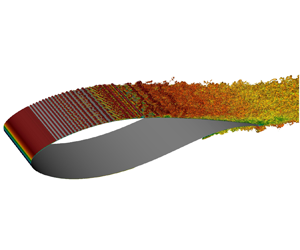
The boundary-layer stability on a section of a rotating wind turbine blade with an FFA-W3 series aerofoil at a chord Reynolds number of $3 \times 10^5$, with varying rotation and radii, is studied with direct numerical simulations and linear stability analyses. Low rotation does not significantly affect transition in the outboard blade region. The relative insensitivity to rotation is due to a laminar separation bubble near the leading edge, spanwise-deformed by a primary self-excited instability, promoting the secondary absolute instability of the Kelvin–Helmholtz (KH) vortices and rapid transition. Moderate increases in rotation, or moving inboard, stabilise the flow by accelerating the attached boundary layer and possibly inducing competition between cross-flow and KH modes. This delays separation and transition. Initially, for high rotation rates or radial locations close to the hub, transition is delayed. Nevertheless, strong stationary and travelling cross-flow modes are eventually triggered, spanwise modulating the KH rolls and shifting the transition line close to the leading edge. Cross-flow velocities as high as $56\,\%$ of the free stream velocity directed towards the blade tip are reached at the transition location. For radial locations farther from the hub, the effective angle of attack is decreased, and cross-flow transition occurs at lower rotation rates. The advance or delay of the transition line compared with a non-rotating configuration depends on the competing rotation effects of stabilising the attached boundary layer and triggering cross-flow modes in the separation flow region.


1 - Fundamentals of Thermal Radiation
-
- Book:
- Thermal Radiation
- Published online:
- 31 October 2024
- Print publication:
- 14 November 2024, pp 3-30
-
- Chapter
- Export citation
Effect of rotation on wake vortices in stratified flow
-
- Journal:
- Journal of Fluid Mechanics / Volume 999 / 25 November 2024
- Published online by Cambridge University Press:
- 14 November 2024, A44
-
- Article
-
- You have access
- Open access
- HTML
- Export citation
-
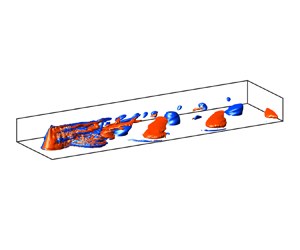
Stratified wakes past an isolated conical seamount are simulated at a Froude number of $Fr = 0.15$ and Rossby numbers of $Ro = 0.15$, 0.75 and $\infty$. The wakes exhibit a Kármán vortex street, unlike their unstratified, non-rotating counterpart. Vortex structures are studied in terms of large-scale global modes, as well as spatially localised vortex evolution, with a focus on rotation effects. The global modes are extracted by spectral proper orthogonal decomposition (SPOD). For all three studied $Ro$ ranging from mesoscale, submesoscale and non-rotating cases, the frequency of the SPOD modes at different heights remains coupled as a global constant. However, the shape of the SPOD modes changes from slanted ‘tongues’ at zero rotation ( $Ro=\infty$) to tall hill-height columns at strong rotation ( $Ro=0.15$). A novel method for vortex centre tracking shows that, in all three cases, the vortices at different heights advect uniformly at approximately $0.9U_{\infty }$ beyond the near wake, consistent with the lack of variability of the global modes. Under system rotation, cyclonic vortices and anticyclonic vortices (AVs) present considerable asymmetry, especially at $Ro = 0.75$. The vorticity distribution as well as the stability of AVs are tracked downstream using statistics conditioned to the identified vortex centres. At $Ro=0.75$, intense AVs with relative vorticity up to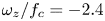 $\omega _z/f_{c}=-2.4$ (where $\omega_z$ is the vertical vorticity and $f_c$ is the Coriolis frequency) are seen with small regions of instability and they maintain large $\omega _z/f_{c}$ magnitude in the far wake. Recent stability analysis that accounts for stratification and viscosity is found to improve on earlier criteria and show that these intense AVs are stable.


5 - Applications of Macroscale Thermal Radiation
-
- Book:
- Thermal Radiation
- Published online:
- 31 October 2024
- Print publication:
- 14 November 2024, pp 100-116
-
- Chapter
- Export citation
A theoretical model for compressible bubble dynamics considering phase transition and migration
-
- Journal:
- Journal of Fluid Mechanics / Volume 999 / 25 November 2024
- Published online by Cambridge University Press:
- 14 November 2024, A58
-
- Article
-
- You have access
- Open access
- HTML
- Export citation
Basic solutions to Taylor–Maccoll equations
-
- Journal:
- Journal of Fluid Mechanics / Volume 999 / 25 November 2024
- Published online by Cambridge University Press:
- 14 November 2024, A48
-
- Article
- Export citation
Multiscale understanding of structural effect on explosive dispersal of granular media
-
- Journal:
- Journal of Fluid Mechanics / Volume 999 / 25 November 2024
- Published online by Cambridge University Press:
- 14 November 2024, A46
-
- Article
- Export citation
A wearable gait lab powered by sensor-driven digital twins for quantitative biomechanical analysis post-stroke
-
- Journal:
- Wearable Technologies / Volume 5 / 2024
- Published online by Cambridge University Press:
- 14 November 2024, e13
-
- Article
-
- You have access
- Open access
- HTML
- Export citation
4 - Experimental Techniques for Macroscale Thermal Radiative Properties
-
- Book:
- Thermal Radiation
- Published online:
- 31 October 2024
- Print publication:
- 14 November 2024, pp 80-99
-
- Chapter
- Export citation

Side-heated Rayleigh–Bénard convection
-
- Journal:
- Journal of Fluid Mechanics / Volume 999 / 25 November 2024
- Published online by Cambridge University Press:
- 13 November 2024, A35
-
- Article
-
- You have access
- Open access
- HTML
- Export citation

A theoretical derivation of slip boundary conditions based on the Cercignani–Lampis–Lord scattering model
-
- Journal:
- Journal of Fluid Mechanics / Volume 999 / 25 November 2024
- Published online by Cambridge University Press:
- 13 November 2024, A36
-
- Article
- Export citation

Interface evolution induced by two successive shocks under diverse reshock conditions
-
- Journal:
- Journal of Fluid Mechanics / Volume 999 / 25 November 2024
- Published online by Cambridge University Press:
- 13 November 2024, A31
-
- Article
- Export citation
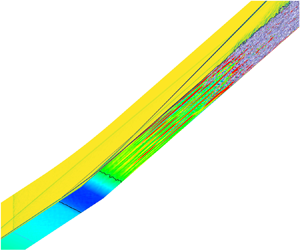
Transition to turbulence in hypersonic flow over a compression ramp due to upstream forcing
-
- Journal:
- Journal of Fluid Mechanics / Volume 999 / 25 November 2024
- Published online by Cambridge University Press:
- 13 November 2024, A37
-
- Article
- Export citation
-
Several transition scenarios are present in a hypersonic compression-ramp flow. In our previous work (Cao et al., J. Fluid Mech., vol. 941, 2022, p. A8), a complete transition process induced by the global instability of a compression-ramp flow was revealed. In a globally stable flow, however, the transition to turbulence can be promoted by convective instabilities, which is the focus of this work. The same flow conditions as in our previous work (Mach number 7.7, Reynolds number $8.6\times 10^5$ based on the flat-plate length) are considered here. Owing to a smaller ramp angle, a weakly separated flow forms on the compression ramp, which supports no global instability. Resolvent analysis identifies low-frequency streamwise streaks as the optimal response of base flow to upstream forcing. Local stability analysis reveals Mack's second mode in the boundary layer downstream of reattachment. By introducing random disturbances upstream of separation in direct numerical simulations, we observe breakdown to turbulence downstream of reattachment. Two transition scenarios are revealed, and they are highly dependent on the amplitude of upstream disturbances. For a large amplitude, strong streamwise streaks develop near the reattachment region, which break down to turbulence quickly. However, when the disturbance amplitude is reduced, the second-mode instability dominates the transition to turbulence.

