Refine search
Actions for selected content:
212822 results in Engineering
Resonant surface waves in an oscillating periodic tank with a submerged hill
-
- Journal:
- Journal of Fluid Mechanics / Volume 999 / 25 November 2024
- Published online by Cambridge University Press:
- 18 November 2024, A69
-
- Article
-
- You have access
- Open access
- HTML
- Export citation
-
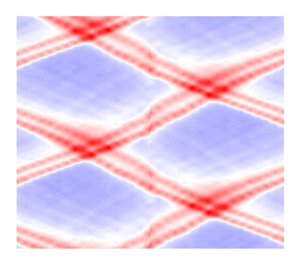
Experimental studies on the sloshing of fluid layers are usually performed in rectangular tanks with fixed boundaries. In contrast, the present study uses a 4.76-m-long circular channel, a geometry with open periodic boundaries. Surface waves are excited by means of a submerged hill that, together with the tank, performs a harmonic oscillation. Laboratory measurements are made using 18 ultrasonic probes, evenly distributed over the channel to track the wave propagation. It is shown that a two-dimensional long-wave numerical model derived via the Kármán–Pohlhausen approach reproduces the experimental data as long as the forcing is monochromatic. The sloshing experiments imply a highly complex surface wave field. Different wave types such as solitary waves, undular bores and antisolitary waves are observed. For order one $\delta _{hill} = h_{hill}/h_0$, where $h_0$ is the mean water level and $h_{hill}$ the obstacle's height, the resonant reflections of solitary waves by the submerged obstacle give rise to an amplitude spectrum for which the main resonance peaks can be explained by linear theory. For smaller $\delta _{hill}$, wave transmissions lead to major differences with respect to the more common cases of sloshing with closed ducts having fully reflective ends for which wave transmission through the end walls is not possible. This ultimately results in more complex resonance diagrams and a pattern formation that changes rather abruptly with the frequency. The experiments are of interest not only for engineering applications but also for tidal flows over bottom topography.


The influence of the shock-to-reshock time on the Richtmyer–Meshkov instability in reshock
-
- Journal:
- Journal of Fluid Mechanics / Volume 999 / 25 November 2024
- Published online by Cambridge University Press:
- 18 November 2024, A68
-
- Article
-
- You have access
- Open access
- HTML
- Export citation
-
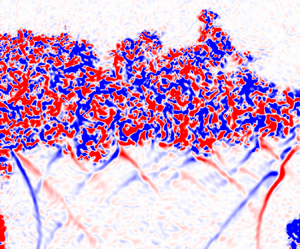
Experiments on the Richtmyer–Meshkov instability (RMI) in a dual driver vertical shock tube (DDVST) are described. An initially planar, stably stratified membraneless interface is formed by flowing air from above and sulfur hexafluoride from below the interface location using the method of Jones & Jacobs (Phys. Fluids, vol. 9, issue 1997, 1997, pp. 3078–3085). A random three-dimensional, multi-modal initial perturbation is imposed by vertically oscillating the gas column to produce Faraday waves. The DDVST design generates two shock waves, one originating above and one below the interface, with these shocks having independently controllable strengths and interface arrival times. The shock waves have nominal strengths of $M_L=1.17$ and $M_H=1.18$ for the shock wave originating in the light and heavy gas, respectively, with these strengths chosen to result in arrested bulk interface motion following reshock. The influence of the length of the shock-to-reshock time, as well as the order of shock arrival, on the post-reshock RMI is examined. The mixing layer width grows according to $h\propto t^\theta$, where $\theta _H=0.36\pm 0.018$ (95 %) and $\theta _L=0.38\pm 0.02$ (95 %) for heavy and light shock first experiments, respectively, indicating no strong dependence on the order of shock wave arrival. Volume integrated specific turbulent kinetic energy (TKE) in the mixing layer versus time is found to decay according to $E_{tot}/\bar {\rho }\propto t^p$ with $p_H=-0.823\pm 0.06$ (95 %) and $p_L=-1.061\pm 0.032$ (95 %) for heavy and light shock first experiments, respectively. Notably, the 95 % confidence intervals do not overlap. Analysis on the influence of the shock-to-reshock time on turbulent length scales, transition criteria, spectra and mixing layer anisotropy are also presented.


Aerodynamic heating in hypersonic shock wave and turbulent boundary layer interaction
-
- Journal:
- Journal of Fluid Mechanics / Volume 999 / 25 November 2024
- Published online by Cambridge University Press:
- 18 November 2024, A66
-
- Article
- Export citation
-
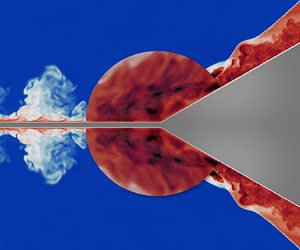
In hypersonic flight the shock wave and turbulent boundary layer interaction (STBLI) sharply increases wall heat transfer that intensifies the aerodynamic heating problems. In this work the STBLI is modelled by compression ramp flow with a Mach number of 5, a Reynolds number based on momentum thickness of 4652 and a wall to recovery temperature ratio of 0.5. The aerodynamic heat generation and transport mechanisms are investigated in the interaction based on theoretical analysis and direct numerical simulation (DNS) that agrees with previous studies. A prediction correlation of wall heat flux in STBLI is deduced theoretically and validated by some representative data including the present DNS, which improves the prediction accuracy and can be applied to a wider $Ma$ range compared with the canonical Q-P theory. The correlation indicates that the sharp increase of wall heat transfer in the STBLI can be explained by the boundary layer compression and the convection transport enhancement. Based on the DNS results, the aerodynamic heat generation and transport mechanisms are revealed in the separation, recirculation and reattachment zones in the STBLI. From this perspective, the peak heat flux can be further explained by the enhancement of near-wall turbulent energy dissipation, compression aerodynamic heat generation and the near-wall turbulent transport. The generation and transport of compression aerodynamic heat reveal the underlying mechanism of the strong correlation between the peak heat flux ratios and the pressure ratios in STBLIs.

Effect of an incoming Gaussian wave packet on underlying turbulence
-
- Journal:
- Journal of Fluid Mechanics / Volume 999 / 25 November 2024
- Published online by Cambridge University Press:
- 18 November 2024, A45
-
- Article
-
- You have access
- Open access
- HTML
- Export citation

On the boundary-layer asymmetry in two-dimensional annular Rayleigh–Bénard convection subject to radial gravity
-
- Journal:
- Journal of Fluid Mechanics / Volume 999 / 25 November 2024
- Published online by Cambridge University Press:
- 18 November 2024, R1
-
- Article
-
- You have access
- Open access
- HTML
- Export citation
-
Radial unstable stratification is a potential source of turbulence in the cold regions of accretion disks. To investigate this thermal effect, here we focus on two-dimensional Rayleigh–Bénard convection in an annulus subject to radially dependent gravitational acceleration $g \propto 1/r$. Next to the Rayleigh number $Ra$ and Prandtl number $Pr$, the radius ratio $\eta$, defined as the ratio of inner and outer cylinder radii, is a crucial parameter governing the flow dynamics. Using direct numerical simulations for $Pr=1$ and $Ra$ in the range from $10^7$ to $10^{10}$, we explore how variations in $\eta$ influence the asymmetry in the flow field, particularly in the boundary layers. Our results show that in the studied parameter range, the flow is dominated by convective rolls and that the thermal boundary-layer (TBL) thickness ratio between the inner and outer boundaries varies as $\eta ^{1/2}$. This scaling is attributed to the equality of velocity scales in the inner ( $u_i$) and outer ( $u_o$) regions. We further derive that the temperature drops in the inner and outer TBLs scale as $1/(1+\eta ^{1/2})$ and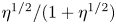 $\eta ^{1/2}/(1+\eta ^{1/2})$, respectively. The scalings and the temperature drops are in perfect agreement with the numerical data.


Collapse of microbubbles over an elastoplastic wall
-
- Journal:
- Journal of Fluid Mechanics / Volume 999 / 25 November 2024
- Published online by Cambridge University Press:
- 18 November 2024, A72
-
- Article
-
- You have access
- Open access
- HTML
- Export citation

Three-dimensional simulation of film boiling on a horizontal surface with magnetic field
-
- Journal:
- Journal of Fluid Mechanics / Volume 999 / 25 November 2024
- Published online by Cambridge University Press:
- 18 November 2024, A74
-
- Article
- Export citation
Full 2D optimized window coefficients for improved range velocity estimation in 5G joint communication and sensing
-
- Journal:
- International Journal of Microwave and Wireless Technologies / Volume 17 / Issue 2 / March 2025
- Published online by Cambridge University Press:
- 18 November 2024, pp. 357-364
-
- Article
-
- You have access
- Open access
- HTML
- Export citation
-
This work presents an approach for optimization of window coefficients for 5G user equipment side sensing, using orthogonal frequency division multiplexing radar-based range and velocity estimation, based on the sounding reference signal (SRS) from the 5G New Radio (NR) standard. The signal configuration and the corresponding waveform are generated in compliance with the 3rd Generation Partnership Project (3GPP) standard for 5G. The limitations of conventional signal processing for resources available for sensing with the SRS are highlighted. The proposed approach, which optimizes the window coefficients to improve the sensing capabilities, is implemented through two methods. The first method employs a decoupled optimization strategy for range and velocity, showing high computational efficiency. Our results demonstrate that this method significantly improves the peak sidelobe level (PSL) of the velocity profile by over $\mathrm{15}\,\mathrm{dB}$, although it does not address the issue of diagonally located sidelobes, which occur due to non-uniform resource distribution. The second method adopts a comprehensive full 2D optimization technique. While it requires more computational resources and does not improve the PSL beyond the first method’s achievements, it mitigates the diagonally located sidelobes issue. The level of these have been improved by more than $\mathrm{3}\,\mathrm{dB}$.


A dual-band microwave sensor for liquid permittivity characterization based on multiple complementary split-ring resonators
-
- Journal:
- International Journal of Microwave and Wireless Technologies / Volume 16 / Issue 8 / October 2024
- Published online by Cambridge University Press:
- 18 November 2024, pp. 1431-1438
-
- Article
- Export citation
Linear instability in thermally stratified quasi-Keplerian flows
-
- Journal:
- Journal of Fluid Mechanics / Volume 999 / 25 November 2024
- Published online by Cambridge University Press:
- 18 November 2024, A75
-
- Article
-
- You have access
- Open access
- HTML
- Export citation
-
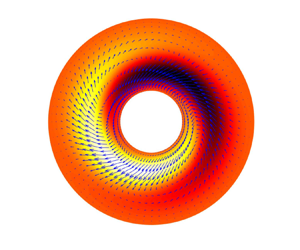
Quasi-Keplerian flow, a special regime of Taylor–Couette co-rotating flow, is of great astrophysical interest for studying angular momentum transport in accretion disks. The well-known magnetorotational instability (MRI) successfully explains the flow instability and generation of turbulence in certain accretion disks, but fails to account for these phenomena in protoplanetary disks where magnetic effects are negligible. Given the intrinsic decrease of the temperature in these disks, we examine the effect of radial thermal stratification on three-dimensional global disturbances in linearised quasi-Keplerian flows under radial gravitational acceleration mimicking stellar gravity. Our results show a thermo-hydrodynamic linear instability for both axisymmetric and non-axisymmetric modes across a broad parameter space of the thermally stratified quasi-Keplerian flow. Generally, a decreasing Richardson or Prandtl number stabilises the flow, while a reduced radius ratio destabilises it. This work also provides a quantitative characterisation of the instability. At low Prandtl numbers $Pr$, we observe a scaling relation of the linear critical Taylor number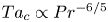 $Ta_c\propto Pr^{-6/5}$. Extrapolating the observed scaling to high $Ta$ and low $Pr$ may suggest the relevance of the instability to accretion disks. Moreover, even slight thermal stratification, characterised by a low Richardson number, can trigger the flow instability with a small axial wavelength. These findings are qualitatively consistent with the results from a traditional local stability analysis based on short wave approximations. Our study refines the thermally induced linearly unstable transition route in protoplanetary disks to explain angular momentum transport in dead zones where MRI is ineffective.


Data-driven optimization of a gas turbine combustor: A Bayesian approach addressing NOx emissions, lean extinction limits, and thermoacoustic stability
- Part of
-
- Journal:
- Data-Centric Engineering / Volume 5 / 2024
- Published online by Cambridge University Press:
- 18 November 2024, e32
-
- Article
-
- You have access
- Open access
- HTML
- Export citation
Efficient high-power 2.3 μm continuous-wave laser operation of diffusion-bonded composite YVO4/Tm:GdVO4 crystals
-
- Journal:
- High Power Laser Science and Engineering / Volume 12 / 2024
- Published online by Cambridge University Press:
- 15 November 2024, e63
-
- Article
-
- You have access
- Open access
- HTML
- Export citation
On the laminar solutions and stability of accelerating and decelerating channel flows
-
- Journal:
- Journal of Fluid Mechanics / Volume 999 / 25 November 2024
- Published online by Cambridge University Press:
- 15 November 2024, A43
-
- Article
-
- You have access
- Open access
- HTML
- Export citation
-
We study the effect of acceleration and deceleration on the stability of channel flows. To do so, we derive an exact solution for laminar profiles of channel flows with an arbitrary, time-varying wall motion and pressure gradient. This solution then allows us to investigate the stability of any unsteady channel flow. In particular, we restrict our investigation to the non-normal growth of perturbations about time-varying base flows with exponentially decaying acceleration and deceleration, with comparisons to growth about a constant base flow (i.e. the time-invariant simple shear or parabolic profile). We apply this acceleration and deceleration through the velocity of the walls and through the flow rate. For accelerating base flows, perturbations never grow larger than perturbations about a constant base flow, while decelerating flows show massive amplification of perturbations – at a Reynolds number of $500$, properly timed perturbations about the decelerating base flow grow $ {O}(10^5)$ times larger than perturbations grow about a constant base flow. This amplification increases as we raise the rate of deceleration and the Reynolds number. We find that this amplification arises due to a transition from spanwise perturbations leading to the largest amplification to streamwise perturbations leading to the largest amplification that only occurs in the decelerating base flow. By evolving the optimal perturbations through the linearized equations of motion, we reveal that the decelerating base flow achieves this massive amplification through the Orr mechanism, or the down-gradient Reynolds stress mechanism, which accelerating and constant base flows cannot maintain.


Adaptive algorithms for drone flight control under communication constraints and information incompleteness
-
- Journal:
- The Aeronautical Journal / Volume 129 / Issue 1332 / February 2025
- Published online by Cambridge University Press:
- 15 November 2024, pp. 282-295
-
- Article
- Export citation
Can isothermal plane Couette flow in fluid overlying porous layer be linearly unstable?
-
- Journal:
- Journal of Fluid Mechanics / Volume 999 / 25 November 2024
- Published online by Cambridge University Press:
- 15 November 2024, A61
-
- Article
-
- You have access
- Open access
- HTML
- Export citation
-
The present study aims to examine the temporal linear stability analysis of isothermal plane Couette flow over a porous layer using the two-domain approach. The flow in the porous layer is described by the unsteady Darcy–Brinkman equations, whereas it is characterised by the Navier–Stokes equations in the fluid layer. In contrast to the Darcy model, it is observed that the isothermal plane Couette flow becomes unstable for such a superposed system on the inclusion of the Brinkman term. From the stability analysis, the two-dimensional mode is found to be least stable, and two modes of instability, namely porous mode and mixed mode are obtained under the consideration of the Darcy–Brinkman model along with advection term (DBA model). For Darcy number $(\delta )=0.01$, depending on the value of the stress-jump coefficient, mixed mode controls the instability of the system at small values of depth ratio $(\hat {d})$, and it disappears for relatively high values of $\hat {d}$, where the porous mode dominates. In addition, it has been observed that when $\hat {d}=0.1$, the critical mode of instability is found to be mixed for $\delta >0.02$ and porous for $\delta \le 0.02$. The stress-jump coefficient destabilises the flow in terms of energy production through perturbed stresses at the interface. As observed in the case of isothermal plane Poiseuille flow studied by Chang, Chen & Straughan (J. Fluid Mech., vol. 564, 2006, pp. 287–303), here also depth ratio (Darcy number) stabilises (destabilises) the flow. However, this characteristic does not remain valid when the advection term is eliminated from the considered momentum equation. For a certain range of $\hat {d} (\delta )$, the destabilising (stabilising) characteristic of the respective parameters are encountered when the fluid mode of instability prevails.


Filtered partial differential equations: a robust surrogate constraint in physics-informed deep learning framework
-
- Journal:
- Journal of Fluid Mechanics / Volume 999 / 25 November 2024
- Published online by Cambridge University Press:
- 15 November 2024, A40
-
- Article
- Export citation
Flexible dual-band antenna for ISM/5G enabled MIMO systems with pattern diversity for wireless body area networks
-
- Journal:
- International Journal of Microwave and Wireless Technologies / Volume 17 / Issue 1 / February 2025
- Published online by Cambridge University Press:
- 15 November 2024, pp. 83-91
-
- Article
- Export citation
A 172 mJ, high-energy picosecond 355 nm ultraviolet laser system at 100 Hz
-
- Journal:
- High Power Laser Science and Engineering / Volume 12 / 2024
- Published online by Cambridge University Press:
- 15 November 2024, e68
-
- Article
-
- You have access
- Open access
- HTML
- Export citation
-
A high-energy picosecond 355 nm ultraviolet (UV) laser operating at 100 Hz was demonstrated. A 352 mJ, 69 ps, 1064 nm laser at 100 Hz was realized firstly by cascaded regenerative, laser diode end-pumped single-pass and side-pumped main amplifiers. The stimulated Raman scattering-based beam shaping technique, thermally induced birefringence compensation and 4f spatial filter-image relaying systems were used to maintain a relatively homogeneous beam intensity distribution during the amplification process. By using lithium triborate crystals for second- and third-harmonic generation (THG), a 172 mJ, approximately 56 ps, 355 nm UV laser was achieved with a THG conversion efficiency of 49%. To the best of our knowledge, it is the highest pulse energy of a picosecond 355 nm UV laser so far. The beam quality factor ${M}^2$ and pulse energy stability were ${M}_x^2$=3.92, ${M}_y^2$=3.71 and root mean square of 1.48%@3 hours. This laser system could play significant roles in applications including photoconductive switch excitation, laser drilling and laser micro-fabrication.


Non-Hermitian Chern number in rotating Rayleigh–Bénard convection
-
- Journal:
- Journal of Fluid Mechanics / Volume 999 / 25 November 2024
- Published online by Cambridge University Press:
- 15 November 2024, A65
-
- Article
- Export citation
Drift-free, 11 fs pulse delay stability in dual-arm PW-class laser systems
-
- Journal:
- High Power Laser Science and Engineering / Volume 12 / 2024
- Published online by Cambridge University Press:
- 15 November 2024, e64
-
- Article
-
- You have access
- Open access
- HTML
- Export citation
