Refine search
Actions for selected content:
212822 results in Engineering
Multilayer substrate integrated waveguide six-port junctions with embedded resistive films
-
- Journal:
- International Journal of Microwave and Wireless Technologies / Volume 17 / Issue 2 / March 2025
- Published online by Cambridge University Press:
- 13 November 2024, pp. 285-293
-
- Article
-
- You have access
- Open access
- HTML
- Export citation
Low-profile pattern reconfigurable patch antenna with dual bands characteristic for 5G NR communication
-
- Journal:
- International Journal of Microwave and Wireless Technologies / Volume 16 / Issue 8 / October 2024
- Published online by Cambridge University Press:
- 13 November 2024, pp. 1291-1302
-
- Article
- Export citation
Wave turbulence in a rotating channel: numerical implementation and results
-
- Journal:
- Journal of Fluid Mechanics / Volume 999 / 25 November 2024
- Published online by Cambridge University Press:
- 13 November 2024, A29
-
- Article
-
- You have access
- Open access
- HTML
- Export citation
-
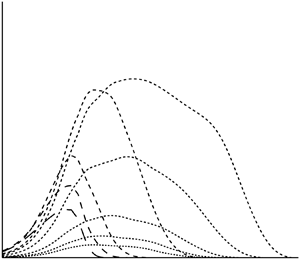
The analysis of Scott (J. Fluid Mech., vol. 741, 2014, pp. 316–349) is implemented numerically. Decaying turbulence is confined to a channel between two infinite, parallel, rotating walls. The Rossby and Ekman numbers are supposed small, the former condition making nonlinearity small, while the latter allows the turbulence to persist for the many rotational periods needed for the small nonlinearity to be effective. The flow is expressed as a combination of inertial waveguide modes, indexed by a two-dimensional wave vector $\boldsymbol{k}$ and an integer n. The $n = 0$ modes form a two-dimensional component of the flow, whereas the remainder is the wave component, on which attention is focused in this article. Assuming statistical axisymmetry and homogeneity in directions parallel to the walls, the second-order moments of the mode amplitudes yield a spectral matrix ${A_{nm}}(k,t)$ (where $k = |\boldsymbol{k} |$), of which the diagonal elements describe the distribution of energy over different modes. Wave-turbulence analysis provides an equation governing the time evolution of ${A_{nn}}$, $n \ne 0$, the wave spectra, which forms the basis for the present work. The initial distribution of energy is Gaussian and depends on a parameter $\varXi$, the initial spectral width. The problem has two other parameters, ${\beta _w}$ and ${\beta _v}$, which correspond to two distinct viscous dissipative mechanisms: wall damping due to boundary layers and volumetric damping by viscous effects throughout the flow. Results obtained by numerical solution include the time evolution of the total wave energy, E, and the detailed description of its distribution over k and n provided by ${A_{nn}}(k)$.


A wideband and multibeam pattern reconfigurable antenna using partially reflecting surface
-
- Journal:
- International Journal of Microwave and Wireless Technologies / Volume 16 / Issue 9 / November 2024
- Published online by Cambridge University Press:
- 13 November 2024, pp. 1579-1587
-
- Article
- Export citation
The reflection of a planar impulsive shock wave at a liquid–gas interface
-
- Journal:
- Journal of Fluid Mechanics / Volume 999 / 25 November 2024
- Published online by Cambridge University Press:
- 13 November 2024, A34
-
- Article
-
- You have access
- Open access
- HTML
- Export citation

Turbulent convection in rotating slender cells
-
- Journal:
- Journal of Fluid Mechanics / Volume 999 / 25 November 2024
- Published online by Cambridge University Press:
- 13 November 2024, A28
-
- Article
-
- You have access
- Open access
- HTML
- Export citation
-
Turbulent convection in the interiors of the Sun and the Earth occurs at high Rayleigh numbers $Ra$, low Prandtl numbers $Pr$, and different levels of rotation rates. To understand the combined effects better, we study rotating turbulent convection for $Pr = 0.021$ (for which some laboratory data corresponding to liquid metals are available), and varying Rossby numbers $Ro$, using direct numerical simulations in a slender cylinder of aspect ratio 0.1; this confinement allows us to attain high enough Rayleigh numbers. We are motivated by the earlier finding in the absence of rotation that heat transport at high enough $Ra$ is similar between confined and extended domains. We make comparisons with higher aspect ratio data where possible. We study the effects of rotation on the global transport of heat and momentum as well as flow structures (a) for increasing rotation at a few fixed values of $Ra$, and (b) for increasing $Ra$ (up to $10^{10}$) at the fixed, low Ekman number $1.45 \times 10^{-6}$. We compare the results with those from unity $Pr$ simulations for the same range of $Ra$ and $Ro$, and with the non-rotating case over the same range of $Ra$ and low $Pr$. We find that the effects of rotation diminish with increasing $Ra$. These results and comparison studies suggest that for high enough $Ra$, rotation alters convective flows in a similar manner for small and large aspect ratios, so useful insights on the effects of high thermal forcing on convection can be obtained by considering slender domains.


Spatially averaged, vegetated, oscillatory boundary and shear layers
-
- Journal:
- Journal of Fluid Mechanics / Volume 999 / 25 November 2024
- Published online by Cambridge University Press:
- 13 November 2024, A33
-
- Article
- Export citation
Neural networks empowered: a machine learning-enabled, Gyro mmID for enhanced virtual reality and motion tracking applications
-
- Journal:
- International Journal of Microwave and Wireless Technologies / Volume 17 / Issue 2 / March 2025
- Published online by Cambridge University Press:
- 13 November 2024, pp. 332-339
-
- Article
-
- You have access
- Open access
- HTML
- Export citation
Modeling of intermodulation in a loaded-line phase shifter based on a polynomial varactor model
-
- Journal:
- International Journal of Microwave and Wireless Technologies / Volume 16 / Issue 7 / September 2024
- Published online by Cambridge University Press:
- 13 November 2024, pp. 1113-1124
-
- Article
-
- You have access
- Open access
- HTML
- Export citation
Impacts of inflow turbulence on the flow past a permeable disk
-
- Journal:
- Journal of Fluid Mechanics / Volume 999 / 25 November 2024
- Published online by Cambridge University Press:
- 13 November 2024, A30
-
- Article
- Export citation
-
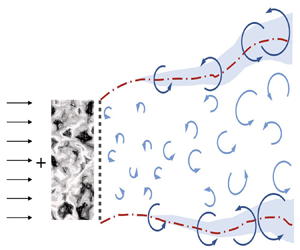
A permeable disk serves as a simplified model for the conversion of wind energy by a horizontal axis wind turbine. In this study, we investigate how inflow turbulence intensity (TI), $I_\infty$, and inflow turbulence integral length scale, $L_\infty$, influence the flow recovery in the wake, the capability of a permeable disk in extracting turbulence kinetic energy (TKE) of the incoming flow, and the statistics of wake-added turbulence using large-eddy simulation. The simulated inflows include various TIs (i.e. $I_\infty =2.5\,\%$– $25\,\%$) and integral length scales (i.e. $L_\infty / D =0.5$– $2.0$) for two thrust coefficients. Simulation results show that both inflow TI and integral length scale influence flow recovery via enhanced ejections and sweeps across the wake boundary, with the former strongly affecting the position where the wake starts to recover and the latter mainly on the recovery rate. Moreover, it is shown that increasing $I_\infty$ and $L_\infty$ increases the TKE extraction by the disk, occurring mainly at scales ( $s$) greater than $0.5D$ and frequencies depending on the inflow integral length scale. As for the wake-added TKE, the inflow TI mainly affects its intensity, while the inflow integral length scale affects both its intensity and the sensitive frequencies, with the spectral distributions in scale space ( $s$) being similar and the peak located around $s/D=1.0$ for the considered inflows.


GaN/SiC V-band 10 W high-power amplifier for inter-satellite communications
-
- Journal:
- International Journal of Microwave and Wireless Technologies / Volume 17 / Issue 2 / March 2025
- Published online by Cambridge University Press:
- 13 November 2024, pp. 177-189
-
- Article
-
- You have access
- Open access
- HTML
- Export citation
Accuracy study for over-the-air frequency synchronization of continuous wave signals
-
- Journal:
- International Journal of Microwave and Wireless Technologies / Volume 17 / Issue 2 / March 2025
- Published online by Cambridge University Press:
- 13 November 2024, pp. 340-346
-
- Article
- Export citation
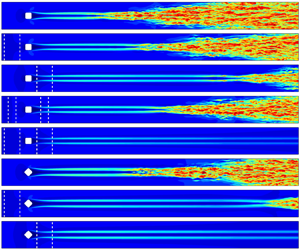
Control of roughness-induced transition in supersonic flows by local wall heating strips
-
- Journal:
- Journal of Fluid Mechanics / Volume 999 / 25 November 2024
- Published online by Cambridge University Press:
- 12 November 2024, A16
-
- Article
- Export citation

Mass transport modelling of two partially miscible, multicomponent fluids in nanoporous media
-
- Journal:
- Journal of Fluid Mechanics / Volume 999 / 25 November 2024
- Published online by Cambridge University Press:
- 12 November 2024, A21
-
- Article
- Export citation

Towards a new roughness parametrization through the effective distribution function
-
- Journal:
- Journal of Fluid Mechanics / Volume 999 / 25 November 2024
- Published online by Cambridge University Press:
- 12 November 2024, A26
-
- Article
-
- You have access
- Open access
- HTML
- Export citation
-
Turbulent flows over rough surfaces can be encountered in a wide range of engineering applications. Despite the progress made after several decades of studies, the prediction of drag and roughness function from the surface geometrical parameters remains an open question. Several methods have shown encouraging results. However, they lack generality and present some scatter in the data. In this paper we propose a new parameter, the effective distribution ( $ED$), which lays foundation on the effective slope with some changes to take into account the sheltering effect of large roughness elements and the drag induced by pinnacles higher than the average roughness elements. To develop this new correlation between geometrical features of the wall and the drag, we performed a set of simulations of the turbulent flow over a rough surface made of triangular elements varying their height and spatial distribution. The $ED$ correlates quite well both with the drag and the roughness function for a wide range of cases having different mean roughness height, skewness and kurtosis. To further validate the $ED$, and assessing how it can be generalized to real rough wall, an irregular wall made from the superposition of random sinusoidal function was considered. Results were consistent with the correlation here presented.


Enhancing tip vortices to improve the lift production through shear layers in flapping-wing flow control
-
- Journal:
- Journal of Fluid Mechanics / Volume 999 / 25 November 2024
- Published online by Cambridge University Press:
- 12 November 2024, A25
-
- Article
- Export citation
-
Flow control of a low-aspect-ratio flat-plate heaving wing at an average angle of attack of $10^{\circ }$ by a steady-blowing jet is numerically studied by using a feedback immersed boundary–lattice Boltzmann method. Blowing jets at the leading edge, mid-chord and trailing edge are considered. The wing enjoys the highest lift production with the trailing-edge downstream blowing jet, which improves the average lift by 50.0 % at $Re = 1000$ and 22.9 % at $Re = 5000$ through the enhancement of the tip vortex circulation caused by the increase in the mass flux of the shear layer at the wing tips. This increase in mass flux decreases as $Re$ increases from 1000 to 5000 due to its self-limiting mechanism. A mid-chord vertical blowing jet induces a middle vortex which enhances the lift production but the enhancement is smaller than that of trailing-edge downstream blowing jet. Other jet arrangements do not significantly increase the lift coefficient, but the mid-chord upstream blowing jet experiences a significant reduction in the drag coefficient, leading to an increase of 50.6 % in the average lift-to-drag ratio. The effectiveness of the flow control is not significantly affected by the aspect ratio.


References
-
- Book:
- Malaysia's Motorcycle Sector
- Published by:
- ISEAS–Yusof Ishak Institute
- Published online:
- 05 July 2025
- Print publication:
- 12 November 2024, pp 61-67
-
- Chapter
- Export citation
Frontmatter
-
- Book:
- Malaysia's Motorcycle Sector
- Published by:
- ISEAS–Yusof Ishak Institute
- Published online:
- 05 July 2025
- Print publication:
- 12 November 2024, pp i-iv
-
- Chapter
- Export citation
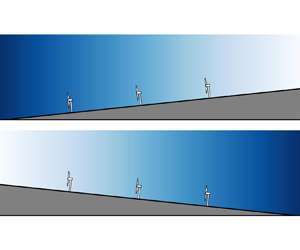
A momentum-conserving wake superposition method for wind-farm flows under pressure gradient
-
- Journal:
- Journal of Fluid Mechanics / Volume 999 / 25 November 2024
- Published online by Cambridge University Press:
- 12 November 2024, A27
-
- Article
- Export citation

Internal gravity waves in flow past a bluff body under different levels of stratification
-
- Journal:
- Journal of Fluid Mechanics / Volume 999 / 25 November 2024
- Published online by Cambridge University Press:
- 12 November 2024, A23
-
- Article
-
- You have access
- Open access
- HTML
- Export citation
-
The flow field of a bluff body, a circular disk, that moves horizontally in a stratified environment is studied using large-eddy simulations. Five levels of stratification (body Froude numbers of ${{Fr}} = 0.5, 1, 1.5, 2$ and $5$) are simulated at Reynolds number of ${{Re}} = 5000$ and Prandtl number of $Pr =1$. A higher ${{Re}} = 50\,000$ database at ${{Fr}} = 2, 10$ and $Pr =1$ is also examined for comparison. The wavelengths and amplitudes of steady lee waves are compared with a linear-theory analysis. Excellent agreement is found over the entire range of ${{Fr}}$ if an ‘equivalent body’ that includes the separation region is employed for the linear theory. For asymptotically large distances, the velocity amplitude varies theoretically as ${{Fr}}^{-1}$ but a correction owing to the dependence of the separation zone on ${{Fr}}$ is needed. The wake waves propagate in a narrow band of angles with the vertical, and have a wavelength that increases with increasing ${{Fr}}$. The envelope of wake waves, demarcated using buoyancy variance, exhibits self-similar behaviour. The higher ${{Re}}$ results are consistent with the buoyancy effects exhibited at the lower ${{Re}}$. The wake wave energy is larger at ${{Re}} = 50\,000$. Nevertheless, independent of ${{Fr}}$ and ${{Re}}$, the ratio of the wake wave potential energy to the wake turbulent energy increases to approximately 0.6–0.7 in the non-equilibrium stage showing their energetic importance besides suggesting universality in this statistic. There is a crossover of energetic dominance of lee waves at ${{Fr}} <2$ to wake-wave dominance at ${{Fr}} \approx 5$.


