Refine search
Actions for selected content:
212822 results in Engineering
Pressure-driven viscoelastic flow in axisymmetric geometries with application to the hyperbolic pipe
-
- Journal:
- Journal of Fluid Mechanics / Volume 999 / 25 November 2024
- Published online by Cambridge University Press:
- 07 November 2024, A7
-
- Article
-
- You have access
- Open access
- HTML
- Export citation
Entrainment of the shear layer separated from a wall-mounted fence
-
- Journal:
- Journal of Fluid Mechanics / Volume 999 / 25 November 2024
- Published online by Cambridge University Press:
- 07 November 2024, A6
-
- Article
- Export citation
Impact of axial strain on linear, transitional and self-similar turbulent mixing layers
-
- Journal:
- Journal of Fluid Mechanics / Volume 999 / 25 November 2024
- Published online by Cambridge University Press:
- 07 November 2024, A5
-
- Article
-
- You have access
- Open access
- HTML
- Export citation
-
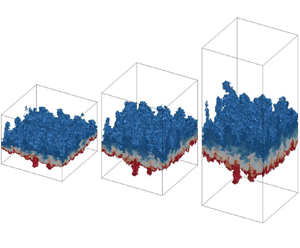
In convergent geometry, the effect of convergence and compression on the Rayleigh–Taylor instability (RTI) and Richtmyer–Meshkov instability (RMI) modifies the growth rate and behaviour of the instabilities. In order to better understand how compression/expansion caused by axial strain rates (i.e. strain rates normal to the interface) change the instability dynamics, axial strain rates are applied to RMI in planar geometry, isolated from the effects of convergence. Potential flow theory for the linear regime shows the growth rate of the instability is modified to include the background velocity difference of the instability's width. Resolved two-dimensional simulations of single-mode RMI showed the potential flow model is accurate whilst the amplitude is small compared with the wavelength. The application of strain rate to an RMI-induced mixing layer was investigated using three-dimensional implicit large eddy simulations (ILES) of the quarter-scale $\theta$-group case by Thornber et al. (Phys. Fluids, vol. 29, 2017, 105107). Whilst the background strain rate contributed to the mixing layer's growth, it was to a smaller extent than expected. The shear production of axial turbulent kinetic energy from the strain rate modified the rate of bulk entrainment, affecting the mixing layer's growth and mixedness, such that the strained simulations no longer attained the same self-similar state. The capability of the buoyancy-drag model by Youngs & Thornber (Physica D, vol. 410, 2020, 132517) to predict the mixing layer width was investigated, using a model calibrated to the unstrained case. New terms were introduced into the buoyancy-drag model, which correspond to the shear production of turbulent kinetic energy.

On the mean structure and unsteadiness of dual shock wave–turbulent boundary layer interactions
-
- Journal:
- Journal of Fluid Mechanics / Volume 999 / 25 November 2024
- Published online by Cambridge University Press:
- 07 November 2024, A3
-
- Article
- Export citation
Eight-port multiband MIMO antenna design with high isolation for 5G smartphones
-
- Journal:
- International Journal of Microwave and Wireless Technologies / Volume 16 / Issue 8 / October 2024
- Published online by Cambridge University Press:
- 07 November 2024, pp. 1316-1330
-
- Article
- Export citation
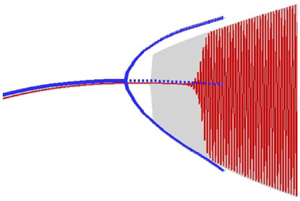
Weakly nonlinear behaviour of transonic buffet on airfoils
-
- Journal:
- Journal of Fluid Mechanics / Volume 999 / 25 November 2024
- Published online by Cambridge University Press:
- 07 November 2024, A8
-
- Article
- Export citation
Effect of skin thickness on electromagnetic dosimetry analysis of a human body model up to 100 GHz
-
- Journal:
- International Journal of Microwave and Wireless Technologies / Volume 16 / Issue 8 / October 2024
- Published online by Cambridge University Press:
- 06 November 2024, pp. 1373-1380
-
- Article
- Export citation
Template-based piecewise affine regression
-
- Journal:
- Research Directions: Cyber-Physical Systems / Volume 2 / 2024
- Published online by Cambridge University Press:
- 06 November 2024, e5
-
- Article
-
- You have access
- Open access
- HTML
- Export citation
Gysel combiners with high-selectivity filtering characteristics: analysis and design
-
- Journal:
- International Journal of Microwave and Wireless Technologies / Volume 17 / Issue 2 / March 2025
- Published online by Cambridge University Press:
- 06 November 2024, pp. 257-268
-
- Article
-
- You have access
- Open access
- HTML
- Export citation
Simulation framework and development of the Future Systems Simulator
-
- Journal:
- The Aeronautical Journal / Volume 128 / Issue 1330 / December 2024
- Published online by Cambridge University Press:
- 06 November 2024, pp. 2754-2780
-
- Article
-
- You have access
- Open access
- HTML
- Export citation
Visual cognition-based optimised design of primary flight displays in cockpits
-
- Journal:
- The Aeronautical Journal / Volume 129 / Issue 1333 / March 2025
- Published online by Cambridge University Press:
- 06 November 2024, pp. 609-626
-
- Article
- Export citation
Metasurface loaded twin-port microstrip antenna with circular polarization features for UHF RFID applications
-
- Journal:
- International Journal of Microwave and Wireless Technologies / Volume 16 / Issue 10 / December 2024
- Published online by Cambridge University Press:
- 06 November 2024, pp. 1798-1805
-
- Article
- Export citation
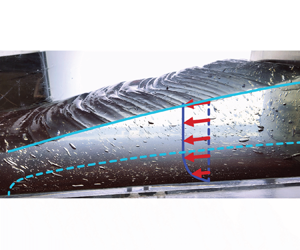
Scraping of a viscoplastic fluid to model mountain building
-
- Journal:
- Journal of Fluid Mechanics / Volume 998 / 10 November 2024
- Published online by Cambridge University Press:
- 05 November 2024, A58
-
- Article
-
- You have access
- Open access
- HTML
- Export citation
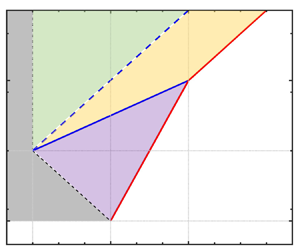
Regimes of stratified turbulence at low Prandtl number
-
- Journal:
- Journal of Fluid Mechanics / Volume 998 / 10 November 2024
- Published online by Cambridge University Press:
- 05 November 2024, A60
-
- Article
-
- You have access
- Open access
- HTML
- Export citation
-
Quantifying transport by strongly stratified turbulence in low Prandtl number ( $Pr$) fluids is critically important for the development of better models for the structure and evolution of stellar and planetary interiors. Motivated by recent numerical simulations showing strongly anisotropic flows suggestive of a scale-separated dynamics, we perform a multiscale asymptotic analysis of the governing equations. We find that, in all cases, the resulting slow–fast systems take a quasilinear form. Our analysis also reveals the existence of several distinct dynamical regimes depending on the emergent buoyancy Reynolds and Péclet numbers, $Re_b = \alpha ^2 Re$ and $Pe_b = Pr Re_b$, respectively, where $\alpha$ is the aspect ratio of the large-scale turbulent flow structures, and $Re$ is the outer-scale Reynolds number. Scaling relationships relating the aspect ratio, the characteristic vertical velocity and the strength of the stratification (measured by the Froude number $Fr$) naturally emerge from the analysis. When $Pe_b \ll \alpha$, the dynamics at all scales is dominated by buoyancy diffusion, and our results recover the scaling laws empirically obtained from direct numerical simulations by Cope et al. (J. Fluid Mech., vol. 903, 2020, A1). For $Pe_b \ge O(1)$, diffusion is negligible (or at least subdominant) at all scales and our results are consistent with those of Chini et al. (J. Fluid Mech., vol. 933, 2022) for strongly stratified geophysical turbulence at $Pr =O(1)$. Finally, we have identified a new regime for $\alpha \ll Pe_b \ll 1$, in which slow, large scales are diffusive while fast, small scales are not. We conclude by presenting a map of parameter space that clearly indicates the transitions between isotropic turbulence, non-diffusive stratified turbulence, diffusive stratified turbulence and viscously dominated flows, and by proposing parameterisations of the buoyancy flux, mixing efficiency and turbulent diffusion coefficient for each regime.


Reinforcement learning-adaptive fault-tolerant IGC method for a class of aircraft with non-affine characteristics and multiple uncertainties
-
- Journal:
- The Aeronautical Journal / Volume 129 / Issue 1331 / January 2025
- Published online by Cambridge University Press:
- 05 November 2024, pp. 84-106
-
- Article
- Export citation
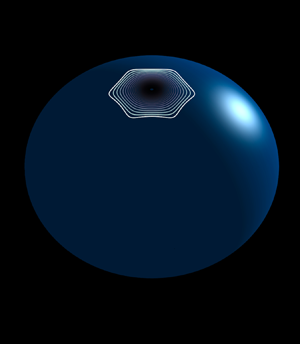
Exact planetary waves and jet streams
-
- Journal:
- Journal of Fluid Mechanics / Volume 998 / 10 November 2024
- Published online by Cambridge University Press:
- 05 November 2024, A43
-
- Article
-
- You have access
- Open access
- HTML
- Export citation
-
We investigate exact nonlinear waves on surfaces locally approximating the rotating sphere for two-dimensional inviscid incompressible flow. Our first system corresponds to a $\beta$-plane approximation at the equator, and the second to a $\gamma$ approximation, with the latter describing flow near the poles. We find exact wave solutions in the Lagrangian reference frame that cannot be written down in closed form in the Eulerian reference frame. The wave particle trajectories, contours of potential vorticity and Lagrangian mean velocity take relatively simple forms. The waves possess a non-trivial Lagrangian mean flow that depends on the amplitude of the waves and on a particle label that characterizes values of constant potential vorticity. The mean flow arises due to potential vorticity conservation on fluid particles. Solutions over the entire space are generated by assuming that the flow far from the origin is zonal and there is a region of uniform potential vorticity between this zonal flow and the waves. In the $\gamma$ approximation, a class of waves is found that, based on analogous solutions on the plane, we call Ptolemaic vortex waves. The mean flow of some of these waves, which we can describe in highly nonlinear scenarios due to the exact nature of the solutions, resembles polar jet streams. Several illustrative solutions are used as initial conditions in the fully spherical rotating Navier–Stokes equations, where integration is performed via the numerical scheme presented in Salmon & Pizzo (Atmosphere, vol. 14, issue 4, 2023, 747). The potential vorticity contours found from these numerical experiments vary between stable permanent progressive form and fully turbulent flows generated by wave breaking.


Intelligent sliding mode fault-tolerant control for aircraft engines with actuator dynamics and faults based on adaptive dynamic programming
-
- Journal:
- The Aeronautical Journal / Volume 129 / Issue 1333 / March 2025
- Published online by Cambridge University Press:
- 05 November 2024, pp. 651-670
-
- Article
- Export citation

The structure and dynamics of the laminar separation bubble
-
- Journal:
- Journal of Fluid Mechanics / Volume 998 / 10 November 2024
- Published online by Cambridge University Press:
- 05 November 2024, A56
-
- Article
- Export citation
-
A novel selective mode decomposition, proper orthogonal decomposition and dynamic mode decomposition methods are used to analyse large-eddy simulation data of the flow field about a NACA0012 airfoil at low Reynolds numbers of $5\times 10^4$ and $9\times 10^4$, and at near-stall conditions. The objective of the analysis is to investigate the structure of the laminar separation bubble (LSB) and its associated low-frequency flow oscillation (LFO). It is shown that the flow field can be decomposed into three dominant flow modes: two low-frequency modes (LFO-Mode-1 and LFO-Mode-2) that govern an interplay of a triad of vortices and sustain the LFO phenomenon, and a high-frequency oscillating (HFO) mode featuring travelling Kelvin–Helmholtz waves along the wake of the airfoil. The structure and dynamics of the LSB depend on the energy content of these three dominant flow modes. At angles of attack lower than the stall angle of attack and above the angle of a full stall, the flow is dominated by the HFO mode. At angles of attack above the stall angle of attack the LFO-Mode-2 overtakes the HFO mode, triggers instability in the LSB and initiates the LFO phenomenon. Previous studies peg the structure, stability and bursting conditions of the separation bubble to local flow parameters. However, the amplitude of these local flow parameters is dependent on the energy content of the three dominant flow modes. Thus, the present work proposes a more robust bursting criterion that is based on global eigenmodes.


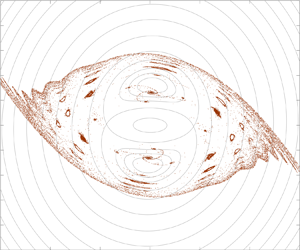
Clustering and chaotic motion of heavy inertial particles in an isolated non-axisymmetric vortex
-
- Journal:
- Journal of Fluid Mechanics / Volume 998 / 10 November 2024
- Published online by Cambridge University Press:
- 05 November 2024, A62
-
- Article
-
- You have access
- Open access
- HTML
- Export citation

A meso–micro atmospheric perturbation model for wind farm blockage
-
- Journal:
- Journal of Fluid Mechanics / Volume 998 / 10 November 2024
- Published online by Cambridge University Press:
- 05 November 2024, A63
-
- Article
- Export citation
