Refine search
Actions for selected content:
212921 results in Engineering
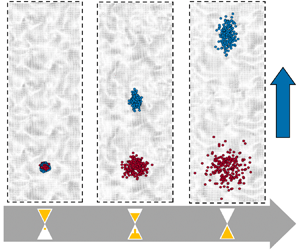
A model for drift velocity mediated scalar eddy diffusivity in homogeneous turbulent flows
-
- Journal:
- Journal of Fluid Mechanics / Volume 989 / 25 June 2024
- Published online by Cambridge University Press:
- 29 July 2024, A14
-
- Article
-
- You have access
- Open access
- HTML
- Export citation
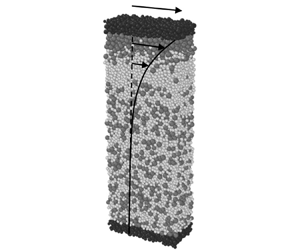
Continuum modelling of size segregation and flow in dense, bidisperse granular media: accounting for segregation driven by both pressure gradients and shear-strain-rate gradients
-
- Journal:
- Journal of Fluid Mechanics / Volume 988 / 10 June 2024
- Published online by Cambridge University Press:
- 29 July 2024, A43
-
- Article
-
- You have access
- Open access
- HTML
- Export citation
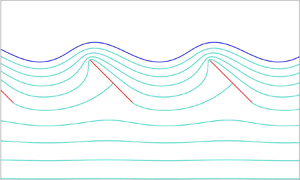
A high-speed tandem hydrofoil cascade
-
- Journal:
- Journal of Fluid Mechanics / Volume 989 / 25 June 2024
- Published online by Cambridge University Press:
- 29 July 2024, A12
-
- Article
-
- You have access
- Open access
- HTML
- Export citation
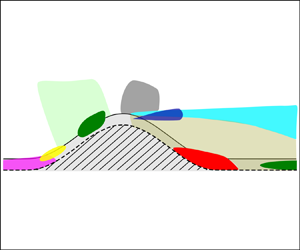
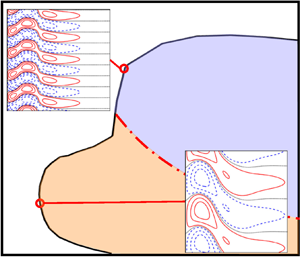
Wall turbulence perturbed by a bump with organized small-scale roughness: flow statistics
-
- Journal:
- Journal of Fluid Mechanics / Volume 989 / 25 June 2024
- Published online by Cambridge University Press:
- 29 July 2024, A13
-
- Article
-
- You have access
- Open access
- HTML
- Export citation
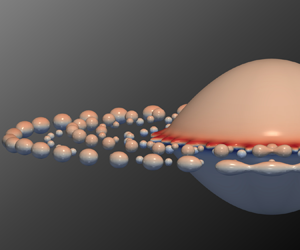
Lattice Boltzmann modelling and study of droplet equatorial streaming in an electric field
- Part of
-
- Journal:
- Journal of Fluid Mechanics / Volume 988 / 10 June 2024
- Published online by Cambridge University Press:
- 26 July 2024, A40
-
- Article
-
- You have access
- Open access
- HTML
- Export citation
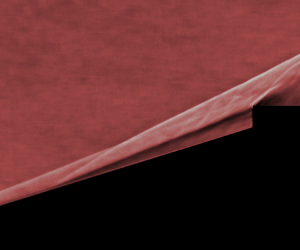
A model for frequency scaling of flow oscillations in high-speed double cones
-
- Journal:
- Journal of Fluid Mechanics / Volume 988 / 10 June 2024
- Published online by Cambridge University Press:
- 25 July 2024, A37
-
- Article
-
- You have access
- Open access
- HTML
- Export citation
-
Coherent small-amplitude unsteadiness of the shock wave and the separation region over a canonical double cone flow, termed in literature as oscillation-type unsteadiness, is experimentally studied at Mach 6. The double cone model is defined by three non-dimensional geometric parameters: fore- and aft-cone angles ( $\theta _1$ and $\theta _2$), and ratio of the conical slant lengths ( $\varLambda$). Previous studies of oscillations have been qualitative in nature, and mostly restricted to a special case of the cone model with fixed $\theta _1 = 0^\circ$ and $\theta _2 = 90^\circ$ (referred to as the spike-cylinder model), where $\varLambda$ becomes the sole governing parameter. In the present effort we investigate the self-sustained flow oscillations in the $\theta _1$- $\varLambda$ parameter space for fixed $\theta _2 = 90^\circ$ using high-speed schlieren visualisation. The experiments reveal two distinct subtypes of oscillations, characterised by the motion (or lack thereof) of the separation point on the fore-cone surface. The global time scale associated with flow oscillation is extracted using spectral proper orthogonal decomposition. The non-dimensional frequency (Strouhal number) of oscillation is seen to exhibit distinct scaling for the two oscillation subtypes. The relationship observed between the local flow properties, instability of the shear layer, and geometric constraints on the flow suggests that an aeroacoustic feedback mechanism sustains the oscillations. Based on this understanding, a simple model with no empiricism is developed for the Strouhal number. The model predictions are found to match well with experimental measurements. The model provides helpful physical insight into the nature of the self-sustained flow oscillations over a double cone at high speeds.


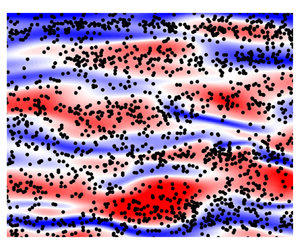
On the relevance of lift force modelling in turbulent wall flows with small inertial particles
-
- Journal:
- Journal of Fluid Mechanics / Volume 988 / 10 June 2024
- Published online by Cambridge University Press:
- 25 July 2024, A47
-
- Article
-
- You have access
- Open access
- HTML
- Export citation
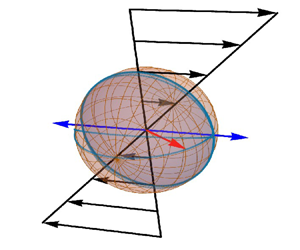
Dynamics of a magnetic particle in an oscillating magnetic field subject to a shear flow
-
- Journal:
- Journal of Fluid Mechanics / Volume 988 / 10 June 2024
- Published online by Cambridge University Press:
- 25 July 2024, A49
-
- Article
-
- You have access
- Open access
- HTML
- Export citation
-
The orientational dynamics of a spherical magnetic particle in linear shear flow subjected to an oscillating magnetic field in the flow plane is analysed in the viscous limit. The shear is in the $X$–
$X$– $Y$ plane, the magnetic field is in the $X$ direction and the vorticity is perpendicular to the flow in the $Z$ direction. The relevant dimensionless groups are $\omega ^\ast$, the ratio of the frequency of the magnetic field and the strain rate, and $\varSigma$, the ratio of the magnetic and hydrodynamic torques. As $\varSigma$ is decreased, there is a transition from in-plane rotation, where the rotation is in the flow ( $X$–
$X$– $Y$) plane, to out-of-plane rotation, where the orientation vector is not necessarily in the $X$–
$X$– $Y$ plane and the dynamics depends on the initial orientation. The particle rotation is phase-locked for in-plane rotation with discrete odd rotation number (number of rotations in one period of magnetic field oscillation), while the orbits are quasi-periodic with non-integer rotation number for out-of-plane rotation. For $\varSigma \gg 1$, regions of odd rotation number $n_o$ are bound by the lines $8 (n_o-1) \varSigma \omega ^\ast = 1$ and $8 (n_o+1) \varSigma \omega ^\ast = 1$, and there are discontinuous changes in the rotation number and mean and root-mean-square torque at these lines. For $\varSigma \ll 1$, the domains of in-plane rotation of finite width in the $\omega ^\ast$– $\varSigma$ plane extend into downward cusps at $\omega ^\ast = {1}/{2 n_o}$. The orbits are quasi-periodic between these domains, where the rotation is out of plane.


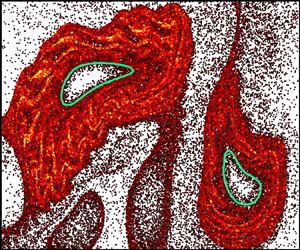
Bacterial barriers
-
- Journal:
- Journal of Fluid Mechanics / Volume 988 / 10 June 2024
- Published online by Cambridge University Press:
- 25 July 2024, F1
-
- Article
-
- You have access
- HTML
- Export citation
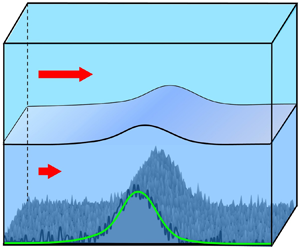
The sandpaper theory of flow–topography interaction for multilayer shallow-water systems
-
- Journal:
- Journal of Fluid Mechanics / Volume 988 / 10 June 2024
- Published online by Cambridge University Press:
- 25 July 2024, A52
-
- Article
- Export citation
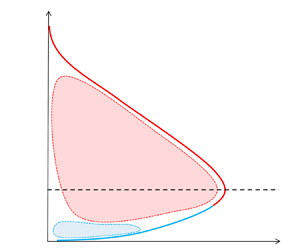
Experimental investigation of the structure of plane turbulent wall jets. Part 1. Spectral analysis
-
- Journal:
- Journal of Fluid Mechanics / Volume 988 / 10 June 2024
- Published online by Cambridge University Press:
- 24 July 2024, A42
-
- Article
- Export citation
-
Plane turbulent wall jets are traditionally considered to be composed of a turbulent boundary layer (TBL) topped by a half-free jet. However, certain peculiar features, such as counter-gradient momentum flux occurring below velocity maximum in experiments and numerical simulations, suggest a different structure of turbulence therein. Here, we hypothesize that turbulence in wall jets has two distinct structural modes, wall mode scaling on wall variables and free-jet mode scaling on jet variables. To investigate this hypothesis, experimental data from our wall jet facility are acquired using single hot-wire anemometry and two-dimensional particle image velocimetry at three nozzle Reynolds numbers 10 244, 15 742 and 21 228. Particle image velocimetry measurements with four side-by-side cameras capture the longest field of view studied so far in wall jets. Direct spatial spectra of these fields reveal modal spectral contributions to variances of velocity fluctuations, Reynolds shear stress, shear force, turbulence production, velocity fluctuation triple products and turbulent transport. The free-jet mode has wavelengths scaling on the jet length scale ${z_{T}}$, and contains two dominant submodes with wavelengths $5{z_{T}}$ and $2.5{z_{T}}$. The region of flow above the velocity maximum shows the presence of the outer jet mode whereas the region below it shows robust bimodal behaviour attributed to both wall and inner jet modes. Counter-gradient momentum flux is effected by the outer jet mode intruding into the region below velocity maximum. These findings support the hypothesis of wall and free-jet structural modes, and indicate that the region below velocity maximum could be much complex than a conventional TBL.


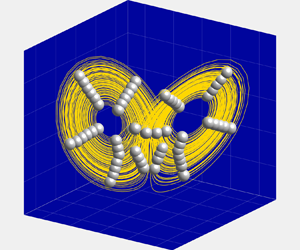
Dynamics-augmented cluster-based network model
-
- Journal:
- Journal of Fluid Mechanics / Volume 988 / 10 June 2024
- Published online by Cambridge University Press:
- 24 July 2024, A48
-
- Article
-
- You have access
- Open access
- HTML
- Export citation
Non-Oberbeck–Boussinesq effects on the linear stability of a vertical natural convection boundary layer
-
- Journal:
- Journal of Fluid Mechanics / Volume 988 / 10 June 2024
- Published online by Cambridge University Press:
- 24 July 2024, A44
-
- Article
-
- You have access
- Open access
- HTML
- Export citation
-
The non-Oberbeck–Boussinesq effects on the stability of a vertical natural convection boundary layer are investigated using the linearised disturbance equations for air flows up to a temperature difference of $\Delta T=100\,{\rm K}$. Based on the linear stability results, the neutral curve is shown to be sensitive to the choice of reference temperature. When evaluated using the film temperature $T_f$, a lower film Grashof number is required to trigger the linear instability for larger $\Delta T$. The relative contributions of shear and buoyant production to the perturbation kinetic energy budget reveals that the marginally unstable modes are amplified based on different mechanisms: for lower wavenumbers at relatively small Grashof number, the instability is driven by buoyancy; whereas for higher wavenumbers and larger Grashof number, the flow becomes unstable due to a shear instability. The use of reference temperature is found to scale the shear- and buoyant-driven instabilities differently so that no single reference temperature definition would collapse the neutral curves. The linear stability result further demonstrates that at a given Grashof number a higher temperature difference would give a larger amplification rate of the perturbation, which then leads to an earlier onset of the nonlinearities when evaluated at $T_f$. Finally, by comparing the amplification rates obtained from direct numerical simulation and the linear stability results, the extent of the linear regime is determined for $\Delta T = 100\,{\rm K}$.


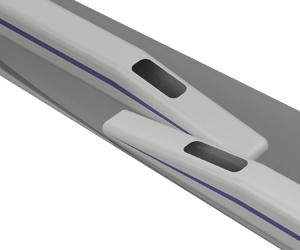
One-dimensional analysis of pressure variations induced by trains passing each other in a tunnel
-
- Journal:
- Journal of Fluid Mechanics / Volume 988 / 10 June 2024
- Published online by Cambridge University Press:
- 24 July 2024, A45
-
- Article
- Export citation
-
In this study, the asymptotic solutions of the pressure variations induced by two trains passing each other in a tunnel are theoretically investigated. The one-dimensional inviscid compressible airflow is analysed, and two methods to obtain numerically exact solutions and $M_{H}$ expansion formulas for approximate equations are presented, where $M_{H}$ is the Mach number of the high-speed train. The pressure coefficient, corresponding to the maximum value of the magnitude of the pressure, is expressed as $|c_{p}|_{max}=|c_{p,min}|=[({R}/({1-R}))$ $(1+\alpha )^{2}+({R(1-R)}/{(1-2R)^{2}})(1-\alpha )^{2}]+O[M_{H}]$, where $c_{p,min}<0$, $\alpha =U_{L}/U_{H}$ and $U_{L}$ and $U_{H}$ denote the speeds of the low- and high-speed trains, respectively, and $R$ is the cross-sectional area ratio of the train to the tunnel. The theoretical results indicate the dependence of the speeds of the two trains on the pressure distribution and that the maximum magnitude of the asymptotic pressure for a fixed value of $M_{H}$ is obtained for $\alpha =1$ and $\alpha =0$ when $R< R_{c}$ and $R>R_{c}$, respectively, where $R_{c}$ denotes the critical blockage ratio. Because the airflow along the side of the low-speed train, induced by the low-speed train, is along the running direction of the high-speed train and reduces the relative velocity of the high-speed train as the two trains pass each other, $|c_{p}|_{max}$ for $\alpha =0$ is larger than $|c_{p}|_{max}$ for $\alpha =1$ when $R>R_{c}$. It is theoretically demonstrated that, as conventional high-speed railway systems satisfy $R< R_{c}$, a conservative pressure estimation can be established assuming $\alpha =1$.


Intrinsic features of flow-induced stability of a square cylinder
-
- Journal:
- Journal of Fluid Mechanics / Volume 988 / 10 June 2024
- Published online by Cambridge University Press:
- 24 July 2024, A50
-
- Article
- Export citation
-
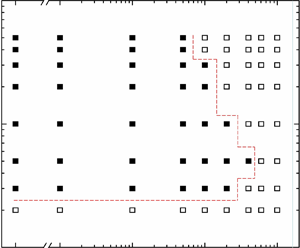
Vortex-induced vibrations and galloping of an elastically mounted square cylinder are investigated for cylinder mass ratio m* = 2–50, damping ratio ζ = 0–1.0, mass-damping ratio m*ζ = 0–50 and flow reduced velocity Ur = 1–80. We home in on the effects of m*, ζ, m*ζ, $({m^\ast } + m_{a\textrm{0}}^\ast )\zeta$ and $({m^\ast } + m_{ae}^\ast )\zeta$ on the critical reduced velocity Urc marking the onset of galloping, where $m_{a\textrm{0}}^\ast $ is the quiescent-fluid added mass ratio and $m_{ae}^\ast $ is the effective added mass ratio. Vibration responses, forces, vibration frequencies and added mass ratios are studied and discussed. The different branches of vortex-induced vibrations have different dependencies of $m_{ae}^\ast $ on Ur. The $m_{ae}^\ast $ in the initial branch is positive and drops rapidly with Ur, but that in the lower branch is negative and declines gently. In the galloping regime, $m_{ae}^\ast $ jumps from negative to positive at the onset of galloping, declining slightly with increasing Ur. Our results and prediction equations show that when ζ = 0, Urc is independent of m* for m* ≥ 5, albeit slightly higher for m* = 3. The latter is ascribed to mode competition. When ζ > 0, Urc linearly increases with increasing ζ. Detailed analysis substantiates that m*ζ or $({m^\ast } + m_{a\textrm{0}}^\ast )\zeta$ does not serve as the unique criterion to predict the galloping occurrence. Here, we propose a new combined mass-damping parameter $({m^\ast } + m_{ae}^\ast )\zeta$ in the relationship between galloping onsets and structural properties, which successfully scales all data of Urc at different m* and ζ values.


Spreading of a viscoelastic drop on a solid substrate
-
- Journal:
- Journal of Fluid Mechanics / Volume 988 / 10 June 2024
- Published online by Cambridge University Press:
- 24 July 2024, A51
-
- Article
- Export citation
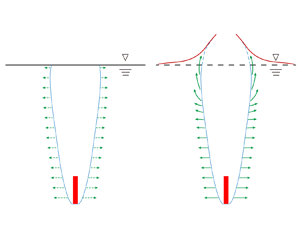
Investigation of free surface effect on the cavity expansion and contraction in high-speed water entry
-
- Journal:
- Journal of Fluid Mechanics / Volume 988 / 10 June 2024
- Published online by Cambridge University Press:
- 24 July 2024, A53
-
- Article
-
- You have access
- Open access
- HTML
- Export citation
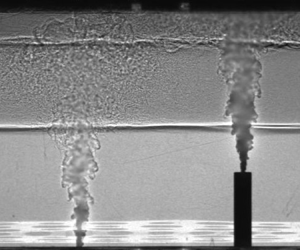
Flow regimes in emptying–filling boxes with two buoyancy sources of differing strengths and elevations
-
- Journal:
- Journal of Fluid Mechanics / Volume 988 / 10 June 2024
- Published online by Cambridge University Press:
- 24 July 2024, A12
-
- Article
-
- You have access
- Open access
- HTML
- Export citation
-
Emptying–filling boxes have been studied in a wide range of configurations for decades, but the flow created in the box by two plumes rising from sources of arbitrary strength and elevation was previously unsolved. Guided by experiments and simplified analytical modelling, we reveal a rich array of two- and three-layer stratifications across seven possible flow regimes. The governing equations for these regimes show how the prevailing regime and stratification properties vary with three key parameters: the relative strength of the plumes, the height difference between their sources and a parameter characterising the resistance of the box to emptying. We observe and explain new behaviours not described in previous studies that are crucial to understanding emptying–filling boxes with multiple plumes. In particular, we demonstrate that the oft-assumed premise that $n$ plumes leads to a stratification with $n+1$ layers is not necessarily true, even in the absence of mixing. Two emptying–filling box models are developed: an analytical model addressing all combinations of the governing parameters and an extended model for three-layer stratifications that incorporates two mixing processes observed in the experiments. The predictions of these two models are in generally excellent agreement with measurements from the experimental campaign covering 69 combinations of the governing parameters. This study improves our understanding of emptying–filling boxes and could facilitate improvements to natural ventilation building design, as demonstrated by an example scenario in which occupants feel cooler upon the addition of a second source of heat.


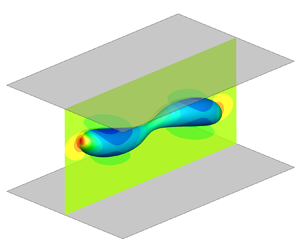
Modelling the effect of soluble surfactants on droplet deformation and breakup in simple shear flow
-
- Journal:
- Journal of Fluid Mechanics / Volume 988 / 10 June 2024
- Published online by Cambridge University Press:
- 24 July 2024, A41
-
- Article
- Export citation
-
A hybrid lattice Boltzmann and finite difference method is applied to study the influence of soluble surfactants on droplet deformation and breakup in simple shear flow. First, the influence of bulk surfactant parameters on droplet deformation in two-dimensional shear flow is investigated, and the surfactant solubility is found to influence droplet deformation by changing average interface surfactant concentration and non-uniform effects induced by non-uniform interfacial tension and Marangoni forces. In addition, the droplet deformation first increases and then decreases with Biot number, increases significantly with adsorption number $k$ and decreases with Péclet number or adsorption depth; and among the parameters, $k$ is the most influential one. Then, we consider three-dimensional shear flow and investigate the roles of surfactants on droplet deformation and breakup for different capillary numbers and viscosity ratios. Results show that in the soluble case with $k=0.429$, the droplet exhibits nearly the same deformation as in the insoluble case due to the balance between surfactant adsorption and desorption; upon increasing $k$ from 0.429 to 1, the average interface surfactant concentration is greatly enhanced, leading to significant increase in droplet deformation. The critical capillary number of droplet breakup $C{{a}_{cr}}$ is identified for varying viscosity ratios in clean, insoluble and soluble ( $k=0.429$ and 1) systems. As the viscosity ratio increases, $C{{a}_{cr}}$ first decreases and then increases rapidly in all systems. The addition of surfactants always favours droplet breakup, and increasing solubility or $k$ could further reduce $C{{a}_{cr}}$ by increasing average interface surfactant concentration and local surfactant concentration near the neck during the necking stage.


Impact of actuation and sensor measurement delays on stability of real-time hybrid aeroelastic simulation system
-
- Journal:
- The Aeronautical Journal / Volume 128 / Issue 1329 / November 2024
- Published online by Cambridge University Press:
- 11 July 2024, pp. 2691-2706
-
- Article
- Export citation
