To save content items to your account,
please confirm that you agree to abide by our usage policies.
If this is the first time you use this feature, you will be asked to authorise Cambridge Core to connect with your account.
Find out more about saving content to .
To save content items to your Kindle, first ensure no-reply@cambridge.org
is added to your Approved Personal Document E-mail List under your Personal Document Settings
on the Manage Your Content and Devices page of your Amazon account. Then enter the ‘name’ part
of your Kindle email address below.
Find out more about saving to your Kindle.
Note you can select to save to either the @free.kindle.com or @kindle.com variations.
‘@free.kindle.com’ emails are free but can only be saved to your device when it is connected to wi-fi.
‘@kindle.com’ emails can be delivered even when you are not connected to wi-fi, but note that service fees apply.
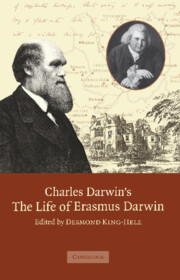
Charles Darwin's book about his grandfather, The Life of Erasmus Darwin, is curiously fascinating. Before publication in 1879, it was shortened by 16%, with several of the cuts directed at its most provocative parts. The cutter, with Charles's permission, was his daughter Henrietta - an example of the strong hidden hand of meek-seeming Victorian women. Originally published in 2003, this first unabridged edition, edited by Desmond King-Hele, includes all that Charles originally intended, the cuts being restored and printed in italics. Erasmus Darwin was one of the leading intellectuals of the eighteenth century. He was a respected physician, a well-known poet, a keen mechanical inventor, and a founding member of the influential Lunar Society. He also possessed an amazing insight into the many branches of physical and biological science. Most notably, he adopted what we now call biological evolution as his theory of life, 65 years prior to Charles Darwin's Origin of Species.
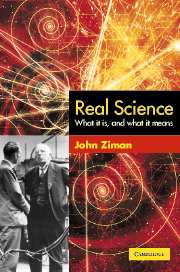
Scientists and 'anti-scientists' alike need a more realistic image of science. The traditional mode of research, academic science, is not just a 'method': it is a distinctive culture, whose members win esteem and employment by making public their findings. Fierce competition for credibility is strictly regulated by established practices such as peer review. Highly specialized international communities of independent experts form spontaneously and generate the type of knowledge we call 'scientific' - systematic, theoretical, empirically-tested, quantitative, and so on. Ziman shows that these familiar 'philosophical' features of scientific knowledge are inseparable from the ordinary cognitive capabilities and peculiar social relationships of its producers. This wide-angled close-up of the natural and human sciences recognizes their unique value, whilst revealing the limits of their rationality, reliability, and universal applicability. It also shows how, for better or worse, the new 'post-academic' research culture of teamwork, accountability, etc. is changing these supposedly eternal philosophical characteristics.
In the very successful and widely discussed first volume in the Golem series, The Golem: What You Should Know About Science, Harry Collins and Trevor Pinch likened science to the Golem, a creature from Jewish mythology, a powerful creature which, while not evil, can be dangerous because it is clumsy. In this second volume, the authors now consider the Golem of technology. In a series of case studies they demonstrate that the imperfections in technology are related to the uncertainties in science described in the first volume. The case studies cover the role of the Patriot anti-missile missile in the Gulf War, the Challenger space shuttle explosion, tests of nuclear fuel flasks and of anti-misting kerosene as a fuel for airplanes, economic modeling, the question of the origins of oil, analysis of the Chernobyl nuclear disaster, and the contribution of lay expertise to the analysis of treatments for AIDS.
Future Imperfect describes and discusses a variety of technological revolutions that might happen over the next few decades, their implications and how to deal with them. Topics range from encryption and surveillance through biotechnology and nanotechnology to life extension, mind drugs, virtual reality and artificial intelligence. One theme of the book is that the future is radically uncertain. Technological changes already begun could lead to more or less privacy than we have ever known, freedom or slavery, effective immortality or the elimination of our species, and radical changes in life, marriage, law, medicine, work and play. We do not know which future will arrive, but it is unlikely to be much like the past. It is worth starting to think about it now.
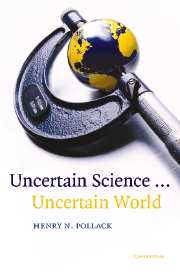
Is the world warming due to the Greenhouse Effect?Can nuclear weapon arsenals be relied upon without periodic testing?Is the world running out of oil?What action should be taken against an outbreak of foot-and-mouth or BSE?Why can't scientists provide certain answers to these and many other questions?The uncertainty of science is puzzling. It arises when scientists have more than one answer to a problem or disagree amongst themselves. In this engaging book, Henry Pollack guides the reader through the maze of contradiction and uncertainty, acquainting them with the ways that uncertainty arises in science, how scientists accommodate and make use of uncertainty, and how in the face of uncertainty they reach their conclusions. Taking examples from recent science headlines and every day life, Uncertain Science … Uncertain World enables the reader to evaluate uncertainty from their own perspectives, and find out more about how science actually works.
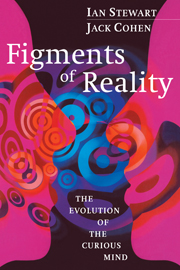
Is the universe around us a figment of our imagination? Or are our minds figments of reality? In this refreshing new look at the evolution of mind and culture, bestselling authors Ian Stewart and Jack Cohen eloquently argue that our minds necessarily evolved inextricably within the context of culture and language. They go beyond conventional reductionist ideas to look at how the mind is the response of an evolving brain trying to grapple with a complex environment. Along the way they develop new and intriguing insights into the nature of evolution, science and humanity.
Conflict, sadly, is part of our everyday life; experienced at home, in the workplace, on our TV screens. But is it an inevitable part of the fabric of our existence? In this volume, eight experts examine conflict at many levels, from the workings of genes to the evolution of galaxies. Evolutionary biologist David Haig examines why we disagree with ourselves, and psychologist Simon Baron-Cohen asks whether differences between the average male and female mind must necessarily lead to misunderstanding. Anthropologist Richard Wrangham explores why chimpanzees and humans have evolved to kill, while archaeologist Barry Cunliffe examines the roots of warfare. Political scientist Lisa Anderson analyses conflict in the Middle East, and broadcaster Kate Adie reflects on television reporting of war. The book concludes with industrial economist William Brown's discussion of conflict in labour relations, and an exploration of the creative and destructive effects of cosmic violence by physicist P. C. W. Davies.
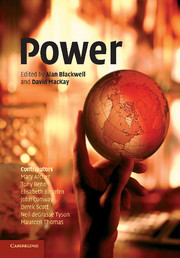
In this book, first published in 2006, seven internationally renowned writers address the theme of Power from the perspective of their own disciplines. Energy expert Mary Archer begins with an exploration of the power sources of our future. Astronomer Neil Tyson leads a tour of the orders of magnitude in the cosmos. Mathematician and inventor of the Game of Life John Conway demonstrates the power of simple ideas in mathematics. Screenwriter Maureen Thomas explains the mechanisms of narrative power in the media of film and videogames, Elisabeth Bronfen the emotional power carried by representations of life and death, and Derek Scott the power of patriotic music and the mysterious Mozart effect. Finally, celebrated parliamentarian Tony Benn critically assesses the reality of power and democracy in society.
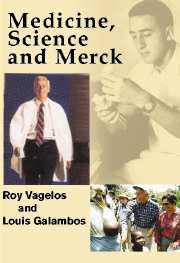
In Medicine, Science, and Merck, the authors trace the careers of a son of Greek immigrants as he mastered three professions and ultimately became the Chief Executive Officer of America's most admired corporation - the multinational, pharmaceutical giant, Merck and Co., Inc. As the authors show, there was hope even for a wise-cracking kid living through the hard times of the 1930s. Education brought out the scholar in Roy Vagelos, who left his family's small restaurant to attend the University of Pennsylvania, Columbia's Medical School, and Massachusetts General Hospital in Boston. At NIH, he mastered biochemistry; at Washington University he became a distinguished science administrator; and at Merck, he headed the pharmaceutical industry's most innovative laboratory and then became its CEO. Throughout, he never lost touch with his family values, his intense desire to help others, or his faith in the partnership principle and the competition that makes it work.
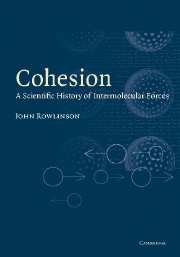
Why does matter stick together? Why do gases condense to liquids, and liquids to solids? This book provides a detailed historical account of how some of the leading scientists of the past three centuries have tried to answer these questions. The topic of cohesion and the study of intermolecular forces has been an important component of physical science research for hundreds of years. This book is organised into four broad periods of advances in our understanding. The first three are associated with Newton, Laplace and van der Waals. The final section gives an account of the successful use in the twentieth century of quantum mechanics and statistical mechanics to resolve most of the remaining problems. The book will be of primary interest to physical chemists and physicists, as well as historians of science interested in the historical origins of our modern day understanding of cohesion.
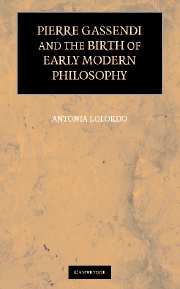
This book offers a comprehensive treatment of the philosophical system of the seventeenth-century philosopher Pierre Gassendi. Gassendi's importance is widely recognized and is essential for understanding early modern philosophers and scientists such as Locke, Leibniz and Newton. Offering a systematic overview of his contributions, LoLordo situates Gassendi's views within the context of sixteenth- and early seventeenth-century natural philosophy as represented by a variety of intellectual traditions, including scholastic Aristotelianism, Renaissance Neo-Platonism, and the emerging mechanical philosophy. LoLordo's work will be essential reading for historians of early modern philosophy and science.
We are all agreed that your theory is crazy. The question that divides us is whether it is crazy enough to have a chance of being correct.
Niels Bohr
Writing research proposals is an integral, although perhaps the least favorite, part of doing science. In an academic environment, the financial resources for carrying out the research come, to a large extent, from external sources. Similarly, in an industrial environment, research proposals are often the means by which a researcher must convey to management the value of supporting a project. Proposals thus are essential for securing research funding, but they are important for other reasons as well. Having research proposals funded shows that your research stands up to peer review, that it has the qualities judged worthy of receiving financial support, and that you are able to communicate research plans in a compelling way. It thus constitutes a sign of professional expertise in job applications and often is considered of critical importance in decisions regarding tenure and promotion. Research grants can sometimes be transferred along with the individual when switching to a new university. Bringing in already-existing research funds can positively influence the decision to make a job offer to the holder of those grants. Research grants thus not only provide the financial means to carry out research, they increase the market value of scientists applying for a job or seeking tenure or promotion.
The brick walls are there for a reason. They're not there to keep us out. The brick wallls are there to give us a chance to show how badly we want something.
Pausch, 2008
Seldom is the path toward success in research either straight or fully charted in advance. Stumbling blocks abound in any research. In this chapter we cover some of the common ones and offer suggestions for steps in conducting research aimed at minimizing their harm and even turning them to advantage.
BEING CONFUSED BECAUSE OF LACK OF DIRECTION
Research can be a confusing activity. Your research plan might be poorly formulated; worse, you might have no plan at all. At times you cannot understand intermediate results of your studies; data that you've recorded might conflict with a theory you developed, or two different lines of reasoning that both seem to make sense give different answers.
The first source of confusion, in which the work basically lacks direction, is clearly a negative one and needs to be fixed early on. Any of a variety of factors can have caused this state of stagnation. Perhaps you have not yet settled on a research topic or you have decided on one but the choice is insufficiently specific to get started on the research. You can avoid this pitfall by being aggressive in choosing and refining a research topic quickly. General considerations when choosing the research topic were given in Chapter 3.
In the theoretical physics community there are many more people who can answer well-posed questions than there are people who can pose the truly important questions. The latter type of physicist can invariably also do much of what the former can do, but the reverse is certainly not true.
Zee, 2003
Many scientists (and non-scientists as well) live under the impression that they don't know much about research topics that lie outside those that occupy them on a daily basis. We often feel like a blank sheet of paper when it concerns such research topics. Perhaps we know more about various areas than we think. The path to ferreting out aspects that we do and don't know is lined with questions. For example, both of us authors are geophysicists, and (an understatement) we don't know much about biomedical research. Yet if we take a topic such as cell therapy, several statements (correct or incorrect, naïve or otherwise) about this area of research can readily bring a number of questions to our lay minds. A line of thinking might go as follows.
In cell therapy one seeks to modify the genetic material of cells in a body in order to correct the deviant behavior that causes a disease. The genetic material is stored in large molecules called DNA. Viruses modify the genetic material of cells. […]
Time is all you have. And you may find one day that you have less than you think.
Pausch, 2008
“I just don't have enough time to do all that I need to do.” This complaint has become almost the mantra of life in modern society. The fretting expressed here invariably leads to a state of physical and emotional stress that is often detrimental to the well-being of both our professional and personal lives. Key words in the mantra are [not] enough time, need, and just. The problem is not that there is not enough time – the time allotted to any individual in life is fixed (but unknown in advance). Therefore, most truly, we each have just the right amount of time for whatever it is that we choose to do in our lives. Rather than there not being enough time for all that we need to do, the problem is that we want to do too many things in a given amount of time. It's a matter of choice. The word just in the mantra suggests that we have no choice in the matter. The key message in this chapter, however, is that we do have that choice.
SETTING PRIORITIES
This brings us to the central point of time management. Given the finite amount of time available, we have essentially two ways to reduce the feeling of having insufficient time – by choosing our activities carefully and by working efficiently.
Whatever your current stage in graduate or even undergraduate study, like it or not, sooner or later you will have to work for a living – as if you haven't been working throughout your graduate school career. So, at some point the moment arrives to apply for a job. Much of what is covered in this chapter is the nuts and bolts of the job-application process aimed at a successful outcome of that process – securing a position that is right for you. But, more than just a tutoring of what to do and what not to do in applying for a job, the chapter aims to share our thoughts on subtle matters you might not otherwise think of but can expect to encounter along the way. Much of how to proceed and what to expect in applying for a job is common to careers in both academia and industry, but we shall also highlight differences.
As indicated in Chapter 14, the first job in an academic environment is likely to be a temporary position as a postdoc. Even then, soon enough the task of applying for a job will appear on the horizon, this time perhaps for a tenure-track faculty position. In industry, life-long employment with a single company used to be common, but this has changed considerably in the ever-more-dynamic world of today.
There are many books on the market with advice for graduate students and other researchers. Some are listed here in various categories.
General advice for graduate students:
Bloom, D.F., Karp, J.D., & Cohen, N. (1998). The Ph.D. Process, A Student's Guide to Graduate School in the Sciences. New York: Oxford University Press.
This is the book for every graduate student in the physical sciences to read.
Bolker, J. (1998). Writing your Dissertation in Fifteen Minutes a Day. New York: Henry Holt and Company LLC.
Booth, W.C., Williams, J.M., & Coulomb, G.C. (2003). The Craft of Research, 2nd edn, Chicago: University of Chicago Press.
Davis, G.B. & Parker, C.A. (1997). Writing the Doctoral Dissertation. New York: Barron's Educational Series Inc.
Feibelman, P.J. (1993). A Ph.D. is Not Enough! A Guide to Survival in Science. Cambridge MA: Perseus Publishing.
Medawar, P.B. (1979). Advice to a Young Scientist. Basic Books.
http://www.basicbooks.com.
Peters, R.L. (1997). Getting What You Came For, The Smart Student's Guide to Earning a Master's or Ph.D., revised edn, New York: Farrar, Straus and Giroux.
The scientific method:
Gauch, H.G., Jr. (2003). Scientific Method in Practice. Cambridge, UK: Cambridge University Press.
Goldstein, I.F. & Goldstein, M. (1984). The Experience of Science. New York: Plenum Press.