To save content items to your account,
please confirm that you agree to abide by our usage policies.
If this is the first time you use this feature, you will be asked to authorise Cambridge Core to connect with your account.
Find out more about saving content to .
To save content items to your Kindle, first ensure no-reply@cambridge.org
is added to your Approved Personal Document E-mail List under your Personal Document Settings
on the Manage Your Content and Devices page of your Amazon account. Then enter the ‘name’ part
of your Kindle email address below.
Find out more about saving to your Kindle.
Note you can select to save to either the @free.kindle.com or @kindle.com variations.
‘@free.kindle.com’ emails are free but can only be saved to your device when it is connected to wi-fi.
‘@kindle.com’ emails can be delivered even when you are not connected to wi-fi, but note that service fees apply.
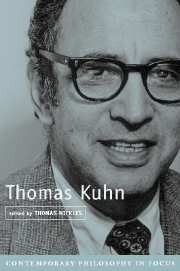
Contemporary Philosophy in Focus offers a series of introductory volumes to many of the dominant philosophical thinkers of the current age. Thomas Kuhn (1922–96), the author of The Structure of Scientific Revolutions, is probably the best-known and most influential historian and philosopher of science of the last 25 years, and has become something of a cultural icon. His concepts of paradigm, paradigm change and incommensurability have changed the way we think about science. This volume offers an introduction to Kuhn's life and work and then considers the implications of Kuhn's work for philosophy, cognitive psychology, social studies of science and feminism. The volume is more than a retrospective on Kuhn, exploring future developments of cognitive and information services along Kuhnian lines. Outside of philosophy the volume will be of particular interest to professionals and students in cognitive science, history of science, science studies and cultural studies.
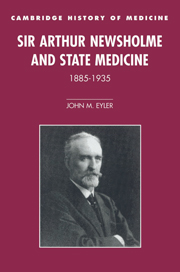
The half century between 1885 and 1935 witnessed an unprecedented expansion of preventive and therapeutic services offered by the state through its local authorities. Behind the expansion in public services were also profound changes in attitudes toward poverty and dependency and toward the political and cultural significance of health; changes in social policy and administration; and changes in the understanding of the causes of disease. This book examines this time of change through the ideas and experiences of one prominent participant, Sir Arthur Newsholme. Professor Eyler draws particular attention to Newsholme's role in constructing a highly successful local health programme; his tenure as the Medical Officer of the Local Government Board in Whitehall where he launched some of its boldest programmes including national health insurance; his post-retirement studies of international health systems; and his statistical and epidemiological studies and their connection to his policy recommendations.
In response to repeated requests this classic book on space-time structure by Professor Erwin Schrödinger is now available in the Cambridge Science Classics series. First published in 1950, and reprinted in 1954 and 1960, this lucid and profound exposition of Einstein's 1915 theory of gravitation still provides valuable reading for students and research workers in the field.
During the period 1840–1940 biology and medicine were transformed, and took on major implications for social amelioration and population growth. New biological disciplines such as genetics and psychology consciously used scientific explanation to redefine the life of the individual. This volume originates from a Past and Present conference on 'The Roots of Sociobiology' held in 1978 and incorporates the results of recent research on problems in the social relations of the biological sciences. The authors describe different historical aspects of the interrelationship of technical experience and social policy in the fields of health, education and social welfare. Insight is provided into contemporary debates on physical and racial deterioration, the sources and distribution of intelligence, the application of evolutionary biology to social and political theory, and the analysis of human societies. The authors raise issues of topical interest, such as the emergence and influence of eugenics, the origin and impact of intelligence testing, the relationship between eugenics, genetics and evolutionary theory, and the causes of the twentieth-century reduction in infant and maternal mortality. The area of coverage is Britain, America and Germany. The introduction provides a review of recent research on the social relations of biology and medicine.
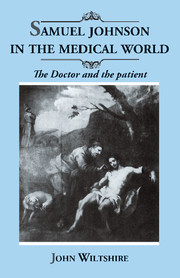
Samuel Johnson has become known to posterity in two capacities: through his own works as the great literary essayist of the eighteenth century, and, through Boswell's Life, as a man - notoriously a medical patient with a string of physical and psychological ailments. John Wiltshire brings the two together in this 1991 study of Johnson the writer as 'Doctor' and patient. The subject of modern medical historians' case studies, Johnson also cultivated the acquaintance of doctors in his own day, and was himself a 'dabbler in physics'. John Wiltshire illuminates Johnson's life and work by setting them in their medical context, and also examines the importance of medical themes in Johnson's own writings. He discusses the many parts of Johnson's work touching on doctors, medicines, hospitals and medical experimentation, and analyses the central theme of human suffering - in body and mind - and its alleviation.
In this study of Robert Boyle's epistemology, Jan W. Wojcik reveals the theological context within which Boyle developed his views on reason's limits. After arguing that a correct interpretation of his views on 'things above reason' depends upon reading his works in the context of theological controversies in seventeenth-century England, Professor Wojcik details exactly how Boyle's three specific categories of things which transcend reason - the incomprehensible, the inexplicable, and the unsociable - affected his conception of what a natural philosopher could hope to know. Also covered in detail is Boyle's belief that God had deliberately limited the human intellect in order to reserve a full knowledge of both theology and natural philosophy for the afterlife.
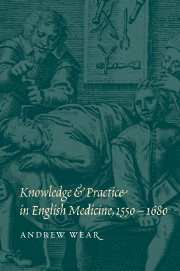
This is a major synthesis of the knowledge and practice of early modern English medicine in its social and cultural contexts. The book vividly maps out some central areas: remedies (and how they were made credible), notions of disease, advice on preventive medicine and on healthy living, and how surgeons worked upon the body and their understanding of what they were doing. The structures of practice and knowledge examined in the first part of the book came to be challenged in the later seventeenth century, when the 'new science' began to overturn the foundation of established knowledge. However, as the second part of the book shows, traditional medical practice was so well entrenched in English culture that much of it continued into the eighteenth century. Various changes did however occur, which set the agenda for later medical treatment and which are discussed in the final chapter.
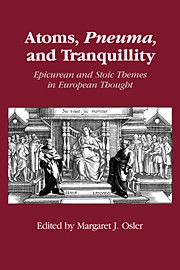
This volume examines the influence that Epicureanism and Stoicism, two philosophies of nature and human nature articulated during classical times, exerted on the development of European thought to the Enlightenment. Although the influence of these philosophies has often been noted in certain areas, such as the influence of Stoicism on the development of Christian thought and the influence of Epicureanism on modern materialism, the chapters in this volume contribute a new awareness of the degree to which these philosophies and their continued interaction informed European intellectual life well into early modern times. The influence of the Epicurean and Stoic philosophies in the areas of literature, philosophy, theology, and science are considered. Many thinkers continue to perceive these philosophies as significant alternatives for understanding the human and natural worlds. Having become incorporated into the canon of philosophical alternatives, Epicureanism and Stoicism continued to exert identifiable influences on scientific and philosophical thought at least until the middle of the eighteenth century.
This volume collects some of the seminal essays on Descartes by Daniel Garber, one of the pre-eminent scholars of early-modern philosophy. A central theme unifying the volume is the interconnection between Descartes' philosophical and scientific interests, and the extent to which these two sides of the Cartesian program illuminate each other, a question rarely treated in the existing literature. Amongst the specific topics discussed in the essays are Descartes' celebrated method, his demand for certainty in the sciences, his account of the relation of mind and body, and his conception of God's activity on the physical world. This collection will be a mandatory purchase for any serious student of or professional working in seventeenth-century philosophy, history of science, or history of ideas.
From the early machines to today's sophisticated aircraft, stability and control have always been crucial considerations. In this second edition, Abzug and Larrabee again forge through the history of aviation technologies to present an informal history of the personalities and the events, the art and the science of airplane stability and control. The book includes never-before-available impressions of those active in the field, from pre-Wright brothers airplane and glider builders through to contemporary aircraft designers. Arranged thematically, the book deals with early developments, research centers, the effects of power on stability and control, the discovery of inertial coupling, the challenge of stealth aerodynamics, a look toward the future, and much more. It is profusely illustrated with photographs and figures, and includes brief biographies of noted stability and control figures along with a core bibliography. Professionals, students, and aviation enthusiasts alike will appreciate this readable history of airplane stability and control.
This is a collection of original studies on the new international health and welfare organisations between the First and the Second World Wars. The diversity of such organisations and their many-sided activities make this a rich and complex area of historical investigation which has direct relevance to current issues in international health. Multilateral organisations such as the League of Nations and a variety of types of non-governmental organisations are discussed. The role of scientific and professional factors, as well as the priorities of women's employment, eugenics and pronatalism are also considered. Together, the various chapters present a cohesive and integrated view of a hitherto neglected area of study. The book also complements comparative studies of welfare states by emphasising the importance of international interactions between expert groups in a broader political and social context.
The Greeks and, especially, the Romans are famous for the heroic engineering of their aqueducts, tunnels and roads. They also measured the circumference of the earth and the heights of mountains with fair precision. This book presents new translations (from Greek, Latin, Arabic, Hebrew and Syriac) of all the ancient texts concerning surveying, including major sources hitherto untapped. It explores the history of surveying instruments, notably the Greek dioptra and the Roman libra, and with the help of tests with reconstructions explains how they were used in practice. This is a subject which has never been tackled before in anything like this depth. The Greeks emerge as the pioneers of instrumental surveying and, though their equipment and methods were simple by modern standards, they and the Romans can be credited with a level of technical sophistication which must count as one of the greatest achievements of the ancient world.
This book is the first in-depth investigation of Coleridge's responses to his dreams and to contemporary debates on the nature of dreaming, a subject of perennial interest to poets, philosophers and scientists throughout the Romantic period. Coleridge wrote and read extensively on the subject, but his richly diverse and original ideas have hitherto received little attention, scattered as they are throughout his notebooks, letters and marginalia. Jennifer Ford's emphasis is on analysing the ways in which dreaming processes were construed, by Coleridge in his dream readings, and by his contemporaries in a range of poetic and medical works. This historical exploration of dreams and dreaming allows Ford to explore previously neglected contemporary debates on 'the medical imagination'. By avoiding purely biographical or psychoanalytic approaches, she reveals instead a rich historical context for the ways in which the most mysterious workings of the Romantic imagination were explored and understood.
Images of scientists and ideas about science are often communicated to the public through historic biographies of eminent scientists, yet there has been little study of the development of scientific biography. Telling Lives brings together a collection of original essays by leading historians of science, several of them biographers, which explore for the first time the nature and development of scientific biography and its importance in forming our ideas about what scientists do, how science works, and why scientific biography remains popular. Theoretical and historical studies range from the seventeenth to the twentieth century, concentrating on such icons as Michael Faraday, Charles Darwin, Humphry Davy, Florence Nightingale and Sir Joseph Banks. With its broad sweep and careful, imaginative scholarship, this volume provides a timely and challenging examination of an important aspect of the culture of science that will be of special interest to historians of science, academics and students, and the general reader interested in the popularization of science.
This collection of essays examines the philosophical and cultural aspects of technology. The issues range widely - from quantum technology to problems of technology and culture in a developing country and contributors approach the issues from a variety of perspectives. The volume includes case-studies, and also more theoretical pieces which consider the fundamental question of whether technology should be perceived as a force for liberation or enslavement. The volume aims to stimulate debate about the relation between technology and philosophy and society in general, and to open a field of enquiry that has been relatively neglected. Written in an accessible style, the contributions are intended equally for philosophers exploring the novel problems arising in the twentieth and twenty-first centuries, but also for technologists interested in the philosophical implications of their work.
Ranging from the beginning of the nineteenth century to the 1980s, this book focuses on the evolution of the law and medical practice of abortion in England. Little academic attention has hitherto been given to the development and scope of abortion law in England, the formative influence of the medical profession, and the impact of the law on medical practice. Consequently, Dr Keown considers the performance of abortion by doctors, and the influence the medical profession had on the restriction of the law in the nineteenth century and on its relaxation in the twentieth. The book does not deal directly with the legal status of the unborn child, the rights and duties of its parents and of the doctors involved in the provision of abortion or the question of the desirability of reform. Rather, adopting a socio-legal perspective, it considers what the scope of the prohibition of abortion has been and focuses on aspects of professional influence on the evolution of that prohibition, and of professional practice thereunder.
In this exploration of the significance of illness in the Victorian literary imagination Miriam Bailin maps the cultural implications and narrative effects of the sickroom as an important symbolic space in nineteenth-century life and literature. Dr Bailin draws on non-fictional accounts of illness by Julia Stephen, Harriet Martineau and others to illuminate the presentation of illness and ministration, patient and nurse, in the fiction of Charlotte Brontë, Charles Dickens and George Eliot. She argues that the sickroom functions as an imagined retreat from conflicts in Victorian society, and that fictional representations of illness serve to resolve both social conflict and aesthetic tension. Her concentration on the sickroom scene as a compositional response to insistent formal as well as social problems yields fresh readings of canonical works and approaches to the constituent elements of Victorian realist narrative.
Gravity is the most enigmatic of all known forces of nature. It controls everything, from ocean tides to the expansion of the Universe. The search for the laws of motion and gravitation started over two thousand years ago. The reader is taken on an exciting journey through the subsequent centuries, identifying the blind alleys, the profound insights and flashes of inspiration that have punctuated this search. Despite the fantastic progress that has been made, the true nature of gravity is still a mystery and this book attempts to show how the current developments in string theory(s) (perhaps the 'Theory of Everything') may lead to a new and radical interpretation of gravity. This book describes the fundamental concepts, developments and experiments, both performed and planned, to increase our understanding of gravity and the natural phenomena in which gravity is the principal player.
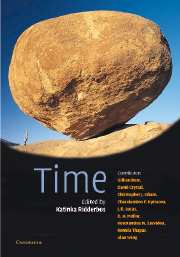
What is time? St Augustine famously claimed that he knew the answer as long as no one asked him for it, but as soon as he tried to explain it he no longer knew. Part of the problem is the intricate nature of the question. Every individual will approach the question 'what is time?' from a different perspective. We find ourselves asking whether time is linear or cyclic, whether it is endless, whether it is possible to travel in time, how the experience of the flow of time arises, how our own internal clocks are regulated and how our language captures the temporality of our existence. In this volume eight eminent researchers explore how investigations in their respective fields impinge on questions about the nature of time. These fields encompass the entire range from the arts and humanities to the natural sciences, mirroring the truly interdisciplinary nature of the subject.