To save content items to your account,
please confirm that you agree to abide by our usage policies.
If this is the first time you use this feature, you will be asked to authorise Cambridge Core to connect with your account.
Find out more about saving content to .
To save content items to your Kindle, first ensure no-reply@cambridge.org
is added to your Approved Personal Document E-mail List under your Personal Document Settings
on the Manage Your Content and Devices page of your Amazon account. Then enter the ‘name’ part
of your Kindle email address below.
Find out more about saving to your Kindle.
Note you can select to save to either the @free.kindle.com or @kindle.com variations.
‘@free.kindle.com’ emails are free but can only be saved to your device when it is connected to wi-fi.
‘@kindle.com’ emails can be delivered even when you are not connected to wi-fi, but note that service fees apply.
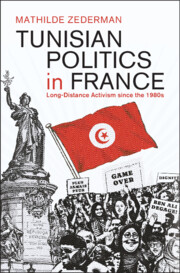
What does it mean to oppose or support an authoritarian regime from afar? During the years of Ben Ali's dictatorship in Tunisia between 1987 and 2011, diaspora activism played a key role in the developments of post-independence Tunisian politics. Centring this study on long-distance activism in France, where the majority of leftist and Islamist exile groups took refuge, Mathilde Zederman explores how this activism helps to shed new light on Tunisia's political history. Tunisian Politics in France closely explores the interactions and conflicts between different constellations of pro-regime and oppositional actors in France, examining the dynamics of what the author persuasively describes as a 'trans-state space of mobilisation'. In doing so, Zederman draws attention to the constraints and possibilities of long-distance activism. Utilising material gathered from extensive fieldwork in France and Tunisia, this study considers how the evolution of diaspora activism both challenges and reinforces the boundaries of Tunisian politics.
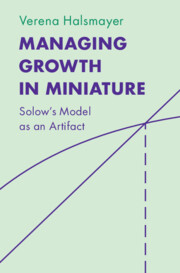
Managing Growth in Miniature explores the history of the way economists think about growth. It focuses on the period between the 1930s and 1960s, tracing the development of the famed 'Solow growth model,' one of the central mathematical models in postwar economics. It argues that models are not simply 'efficient tools' providing answers to the problems of economic theory and governance. The Solow model's various uses and interpretations related not only to the ways it made things (in)visible, excluded questions, and suggested actions. Its 'success' and effects ultimately also pertained to its fundamental ambiguities. Attending to the concrete sides of economic abstractions, this book provides a richly layered and accessible account of the forms of knowledge that shaped the predominant notion of 'economic growth' and ideas of how to govern it.
Within Holocaust studies, there has been an increasingly uncritical acceptance that by engaging with social media, Holocaust memory has shifted from the ‘era of the witness’ to the ‘era of the user’ (Hogervorst 2020). This paper starts by problematising this proposition. This claim to a paradigmatic shift implies that (1) the user somehow replaces the witness as an authority of memory, which neglects the wealth of digital recordings of witnesses now circulating in digital spaces and (2) agency online is solely human-centric, a position that ignores the complex negotiations between corporations, individuals, and computational logics that shape our digital experiences. This article proposes instead that we take a posthumanist approach to understanding Holocaust memory on, and with, social media. Adapting Barad's (2007) work on entanglement to memory studies, we analyse two case studies on TikTok: the #WeRemember campaign and the docuseries How To: Never Forget to demonstrate: (1) the usefulness of reading Holocaust memory on social media through the lens of entanglement which offers a methodology that accounts for the complex network of human and non-human actants involved in the production of this phenomenon which are simultaneously being shaped by it. (2) That professional memory institutions and organisations are increasingly acknowledging the use of social media for the sake of Holocaust memory. Nevertheless, we observe that in practice the significance of technical actancy is still undervalued in this context.
The field of Atlantic history initially focused exclusively on the Anglo-American North Atlantic, largely ignoring the South Atlantic and Africa. This approach, dominant after World War II, portrayed a “Western civilization” based on North Atlantic liberal values, akin to a postwar Mediterranean. Over time, historians of the Anglo-American Atlantic criticized this narrow focus, recognizing the broader interconnectedness of the Atlantic world. Recent decades have seen a shift, with more historians acknowledging the Atlantic as a complex, interconnected space involving four continents. Particularly notable is the rise of studies on the South Atlantic, especially regarding science and empire in the Iberian world. These studies highlight the significant role of Spain and Portugal, challenging the previously North Atlantic-centered narrative. This research has revealed that the Atlantic world was as much, if not more, shaped by Spanish and Portuguese influences as by English ones. The reviewed works exemplify this shift, focusing on the South Atlantic's imperial entanglements and the African diaspora in the Caribbean.
Many early modern Italian nobles were obsessed with duelling. Despite bans from secular authorities and the Council of Trent, the violent honor complex was veiled in part under the title of the scienza cavalleresca, the knightly science, which provided rules for the conduct of conflicts between aristocrats and those with noble aspirations. Such rules were both concerned with emotions and the object of emotions. Using the tools of the history and sociology of emotions, this article contributes to the emotional history of the scienza cavalleresca through examining the rules proposed both as feeling rules in themselves and as objects of emotional judgment. Toward the turn of the eighteenth century, more aristocrats began rejecting such codes with explicit objections to the scienza cavalleresca and its ethical basis. One such noble was Paolo Mattia Doria (1667–1746), a notorious duellist in the closing years of the Spanish regime, who renounced the vendetta and expressed disgust with its practitioners. A zealous convert against the noble vengeance system, he will serve as an example to explore the wider struggle over emotional values in early modern Italy and, more generally, in societies with high levels of violence. The article traces the role of emotions in the scienza cavalleresca, the taste for dispute through one genre (letters of challenge or cartelli di sfida), then explores the case of Doria. From these three stages, the article argues for the significance of adopting approaches from the sociology of emotions to analyze elite cultures of violence.
This paper examines the population of corporate directors of Britain at the turn of the twentieth century. Over the period 1881-1911 the corporate form became the most common mode of business organisation for large businesses. As their number increased, the population of directors expanded and reflected an increasingly diversified corporate landscape. Based on a large-scale dataset, this paper analyses the characteristics and networks of this wider population of directors. The study goes beyond previous work, which has mainly focused on elite directors or prominent companies, and shows three key findings. First, the population of directors was very connected into a large network, complete isolation from this network was rare. Second, over 1881-1911 director interlocks with banks became less important for most sectors, while interlocks with other financial institutions such as trusts became increasingly important. Insurance companies stood out as the most connected sector spanning smaller local companies and larger international ones. Third, during the period studied there was a shift from director clusters that were mainly based on proximity, to those that were connected through industries.
The twentieth-century processes of legal modernization rendered transformations to the concept of authority and its public perception. This article builds on the complex Weberian articulations of these transformations to analyze a contemporary contentious debate concerning the establishment of a Rabbinical Court of Appeals, in Mandatory Palestine, between 1918 and 1921. This initiative, imposed by the British government and supported by non-religious Jewish leaders, raised a heated controversy between two rabbinical figures—Haim Hirschnson of Hoboken, New Jersey, and Ben-Zion Uziel of Jaffa. Based on a close reading of their texts, juxtaposing them to Weberian conceptualizations of modern authority, and contextualizing them in particular historical circumstances, I argue that both rabbis comprehended the appellate mechanism as transforming the concept of rabbinical authority. By instituting appellate courts, authority shifts from its “charismatic” or “traditional” form to a “legal” institutional-based form. They harshly disagreed, however, if this transformation is a positive development in the modernization of Jewish law, or, on the contrary, will have a detrimental impact on the public's trust in the judiciary. The rabbinical articulations of these Weberian themes, as I suggest to interpret their texts, shed light on the application of the Weberian theory of bureaucracy to the judicial system and legal profession and also provide illuminating insights into the analysis of current church-law relationships, in Israeli law and elsewhere.
This article describes the evolution of the commercial connections between China and the southern Sulawesian port of Makassar from the beginning of the seventeenth century until 1669, when the Dutch Vereenigde Oost Indische Compagnie conquered Makassar. It attempts to show that these connections went through several transformations. Initially direct Chinese shipping supplied Makassar with Chinese goods, but this direct trade lasted only about a decade. However, commerce carried by Macanese ships and trade in Indochinese ports that were frequented by both Sulawesian and Chinese vessels maintained the commercial connection. This connection in its different forms allowed Makassar to act as an entrepôt that supplied Chinese goods and Japanese copper to more distant parts of Southeast Asia, especially those in the eastern Indonesian archipelago. The article concludes by arguing that after the conquest of Makassar, Banjarmasin in southern Borneo developed as a new regional entrepôt connecting China to the eastern archipelago.
Turn-of-the-century America witnessed many forgotten risk-making experiments that probed the limits of insurability by stepping beyond the familiar fields of life, fire, and marine insurance. One attempted to underwrite firms’ lost profits during strikes.
The ensuing debates on strike insurance’s practicability revealed scientistic expectations of never-ending actuarial progress that united an otherwise-divided business community. Yet attempting to realize strike insurance quickly meant grappling with the limits of insurability. Labor strife’s fuzzy causality involving human agency forestalled the homogenous classification that underlay actuaries’ averaging. Thus, strike underwriters sidestepped actuarial ratemaking to offer uniform premiums to those deemed acceptable risks. This solution not only left them susceptible to adverse selection and moral hazard but also highlighted the limits of insurers’ ability to transform uncertainty into commoditized risk, more broadly.
Recognizing these limits has important historiographical implications. Based largely on studies of life insurance—the gold standard of insurability—the rise of financial risk management has claimed a central place in the history of American capitalism. This literature thus threatens to obscure the ongoing significance of unclassifiable, unquantifiable uncertainty. Uncovering forgotten risk-making projects like attempts to establish strike insurance, where Americans grappled with the limits of insurability, is thus a crucial corrective.
Investment banks collaborated with health care entrepreneurs and managers in the 1990s to add a costly layer of investor-owned corporations to the US medical delivery system. In capitalizing and consolidating physician practices, publicly traded Physician Practice Management Companies (PPMCs) incorporated elements of the broader capitalist economy. Companies such as PhyCor, MedPartners, and FPA Medical Management turned to the equity and debt markets to generate shareholder profits and capital for acquisitions. Contemporary theories of financial economics reinforced their activities. PPMCs collapsed after shareholder lawsuits accused them of reporting false figures to the SEC and banks withdrew their credit. Physicians were both accomplices and victims in the process that made the medical delivery system less equitable, less effective, and more expensive. Although this experiment in medical capitalism failed, it widened the door for Wall Street to build new ways to profit from health care.
This study examines the credit market in seventeenth-century Stockholm, a rapidly growing city whose credit market is an early example of a market with both private and institutional actors. Using a sample of 1,500 probate inventories from 1679 to 1708, we focus on the practices and experiences of municipal and state servants, and we examine in detail the probate inventories of employees of the royal court. The latter group had their wages paid by the king in a world where being in arrears was the norm, and their spatial and social proximity to the Bank of the Estates made them potential pioneers in the movement towards an institutionalized and formalized capital market. The credit market has a mixed character, both in terms of the opportunities available to investors and in terms of their behavior. For people with a surplus of cash and good connections, money lending could be a way to increase their income. The court servants and many others moved seamlessly between institutional and private, as well as formal and informal, credit. The article shows that wage earners and state servants were central to the transformation of the early modern credit market. For them, the credit market and the bank offered investment opportunities that matched their skills and circumstances.
Logwood, a dyestuff extracted from its namesake tree native to the Yucatán Peninsula, was a commodity valued in the textile centres of early modern Europe. The trade in logwood began as an extractive endeavour attempted by merchants and former pirates on the margins of Spanish colonial authority, but by the late eighteenth century it had expanded to become a wide-reaching activity with connections to broader trends on both sides of the Atlantic. In the New World, the trade's growth fuelled Anglo-Spanish imperial rivalries and led to the introduction of slave labour to harvest dwindling logwood stands. The ecological consequences of human exchange also spread logwood's range to Caribbean islands, turning a frontier trade into a domesticated plantation industry. In the Old World, logwood was a versatile dye source that contributed to a range of hues. Initial regulations to protect consumers eased as dyers improved the quality of logwood dyes. The logwood trade expanded global textile supply chains and brought innovation to Europe's proto-industrial textile industry. It gave the continent's dyers new ways to meet consumer demand and spurred the development of mechanical methods to expedite refining.
This article examines questions pertaining to Indigenous people’s citizenship status, the problematic definition of orphanhood, rule of law, and structural racism in Brazilian society. The definition of orphanhood was articulated in a way that allowed for the extralegal abuse and racialized exploitation of labor to continue long past the legal end of Indigenous slavery (1755). Indigenous persons’ legal status, the definition of orphanhood, and guardianship laws worked together to legitimate the permanence of child separation as a means for wealthier Brazilians to get free child labor. The article uncovers the ambiguities in defining Indigenous people’s legal status, making citizenship status a subjective determination contested on a case-by-case basis. With this foreground understanding, the article presents the practice of child separation and the created discourse to legitimize Indigenous, Black, and mixed-race children as unpaid criadas de casa (housemaids).
This article studies a theoretical term for diasporic cultural production proposed by the contemporary Black Brazilian writer Conceição Evaristo—escrevivência. Evaristo’s first novel, Becos da Memória ([2006] 2017)—semiautobiographical remembrances of a midcentury favela community during its eviction—exemplifies escrevivência as a theory of the transmission of a culture of resistance to imposed dispossession. The term has been cited in a proliferation of antiracist critiques and studies on marginal subjects in Brazil. My argument is that escrevivência is crucial for Brazilian decolonial thought, given the temporally recursive frame it enunciates, which opens the present and future to prior articulations of Black culture in Brazil. I make three approaches to Becos within escrevivência’s temporal frame, examining literary anteriority (the influence of Carolina Maria de Jesus’s works), narrated marginality (polyphony, embodiment, domestic labor, minor literature), and cultural heritage (the instantiation and circulation of Black language).
Labor scholars have increasingly recognized the need to look beyond the workplace and explore where and how workers lived, socialized, shopped, or protested. The six books reviewed in this essay contribute to understanding how modern cities shaped the process of working-class formation as well as workers’ identity, experiences, and economic and material conditions. From different standpoints, these urban and labor histories of Paris, Mexico City, Miami, Port Said, Montevideo, and Santiago, Chile, demonstrate the impact of urban modernization, industrial capitalism, and migration on working families. By bringing together books from different regions and historiographical traditions, this essay also reflects on the possibilities and challenges of writing a global labor urban history.