To save content items to your account,
please confirm that you agree to abide by our usage policies.
If this is the first time you use this feature, you will be asked to authorise Cambridge Core to connect with your account.
Find out more about saving content to .
To save content items to your Kindle, first ensure no-reply@cambridge.org
is added to your Approved Personal Document E-mail List under your Personal Document Settings
on the Manage Your Content and Devices page of your Amazon account. Then enter the ‘name’ part
of your Kindle email address below.
Find out more about saving to your Kindle.
Note you can select to save to either the @free.kindle.com or @kindle.com variations.
‘@free.kindle.com’ emails are free but can only be saved to your device when it is connected to wi-fi.
‘@kindle.com’ emails can be delivered even when you are not connected to wi-fi, but note that service fees apply.
RNA molecules play many functional and regulatory roles in cells, and hence, have gained considerable traction in recent times as therapeutic interventions. Within drug discovery, structure-based approaches have successfully identified potent and selective small-molecule modulators of pharmaceutically relevant protein targets. Here, we embrace the perspective of computational chemists who use these traditional approaches, and we discuss the challenges of extending these methods to target RNA molecules. In particular, we focus on recognition between RNA and small-molecule binders, on selectivity, and on the expected properties of RNA ligands.
Machine learning (ML) has revolutionised the field of structure-based drug design (SBDD) in recent years. During the training stage, ML techniques typically analyse large amounts of experimentally determined data to create predictive models in order to inform the drug discovery process. Deep learning (DL) is a subfield of ML, that relies on multiple layers of a neural network to extract significantly more complex patterns from experimental data, and has recently become a popular choice in SBDD. This review provides a thorough summary of the recent DL trends in SBDD with a particular focus on de novo drug design, binding site prediction, and binding affinity prediction of small molecules.
Models of insulin secretory vesicles from pancreatic beta cells have been created using the cellPACK suite of tools to research, curate, construct and visualise the current state of knowledge. The model integrates experimental information from proteomics, structural biology, cryoelectron microscopy and X-ray tomography, and is used to generate models of mature and immature vesicles. A new method was developed to generate a confidence score that reconciles inconsistencies between three available proteomes using expert annotations of cellular localisation. The models are used to simulate soft X-ray tomograms, allowing quantification of features that are observed in experimental tomograms, and in turn, allowing interpretation of X-ray tomograms at the molecular level.
The viral replication cycle is controlled by information transduced through both molecular and mechanical interactions. Viral infection mechanics remains largely unexplored, however, due to the complexity of cellular mechanical responses over the course of infection as well as a limited ability to isolate and probe these responses. Here, we develop an experimental system consisting of herpes simplex virus type 1 (HSV-1) capsids bound to isolated and reconstituted cell nuclei, which allows direct probing of capsid–nucleus mechanics with atomic force microscopy (AFM). Major mechanical transformations occur in the host nucleus when pressurised viral DNA ejects from HSV-1 capsids docked at the nuclear pore complexes (NPCs) on the nuclear membrane. This leads to structural rearrangement of the host chromosome, affecting its compaction. This in turn regulates viral genome replication and transcription dynamics as well as the decision between a lytic or latent course of infection. AFM probing of our reconstituted capsid–nucleus system provides high-resolution topographical imaging of viral capsid docking at the NPCs as well as force volume mapping of the infected nucleus surface, reflecting mechanical transformations associated with chromatin compaction and stiffness of nuclear lamina (to which chromatin is tethered). This experimental system provides a novel platform for investigation of virus–host interaction mechanics during viral genome penetration into the nucleus.
The SARS-CoV-2 virus has made the largest pandemic of the 21st century, with hundreds of millions of cases and tens of millions of fatalities. Scientists all around the world are racing to develop vaccines and new pharmaceuticals to overcome the pandemic and offer effective treatments for COVID-19 disease. Consequently, there is an essential need to better understand how the pathogenesis of SARS-CoV-2 is affected by viral mutations and to determine the conserved segments in the viral genome that can serve as stable targets for novel therapeutics. Here, we introduce a text-mining method to estimate the mutability of genomic segments directly from a reference (ancestral) whole genome sequence. The method relies on calculating the importance of genomic segments based on their spatial distribution and frequency over the whole genome. To validate our approach, we perform a large-scale analysis of the viral mutations in nearly 80,000 publicly available SARS-CoV-2 predecessor whole genome sequences and show that these results are highly correlated with the segments predicted by the statistical method used for keyword detection. Importantly, these correlations are found to hold at the codon and gene levels, as well as for gene coding regions. Using the text-mining method, we further identify codon sequences that are potential candidates for siRNA-based antiviral drugs. Significantly, one of the candidates identified in this work corresponds to the first seven codons of an epitope of the spike glycoprotein, which is the only SARS-CoV-2 immunogenic peptide without a match to a human protein.
Resolutions of per-frame reconstructions for various samples frozen at different cooling rates. (a) Resolutions of per-frame reconstructions of various samples frozen by lowering the cooling rate. The green lines are for apo-ferritin (rhombus), glutamate dehydrogenase (GDH; square) and virus-like particles (VLP; triangle) collected in the pink region marked in Fig. 1a. The red lines are for apo-ferritin (rhombus), GDH (square) and aldolase (triangle) frozen at −110 °C. Aldolase was frozen on an Au grid covered with a holey NiTi film (regular triangles), and also on a Cu grid covered with a holey carbon film (inverted triangle). The grey line shows the resolutions of downloaded per-frame reconstructions (EMD-11210) of DNA protection protein during starvation (DPS). (b) Resolutions of per-frame reconstructions of GDH datasets using a cooling-rate gradient. The green dataset was collected for a standard frozen sample formed at the highest cooling rate, the blue dataset was collected in the light-blue region in Fig. 1a, and the red dataset was collected in the pink region in Fig. 1a.
When biological samples are first exposed to electrons in cryo-electron microcopy (cryo-EM), proteins exhibit a rapid ‘burst’ phase of beam-induced motion that cannot be corrected with software. This lowers the quality of the initial frames, which are the least damaged by the electrons. Hence, they are commonly excluded or down-weighted during data processing, reducing the undamaged signal and the resolution in the reconstruction. By decreasing the cooling rate during sample preparation, either with a cooling-rate gradient or by increasing the freezing temperature, we show that the quality of the initial frames for various protein and virus samples can be recovered. Incorporation of the initial frames in the reconstruction increases the resolution by an amount equivalent to using ~60% more data. Moreover, these frames preserve the high-quality cryo-EM densities of radiation-sensitive residues, which is often damaged or very weak in canonical three-dimensional reconstruction. The improved freezing conditions can be easily achieved using existing devices and enhance the overall quality of cryo-EM structures.
HCQ specifically binds CTD to inhibit its interaction with nucleic acid. (a) (I) Superimposition of HSQC spectra of CTD in the free state (blue) and in the presence of HCQ at 1:7.5 (CTD:HCQ) (red). (II) Zoom of HSQC spectra of CTD in the absence (blue) and in presence of HCQ at 1:0.925 (cyan); 1:1.86 (black); 1:3.75 (green); 1:7.5 (red). The assignments of the significantly perturbed residues are labelled. (b) Residue-specific chemical shift difference (CSD) of CTD in the presence of HCQ at 1:3.75 (blue) and 1:7.5 (red) (CTD:HCQ). The significantly perturbed residues are labelled, which are defined as those with the CSD values at 1:7.5 > 0.093 (average value + one standard deviation) (cyan line). (c) Superimposition of HSQC spectra of CTD only in the presence of HCQ at 1:7.5 (red) and with additional addition of S2m at 1:1 (CTD:S2m) (blue).
SARS-CoV-2 nucleocapsid (N) protein plays the essential roles in key steps of the viral life cycle, thus representing a top drug target. Functionality of N protein including liquid–liquid phase separation (LLPS) depends on its interaction with nucleic acids. Only the variants with N proteins functional in binding nucleic acids might survive and spread in evolution and indeed, the residues critical for binding nucleic acids are highly conserved. Hydroxychloroquine (HCQ) was shown to prevent the transmission in a large-scale clinical study in Singapore but so far, no specific SARS-CoV-2 protein was experimentally identified to be targeted by HCQ. Here by NMR, we unambiguously decode that HCQ specifically binds NTD and CTD of N protein with Kd of 112.1 and 57.1 μM, respectively to inhibit their interaction with nucleic acid, as well as to disrupt LLPS. Most importantly, HCQ-binding residues are identical in SARS-CoV-2 variants and therefore HCQ is likely effective to different variants. The results not only provide a structural basis for the anti-SARS-CoV-2 activity of HCQ, but also renders HCQ to be the first known drug capable of targeting LLPS. Furthermore, the unique structure of the HCQ-CTD complex suggests a promising strategy for design of better anti-SARS-CoV-2 drugs from HCQ.
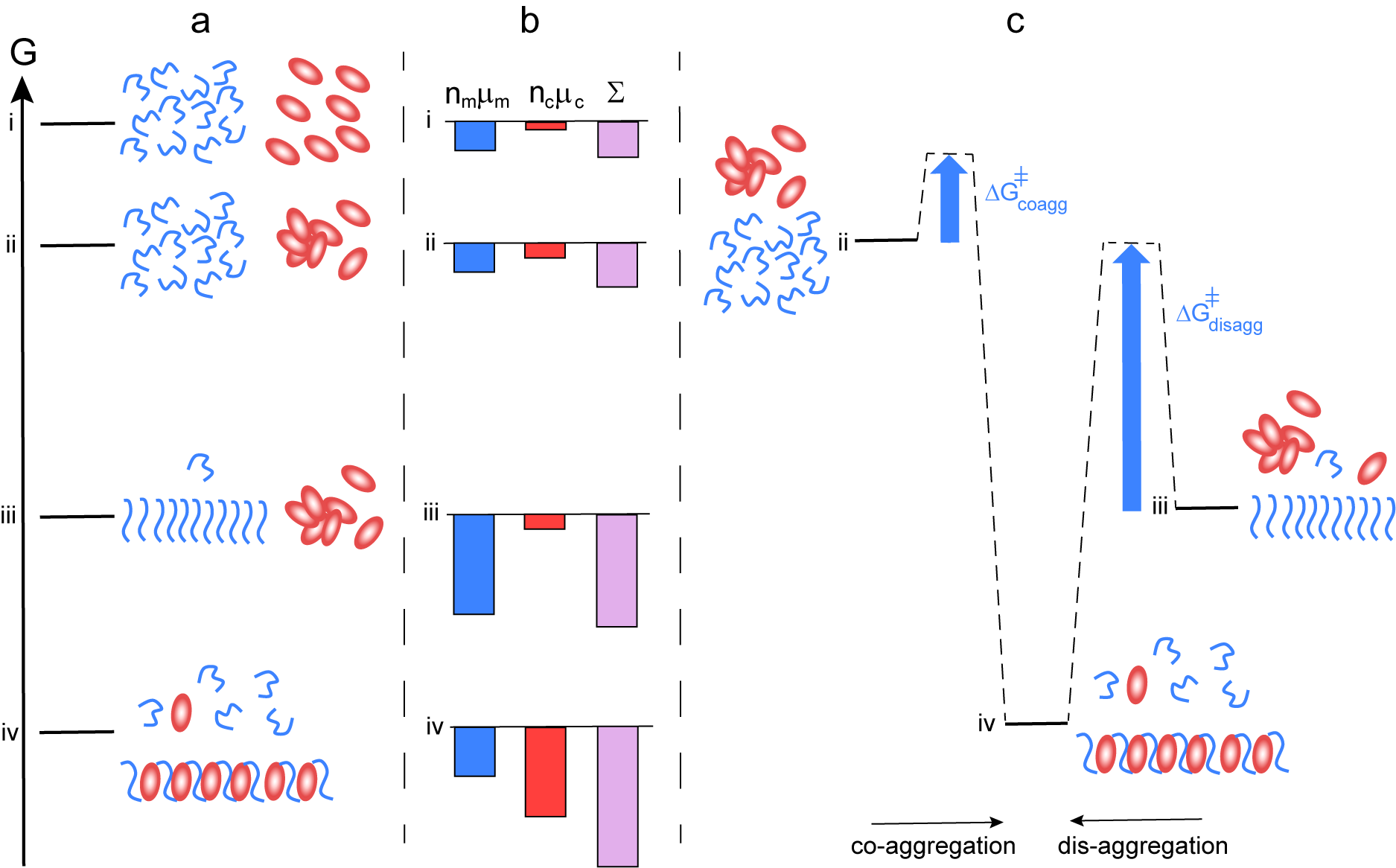
Thermodynamics of co-aggregation and disaggregation. (a) Free energy diagram for a closed system of an amyloid peptide (blue) and chaperone (red). At the highest level i, all species are monomeric. At level ii, the peptide is monomeric and the chaperone a mixture of monomers and oligomers. At level iii, there are amyloid fibrils, chaperone oligomers and monomers of both. At level iv, co-aggregates of peptide and chaperone co-exist with monomers of both, and the peptide monomer concentration in this state is higher than in state iii. (b) Chemical potential summed up over all molecules of each kind separately (peptide blue and chaperone red), and for the system (purple). There is a large increase in amyloid peptide solubility from state iii to state iv. (c) Reaction coordinate diagram for the case of co-aggregation (from ii to vi) and for disaggregation (from iii to iv) illustrating the much higher energy barrier in the latter case.
Chaperones protect other proteins against misfolding and aggregation, a key requirement for maintaining biological function. Experimental observations of changes in solubility of amyloid proteins in the presence of certain chaperones are discussed here in terms of thermodynamic driving forces. We outline how chaperones can enhance amyloid solubility through the formation of heteromolecular aggregates (co-aggregates) based on the second law of thermodynamics and the flux towards equal chemical potential of each compound in all phases of the system. Higher effective solubility of an amyloid peptide in the presence of chaperone implies that the chemical potential of the peptide is higher in the aggregates formed under these conditions compared to peptide-only aggregates. This must be compensated by a larger reduction in chemical potential of the chaperone in the presence of peptide compared to chaperone alone. The driving force thus relies on the chaperone being very unhappy on its own (high chemical potential), thus gaining more free energy than the amyloid peptide loses upon forming the co-aggregate. The formation of heteromolecular aggregates also involves the kinetic suppression of the formation of homomolecular aggregates. The unhappiness of the chaperone can explain the ability of chaperones to favour an increased population of monomeric client protein even in the absence of external energy input, and with broad client specificity. This perspective opens for a new direction of chaperone research and outlines a set of outstanding questions that aim to provide additional cues for therapeutic development in this area.
A plot of H2O2 concentration as a function of %RH in the laboratory during the generation of mist using Biograde water. Each point represents a single measurement.
Mist is generated by ultrasonic cavitation of water (Fisher Biograde, pH 5.5–6.5) at room temperature (20–25 °C) in open air with nearly constant temperature (22–25 °C) but varying relative humidity (RH; 24–52%) over the course of many months. Water droplets in the mist are initially about 7 μm in diameter at about 50% RH. They are collected, and the concentration of hydrogen peroxide (H2O2) is measured using commercial peroxide test strips and by bromothymol blue oxidation. The quantification method is based on the Fenton chemistry of dye degradation to determine the oxidation capacity of water samples that have been treated by ultrasonication. It is found that the hydrogen peroxide concentration varies nearly linearly with RH over the range studied, reaching a low of 2 parts per million (ppm) at 24% RH and a high of 6 ppm at 52% RH. Some possible public health implications concerning the transmission of respiratory viral infections are suggested for this threefold change in H2O2 concentration with RH.
We report the use of aqueous microdroplets to accelerate deoxyribonucleic acid (DNA) fragmentation by deoxyribonuclease I (DNase I), and we present a simple, ultrafast approach named DNA fragment mass fingerprinting to discriminate different DNA sequences by comparing their fragment mass patterns. DNA fragmentation in tiny microdroplets, which was produced by electrosonically spraying (+3 kV) a room temperature aqueous solution containing 10 μM DNA and 10 μg ml−1 DNase I from a homemade setup, takes less than 1 ms. High differentiation/identification fidelity could be obtained by applying a cosine correlation measure for similarity assessment between two fragment mass patterns, which compares both mass-to-charge ratios (m/z) with an error tolerance of 5 ppm and the peaks’ relative intensities. A single-nucleotide mutation in the sequence of bases, as exemplified by the sickle cell anemia mutation, is differentiated by setting a cutoff value of similarity at 90%. The order change of two adjacent bases in the sequence could still be well discriminated with a similarity of only 62% between the fragment mass patterns of the two similar sequences, which have the same molecular weights and thus cannot be differentiated by gel electrophoresis or direct mass detection by mass spectrometry. Compared to traditional genotyping methods, such as quantitative real-time polymerase chain reaction, the identification process with our approach could be completed within several minutes without any other expensive and complicated reagents or experimental steps. The potential of our approach for convenient and fast microbe genetic discrimination or identification is further demonstrated by differentiating the Orf1ab gene fragments of two similar coronaviruses with a very high sequence homologous rate of 96%, SARS-CoV-2 and bat-SL-CoVZC45, with a similarity of 0% between their fragment mass patterns.
(A) Microscope view during the intracellular vesicle impact electrochemical cytometry experiment (scale bar = 20 μm). (B) Normalised frequency histogram for the number of molecules stored in vesicles in control (blue) and modafinil-treated cells (red). The distribution fits are shown for control cells with a dashed line and modafinil-treated cells with a solid line. (C) Average of the number of molecules stored per vesicle in PC12 cells treated without (control) or with 10 μM modafinil. Number of analysed cells: control cells (15 cells) and modafinil-treated cells (18 cells). The results were compared by a two-tailed Mann–Whitney rank-sum test, *p < 0.05, **p < 0.01 and ***p < 0.001.
Modafinil is a mild psychostimulant-like drug enhancing wakefulness, improving attention and developing performance in various cognitive tasks, but its mechanism of action is not completely understood. This is the first combination of amperometry, electrochemical cytometry and mass spectrometry to interrogate the mechanism of action of a drug, here modafinil, at cellular and sub-cellular level. We employed single-cell amperometry (SCA) and intracellular vesicle impact electrochemical cytometry (IVIEC) to investigate the alterations in exocytotic release and vesicular catecholamine storage following modafinil treatment. The SCA results reveal that modafinil slows down the exocytosis process so that, the number of catecholamines released per exocytotic event is enhanced in the modafinil-treated cells. Also, IVIEC results offer an upregulation effect of modafinil on the vesicular catecholamine storage. Mass spectrometry imaging by time-of-flight secondary ion mass spectrometry (ToF-SIMS) illustrates that treatment with modafinil reduces the cylindrical-shaped phosphatidylcholine at the cellular membrane, while the high curvature lipids with conical structures such as phosphatidylethanolamine and phosphatidylinositol are elevated after modafinil treatment. Combining the results obtained by SCA, IVIEC and ToF-SIMS suggests that modafinil-treated cells release a larger portion of their vesicular content at least in part by changing the lipid composition of the cell membrane, suggesting regulation of cognition.
Sweden tops gender equality rankings, but Swedish academia is still lacking women in top positions. To address gender inequality in its faculty, Chalmers University of Technology has invested 300 million SEK (30 million Euros) over 10 years in Gender initiative for Excellence (Genie). Genie aims to increase the university’s success and excellence via gender equality efforts. In this editorial, we want to share insights on explicit efforts during Genie’s first 2.5 years with the goal to inspire and advise other universities and researchers.
Zinc ion is essential for normal brain function that modulates synaptic activity and neuronal plasticity and it is associated with memory formation. Zinc is considered to be a contributing factor to the pathogenesis of ischemia, but the association between zinc and ischemia on vesicular exocytosis is unclear. In this study, we used a combination of chemical analysis methods and a cell model of ischemia/reperfusion to investigate exocytotic release and vesicular content, as well as the effect of zinc alteration on vesicular exocytosis. Oxygen–glucose deprivation and reperfusion (OGDR) was used as an in vitro model of ischemia in a model cell line. Exocytotic release and vesicular storage of catecholamine content were increased following OGDR, resulting in a higher fraction of release during exocytosis. However, zinc eliminated these increases following OGDR and the fraction of release remained unchanged. Understanding the consequences of zinc accumulation on vesicular exocytosis at the early stage of OGDR should aid in the development of therapeutic strategies to reduce ischemic brain injury. As the fraction released has been suggested to be related to presynaptic plasticity, insights are gained towards deciphering ischemia related memory impairment.
Bitter taste is sensed by bitter taste receptors (TAS2Rs) that belong to the G protein-coupled receptor (GPCR) superfamily. In addition to bitter taste perception, TAS2Rs have been reported recently to be expressed in many extraoral tissues and are now known to be involved in health and disease. Despite important roles of TAS2Rs in biological functions and diseases, no crystal structure is available to help understand the signal transduction mechanism or to help develop selective ligands as new therapeutic targets. We report here the three-dimensional structure of the fully activated TAS2R4 human bitter taste receptor predicted using the GEnSeMBLE complete sampling method. This TAS2R4 structure is coupled to the gustducin G protein and to each of several agonists. We find that the G protein couples to TAS2R4 by forming strong salt bridges to each of the three intracellular loops, orienting the activated Gα5 helix of the Gα subunit to interact extensively with the cytoplasmic region of the activated receptor. We find that the TAS2Rs exhibit unique motifs distinct from typical Class A GPCRs, leading to a distinct activation mechanism and a less stable inactive state. This fully activated bitter taste receptor complex structure provides insight into the signal transduction mechanism and into ligand binding to TAS2Rs.
G protein-first mechanism of activation for opioid receptors and their cognate Gi protein. Σ0: In the absence of ligand and Gi protein, the opioid receptors adopt the inactive conformation, featuring a tight hydrogen bond between the cytosolic ends of TM3 and TM6 that keeps the cytoplasmic region tightly closed. Σ1: Before agonist binding, the inactive Gi protein tightly bound to GDP couples to inactive opioid receptor, to form a pre-coupled opioid receptor-Gi (GDP) complex. Σ2: Interactions between inactive opioid receptor and inactive Gi (GDP) leads to breaking the TM3-TM6 hydrogen bond and opening the cytoplasmic region of the receptors to accommodate the Gi protein. As a result, the pre-activated state (Σ2) emerges, which remains at this resting state until an agonist binds the receptor. Σ3′: agonist bound to the pre-activated state induces the Gi (GDP) to be activated. Activation of the Gi protein is associated with a remarkable opening in the cleft between AH and Ras-like domains of Gα, providing an exit path for GDP release or exchange with a GTP. Σ4′: Upon GDP release of exchange, the agonist-opioid receptor-Gi protein evolves to its fully active state.
We report the G protein-first mechanism for activation of G protein-coupled receptors (GPCR) for the three closest subtypes of the opioid receptors (OR), μOR, κOR and δOR. We find that they couple to the inactive Gi protein-bound guanosine diphosphate (GDP) prior to agonist binding. The inactive Gi protein forms anchors to the intracellular loops of the inactive apo-μOR, apo-κOR and apo-δOR, inducing opening of the cytoplasmic region to form a pre-activated state that holds Gi protein in place until agonist binds. Then, agonist binds to μOR, κOR and δOR already complexed with Gi protein, to trigger the Gαi to open up the tightly coupled GDP binding site, making GDP accessible for GTP exchange, an essential step for Gi signalling. We show that the agonist alone cannot open the intracellular region of μOR and κOR, requiring Gi protein to open the cytoplasmic region by itself. We consider that this G protein-first mechanism may apply to activation of other Class A GPCRs. However, for δOR, agonist binding can open up the intracellular region to encourage Gi protein recruitment. Thus, activation of Gi protein mediated by δOR favourably may proceed with either ligand-first or G protein-first activation mechanisms.
Although the consequences of the crowded cell environments may affect protein folding, function and misfolding reactions, these processes are often studied in dilute solutions in vitro. We here used biophysical experiments to investigate the amyloid fibril formation process of the fish protein apo-β-parvalbumin in solvent conditions that mimic steric and solvation aspects of the in vivo milieu. Apo-β-parvalbumin is a folded protein that readily adopts an amyloid state via a nucleation–elongation mechanism. Aggregation experiments in the presence of macromolecular crowding agents (probing excluded volume, entropic effects) as well as small molecule osmolytes (probing solvation, enthalpic effects) revealed that both types of agents accelerate overall amyloid formation, but the elongation step was faster with macromolecular crowding agents but slower in the presence of osmolytes. The observations can be explained by the steric effects of excluded volume favoring assembled states and that amyloid nucleation does not involve monomer unfolding. In contrast, the solvation effects due to osmolyte presence promote nucleation but not elongation. Therefore, the amyloid-competent nuclei must be compact with less osmolytes excluded from the surface than either the folded monomers or amyloid fibers. We conclude that, in contrast to other amyloidogenic folded proteins, amyloid formation of apo-β-parvalbumin is accelerated by crowded cell-like conditions due to a nucleation process that does not involve large-scale protein unfolding.
Numerous terminal branches of motor nerves each end on individual component muscle fibres making up their motor unit. Each ramification terminates in a neuromuscular junction comprising pre- and postsynaptic membranes separated by the synaptic cleft. The neurotransmitter acetylcholine is released in response to depolarisation from presynaptic vesicles as discrete quanta. Each such event elicits a postsynaptic miniature endplate potential. This probabilistic release process follows a Poisson distribution whose probability increases with presynaptic depolarisation. The released acetylcholine diffuses across the synaptic gap to access postsynaptic ACh receptors, proteins each comprising five transmembrane subunits surrounding a central pore. Two of these (α) subunits each include an ACh binding site. ACh binding to both sites causes pore opening, permitting Na+ and K+ permeation, generating endplate currents demonstrable under voltage clamp. The resulting endplate potentials trigger a propagated action potential in the innervated muscle fibre when the resulting depolarisation attains the Na+ channel threshold.