To save content items to your account,
please confirm that you agree to abide by our usage policies.
If this is the first time you use this feature, you will be asked to authorise Cambridge Core to connect with your account.
Find out more about saving content to .
To save content items to your Kindle, first ensure no-reply@cambridge.org
is added to your Approved Personal Document E-mail List under your Personal Document Settings
on the Manage Your Content and Devices page of your Amazon account. Then enter the ‘name’ part
of your Kindle email address below.
Find out more about saving to your Kindle.
Note you can select to save to either the @free.kindle.com or @kindle.com variations.
‘@free.kindle.com’ emails are free but can only be saved to your device when it is connected to wi-fi.
‘@kindle.com’ emails can be delivered even when you are not connected to wi-fi, but note that service fees apply.
This work offers a comprehensive approach to understanding the phenomena underlying vesicular exocytosis, a process involved in vital functions of living organisms such as neuronal and neuroendocrine signaling. The kinetics of release of most neuromediators that modulate these functions in various ways can be efficiently monitored using single-cell amperometry (SCA). Indeed, SCA at ultramicro- or nanoelectrodes provides the necessary temporal, flux, and nanoscale resolution to accurately report on the shape and intensity of single exocytotic spikes. Rather than characterizing amperometric spikes using standard descriptive parameters (e.g., amplitude and half-width), however, this study summarizes a modeling approach based on the underlying biology and physical chemistry of single exocytotic events. This approach provides deeper insights into intravesicular phenomena that control vesicular release dynamics. The ensuing model’s intrinsic parsimony makes it computationally efficient and friendly, enabling the processing of large amperometric traces to gain statistically significant insights.
This work poses and partially explores an astrobiological hypothesis: might polymeric sulfur and phosphorus-based oxides form heteropolymers in the acidic cloud decks of Venus’ atmosphere? Following an introduction to the emerging field of computational astrobiology, we demonstrate the use of quantum chemical methods to evaluate basic properties of a hypothetical carbon-free heteropolymer that might be sourced from feedstock in the Venusian atmosphere. Our modeling indicates that R-substituted polyphosphoric sulfonic ester polymers may form via multiple thermodynamically favorable pathways and exhibit sufficient kinetic stability to persist in the Venusian clouds. Their thermodynamic stability compares favorably to polypeptides, whose formation is slightly thermodynamically unfavored relative to amino acids in most known abiotic conditions. We propose a combined approach of vibrational spectroscopy and mass spectrometry to search for related materials in Venus’s atmosphere but note that none of the currently planned missions are well suited for their detection. While predicted Ultraviolet–Visible spectra suggest that the studied polymers are unlikely candidates for Venus’s unidentified UV absorbers, the broader possibility of sulfuric acid–based chemistry supporting alternative biochemistries challenges the traditional carbon-centric models of life. We argue that such unconventional lines of inquiry are warranted in the search for life beyond Earth.
Single-molecule methods offer powerful insights into DNA-protein interactions at the individual DNA molecule level. We developed an automated, high-throughput nanofluidic imaging platform to characterize DNA-protein complexes in solution. The platform uses a nanofluidic chip with 10 sets of nanochannels where thousands of DNA molecules can be simultaneously analyzed in different conditions. Using this approach, we investigate Rok, a multifunctional Bacillus subtilis protein involved in genome organization and transcription regulation. Our findings confirm the DNA-condensing activity of Rok, likely attributed to its ability to bridge distant DNA segments. Additionally, Rok promotes the hybridization of 12 base complementary single-stranded DNA overhangs, suggesting a potential role in homology search during recombination. Rok also displays sequence-selective binding, preferentially associating with adenine and thymine-rich (AT-rich) DNA regions. To explore the structural features of Rok underlying these activities and test our nanofluidic system further, we compare wild-type Rok with two variants: ∆Rok, lacking the neutral part of the internal linker, and sRok, a naturally occurring variant without the linker. This comparison highlights the role of the linker in hybridization, i.e., interaction with single-stranded DNA. Together, these findings enhance our understanding of Rok-mediated DNA dynamics and establish single-molecule nanofluidics as a powerful tool for high-throughput studies of DNA–protein interactions.
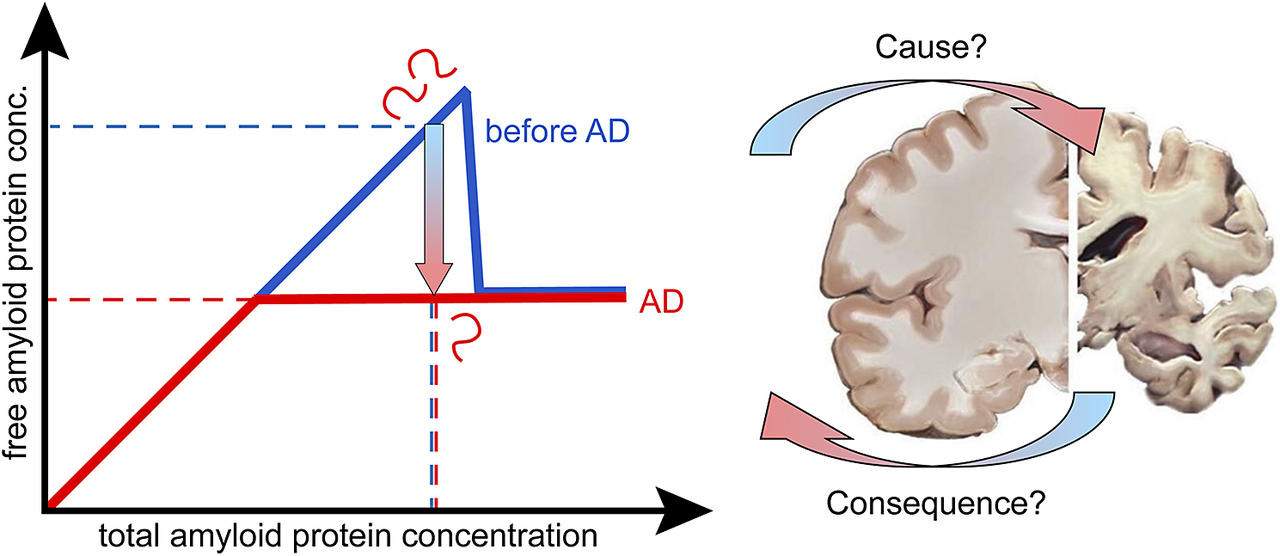
In this perspective, we ask the question whether the apparently lower solubility of specific proteins in amyloid disease is a cause or consequence of the protein deposition seen in such diseases. We focus on Alzheimer’s disease and start by reviewing the experimental evidence of disease-associated reduction in the measured concentration of amyloid β peptide, Aβ42, in cerebrospinal fluid. We propose a series of possible physicochemical explanations for these observations. These include a reduced solubility, a reduced apparent solubility, as well as a long-lived metastable state manifested in healthy individuals as a free concentration of Aβ42 in the solution phase above the solubility limit. For each scenario, we discuss whether it is most likely a cause or a consequence of the observed protein deposition in the disease.
Protein circular dichroism (CD) and infrared absorbance (IR) spectra are widely used to estimate the secondary structure content of proteins in solution. A range of algorithms have been used for CD analysis (SELCON, CONTIN, CDsstr, SOMSpec) and some of these have been applied to IR data, though IR is more commonly analysed by bandfitting or statistical approaches. In this work we provide a Python version of SELCON3 and explore how to combine CD and IR data to best effect. We used CD data in Δε/amino acid residue and scaled the IR spectra to similar magnitudes. Normalising the IR amide I spectra scaled to a maximum absorbance of 15 gives best general performance. Combining CD and IR improves predictions for both helix and sheet by ~2% and helps identify anomalously large errors for high helix proteins such as haemoglobin when using IR data alone and high sheet proteins when using CD data alone.
Retinylidene proteins are retinal-binding light-sensitive proteins found in organisms ranging from microbes to human. Microbial opsins have been utilized in optogenetics, while animal opsins are essential for vision and light-dependent metabolic functions. However, retinylidene proteins have hydrophobic transmembrane (TM) domains, which makes them challenging to study. In this structural and functional bioinformatics study, I use the QTY (glutamine, threonine, tyrosine) code to design water-soluble QTY analogues of retinylidene proteins, including nine human and three microbial opsins. I provide superpositions of the AlphaFold3-predicted hydrophobic native proteins and their water-soluble QTY analogues, and experimentally determined structures when available. I also provide a comparison of surface hydrophobicity of the variants. Despite significant changes to the protein sequence (35.53–50.24% in the TM domain), protein characteristics and structures are well preserved. Furthermore, I run molecular dynamics (MD) simulations of native and QTY-designed OPN2 (rhodopsin) and analyze their response to the isomerization of 11-cis-retinal to all-trans-retinal. The results show that the QTY analogue has similar functional behavior to the native protein. The findings of this study indicate that the QTY code can be used as a robust tool to design water-soluble retinylidene proteins. These have potential applications in protein studies, therapeutic treatments, and bioengineering.
DNA unzipping by nanopore translocation has implications in diverse contexts, from polymer physics to single-molecule manipulation to DNA–enzyme interactions in biological systems. Here we use molecular dynamics simulations and a coarse-grained model of DNA to address the nanopore unzipping of DNA filaments that are knotted. This previously unaddressed problem is motivated by the fact that DNA knots inevitably occur in isolated equilibrated filaments and in vivo. We study how different types of tight knots in the DNA segment just outside the pore impact unzipping at different driving forces. We establish three main results. First, knots do not significantly affect the unzipping process at low forces. However, knotted DNAs unzip more slowly and heterogeneously than unknotted ones at high forces. Finally, we observe that the microscopic origin of the hindrance typically involves two concurrent causes: the topological friction of the DNA chain sliding along its knotted contour and the additional friction originating from the entanglement with the newly unzipped DNA. The results reveal a previously unsuspected complexity of the interplay of DNA topology and unzipping, which should be relevant for interpreting nanopore-based single-molecule unzipping experiments and improving the modeling of DNA transactions in vivo.
Human mitochondrial Complex I is one of the largest multi-subunit membrane protein megacomplexes, which plays a critical role in oxidative phosphorylation and ATP production. It is also involved in many neurodegenerative diseases. However, studying its structure and the mechanisms underlying proton translocation remains challenging due to the hydrophobic nature of its transmembrane parts. In this structural bioinformatic study, we used the QTY code to reduce the hydrophobicity of megacomplex I, while preserving its structure and function. We carried out the structural bioinformatics analysis of 20 key enzymes in the integral membrane parts. We compare their native structure, experimentally determined using Cryo-electron microscopy (CryoEM), with their water-soluble QTY analogs predicted using AlphaFold 3. Leveraging AlphaFold 3’s advanced capabilities in predicting protein–protein complex interactions, we further explore whether the QTY-code integral membrane proteins maintain their protein–protein interactions necessary to form the functional megacomplex. Our structural bioinformatics analysis not only demonstrates the feasibility of engineering water-soluble integral membrane proteins using the QTY code, but also highlights the potential to use the water-soluble membrane protein QTY analogs as soluble antigens for discovery of therapeutic monoclonal antibodies, thus offering promising implications for the treatment of various neurodegenerative diseases.
Manipulating matter by strong coupling to the vacuum field has attracted intensive interests over the last decade. In particular, vibrational strong coupling (VSC) has shown great potential for modifying ground state properties in solution chemistry and biochemical processes. In this work, the effect of VSC of water on the melting behaviour of ds-DNA, an important biophysical process, is explored. Several experimental conditions, including the concentration of ds-DNA, cavity profile, solution environment, as well as thermal annealing treatment, were tested. No significant effect of VSC was observed for the melting behaviour of the ds-DNA sequence used. This demonstrates yet again the robustness of ds-DNA to outside perturbations. Our work also provides a general protocol to probe the effects of VSC on biological systems inside microfluid Fabry–Perot cavities and should be beneficial to better understand and harness this phenomenon.
DNA helicases are molecular motors that use the energy from nucleotide hydrolysis to move along DNA, promoting the unwinding or rewinding of the double helix. Here, we use magnetic and optical tweezers to track the motion of three helicases, gp41, RecQ, and RecG, while they unwind or rewind a DNA hairpin. Their activity is characterized by measuring the helicase velocity and diffusivity under different force and ATP conditions. We use a continuous-time random walk framework that allows us to compute the mean helicase displacement and its fluctuations analytically. Fitting the model to the measured helicase velocity and diffusivity allows us to determine the main states and transitions in the helicase mechanochemical cycle. A general feature for all helicases is the need to incorporate an off-pathway pausing state to reproduce the data, raising the question of whether pauses play a regulatory role. Diffusivity measurements also lead to estimations of the thermodynamic uncertainty factor related to the motor efficiency. Assuming a tight mechano-chemical coupling, we find that the RecG helicase reaches a high efficiency when operating uphill, whereas the unwinding gp41 and RecQ helicases display much lower efficiencies. Incorporating the analysis of fluctuations allows for better characterization of the activity of molecular machines, which represents an advance in the field.
Metabolic enzymes are the catalysts that drive the biochemical reactions essential for sustaining life. Many of these enzymes are tightly regulated by feedback mechanisms. To fully understand their roles and modulation, it is crucial to investigate the relationship between their structure, catalytic mechanism, and function. In this perspective, by using three examples from our studies on Mycobacterium tuberculosis (Mtb) isocitrate lyase and related proteins, we highlight how an integrated approach combining structural, activity, and biophysical data provides insights into their biological functions. These examples underscore the importance of employing fast-fail experiments at the early stages of a research project, emphasise the value of complementary techniques in validating findings, and demonstrate how in vitro data combined with chemical, biochemical, and physiological knowledge can lead to a broader understanding of metabolic adaptations in pathogenic bacteria. Finally, we address the unexplored questions in Mtb metabolism and discuss how we expand our approach to include microbiological and bioanalytical techniques to further our understanding. Such an integrated and interdisciplinary strategy has the potential to uncover novel regulatory mechanisms and identify new therapeutic opportunities for the eradication of tuberculosis. The approach can also be broadly applied to investigate other biochemical networks and complex biological systems.
Metabolism is at the core of all functions of living cells as it provides Gibbs free energy and building blocks for synthesis of macromolecules, which are necessary for structures, growth, and proliferation. Metabolism is a complex network composed of thousands of reactions catalyzed by enzymes involving many co-factors and metabolites. Traditionally it has been difficult to study metabolism as a whole network and most traditional efforts were therefore focused on specific metabolic pathways, enzymes, and metabolites. By using engineering principles of mathematical modeling to analyze and study metabolism, as well as engineer it, that is, design and build, new metabolic features, it is possible to gain many new fundamental insights as well as applications in biotechnology. Here, we present the history and basic principles of engineering metabolism, as well as the newest developments in the field. We are using examples of applications in: (1) production of protein pharmaceuticals and chemicals; (2) basic studies of metabolism; and (3) impacting health care. We will end by discussing how engineering metabolism can benefit from advances in artificial intelligence (AI)-based models.
High resolution structures of protein complexes provide a wealth of information on protein structure and function. Databases of these protein structures are also used for artificial-intelligence (AI)-based methods of structural modelling. Despite the wealth of protein structures that have been determined by structural biologists, there are still gaps, or missing pieces in the puzzle of protein structural biology. Highly flexible regions may be missing from protein structures and conformational changes of different protein complex states may not be captured by current databases. In this perspective, I sketch out several ways that cross-linking mass spectrometry can contribute to filling in some of these missing pieces: Identification of cross-linked interactions in highly flexible protein regions not captured by other structural techniques; capturing conformational changes of protein complexes in different functional states; serving as distance constraints in integrative structural modelling and providing structural information of in cellulo proteins. The myriad ways in which cross-linking mass spectrometry contributes to filling in missing pieces in structural biology makes it a powerful technique in structural biology.
Introduces Nernst potentials for bacterial cells, simple Hodgkin–Huxley models for action potentials and describes experimental methods to measure membrane potentials.