To save content items to your account,
please confirm that you agree to abide by our usage policies.
If this is the first time you use this feature, you will be asked to authorise Cambridge Core to connect with your account.
Find out more about saving content to .
To save content items to your Kindle, first ensure no-reply@cambridge.org
is added to your Approved Personal Document E-mail List under your Personal Document Settings
on the Manage Your Content and Devices page of your Amazon account. Then enter the ‘name’ part
of your Kindle email address below.
Find out more about saving to your Kindle.
Note you can select to save to either the @free.kindle.com or @kindle.com variations.
‘@free.kindle.com’ emails are free but can only be saved to your device when it is connected to wi-fi.
‘@kindle.com’ emails can be delivered even when you are not connected to wi-fi, but note that service fees apply.
This chapter turns to examine the role that technological development has played in the glasshouse agrifood value chain and how this has changed over the post-War period. It highlights the restructuring of the state-funded techno-science based and its increasing marketisation and fragmentation.
The promise of global innovation lies in the unlikely combination of knowledge and information from different sources and locations. Companies that can scan the globe for fresh ideas and integrate knowledge from multiple subsidiaries around the world stand the best chance of generating innovative solutions. However, innovation is also one of the central arenas of geopolitical tensions. Governments aim to have a leg up in the innovation contest for national security and economic competitiveness. Consequently, when geopolitical tensions increase, governments strive to keep innovations at home and increase barriers to the cross-border flow of cutting-edge knowledge, technology, and information. Multiple technology standards further increase the challenges of cross-border knowledge integration. Companies withdraw or scale back foreign innovation efforts and the flow of ideas, talent, and resources slows. Proactive companies and managers strive to balance knowledge diversity with geopolitical risk, keep more sensitive projects at home, adopt operational strategies to have greater control over innovation, and differentiate between technologies.
This paper examines Britain’s process of electrification following a disruptive stock market boom and bust in 1882. This is done by noting the companies that raise finance on British stock exchanges, the amounts raised, and the returns earned on that money. It also examines the impact of the Lighting Act of 1882, finding that the Act inhibited investment, but with important exceptions. We find the Act was not a barrier to entrepreneurs alert to the possibilities of electrification. However, the limited British electrical investment after the 1882 crash was more heavily and successfully concentrated on supplying electricity to end users than on developing electrical equipment. When electrification began in earnest after 1888, upon the amendment of the 1882 Lighting Act, there existed only a very weak engineering base to support it, leading to slow, expensive, and unimaginative electrification.
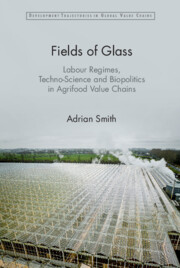
What is the relationship between technology and labour regimes in agrifood value chains? By deploying the concept of agrarian biopolitical articulations, Field of Glass formulates new perspectives that bridge the hitherto distinct worlds of value chain research, agrarian political economy, labour regime theory, and agrarian techno-science to explain the enduring insecurity of food systems in the United Kingdom. Using both historical and contemporary research, Adrian Smith explores how the precarity and exploitation of migrant labour intersects with ecology and techno-science/innovation, such as hydroponic and robotic technologies, to explain the development and changing nature of glasshouse agrifood value chains in the UK. Smith concludes by reflecting on how agrarian bio-politics have shaped the glasshouse agrifood sector and the emergence of contemporary 'high road' and 'low road' strategies, highlighting their contradictions and negative consequences for local development and food supply security.
This Element offers a portrait of leadership exemplars in UK finance. It challenges the common trope that finance is morally bankrupt. More significantly, it provides an empirically informed account of what it means to lead ethically and by example. Drawing upon Linda Zagzebski's philosophy of moral exemplarism, as well as Braun and Clarke's reflexive approach to thematic analysis, this Element sifts through a rich interview dataset to identify three types of exemplary leader. The sage exemplifies a purpose-giving wisdom. The hero is admired for a courageous form of empathy. And the novice, an under-appreciated type of exemplar, is singled out for curiosity. Foregrounding the place of positive emotions in role modeling, this Element sheds light on the virtues and psychology of leading by example. It also serves as an exemplar of what the humanities can contribute to the dynamic field of leadership studies.
Defining Hybrid Heroes: The Leadership Spectrum from Scoundrel to Saint defines the hero (and his or her journey) from a hybrid perspective, exploring the spectrum from scoundrel to saint. It utilizes a more dynamic and situational outlook, regarding heroism not only as a personal characteristic, but also as a series of heroic acts within a given situation.
The book examines the hybrid hero from several distinctive points of view, e.g. through lenses dominated by fiction, business, politics and psychology, and paints a new, more complex portrait that takes full advantage of the authors' varied backgrounds. Inge Brokerhof has an academic background in psychology and has studied the impact of narrative fiction on workplace variables, such as career identity, employability and moral leadership. Stephan Sonnenburg has studied Joseph Campbell and the impact of the hero's journey on creativity and innovation management. Greg Stone is a communications consultant who teaches executives and professors how to explain their work in clear and compelling language.
This book will be at once theoretical and practical, with a combination of substantial intellectual content to satisfy an academic audience and a series of specific recommendations to meet the needs of thinking managers seeking to improve their leadership skills. In the 'real world' of business, leaders are often both scoundrel and saint. They are role models and anti-models at the same time. The authors show how they can make these warring traits work for them and how academics can gain a new perspective on approaching leadership and management.
The Animal Crossing virtual world is one of Japan's most successful but unrecognised cultural exports, gaining a global audience during the COVID-19 pandemic among people who traditionally have not been attracted to networked computer games but are enchanted by the world's emphasis of sociability and curation rather than violence. The book is the first major study of Animal Crossing, written in an incisive and engaging style for students, academics, non-specialist members of the public and businesspeople interested in the potential of an unconventional online global space that has diverse demographics.
The book contextualises Animal Crossing within the history of computer games and global acceptance of Japanese aesthetics within popular culture alongside the Walkman, Hello Kitty, Anime, Manga and Godzilla. It brings together scholarly and popular literature without jargon, providing an accessible authoritative resource for people interested in different aspects of Animal Crossing in particular or consumer engagement with virtual worlds in general. It offers incisive comments about Animal Crossing as a legal, technological, social, cultural and commercial phenomenon.
Ex ante, my primary concerns were about implementation across the wide expanse of federal applications, supporting the supplemental use of distributional weighting, trying to find a supportable middle ground on discounting using the expected value of bounds and a more consistent scope of analysis. Ex post, I felt heard if not followed, perhaps not uncommon for reviewers.
The sharing economy has expanded rapidly, reshaping consumption, labor, and service delivery across sectors. While much research highlights its benefits, critical perspectives on its limitations remain fragmented. This study addresses that gap through a systematic literature review, identifying and categorizing the main drawbacks of the sharing economy across five dimensions: social, legal, technological, economic, and environmental. By synthesizing these critiques into a cohesive framework, the study offers a more comprehensive understanding of the structural challenges associated with sharing economy platforms. It draws on interdisciplinary perspectives to highlight issues such as platform power asymmetries, regulatory gaps, and labor precarity – concerns that have intensified in the wake of the COVID-19 pandemic. The paper contributes to theory by integrating insights across academic domains and to practice by offering targeted recommendations for policymakers and managers. These include differentiated regulation and improved governance strategies to support fairer, more sustainable platform models.
A new form of human–machine collaborative capabilities has been called to complement traditional capabilities to ensure higher but more responsible performance. We reviewed the extant literature on leadership in the artificial intelligence context to identify the leaders’ essential artificial intelligence-driven capabilities and synthesize the systematic review findings into an integrated conceptual framework to highlight how artificial intelligence-driven organizations could lead more responsibly. We conducted the systematic review and thematic analysis based on 37 papers identified from Emerald Insight, EBSCOhost Business Source Complete, and ScienceDirect databases. We found organizational leaders require technical, adaptive, and transformational capabilities to lead in an artificial intelligence-driven disruptive organizational environment. Our findings contribute to dynamic managerial capability and responsible leadership for performance theories by showing how these three uncovered capabilities enable organizational leaders to deploy dynamic managerial capabilities – sensing, seizing and reconfiguring more responsibly.
China has made nationalism central as the country seeks to achieve a 'rejuvenation of the Chinese nation'. The new wave of consumer nationalism in China reached a fever pitch in recent years. This book will be the first book that systematically analyzes the different waves of consumer nationalism in China, the types of its nationalistic consumer actions, and the critical impact of the new wave which has increased the possibility of a consumer base that could turn hostile at any moment.
It argues that the outbursts of nationalist consumer outrage have become an increasing risk for businesses in China or businesses dealing with Chinese markets and that as China faces growing diplomatic challenges abroad, multinational companies need to enhance focus and strategic planning in communication operations when dealing with the world's second-largest economy.
Epidemiological and economic (Epi-econ) models account for endogenous interactions between the epidemic and the economy. We explore the applicability of an Epi-econ model to isolate the effects of lockdown policies during coronavirus disease 2019 in the Netherlands. To this aim, we recalibrate the seminal Epi-econ model of Eichenbaum and colleagues with updated parameters specific to the Dutch context. We find that the model performs poorly in replicating observed Epi-econ trends under baseline assumptions. Next, we explore possibilities to improve model fit by relaxing policy and transmission parameters, and by incorporating observed “random noise” in infectivity parameters. This approach spectacularly improves model performance in replicating observed trends. Finally, we test the performance of the model in simulating alternative policy scenarios. We use the Containment and Health Index from the Blavatnik School of Government to replace Dutch policy parameters with exemplary countries on opposite sides of the stringency spectrum. We find that a more stringent lockdown policy would reduce peak prevalence, while aggravating peak economic contraction, but with little effect on overall trends. Conversely, a more lenient lockdown policy was estimated to increase the peak and overall prevalence, with little effect on economic outcomes. We conclude that while rigorous adjustments to existing models were required, a combined Epi-econ model could be informative to policymakers in assessing alternative lockdown policy options.
In an era of fragmented global production and domestic decentralization, middle-income countries confront the complex challenge of industrial upgrading. While national governments remain central to industrial policy design and funding, upgrading unfolds through multi-level interactions between state and business actors across international, national, and subnational spheres. This raises a critical question: How do local political-economic coalitions between firms and governments shape the implementation of national industrial policies and leverage them for upgrading?
This paper moves beyond the predominantly national-level analysis of industrial policy, which often treats implementation as straightforward. Instead, it presents a novel theoretical framework that emphasizes how the interplay of executive leadership, business cohesion, and bureaucratic quality fundamentally shapes industrial upgrading outcomes in today’s globalized, decentralized economy. The framework is tested and refined through a longitudinal comparative study of a key technology sector industrial policy (Prosoft) in two Mexican states - Nuevo León and Puebla - from 2000 to 2015. Drawing on semi-structured interviews with key stakeholders and secondary sources, the analysis demonstrates how distinct regional state-business configurations critically influence both policy implementation and upgrading trajectories.
We find that firms enlarge the executive pay gap when executive mobility is constrained by more enforceable noncompete agreements. We interpret this finding as evidence that firms increase tournament incentives to keep executives incentivized after the loss of valuable outside employment options. Consistent with this argument, we observe more significant increases in pay gaps for executives with greater ex ante mobility options. However, shocks reducing enforceability have a weaker, less robust impact on pay gaps, contributing to asymmetric effects. Following restrictions to mobility, equity portfolios that long (short) firms that boost (do not boost) executive pay gaps generate positive alphas.