To save content items to your account,
please confirm that you agree to abide by our usage policies.
If this is the first time you use this feature, you will be asked to authorise Cambridge Core to connect with your account.
Find out more about saving content to .
To save content items to your Kindle, first ensure no-reply@cambridge.org
is added to your Approved Personal Document E-mail List under your Personal Document Settings
on the Manage Your Content and Devices page of your Amazon account. Then enter the ‘name’ part
of your Kindle email address below.
Find out more about saving to your Kindle.
Note you can select to save to either the @free.kindle.com or @kindle.com variations.
‘@free.kindle.com’ emails are free but can only be saved to your device when it is connected to wi-fi.
‘@kindle.com’ emails can be delivered even when you are not connected to wi-fi, but note that service fees apply.
We present a versatile and flexible method to sequentially self-assemble micron-scale components at specific locations onto unconventional substrates, such as glass and plastic. In this method, components are independently batch fabricated and assembled onto a series of receptor sites incorporated onto a substrate in a fluid medium. Initially, all self-assembly sites are blocked with a photoresist polymer. Controlled light exposure can be used to remove the polymer and make a site available for receiving a microcomponent. By repeating this procedure, various microcomponents may be integrated onto specific locations on the substrate. To demonstrate the process, we prepared four types of 20 μm thick, 320 μm diameter circular silicon components and showed their optically controllable self-assembly in arrays of 640 receptor sites on glass and plastic with yields reaching 85%. The integration and operation of two types of functional components, red light-emitting diodes and silicon resistors, on plastic substrates was also demonstrated.
We report the processing and immobilization of enzyme Ribonuclease A (RNase A) onto SiO2 glass collectors using the matrix assisted pulsed laser evaporation (MAPLE) technique. The experiments were performed inside a stainless steel irradiation chamber. A pulsed UV KrF* (λ = 248 nm, τFWHM ≈ 25 ns, ν = 10 Hz) excimer laser source was used for the irradiations. The laser fluence was varied in the range 0.4–0.7 J/cm2. The morphology of the obtained films was investigated by atomic force microscopy (AFM) and their structure and composition by Fourier transform infrared spectroscopy (FTIR). The FTIR spectra of the films obtained from composite MAPLE targets consisting of 1% (w/v) RNase A in Hepes-KOH 10 mM pH 7.5 buffer exhibit the same bands as the spectrum of the initial, nonirradiated material. The enzymatic activity of the obtained structures was analyzed using synthetic substrate polycytidylic acid (poly(C)). The poly (C) cleavage by the immobilized enzyme and the products of formation were analyzed by means of reverse phase high performance liquid chromatography (HPLC).
Technological progress in the synthesis and characterization of nanometer-scale structures has improved understanding of molecular and colloidal aggregation, self-assembly, and crystal growth. While substrates are commonly used to control nucleation and growth in metal and semiconductor crystals, their use in protein epitaxy has been limited by the lack of substrate structures commensurate with protein sizes. In this paper we describe the use of polished cross sections of amorphous alumina–silica nanolaminates whose periods varied from 8 to 200 nm in the formation of self-assembled monolayers of the protein macromolecule aspartate transcarbamoylase (ATCase). Scanning force microscopy images of rapidly deposited ATCase demonstrates one-dimensional protein ordering along 13.5 nm wide silica nanolaminate. Numerical studies of irreversible adhesion indicate that patterning can induce a higher degree of ordering by varying the substrate periodicity. We expect this to have implications for nucleation and growth of both two-dimensional crystalline layers and bulk protein crystals.
This work investigated the cell labeling of 12-nm meso-2,-3-dimercaptosuccinic acid (DMSA)-coated Fe3O4 magnetic nanoparticles with multiple mammalian cells. Six different cells, including RAW264.7, Hepa1-6, THP-1, HepG2, HeLa, and HL-7702, were treated with the nanoparticles at various concentrations (20~100 μg/mL) for different times (2~72 h), and the labeling effect was evaluated by observing the intracellular internalization of the nanoparticles with Prussian blue staining and measuring the corresponding cellular iron loading with colorimetric assay. The results demonstrated that the nanoparticles could label all cells studied. However, the labeling efficiency was not the same between different cells, which depended on the cell types, the nanoparticles’ concentration, and the time of treating cells with the nanoparticles. In comparison, RAW264.7 was labeled more effectively than other cells at any concentration of the nanoparticles. The iron loading of RAW264.7 significantly increased with the concentration of the nanoparticles and the treatment time. However, both human liver cells (HepG2 and HL-7720) were labeled with the lowest iron loading. The measurement of cell viability revealed that the growth of all cells was not affected by the nanoparticles at a common in vivo application dose of iron nanoparticles (30 μg/mL), demonstrating that the nanoparticles have better biocompatability.
Ordered nanoparticle assemblies can exhibit collective properties that are quite different from those displayed by the individual nanoparticles or their bulk counterpart. This paper reviews recent progress on the assembly of superparamagnetic nanoparticles, with emphasis on different strategies for their chemical fabrication with highly ordered nanostructures as well as their novel properties. Prospective applications of superparamagnetic nanoparticles in the fields of photonic crystals, biomedicine, and biology are also discussed.
A 〈110〉 oriented Tb0.3Dy0.7Fe1.95 alloy rod was annealed at 500 °C under a magnetic field of 0.3 T, which was applied 35° away from the rod axis. X-ray diffraction characterization and optical microscopy observation showed that both the crystal orientation and morphologies were retained after magnetic annealing. Magnetic force microscopy images exhibited obvious change of the magnetic domain configurations. The magnetostrictive performance was changed drastically. Saturation axial magnetostriction λ‖s increased from 1023 to 1650 ppm by the ratio of 61.3%, but saturation perpendicular magnetostriction λ⊥s decreased from −802 to −624 ppm. Maximum magnetostrictive strain coefficients d33 and d31 were found to be enhanced by 29.3% and 32.6%, respectively. In addition, the fields for obtaining both optimum d33 and d31 decreased, which indicates that better magnetostrictive performance can be achieved at lower external fields after magnetic annealing.
Both low and high resistance states (which were written by voltage application in a local region of NiO/Pt films using conducting atomic force microscopy [C-AFM]) were observed with scanning electron microscopy (SEM) and electron probe microanalysis (EPMA). The writing regions are distinguishable as dark areas in a secondary electron image and thus can be specified without using a complicated sample fabrication process to narrow down the writing regions such as the photolithography technique. In addition, the writing regions were analyzed using energy-dispersive x-ray spectroscopy (EDS) mapping. No difference between the inside and outside of the writing regions is observed for all the mapped elements including C and Rh. Here, C and Rh are the most probable candidates for contamination that affect the secondary electron image. Therefore, our results suggested that the observed change in the contrast of the secondary electron image is related to the intrinsic change in the electronic state of the NiO film and a secondary electron yield is correlated to the physical properties of the film.
The temperature dependence of the various electric relaxation times in the perovskite oxide CaCu3Ti4O12 (CCTO) is determined (i) by trap state spectroscopy and (ii) by the dielectric loss function. A similarity in both number and properties of the (i) and (ii) relaxation times was found, suggesting that the dielectric response is strongly correlated with the trap state relaxation, although some differences remain. One or more dipoles developing charged trap states are considered responsible, and the experimental dielectric response of CCTO and Mn substituted CCTO are explored.
As deposited amorphous and crystallized thin films of Ti 37.5% Si alloy deposited by pulsed laser ablation technique were irradiated with 100 keV Xe+ ion beam to an ion fluence of about 1016 ions-cm−2. Transmission electron microscopy revealed that the implanted Xe formed amorphous nanosized clusters in both cases. The Xe ion-irradiation favors nucleation of a fcc-Ti(Si) phase in amorphous films. However, in crystalline films, irradiation leads to dissolution of the Ti5Si3 intermetallic phase. In both cases, Xe irradiation leads to the evolution of similar microstructures. Our results point to the pivotal role of nucleation in the evolution of the microstructure under the condition of ion implantation.
A promising n-type thermoelectric oxide, based on the tungsten bronze-structured ferroelectric SrxBa1–xNb2O6–δ (SBN, x~0.61), was investigated to enhance the thermoelectric power factor through templated grain growth (textured polycrystalline). In the reduced SBN textured, both the electrical conductivity (σ) and the magnitude of thermopower (S) are increased in the c axis: σ33 > σ11 and |S33| > |S11|, and consequently, the thermoelectric power factor (PF) increased significantly due to crystal anisotropy and grain boundary density reduction. It was found in randomly oriented polycrystalline ceramics that the thermoelectric properties are dominated by a-axis properties. A ferroelectric–thermoelectric anomaly is observed at 4mm–4/mmm phase transition temperature (TC) and depends on temperature and reduction degree, consistent with our earlier observations in single crystal SBN. Above TC, the carrier transport mechanism is controlled by polaron hopping conduction, and below TC the behavior depends on the degree of reduction. However, the magnitude of the Seebeck coefficient is dependent on the crystal anisotropy.
A catalytic technique to enhance graphite formation in nongraphitizing carbons was adapted to work with three-dimensional wood-derived scaffolds. Unlike many synthetic graphite precursors, wood and other cellulosic carbons remain largely disordered after high temperature pyrolysis. Using a nickel nitrate liquid catalyst and controlled pyrolysis conditions, wood-derived scaffolds were produced showing similar graphitic content to traditional pitch-based graphite while retaining the high-aspect ratio pores of the precursor wood microstructure. Graphite formation was studied as a function of processing time and pyrolysis temperature, and the resulting carbons were analyzed using x-ray diffraction, Raman spectroscopy, x-ray photoelectron spectroscopy, and electron microscopy techniques.
We report on the electrochromic response of as-deposited and annealed nanostructured molybdenum trioxide films prepared with the glancing angle deposition (GLAD) technique. Morphology of the as-deposited films, obtained with an atomic force microscope (AFM), showed a typical grain size of 10 to 50 nm diameter. After annealing, the AFM images clearly showed the dominant presence of a layered structure, characteristic of the orthorhombic (α) phase of molybdenum trioxide, with typical grain dimensions of a few micrometers. The annealed samples showed pronounced coloration in the visible and near-infrared regions of the electromagnetic spectrum, while the as-deposited samples showed significant coloration only in the visible region.
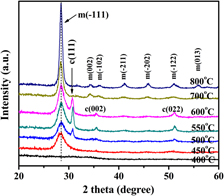
Hafnium dioxide (HfO2) thin films were synthesized on silicon and quartz substrates by thermal oxidation of metallic hafnium films in oxygen. The crystalline structure and optical properties of the HfO2 films were systematically investigated using x-ray diffraction, ultraviolet (UV)-Raman, and UV-visible spectrophotometer techniques. All the films thermally oxidized at 450 to 800 °C were mostly monoclinic. Interestingly, cubic phase coexisted with monoclinic phase in the films thermally oxidized at 500 to 600 °C. The corresponding optical band gap (Eg) varied from 5.92 to 6.08 eV for the films with a different phase ratio (cubic to monoclinic one) ranging between 0 and 1:3. These results imply that the mixed phase could have a certain effect on the increase of the Eg of HfO2 films.
The poly (vinylidene difluoride) (PVDF) has been of great interest for energy conversion of microelectromechanical system devices. A semicrystalline polymer, the PVDF has five crystallographic forms, α, β, γ, δ, and ε. The latter four structures exhibit a permanent dipole moment. In this research, we investigated effects of microstructures of the PVDF on its piezoelectricity for energy harvesting. Using various experimental techniques, we observed the power density generated by a mechanical force that was correlated with the phase transformation between amorphous, α, β, and γ phases. The transformation was time-dependent in a nonlinear manner. Such transformation influences the energy transition and storage of small devices.
We report on the enhanced dielectric constant and electrical resistivity of the Co-ferrite (CoO.Fe2O3) by partially substituting Fe with La. Structural characteristics of La-doped Co ferrite namely CoO.Fe1.925La0.075O3 indicate the cubic inverse spinel phase with a small amount of LaFeO3 additional phase. The lattice parameter obtained is 8.401 Å (±0.001 Å), which is higher than that reported for Co ferrite (8.387 Å, ±0.001 Å). The dielectric constant and electrical resistivity of CoO.Fe1.925La0.075O3 are higher compared with pure Co ferrite. The dielectric constant dispersion of CoO.Fe1.925La0.075O3 in the frequency range of 100 Hz to 1 MHz fits to the modified Debye’s function with more than one ion contributing to the relaxation. Temperature-dependent electrical resistivity curves exhibit two distinct regions indicative of two different types of conduction mechanisms. Analysis of the data indicates that the small polaron and variable-range hopping mechanisms are operative in the 220 to 300 K and 160 to 220 K temperature regions, respectively.
Tin oxide (SnO2) nanotubes have been synthesized using carbon nanotubes (CNTs) as removable templates. The entire synthesis takes place on the microscale on a micromachined hotplate, without the use of photolithography, taking advantage of the device’s built-in heater. Well-aligned multiwalled CNT forests were grown directly on microhotplates at 600 °C using a bimetallic iron/alumina composite catalyst and acetylene as precursor. Thin films of anhydrous SnO2 were then deposited onto the CNT forests through chemical vapor deposition of tin nitrate at 375 °C. The CNTs were then removed through a simple anneal process in air at temperatures above 450 °C, resulting in SnO2 nanotubes. Gas sensing measurements indicated a substantial improvement in sensitivity to trace concentrations of methanol from the SnO2 nanotubes in comparison with a SnO2 thin film. The synthesis technique is generic and may be used to create any metal oxide nanotube structure directly on microscale substrates.
This work uses a method based on indentation to characterize a polydimethylsiloxane (PDMS) elastomer submerged in an organic solvent (decane, heptane, pentane, or cyclohexane). An indenter is pressed into a disk of a swollen elastomer to a fixed depth, and the force on the indenter is recorded as a function of time. By examining how the relaxation time scales with the radius of contact, one can differentiate the poroelastic behavior from the viscoelastic behavior. By matching the relaxation curve measured experimentally to that derived from the theory of poroelasticity, one can identify elastic constants and permeability. The measured elastic constants are interpreted within the Flory–Huggins theory. The measured permeability indicates that the solvent migrates in PDMS by diffusion, rather than by convection. This work confirms that indentation is a reliable and convenient method to characterize swollen elastomers.