To save content items to your account,
please confirm that you agree to abide by our usage policies.
If this is the first time you use this feature, you will be asked to authorise Cambridge Core to connect with your account.
Find out more about saving content to .
To save content items to your Kindle, first ensure no-reply@cambridge.org
is added to your Approved Personal Document E-mail List under your Personal Document Settings
on the Manage Your Content and Devices page of your Amazon account. Then enter the ‘name’ part
of your Kindle email address below.
Find out more about saving to your Kindle.
Note you can select to save to either the @free.kindle.com or @kindle.com variations.
‘@free.kindle.com’ emails are free but can only be saved to your device when it is connected to wi-fi.
‘@kindle.com’ emails can be delivered even when you are not connected to wi-fi, but note that service fees apply.
Nanoindentation is useful for evaluating the mechanical properties, such as elastic modulus, of multilayer thin film materials. A fundamental assumption in the derivation of the elastic modulus from nanoindentation is that the unloading process is purely elastic. In this work, the validity of elastic assumption as it applies to multilayer thin films is studied using the finite element method. The elastic modulus and hardness from the model system are compared to experimental results to show validity of the model. Plastic strain is shown to increase in the multilayer system during the unloading process. The indentation-derived modulus of a monolayer material shows no dependence on unloading plasticity while the modulus of the multilayer system is dependent on unloading-induced plasticity. Lastly, the cyclic behavior of the multilayer thin film is studied in relation to the influence of unloading-induced plasticity. It is found that several cycles are required to minimize unloading-induced plasticity.
As electronic devices are indispensable in many aspects of our lives today, their integration with unconventional surfaces is increasingly essential. Electronic devices which maintain their electrical properties upon stretching are desirable for various wearable applications. Stretchable devices demonstrated are conventionally fabricated using semiconductor processing techniques. In this study, we demonstrate stretchable electrodes, which are basic components of electrical circuits, using screen printing, a large area printing method. It provides a low cost and scalable method to fabricate large area stretchable devices. Despite the larger width and thickness of the electrodes which increases the stiffness of the material, stretchability beyond 40% is demonstrated, which is suitable for certain wearable applications. The stretchable electrodes are integrated with light emitting diodes (LEDs) to demonstrate a stretchable LED matrix. The large area LED matrices exhibit variable stretchability, depending on the LED areal coverage. This technique is expected to be applicable in the fabrication of other stretchable, large area, and more complex electronic systems.
AlGaN-based quantum well (QW) heterostructures grown by plasma-assisted molecular beam epitaxy on c-Al2O3 substrates have been studied. The high-temperature (785 °C) synthesis of AlN buffer layer nucleated by a migration-enhanced epitaxy and including several ultrathin GaN interlayers was the optimum approach for lowering the threading dislocations density down to 108–109 cm−2. High-angle annular dark-field scanning transmission electron microscopy (HAADF STEM) has revealed the step-like roughness of the AlN/Al2O3 interface. Also, the formation of Al-rich barriers induced by temperature-modulated epitaxy and the spontaneous compositional disordering have been found in the AlxGa1−xN (x > 0.6) barrier layers. The origin of these phenomena and their influence on parameters of the mid-UV stimulated emission observed in the QW heterostructures were discussed. The fine structure of the QWs formed by a submonolayer digital alloying technique has been displayed by HAADF STEM, and optical properties of the QW structures were studied by temperature- and time-dependent photoluminescence spectroscopy.
Synchrotron powder X-ray diffraction, X-ray absorption spectroscopy (XAS), and proton nuclear magnetic resonance (1H-NMR) data have been used to examine the structure of hypoxanthine, 1,7-dihydro-6H-purin-6-one (C5H4N4O), a purine base that participates in numerous metabolic processes. XAS and 1H-NMR spectroscopy were used to determine that hypoxanthine was present in its keto form (both in solid state and dissolved in an organic solvent). Rigid body refinement was performed with the Rietveld software package GSAS yielding triclinic lattice parameters of a = 7.1179 (2) Å, b = 9.7830 (3) Å, c = 10.4009 (3) Å, α = 58.876 (1)°, β = 67.609 (1)°, and γ = 71.937 (2)° (C5H4N4O, Z = 4, space group P$\bar 1$).
Lead-free ceramics (1 − x)(K1/2Na1/2)NbO3–xBi(Sc3/4Co1/4)O3 [(1 − x)KNN–xBSC] were prepared by the conventional solid-state sintering method. X-ray diffraction patterns show that the introduction of BSC into KNN system caused insignificant change in crystal structure. The composition with x = 0.015 has diphasic tetragonal and orthorhombic phases. Moreover, the grain size significantly dependent on the composition. The phase transition temperatures of orthorhombic–tetragonal (TO–T) and tetragonal–cubic (TC) decreased with increasing x from 0 to 0.025. The TO–T value of KNN–0.015BSC ceramic is close to room temperature, resulting in good electrical properties (d33 = 190 pC/N, kp = 40.3%, εr = 1494, tgδ = 0.026), with the Curie temperature TC = 321 °C. The combination of good piezoelectric properties and high TC makes these KNN–BSC ceramics suitable for elevated temperature piezoelectric devices.
X-ray powder diffraction data for 5-Chloro-N-(4-nitrophenyl)pentanamide, C11H13ClN2O3, are reported [a = 8.036(4) Å, b = 15.972(5) Å, c = 9.829(5) Å, α = 90°, β = 104.227(2)°, γ = 90°, V = 1222.98 Å3, Z = 4, ρx = 1.3941 g cm−3 and space group P21/c]. All measured lines were indexed and are consistent with the P21/c space group. No detectable impurities were observed.
We report a cost-effective, surfactant-free, and scalable synthesis technique for lead telluride (PbTe) nanocubes by a chemical precipitation method. The high-resolution transmission electron microscopy studies indicated the evolution of nucleation centers (spherical) into nanocubes with the addition of the Pb and Te atoms. The spark plasma sintered PbTe nanocubes exhibited an enhanced Seebeck coefficient, S > +400 µV, higher than the reported values of the bulk PbTe over an extended temperature range of 300–425 K, and a moderate electrical conductivity, σ ∼ 8000 S/m at 300 K. A significant reduction in the lattice thermal conductivity was observed due to effective phonon scattering from the presence of numerous interfaces introduced by nanostructuring. The resulting figure-of-merit (ZT) ∼ 0.45 at 300 K is higher than the reported values at this temperature in other PbTe nanostructures. Moreover, a moderate thermoelectric compatibility factor makes the PbTe nanocubes a potential candidate for green energy generation.
Semi-interpenetrating polymer network (semi-IPN) and fully interpenetrating polymer network (full-IPN) hydrogels composed of sodium alginate (SA) and N-isopropylacrylamide (NIPAAm) were prepared with Ca2+ and N,N′-methylenebisacrylamide (BIS) as the cross-linkers, respectively. The influence of the SA content and crosslinking degree of alginate on thermosensitive, swelling, mechanical, morphological, and thermal properties was investigated in detail. The hydrogels obtained exhibited obvious thermosensitivity and rapid swelling rate. The presence of Ca2+ contributed to the improvement of mechanical properties obviously, without altering the thermosensitivity and network porosity of the hydrogels significantly. The compressive strength of full-IPN hydrogel was improved considerably, while the tensile strength was increased by 308.5% than semi-IPN hydrogel. The Tg of full-IPN dried hydrogel ran up to 142.9 °C with respect to 97.3 °C of pure PNIPAAm, and the improvement indicated that hydrogel with more compact structure was prepared.
This work aims to synthesize PtPd catalytic clusters and to study the effect of the particle size, the curvature and possible alloying on the catalytic activity for oxygen reduction reaction, electrochemical stability, the mass-transfer of redox active species toward catalytic sites and the electro-kinetic of the oxygen reduction reaction (ORR) process. The curvature and the chemical composition of the catalyst surface significantly influence the electrochemically active surface area and catalytic activity toward oxygen reduction, regardless the particle size. The best catalytic activity was accomplished for 45 nm clusters due to possible alloying that enhance the O2 adsorption and dissociation. The complementary impedance studies demonstrated that 45 nm cluster has also the shortest effective diffusion length and the highest reaction rate constant among all morphologies, indicating on superior reactant transport to the catalytic sites. In addition, the 45 nm clusters showed improved electrochemical stability that is believed to be the combined effect of alloying and the compactness of the structure.
X-ray powder diffraction data for 3-(4-Morpholinyl)-1-(4-nitrophenyl)-5,6-dihydro-2(1H)-pyridinone, C15H17N3O4, are reported [a = 7.112(1) Å, b = 33.360(2) Å, c = 6.265(1) Å, α = 90°, β = 94.037(1)°, γ = 90°, V = 1483.08 Å3, Z = 4, ρcal = 1.358 g cm−3 and space group P21]. All measured lines were indexed and are consistent with the P21 space group. No detectable impurities were observed.
X-ray powder diffraction data for piperaquine, C29H32Cl2N6, are reported [a = 15.8865(1) Å, b = 12.5975(3) Å, c = 13.2647(3) Å, β = 91.2890(1)°, unit-cell volume V = 2654.02 Å3, Z = 4, and space group P21/n]. All measured lines were indexed and are consistent with the P21/n space group. No detectable impurities were observed.
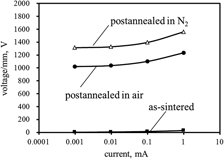
This study describes the nonlinear characteristics of SrCoO3-doped ZnO varistors and multilayer ceramic varistors (MLCVs) with copper electrodes, both of which are sintered in a reducing atmosphere. Due to postannealing effects in air or N2 with low-oxygen concentration (0.02%), bulk disks can be sintered in a reducing atmosphere, with a usable V1 mA/mm (e.g., 1600 V for bulk bodies or 1200 V for Cu cofiring) and highly nonlinear indices (α10 μA = V1 mA/V10 μA < 1.3), regardless of whether cofiring with Cu electrodes on disk surfaces was conducted or not. On the basis of this procedure, Cu-MLCVs were successfully produced, without oxidation of Cu-internal electrodes or structural defects. They exhibited high stability as well as a useful nonlinearity of V1 mA = 10.4 V and α10 μA = 1.93. The resultant stability against electrostatic discharge (ESD) satisfies the highest standard of level 4 in IEC61000-4-2 (ESD stability test). This is the first report to show that MLCVs with base metals have practical properties, including stability.
Glassy organic semiconductors provide a convenient host for dispersing guest molecules, such as dopants or light-emitting chromophores. However, many glass-forming compounds will crystallize over time leading to changes in performance and stability in devices. Methods to stabilize amorphous molecular solids are therefore desirable. We demonstrate that solution-processable glasses can be formed from a mixture of 8,8′-biindeno[2,1-b]thiophenylene (BTP) atropisomers. While the trans isomer of methylated BTP, (E)-MeBTP crystallizes in spin-cast films, the addition of (Z)-MeBTP slows the growth of the spherulites. X-ray scattering and optical microscopy indicate that films containing 40% (Z)-MeBTP do not crystallize, even with the addition of nucleation agents and aging for several months.
The crystal structure of lacosamide form I has been solved and refined using synchrotron X-ray powder diffraction data, and optimized using density functional techniques (density functional theory). Lacosamide form I crystallizes in space group P21 (#4) with a = 10.677 73(5), b = 4.799 68(2), c = 13.639 16(9) Å, β = 91.6331(10)̊, V = 698.719(6) Å3, and Z = 2. Van der Waals interactions are important in the crystal structure. Two N–H···O hydrogen bonds form C1,1(4) chains along the b-axis. Several weaker C–H···O hydrogen bonds to the ketone oxygens also contribute to the packing energy. These C–H···O extend both along the b-axis and in the ac-plane, and help link the molecules in three dimensions. The powder pattern has been submitted to International Centre for Diffraction Data for inclusion in the Powder Diffraction File™.
Single crystals of Ca0.9Nd0.1Ti0.9Al0.1O3 (CNTAO) were grown using optical floating zone technique and the grown crystals were characterized by Laue diffraction and powder X-ray diffraction techniques for crystal quality and its composition, respectively. The powder pattern of CNTAO was indexed and refined using GSAS program to an orthorhombic structure with space group Pbnm (#62), a = 5.3832(1), b = 5.4343(1), c = 7.6389(2) Å, V = 223.4677 Å3′, and Z = 4.
The crystal structure of ziprasidone hydrochloride monohydrate has been solved and refined using synchrotron X-ray powder diffraction data, and optimized using density functional techniques. Ziprasidone hydrochloride monohydrate crystallizes in space group P-1 (#2) with a = 7.250 10(3), b = 10.986 66(8), c = 14.071 87(14) Å, α = 83.4310(4), β = 80.5931(6), γ = 87.1437(6)°, V = 1098.00(1) Å3, and Z = 2. The ziprasidone conformation in the solid state is very close to the minimum energy conformation. The positively-charged nitrogen in the ziprasidone makes a strong hydrogen bond with the chloride anion. The water molecule makes two weaker bonds to the chloride, and acts as an acceptor in an N–H⋯O hydrogen bond. The powder pattern is included in the Powder Diffraction File™ as entry 00-064-1492.
The National Institute of Standards and Technology (NIST) certifies a suite of Standard Reference Materials (SRMs) to address specific aspects of the performance of X-ray powder diffraction instruments. This report describes SRM 1976b, the third generation of this powder diffraction SRM. SRM 1976b consists of a sintered alumina disc, approximately 25.6 mm in diameter by 2.2 mm in thickness, intended for use in the calibration of X-ray powder diffraction equipment with respect to line position and intensity as a function of 2θ-angle. The sintered form of the SRM eliminates the effect of sample loading procedures on intensity measurements. Certified data include the lattice parameters and relative peak intensity values from 13 lines in the 2θ region between 20° and 145° using CuKα radiation. A NIST-built diffractometer, incorporating many advanced and unique design features was used to make the certification measurements.
The crystal structure of fingolimod hydrochloride (C19H34ClNO2) has been solved and refined using synchrotron X-ray powder diffraction data, and optimized using density functional techniques. Fingolimod hydrochloride crystallizes in space group P21/n (#14) with a = 7.137 53(5), b = 5.957 98(4), c = 49.5196(4) Å, β = 91.0808(7)°, V = 2105.46(2) Å3, and Z = 4. The structure consists of a “lipid bilayer” packing. The polar ends of the molecules make O–H···Cl and N–H···Cl hydrogen bonds to the chloride anion, and the octyl side chains pack adjacent to each other. The hydrogen bonds form three types of chains with graph sets C1,2(7), C1,2(7), and C1,2(8). The result is a complex chain of hydrogen bonds parallel to the b-axis. The powder pattern has been submitted to ICDD for inclusion in future releases of the Powder Diffraction File™.