To save content items to your account,
please confirm that you agree to abide by our usage policies.
If this is the first time you use this feature, you will be asked to authorise Cambridge Core to connect with your account.
Find out more about saving content to .
To save content items to your Kindle, first ensure no-reply@cambridge.org
is added to your Approved Personal Document E-mail List under your Personal Document Settings
on the Manage Your Content and Devices page of your Amazon account. Then enter the ‘name’ part
of your Kindle email address below.
Find out more about saving to your Kindle.
Note you can select to save to either the @free.kindle.com or @kindle.com variations.
‘@free.kindle.com’ emails are free but can only be saved to your device when it is connected to wi-fi.
‘@kindle.com’ emails can be delivered even when you are not connected to wi-fi, but note that service fees apply.
Phased array technology has taken the world by storm in the inspection ability to scan structures and to achieve dynamic beam focusing and beam steering without mechanically moving actuators over the part under examination. Modern-day electronics and cost reduction have inspired activity in this area. The first real-time phased array multi-element transducer system used in medical ultrasound was introduced in the ’70s with applications in solid materials following in the ’80s. In the case of using bulk wave ultrasound, only straight line computation was needed to control wave interference phenomena at selected points inside the human body or inside a specific solid structure. In addition to real-time phased array systems, synthetic focusing was introduced whereby enough information was transmitted from a multi-element array and subsequently received by the individual elements, where software was used to simulate the real-time phased array approach. Both methods provide special advantages.
During the ’90s, real-time phased array and synthetic focusing methods were introduced for cylindrical structures, primarily pipelines. The time delay computations to achieve this are more complex. This chapter primarily focuses on principles for cylindrical piping structures.
Cu-based shape memory alloys (SMAs) and among these copper–zinc (Cu–Zn), copper–aluminum (Cu–Al), and copper–tin (Cu–Sn) alloys both with and without ternary additions have shown potential due to their good shape recovery, ease of fabrication, excellent conductivity of heat and electricity. However, their applications are still limited because of the shortcomings of thermal stability, brittleness, and mechanical strength, which are closely related with microstructural characteristic of Cu-based SMAs, such as coarse grain sizes, high elastic anisotropies, and the congregation of secondary phases or impurities along the grain boundaries. Efforts are being made to overcome these drawbacks with proper ternary additions, adopting alternative processing routes and also optimizing the heat treatment cycles. The present article will deal with the current status of research and commercialization of Cu-based SMAs and dwell upon the future directions in which research should be targeted and future prospects of converting the research into components for commercial use.
Plate-shaped Gd2O3 nanoclusters (GNCs) with well-controlled loading were fabricated by using amphiphilic poly(maleic anhydride-alt-1-octadecene) (PMAO) grafted with PEG as nanogel. The hydrodynamic size of the obtained GNCs was well controlled to <260 nm under appropriate emulsion process conditions and they showed excellent long-term dispersibility in phosphate buffer saline. MRI measurements clearly indicated the substantial improvement in T1 effect of the nanoclusters as compared with the individual Gd2O3 nanoplates. The obtained GNCs possessed a high r1 value of 7.948 s−1mM−1 [Gd], which is 2.23 times higher than that of the commercial product Gd-DOTA, and low r2/r1 of 1.04. In vitro test of the obtained GNCs was demonstrated in NIH/3T3 cell lines, and clear T1-weighted images were obtained. Thus, the PMAO-g-PEG assisted GNCs were potentially useful for T1-weighted MRI contrast agents.
The present study is dealing with the basic physics for a novel way to generate a free-formed ceramic body, not like common layer by layer, but directly by Selective Volume Sintering (SVS) in a compact block of ceramic powder. To penetrate with laser light into the volume of a ceramic powder compact it is necessary to investigate the light scattering properties of ceramic powders. Compared with polymers and metals, ceramic materials are unique as they offer a wide optical window of transparency. The optical window typically ranges from below 0.3 up to 5 µm wave length. In the present study thin layers of quartz glass (SiO2) particles have been prepared. As a function of layer thickness and the particle size, transmission and reflection spectra in a wave length range between 0.5 and 2.5 µm have been recorded. Depending on the respective particle size and by choosing a proper relation between particle size and wave length of the incident laser radiation, it is found that light can penetrate a powder compact up to a depth of a few millimeters. With an adjustment of the light absorption properties of the compact the initiation of sintering in the volume of the compact is possible.
A technique has been developed for determining coefficients in the power approximation of the “stress–strain” diagram by results of scratch testing with a Berkovich indenter under a normal load of 5 mN on the indenter. The procedure is based on a comparison of experimental results with the finite element simulation of the test process. The technique is intended for application on nanomechanical testing equipment enabling one to perform tests with recording of loading diagrams in terms of the “normal force – indenter displacement” coordinates. To obtain correct results, one must observe the following restrictions: indenter penetration depth > 150 nm under a loading of 5 mN with the indenter tip curvature radius R < 50 nm; indenter penetration depth > 250 nm with 50 < R < 100 nm; the tested metal must be ductile enough, for a scratch to be formed by the mechanism of plastic deformation rather than fracture.
Taking a unique materials science approach, this text introduces students to the basic concepts and applications of materials and biomedical engineering and prepares them for the challenges of the new interdisciplinary field of biomaterials science. Split into three sections - Basic Biology Principles, Biological Materials, and Bioinspired Materials and Biomimetics - it presents biological materials along with the structural and functional classification of biopolymers, bioelastomers, foams, and ceramic composites. More traditional biomimetic designs such as Velcro are then discussed in conjunction with new developments that mimic the structure of biological materials at the molecular level, mixing nanoscale with biomolecular designs. Bioinspired design of materials and structures is also covered. Focused presentations of biomaterials are presented throughout the text in succinct boxes, emphasising biomedical applications, whilst the basic principles of biology are explained, so no prior knowledge is required. The topics are supported by approximately 500 illustrations, solved problems, and end-of-chapter exercises.
An accessible yet rigorous discussion of the thermodynamics of surfaces and interfaces, bridging the gap between textbooks and advanced literature by delivering a comprehensive guide without an overwhelming amount of mathematics. The book begins with a review of the relevant aspects of the thermodynamics of bulk systems, followed by a description of the thermodynamic variables for surfaces and interfaces. Important surface phenomena are detailed, including wetting, crystalline systems (including grain boundaries), interfaces between different phases, curved interfaces (capillarity), adsorption phenomena and adhesion of surface layers. The later chapters also feature case studies to illustrate real-world applications. Each chapter includes a set of study problems to reinforce the reader's understanding of important concepts. Ideal as an auxiliary text for students and a self-study guide for industry practitioners and academic researchers working across a broad range of materials.
In this new edition of their classic work on Cellular Solids, the authors have brought the book completely up to date, including new work on processing of metallic and ceramic foams and on the mechanical, electrical and acoustic properties of cellular solids. Data for commercially available foams are presented on material property charts; two new case studies show how the charts are used for selection of foams in engineering design. Over 150 references appearing in the literature since the publication of the first edition are cited. The text summarises current understanding of the structure and mechanical behaviour of cellular materials, and the ways in which they can be exploited in engineering design. Cellular solids include engineering honeycombs and foams (which can now be made from polymers, metals, ceramics and composites) as well as natural materials, such as wood, cork and cancellous bone.
X-ray powder diffraction data, unit-cell parameters, and space group for a sodium azobarbituric acid dihydrate are presented [a = 3.546 (1) Å, b = 9.210 (2) Å, c = 9.738 (4) Å, α = 104.07 (4)°, β = 98.09 (6)°, γ = 98.80 (2)°, unit-cell volume V = 299.6 Å3, Z = 1, and space group P − 1]. All the measured lines were indexed. No detectable impurities were observed.
Additive manufacturing has provided a pathway for inexpensive and flexible manufacturing of specialized components and one-off parts. At the nanoscale, such techniques are less ubiquitous. Manufacturing at the nanoscale is dominated by lithography tools that are too expensive for small- and medium-sized enterprises (SMEs) to invest in. Additive nanomanufacturing (ANM) empowers smaller facilities to design, create, and manufacture on their own while providing a wider material selection and flexible design. This is especially important as nanomanufacturing thus far is largely constrained to 2-dimensional patterning techniques and being able to manufacture in 3-dimensions could open up new concepts. In this review, we outline the state-of-the-art within ANM technologies such as electrohydrodynamic jet printing, dip-pen lithography, direct laser writing, and several single particle placement methods such as optical tweezers and electrokinetic nanomanipulation. The ANM technologies are compared in terms of deposition speed, resolution, and material selection and finally the future prospects of ANM are discussed. This review is up-to-date until April 2014.
Phase change memory (PCM) is an emerging technology that combines the unique properties of phase change materials with the potential for novel memory devices, which can help lead to new computer architectures. Phase change materials store information in their amorphous and crystalline phases, which can be reversibly switched by the application of an external voltage. This article describes the advantages and challenges of PCM. The physical properties of phase change materials that enable data storage are described, and our current knowledge of the phase change processes is summarized. Various designs of PCM devices with their respective advantages and integration challenges are presented. The scaling limits of PCM are addressed, and its performance is compared to competing existing and emerging memory technologies. Finally, potential new applications of phase change devices such as neuromorphic computing and phase change logic are outlined.
Fundamental latency and energy limitations are driving major changes in communication and computation hardware. Parallel multicore and multiprocessor architectures are emerging as highly interconnected, communication-centric computation tools that at high node count will approach neural network connectivity and complexity. Monolithically integrated silicon photonics with electronics offers a promising platform for scaling functionality with high volume manufacturing and short design cycle times. The system parameters for this emerging “design for function” paradigm are cost, energy, and bandwidth density. The platform has been built on transmission of a λ ≈ 1550 nm photon wavelength; Si, Ge, Si3N4, and SiO2 materials; and standard complementary metal oxide semiconductor foundry processing. Dimensional shrink is achieved through strong signal confinement in high refractive index contrast material composites. Precision pattern transfer has enabled both photonic interconnect and signal processing functionality. New materials, process integration, and packaging are the keys to success.
This article reviews the potential of graphene and related two-dimensional (2D) materials for applications in micro- and nanoelectronics. In addition to graphene, special emphasis is placed on transition metal dichalcogenides (TMDs). First, we discuss potential solutions for application-scale material growth, in particular chemical vapor deposition. We describe challenges for electrical contacts and dielectric interfaces with 2D materials. The device-related sections in this review first weigh the pros and cons of semi-metal graphene as a field-effect transistor (FET) channel material for logic and radio frequency applications. This is followed by an introduction to alternate graphene switch concepts that utilize the particular properties of the material, namely tunnel FETs, vertical devices, and bilayer pseudospin FETs. The final section is dedicated to semiconducting TMDs and their integration in FETs using the examples of n-type molybdenum disulfide (MoS2) and p-type tungsten diselenide (WSe2).
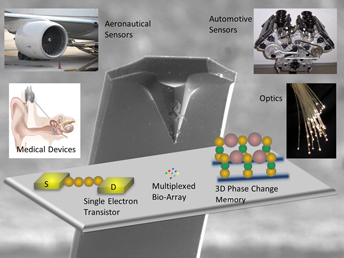
Extension of microelectromechanical systems (MEMS) into more extreme operating conditions will require a wider range of material properties than are currently available in conventional systems. Successful integration of new materials is dependent on concurrent development of compatible fabrication routes and scale appropriate evaluation techniques. This review focuses on emerging material classes that have potential to replace silicon-based MEMS in elevated temperature applications. Basic silicon mechanical properties and micromachining methods are reviewed to provide context for developing material systems such as silicon carbide, silicon carbonitrides, and several nickel-based alloys. Potential improvements in strength, thermal stability, and reliability are juxtaposed with fabrication, reproducibility, and economic feasibility issues that must also be addressed.