To save content items to your account,
please confirm that you agree to abide by our usage policies.
If this is the first time you use this feature, you will be asked to authorise Cambridge Core to connect with your account.
Find out more about saving content to .
To save content items to your Kindle, first ensure no-reply@cambridge.org
is added to your Approved Personal Document E-mail List under your Personal Document Settings
on the Manage Your Content and Devices page of your Amazon account. Then enter the ‘name’ part
of your Kindle email address below.
Find out more about saving to your Kindle.
Note you can select to save to either the @free.kindle.com or @kindle.com variations.
‘@free.kindle.com’ emails are free but can only be saved to your device when it is connected to wi-fi.
‘@kindle.com’ emails can be delivered even when you are not connected to wi-fi, but note that service fees apply.
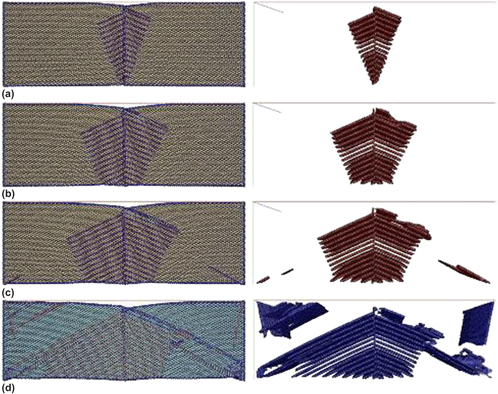
To determine whether plastic-hardening behavior occurs in metal nanowires, an atomistic simulation was performed to investigate the tension process in a bicrystal Cu nanowire. The results indicate that bicrystal Cu nanowires exhibit strain-hardening behavior, unlike their single-crystal counterparts. The strain-hardening behavior is related to the orientation of two crystal grains, and the number of atoms determines whether strain-hardening behavior occurs in the asymmetrically tilted bicrystal Cu nanowires. Strain hardening occurs in almost bicrystal Cu nanowires with different orientation angles. The initial yield stress is determined by the grain whose orientation angle is closer to 45° among the two crystal grains, resulting in a high value of the tilting tendency factor, and thus making it easier to generate slip.
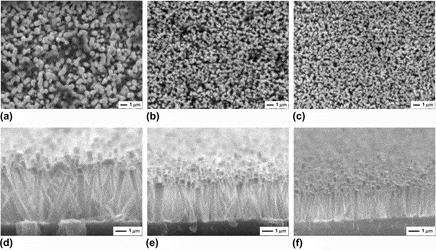
In this paper, we report on the well-aligned zinc oxide (ZnO) nanorods synthesized on Ag buffer layer/glass substrate using a modified hydrothermal method, which adopts the strategy of Ag layer facing down. The effects of position, thickness, and annealing temperature of Ag layer on the shape of ZnO nanocrystals were systematically investigated. It was found that the diameter and length of ZnO nanorods decrease with the Ag layer height up to 12 mm, above which no obvious decrease was observed. Oppositely, the density, diameter, and length of ZnO rods all increase with an increase in the Ag layer thickness, except that the length becomes constant above a critical thickness of 60 nm. In addition, when the Ag layer annealing temperature increases from 300 to 400 °C, the nanorod density decreases, the diameter increases, and the length remains nearly invariable, respectively. Surprisingly, randomly inclined nanorods with two different diameters dispersedly coexist on the Ag layer that was annealed at 500 °C. This work may provide an effective approach for the shape control in ZnO-based applications.
Aluminum alloy castings find extensive applications in automobile and other engineering industries. Production of defect-free castings requires a good understanding of the volume deficit characteristic. The volume deficit of a casting depends on the casting material and casting conditions. Patterson and Engler have classified the volume deficit into four types namely, macrocavities, internal porosity, surface sinking, and volumetric contraction. The influence of process parameters on the characteristics determines the casting quality. The process parameters considered in this study are bottom chill, casting shape, and pouring temperature. Two basic shapes rectangle and cylinder are considered. The volume deficit decreases with an increase in the silicon content. The AA 356.0 alloy shows more amount of volume deficit than AA 413.0 alloy. X-ray computer tomography (XCT) helps to reveal the size, shape, and location of defects in castings. Quantification of internal closed porosity of AA 413.0 casting is done using XCT and successfully validated through destructive testing of castings.
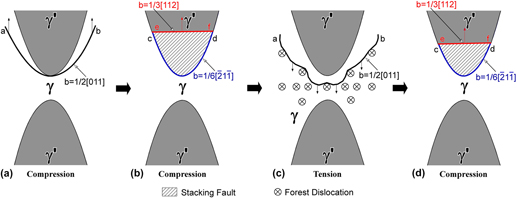
Thermomechanical fatigue (TMF) tests have been carried out in a nickel-based single crystal TMS-82 superalloy, and the dynamic evolutions of dislocations and stacking faults have been studied in detail. It is found that the reversible formation of stacking faults is always associated with the loading orientation. Specifically, stacking faults expand under compression and shrink under tension due to the disappearance and appearance of dislocations during the TMF process. Stacking faults result from shear of γ′ precipitates by 1/3<112> dislocations, which arise from the decomposition of 1/2<110> matrix dislocations. The calculations of critically resolved shear stress to push dislocations that glide in the γ′ particles confirm the expansion of stacking faults under compression. However, under tension, dislocations in γ channel prevent 1/2<110> dislocations to enter γ′ cuboids and consequently, stacking faults shrink. Appearance and disappearance of dislocations during TMF cycling are associated with plastic deformation and annealing process, respectively.
Ceramic volumetric composites xLa0.7Pb0.3MnO3–(1−x)PbTiO3 (x = 0.18 and 0.85) were prepared. X-ray investigations have shown that rather low sintering temperature (800 °C) has allowed us to avoid the reaction and interdiffusion between two initial phases. Heat capacity, thermal expansion, and intensive magnetocaloric effect were measured in a wide temperature range. The sample composition has a low influence on temperatures of the ferromagnetic and ferroelectric phase transitions in composites. Electro- and barocaloric effects were determined by analysis in the framework of thermodynamic theory, electric equation of state, Maxwell relationships, and entropy–temperature–pressure phase diagram. Multicaloric efficiency of composites is discussed and compared with that of initial La0.7Pb0.3MnO3 and PbTiO3 compounds. Variation of a relationship between components can significantly increase both barocaloric and magnetocaloric efficiency of compositional material due to the mechanical stress appearing between grains of different ferroic phases under magnetic field.
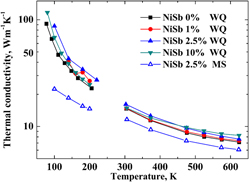
The microstructure and thermoelectric properties of InSb–NiSb composite system are investigated. NiSb, ranging from micro- to nanoscale, is introduced as a nonsoluble second phase in the InSb matrix by using the water quenching method. The morphology of the second phase is adjusted by varying the composition from hypoeutectic to hypereutectic alloys. The eutectic composite with a semiconducting InSb matrix and a metallic NiSb fiber on the order of 100-nm diameter is obtained. Melt spinning (MS) is applied to the eutectic composition to change the NiSb dispersion phase to around 200-nm diameter sphere. Transport properties, including Seebeck coefficient, resistivity, Hall coefficient, and thermal conductivity, are measured from 80 to 630 K. Compared to the water quenched (WQ) eutectic sample, the MS process results in a slight increase in the carrier concentration but a remarkable reduction in the mobility and thermal conductivity. Compared to the InSb matrix, ZT of the samples with the NiSb second phase is lower. For the eutectic samples, ZT is significantly reduced after the MS process because of the loss in mobility. ZT of the WQ InSb matrix is the highest in all the samples, ∼0.5 at 600 K.
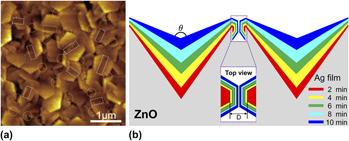
We have fabricated Ag-decorated ZnO nanoplate arrays by combining water-bath heating toward ZnO hexagonal nanoplate arrays and subsequent decoration of Ag films or nanoparticles on the ZnO surfaces by magnetron sputtering or photoreduction. Experimental surface-enhanced Raman scattering (SERS) results show that Ag-film–ZnO hybrid substrates with different Ag sputtering times exhibit a large difference in enhanced SERS signals for Rhodamine 6G (10−7 M). Atomic force microscope analysis reveals that two kinds of positions create abundant “hot spots” in this SERS substrate: one is located at the gap between adjacent separate Ag-film–ZnO hybrid nanoplates, and the other is located at the V-grooves formed by two adjacent interlaced Ag-film–ZnO hybrid nanoplates. The effects of simultaneous changes in interplate spacing and groove wall angle are considered to be the key factors affecting the SERS of our prepared Ag-film–ZnO hybrid substrates, which have also been evaluated by finite-difference time-domain simulation.
Using first principle density functional calculations, we study the formation of 2D transition metal dichalcogenides (TMDs) on TiC1−xAx, (A = S, Se, and Te) surfaces. We examine the structural misfits between chalcogen-containing TiC and different TMDs and demonstrate that the conditions for formation of TMDs are fulfilled in TiC1−xAx. We also demonstrate the influence of chalcogens on the cohesive properties and electronic structure of the carbides. We find that they react with W and form W-dichalcogenides. In the experimentally reported Ti–C–S nanocomposite coatings, the carbide grains are embedded in an amorphous carbon matrix. We discuss here the role of this matrix in the reaction. We propose that TiC1−xTex and TiC1−xSex are the favorable sources for dichalcogenide formation and suggest an alternative way to produce 2D materials in general. Furthermore, we argue that using Ti–C–Te or Ti–C–Se in nanocomposite coatings may be more advantageous for tribological applications than that of Ti–C–S.
To clarify the underlying mechanism of formation and growth of aluminum coating, the interface microstructures of as-prepared aluminum coating iron were investigated using various experimental methods. The liquid Al–Si, Al–Ge alloys were chosen as the dipping baths. In both cases, the total thickness of the reaction layer is controlled mainly by the well-known diffusion growth of η-Al5Fe2. The melt environment of the Al bath plays a decisive role in the formation and growth of the diffusion layer. The results show that Ge atoms could also decelerate reaction layer growth like Si atoms, which mainly restrain the diffusion of Al atoms. Meanwhile, Ge element represents an abnormal concentration gradient in the η-Al5Fe2 phase. The diverse growth behavior of the diffusion layer is attributed to the strong controlling role of the alloying element in Al baths based on the atomic diffusion and activity analysis.
Heteroepitaxial Ge quantum dots were grown on Si (001) by molecular beam epitaxy, with a Mn co-deposition flux giving a nominal composition of Ge0.9Mn0.1. At this large Mn flux, and with growth temperatures of 450 °C required for Ge quantum dot self-assembly, extensive second phase formation occurred. Atomic force microscopy reveals that quantum dots typical for the Ge/Si (001) system still form. In addition, copious formation of both rod-like and cluster-like morphologies is observed, with many of these structures conjoined to Ge dots. Extensive transmission electron microscopy identified several coexisting intermetallic phases, all based on Mn–silicide crystal structures, albeit with varying degrees of Ge substitution. The Ge quantum dots themselves appear to have little or no Mn incorporated in them, indicating that the intermetallic particles scavenge Mn from extended surface areas. Under these growth conditions, Mn is highly mobile, with surface diffusion lengths of the order of 800 nm, with significant bulk mobility as well, resulting in surface structures that also penetrate the Si substrate. A magnetic phase transition at 220 °C does not match known behavior of the bulk silicide phases but might result from extensive ternary alloying with Ge, especially into the cubic MnSi phase.
This work reports the gold-coated self-organized silicon nanopyramidal array prepared by a wet etching and magnetron sputtering process at room temperature. Scanning electron microscopy was used to detect the morphology of gold films. The surface-enhanced Raman scattering (SERS) spectra of the rhodamine 6G (R6G) molecules adsorbed on a nanoscale gold film were recorded. Experimental results show the relationships between gold film thickness and SERS intensity. A full three-dimensional finite difference time domain calculations were carried out, which compare the experimental results and show agreement with ratios of the SERS enhancement for the different thicknesses of gold films. Furthermore, numerical simulations of the array were conducted for both a real gold metal coating and a perfect electrical conductor to determine whether the SERS enhancement was due to diffraction or plasmonic effects. The sample with the fast fabrication process used in this work could provide a new way to obtain a uniform enhancement and low cost SERS substrate.
Dispersions containing 1 mg/mL of several carbon nanomaterials were used to deposit films containing 1 to 20 layers. The electrical properties of the composite films were characterized via impedance spectroscopy along two directions: in-plane on the film topmost surface and also through the thickness. It was found that carbon black nanoparticles never achieved full in-plane interconnection while the multiwalled carbon nanotube (MWNT) and single-walled carbon nanotube were already percolated at one layer. Graphite flakes showed a complete percolation curve that allowed its resistance to change by 6–7 orders of magnitude. The differences in the microstructure, electrical response, and thermal decomposition behavior of these carbon nanomaterial–paper substrate films were explained by detailed equivalent circuit analysis of the impedance spectra. Interpretation was supplemented by scanning electron microscopy images and thermal analysis via Differential Scanning Calorimetry/Thermogravimetric Analysis (DSC/TGA). Thru-plane electrical properties were for the most part similar, although only films with short MWNT showed a clearly infiltrated network structure.
Plasma electrolysis (PE) is a combination of electrolysis and plasma discharge. Previous studies indicated that PE usually created porous surface with irregular morphology as a result of the plasma–cathode interaction that was dominated by physical reactions. This paper demonstrated that highly ordered textured silicon surfaces could be created using PE. This abnormal anisotropic etching phenomenon implied that the chemical reactions were decoupled from the physical processes and the physical reactions were suppressed. Raman spectra confirmed that the textured silicon surface created by PE conserved the crystalline structure. Therefore, PE may lead to new process regimes for surface engineering.