Refine search
Actions for selected content:
106129 results in Materials Science
The application of the X-ray micro-diffraction to study some industrial problems
-
- Journal:
- Powder Diffraction / Volume 28 / Issue S2 / September 2013
- Published online by Cambridge University Press:
- 14 November 2013, pp. S133-S143
-
- Article
- Export citation
Double Bent Crystal Monochromator for High Resolution Neutron Powder Diffraction
-
- Journal:
- Powder Diffraction / Volume 28 / Issue S2 / September 2013
- Published online by Cambridge University Press:
- 14 November 2013, pp. S351-S359
-
- Article
- Export citation
Metal hydride formation in palladium and palladium rich intermetallic compounds studied by in situ neutron diffraction
-
- Journal:
- Powder Diffraction / Volume 28 / Issue S2 / September 2013
- Published online by Cambridge University Press:
- 14 November 2013, pp. S242-S255
-
- Article
- Export citation
XRD profile modeling approach tools to investigate the effect of charge location on hydration behavior in the case of metal exchanged smectite
-
- Journal:
- Powder Diffraction / Volume 28 / Issue S2 / September 2013
- Published online by Cambridge University Press:
- 14 November 2013, pp. S284-S300
-
- Article
- Export citation
Crystal structure of RbBaVO4 and high-pressure modification of KCaVO4
-
- Journal:
- Powder Diffraction / Volume 28 / Issue S2 / September 2013
- Published online by Cambridge University Press:
- 14 November 2013, pp. S65-S74
-
- Article
- Export citation
Using X-ray diffraction for studying the effect of modulation and machining parameters on deformation level in brass particulate produced by modulation assisted machining
-
- Journal:
- Powder Diffraction / Volume 28 / Issue S2 / September 2013
- Published online by Cambridge University Press:
- 14 November 2013, pp. S315-S326
-
- Article
- Export citation

Microwave-assisted solution combustion synthesis of high aspect ratiocalcium phosphate nanoparticles
-
- Journal:
- Journal of Materials Research / Volume 28 / Issue 22 / 28 November 2013
- Published online by Cambridge University Press:
- 13 November 2013, pp. 3119-3129
- Print publication:
- 28 November 2013
-
- Article
- Export citation

Recent advances on solar water splitting using hematite nanorod film produced by purpose-built material methods
-
- Journal:
- Journal of Materials Research / Volume 29 / Issue 1 / 14 January 2014
- Published online by Cambridge University Press:
- 13 November 2013, pp. 16-28
- Print publication:
- 14 January 2014
-
- Article
- Export citation

Characterization of the interfacial strength of SiNx/GaAs film/substrate systems using energy balance in nanoindentation
-
- Journal:
- Journal of Materials Research / Volume 28 / Issue 22 / 28 November 2013
- Published online by Cambridge University Press:
- 11 November 2013, pp. 3137-3145
- Print publication:
- 28 November 2013
-
- Article
- Export citation
An investigation of metallurgical bonding in Al–7Si/gray iron bimetal composites
-
- Journal:
- Journal of Materials Research / Volume 28 / Issue 22 / 28 November 2013
- Published online by Cambridge University Press:
- 11 November 2013, pp. 3190-3198
- Print publication:
- 28 November 2013
-
- Article
- Export citation
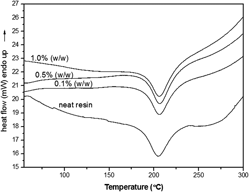
Benzoxazine resin and their nanostructured composites cure kinetic by DSC
-
- Journal:
- Journal of Materials Research / Volume 28 / Issue 22 / 28 November 2013
- Published online by Cambridge University Press:
- 11 November 2013, pp. 3094-3099
- Print publication:
- 28 November 2013
-
- Article
- Export citation
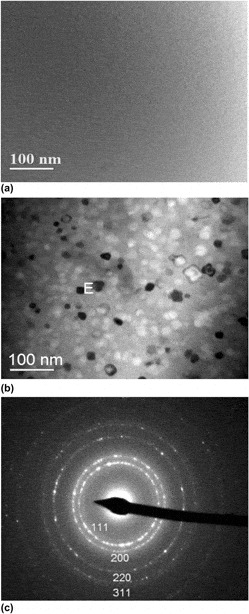
Crystallization and carbonization of an electrical discharge machined Zr-based bulk metallic glass alloy
-
- Journal:
- Journal of Materials Research / Volume 28 / Issue 22 / 28 November 2013
- Published online by Cambridge University Press:
- 11 November 2013, pp. 3177-3184
- Print publication:
- 28 November 2013
-
- Article
- Export citation
Preparation of PVP-coated copper oxide nanosheets as antibacterial and antifungal agents
-
- Journal:
- Journal of Materials Research / Volume 28 / Issue 22 / 28 November 2013
- Published online by Cambridge University Press:
- 11 November 2013, pp. 3109-3118
- Print publication:
- 28 November 2013
-
- Article
- Export citation
Structural phase transition in Zn1.98Mn0.02P2O7: EPR evidence for enhanced line broadening and large zero-field splitting parameter in high temperature phase
-
- Journal:
- Journal of Materials Research / Volume 28 / Issue 22 / 28 November 2013
- Published online by Cambridge University Press:
- 11 November 2013, pp. 3157-3163
- Print publication:
- 28 November 2013
-
- Article
- Export citation
Increased conductivity of polymerized ionic liquids through the use of a nonpolymerizable ionic liquid additive
-
- Journal:
- Journal of Materials Research / Volume 28 / Issue 22 / 28 November 2013
- Published online by Cambridge University Press:
- 08 November 2013, pp. 3086-3093
- Print publication:
- 28 November 2013
-
- Article
- Export citation
First-principles study of metal-induced gap states in metal/oxide interfaces and their relation with the complex band structure
-
- Journal:
- MRS Communications / Volume 3 / Issue 4 / December 2013
- Published online by Cambridge University Press:
- 08 November 2013, pp. 191-197
- Print publication:
- December 2013
-
- Article
- Export citation
Phase behavior of polymer blends with reversiblecrosslinks—A self-consistent field theory study
-
- Journal:
- Journal of Materials Research / Volume 28 / Issue 22 / 28 November 2013
- Published online by Cambridge University Press:
- 08 November 2013, pp. 3079-3085
- Print publication:
- 28 November 2013
-
- Article
- Export citation
-
An extended version of self-consistent field (SCF) theory that was recentlyintroduced by the authors [Li et al., J. Chem. Phys.137, 024906, (2012)] is used to study the phase behavior of apolymer blend with reversible crosslinks. The system consists of symmetricAB diblock copolymers and homopolymers of typeA and B. We consider reversible crosslinksthat can form between the diblock copolymers with a crosslink strengthz and crosslink weights ωA and ωB for monomers of type A and B,respectively. Crosslinks between homopolymers are disabled. We present a phasediagram as a function of the A fraction of homopolymers $\phi _{\rm{\alpha }}^{{\rm{rel}}}$, the crosslink strength z, and the crosslinkasymmetry ∆ω = ωA − ωB. A hexagonal phase is found for suitably large $\phi _{\rm{\alpha }}^{{\rm{rel}}}$, and suitably small z and $\left| {\Delta {\rm{\omega }}} \right|$. Otherwise the system forms a lamellar phase. A deeper insightinto the phase behavior is gained from analyzing the free energy contributionsin the hexagonal and the lamellar phase with the help of the capabilities of theextended SCF theory developed by us.


9 - Heterojunction solar cells based on colloidal quantum dots
-
-
- Book:
- Colloidal Quantum Dot Optoelectronics and Photovoltaics
- Published online:
- 05 November 2013
- Print publication:
- 07 November 2013, pp 233-255
-
- Chapter
- Export citation
8 - Optical gain and lasing in colloidal quantum dots
-
-
- Book:
- Colloidal Quantum Dot Optoelectronics and Photovoltaics
- Published online:
- 05 November 2013
- Print publication:
- 07 November 2013, pp 199-232
-
- Chapter
- Export citation
4 - Charge and energy transfer in polymer/nanocrystal blends
-
-
- Book:
- Colloidal Quantum Dot Optoelectronics and Photovoltaics
- Published online:
- 05 November 2013
- Print publication:
- 07 November 2013, pp 87-111
-
- Chapter
- Export citation
