To save content items to your account,
please confirm that you agree to abide by our usage policies.
If this is the first time you use this feature, you will be asked to authorise Cambridge Core to connect with your account.
Find out more about saving content to .
To save content items to your Kindle, first ensure no-reply@cambridge.org
is added to your Approved Personal Document E-mail List under your Personal Document Settings
on the Manage Your Content and Devices page of your Amazon account. Then enter the ‘name’ part
of your Kindle email address below.
Find out more about saving to your Kindle.
Note you can select to save to either the @free.kindle.com or @kindle.com variations.
‘@free.kindle.com’ emails are free but can only be saved to your device when it is connected to wi-fi.
‘@kindle.com’ emails can be delivered even when you are not connected to wi-fi, but note that service fees apply.
A series of iron-doped lead titanate PbTi(1−x)FexO(3−δ) samples in the x = 0–1 composition range was prepared using sol–gel synthesis at a calcination temperature of 700 °C. The room temperature CuKα powder diffraction data collected from x = 0, 0.005, 0.01, 0.025, 0.05, 0.075, 0.1, 0.125, 0.15, 0.175, 0.2, and 0.3 samples were analyzed using the Rietveld method. Magnetoplumbite (PbFe12O19) secondary phase formation was observed at compositions x = 0.4, 0.5, 0.6, 0.7, 0.8, 0.9, and 1. Fe-composition dependent decrease of tetragonal distortion has been observed. According to Vegard's law, the B-site iron solubility limit in the lead titanate host was found to be approximately 10 mol% (x = 0.1). Homogeneous distribution of dopants below the solubility limit was evidenced by the linear behavior of unit-cell parameters. The absence of a cubic phase and the persistence of distorted oxygen octahedra indicated the existence of ferroelectric properties even at the x = 0.3 composition. Beyond x = 0.3, the P4mm tetragonal model was determined to be invalid possibly because of oxygen defect driven structural changes, mainly tilting Fe-polyhedra.
Aluminum–silicon alloys are an important class of commercial casting materials having wide applications in automotive and aerospace industries. Etching the Al–Si eutectic leads to selective dissolution of Al, resulting in novel morphology – macroporous Si spheres with a three-dimensional nano network. Up to 5% Al is dissolved in Si, leading to an expansion of the crystal lattice. The resulting porous Si is electrochemically active with lithium and thus can be used as a high capacity anode for lithium-ion batteries. The etching of Al–Si provides a simple and low-cost method of producing nano-structured Si materials.
Nanoscale metal–insulator–metal (MIM) diodes consisting of a nanoscale-thickness insulator layer sandwiched between two dissimilar metal layers offer the potential for very high frequency alternating current to direct current signal rectification. Active nanoscale tuning of electronic tunneling through the insulator layer to form point contact diodes has previously been limited to barriers composed of soft organic films due to the force limitations of conductive-atomic force microscopy. In this paper, MIM diodes with oxide-based insulators are formed in situ with sub-nanometer depth precision and characterized using a nanoindenter equipped with electrical testing capabilities. Simultaneous measurement of both electrical and nano-mechanical information is accomplished in an MIM stack of the form Nb/Nb2O5/boron-doped diamond nanoindenter tip. Using this technique, we show that the diode behavior can be electromechanically tuned over a range of more than 1 V at equivalent currents via small changes in indentation depth and the results can be modeled using a Fowler–Nordheim approximation.
Porous Al2O3 ceramics were fabricated using a rapid gelation to fix the foam structure after mechanical foaming. The slurry was made with deionized water, Al2O3 powder, a water-soluble copolymer of isobutylene and maleic anhydride, and a surfactant. The resultant gel formed at room temperature in air. The influence of the surfactant (EMAL TD) content on gelling behavior, pore structure (porosity, cell size), shrinkage behavior, and compressive strength of the resultant porous Al2O3 ceramics was evaluated. Porous Al2O3 ceramics were sintered in only one step without debinding because of the low concentration of additives (≤0.5 wt%). The porous Al2O3 ceramics had porosities from 20 to 89% and cell sizes from 60 to 220 μm. The compressive strength was 75 MPa when the porosity was 60%.
By taking the machine stiffness into the classic Hertzian solution rather than assuming a constant machine stiffness, we developed an approach to simultaneously derive the spherical indenter tip radius and machine stiffness in arbitrary ranges of loads and indenter radii. In contrast, the direct Hertzian fitting method tends to underestimate the radius, especially for larger indenter tips. The success is based on indention tests on two materials with known material stiffness, and the displacement difference under the same load is not affected by the machine stiffness. A total of eight spherical indenter tips with the radii ranging from a few microns to hundreds of microns have been indented on fused silica and single crystal sapphire. Our method gives correct indenter radii for all indenters. The machine stiffness is found to indeed vary with the indentation load and indenter radius. This method has many potential applications in the area of nano-indentation with spherical indenters, such as indentation size effect, modulus and hardness measurement, and micropillar testing.
A new strategy using hyperbranched poly(amidoamine)s to functionalize CdTe quantum dots (QDs) has been described. Hyperbranched poly(amidoamine)s with amine terminals (HP-EDAMA1) were synthesized by one-pot polymerization via the coupled-monomer method and subsequently used to functionalize preformed CdTe QDs. Quite different from previous studies in which the photoluminescence of QDs was quenched by further functionalization with tailored ligands, the quantum yield of CdTe/HP-EDAMA1 nanocomposites was 2 times that of pure CdTe QDs without modification. With this versatile method, the photoluminescence quenching of QDs in the modification process by matrix materials can be effectively solved and new QDs/hyperbranched polymer nanocomposites with potential applications in biomedicine might be offered.
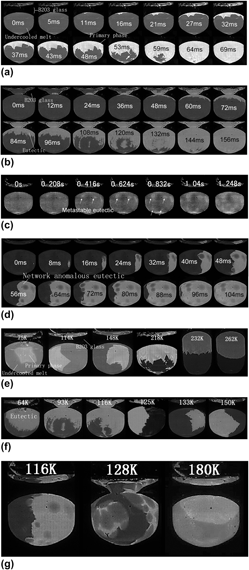
Solidification of undercooled Ni–3.3 wt% B alloy melt was investigated by glass fluxing. If ΔTe < 140 ± 10 K, two recalescences appear, indicating that stable eutectic reaction occurs; if ΔTe ≥ 140 ± 10 K, three recalescences can be observed, indicating that metastable eutectic reaction occurs. Analysis indicates that the phase fractions of the as-solidified structure can be predicted by the recalescence delay times in the cooling curves. High-speed video images show that the solidification interface of primary solidification changes from single dendritic shape to spherical shape with increasing ΔTp; the interface of eutectic solidification changes from many small “dendrites” to a single large one with increasing ΔTe; the interface of residual liquid solidification changes from many small rings to a single large one with increasing ΔTr. The growth velocity of eutectic solidification suggests a coupled growth at small and moderate undercoolings and decoupled growth at large undercooling, whereas that of residual liquid solidification cannot be interpreted by the available models.
In the bending design of prestressed members in general, and of beams in particular, the process below should be followed:
Critical stress state (CSS) criteria must be satisfied at all stages of the life of the beam (i.e. at transfer, during handling, during construction, under service load conditions and after losses have occurred).
If applicable, shear and torsion must be designed for and the CSS design modified if necessary (see Clauses 8.2–8.4 of AS 3600-2009 [the Standard]).
The design must be checked for adequacy under ultimate load conditions (see Clause 8.1 of the Standard).
End-block stresses must be estimated and reinforcement provided (Clause 12.5 of the Standard).
Deflections must be assessed and kept within acceptable limits (see Clause 8.5 of the Standard).
There are other general design requirements that have to be met. including durability (Section 4 of the Standard), fire resistance (Section 5), material properties (Section 3), and other serviceability considerations including crack control (for partially prestressed beams only) and vibration (Clause 9.5). For cracked partially prestressed beams, Equations 4.7(1) and (2) respectively may be used to estimate the average and maximum crack widths.
As discussed in Section 1.2, in addition to strength, durability and fire resistance, serviceability is a design requirement specified in AS 3600-2009 (the Standard). Practical recommendations are given in Clauses 8.5, 8.6 and 8.9 of the Standard, for the treatments of beam deflection, crack control and slenderness limits for beams, respectively. The Standard also touches very briefly on the vibration of beams, stating qualitatively in Clause 8.7 (and in Clause 9.5 for slabs) that ‘vibration of beams shall be considered and appropriate action taken where necessary to ensure that the vibrations induced by machinery, or vehicular or pedestrian traffic, will not adversely affect the serviceability of the structure’.
Although vibration topics are not dealt with in this book, the reader may refer to articles published by Chowdhury and Loo (2001, 2006), and by Salzmann, Fragomeni and Loo (2003) for the damping characteristics of simple and continuous concrete beams.
In this chapter, details are provided on short- and long-term deflection calculations, and on alternative design requirements of maximum span/effective depth ratio, in accordance with the Standard. The analysis of the total deflection of beams under repeated loading is also introduced as an advanced topic. For completeness, crack control of beams is discussed in some detail. All the deflection topics are supplemented by worked out examples. Recommendations for computing effective flange width s have been presented in Section 3.7.2. The reader is referred to the Standard for discussions on slenderness limits and vibrations.
For a traditional building or bridge structure, the vertical forces in the walls, columns and piers are carried to the subsoil through a foundation system. The most common system consists of footings. In soft soil, because the bearing capacity is low, piles are needed to transfer the forces from the superstructure to deeper grounds where stiffer clay, sand layers or bed rock exist. The wall or column forces are each distributed to the piles or group of piles through a footing-like cap – a pile cap.
In civil and structural engineering, slopes often need be to cut to provide level grounds for construction. To ensure stability at and around the cuts or to meet similar requirements, the use of retaining walls for the disturbed soil and backfill is sometimes necessary.
The design of reinforced concrete footings and pile caps is generally governed by shear or transverse shear for wall footings, and transverse or punching shear for column footings and pile caps. Retaining walls behave like a cantilever system, resisting the horizontal pressures exerted by the disturbed soil or backfill (or both) by bending action.
The analysis of the forces acting above and below typical wall footings and their design are presented in Section 11.2. The treatments for footings supporting single and multiple columns are given in Section 11.3 whereas Section 11.4 deals with pile caps. Illustrative and design examples are given to highlight the application of the analysis and design procedures.
The second edition retains all of the features of the original book on the explicit and implicit advice of our peers via the mandatory Cambridge University Press review process. To limit the volume size, the old Appendix C, ‘Development of an integrated package for design of reinforced concrete flat plates on personal computer’, has been removed, being of diminishing practical importance. To enhance the contents, new and important materials are added, some of which were also on the advice of the reviewers:
updated tables and figures to reflect the amendments and addenda to AS3600-2009 promulgated by Standards Australia International since its first publication
additional information on fire design, detailing and cover, long-term deflection, as well as aspects of partially prestressed concrete design; and
an expanded Appendix on strut-and-tie modelling, encompassing the latest publications on the topic plus a numerical example.
Just as significant, another 37 tutorial problems have been added to the various chapters of the book. This makes a total of 108.