To save content items to your account,
please confirm that you agree to abide by our usage policies.
If this is the first time you use this feature, you will be asked to authorise Cambridge Core to connect with your account.
Find out more about saving content to .
To save content items to your Kindle, first ensure no-reply@cambridge.org
is added to your Approved Personal Document E-mail List under your Personal Document Settings
on the Manage Your Content and Devices page of your Amazon account. Then enter the ‘name’ part
of your Kindle email address below.
Find out more about saving to your Kindle.
Note you can select to save to either the @free.kindle.com or @kindle.com variations.
‘@free.kindle.com’ emails are free but can only be saved to your device when it is connected to wi-fi.
‘@kindle.com’ emails can be delivered even when you are not connected to wi-fi, but note that service fees apply.
SnZn(OH)6 (ZHS) with different morphologies were synthesized by a facile self-templated method at room temperature. It was found that the morphology of ZHS could be controlled by varying the concentration of OH−. The crystalline structure and morphology of the particles were characterized by x-ray diffraction, UV-vis diffuse reflectance spectroscopy, scanning electron microscopy images, and N2 adsorption. The results indicated that the particles had almost uniform monoclinic geometry and uniform size. The photocatalytic activity of ZHS with different morphologies was tested through degradation of Rhodamine B (RhB). Therein, the hollow ZHS showed the highest light catalytic performance due to its large BET surface area, wide band gap, and high crystallinity.
Recent advances in multiscale manufacturing enable fabrication of hollow-truss based lattices with dimensional control spanning seven orders of magnitude in length scale (from ∼50 nm to ∼10 cm), thus enabling the exploitation of nano-scale strengthening mechanisms in a macroscale cellular material. This article develops mechanical models for the compressive strength of hollow microlattices and validates them with a selection of experimental measurements on nickel microlattices over a wide relative density range (0.01–10%). The limitations of beam-theory-based analytical approaches for ultralight designs are emphasized, and suitable numerical (finite elements) models are presented. Subsequently, a novel computational platform is utilized to efficiently scan the entire design space and produce maps for optimally strong designs. The results indicate that a strong compressive response can be obtained by stubby lattice designs at relatively high densities (∼10%) or by selectively thickening the nodes at ultra-low densities.
We report the synthesis of a direct gap semiconductor, ZnSnN2, by a plasma-assisted vapor–liquid–solid technique. Powder X-ray diffraction measurements of polycrystalline material yielded lattice parameters in good agreement with predicted values. Photoluminescence efficiency at room temperature was observed to be independent of excitation intensity between 103 and 108 W/cm2. The band gap was measured by photoluminescence excitation spectroscopy to be 1.7 ± 0.1 eV. The range of direct band gaps for the Zn(Si,Ge,Sn)N2 alloys is now predicted to extend from 4.5 to 1.7 eV, opening up this little-studied family of materials to a host of important applications.
Atomic force microscopy (AFM) has proven useful in the investigation of porous surfaces due to its nanoscale spatial resolution, micron scale range, compatibility with nonconducting materials, and even applicability ability to biological systems since it can operate in fluids. Since AFM directly measures the surface by contact, it is particularly suited for quantifying the roughness, and more appropriately for porous and particulate materials, the surface area. In this work, a multi-scale porous material, human molar dentin, was studied with AC mode AFM (both in-air and in-liquid), enabling extensive analyses both for plain dentin as well as specimens exposed to nanoparticle TiO2 containing toothpaste to approximate personal dental hygiene. Finally, high speed AFM is also demonstrated in vitro with equivalent results, except that the time required per image is reduced by several orders of magnitude from tens of minutes to as little as 6 s. Careful implementation of AFM, both at standard and high speeds, is therefore effective for investigating highly porous materials, including biological tissue, in environmentally or physiologically relevant conditions.
Recently, the {10-12} twin variants activated during dynamic plastic deformation (DPD) of Mg alloy have been investigated by analyzing their Schmid factors (SFs), and their contributions to deformation have been calculated. During DPD of Mg–3%Al–1%Zn alloy, different {10-12} variants are generated relative to their SFs when initial grains have defined orientations with one a-axis of the crystal lattice at roughly 0 or 30° from the compression direction. The volume fraction of twins deeply influences the strain accommodated by twinning. The {10-12} variant pair with the maximum SF accommodated about 90% of the twinning strain. Its high volume fraction indicated that both nucleation and growth mechanisms played important roles in the strain accommodation. Other {10-12} variants had a lower volume fraction and accommodated twinning strain mainly by twin nucleation and made a lesser contribution to the total deformation.
Nanocasting into silica templates for preparation of mesoporous materials has up to now been limited to those metal oxides and metals that can withstand the harsh silica etching processes currently used. Two new methods of removing the silica template are reported, either by dissolving the silica in methanolic base or by dissolution in aqueous base under an external potential. The utility of these methods is demonstrated in the synthesis of hierarchically porous zinc oxide, nickel oxide, and copper monoliths that would dissolve or react using other template removal methods. The successful etching of monolithic zinc oxide using methanolic base etching can be explained by the reduced solubility of zinc oxide in methanol compared with an aqueous base, while it also reduces the formation of hydroxides when etching the nickel oxide and copper monoliths. Alternatively, the formation of highly soluble copper oxide/hydroxide can be avoided by holding the copper monolith at a sufficiently negative potential while etching with an aqueous base.
The magnetic anisotropy energy (MAE) of the bulk hcp Co under mechanical deformation is calculated by ab initio density functional theory (DFT) calculations based on the projector augmented wave method. We present a thorough investigation with respect to the choice of exchange-correlation functionals. The generalized gradient approximation (GGA) succeeds in predicting the easy axis of magnetization but underestimates the MAE in comparison to the experimental value, whereas the local density approximation gives a wrong magnetic easy axis. The DFT+U method offers an alternative to increase the MAE value. Unfortunately, as the MAE reaches the experimental value, strong distortions of the lattice parameters are observed. Our results with GGA suggest that a simultaneous reduction of the c/a ratio and increase of the lateral lattice parameter a will strongly enhance the MAE of the material, as observed experimentally. We also found that the MAE in hcp Co is reduced by shear strain.
Ca3Co4O9 and Ca2.8Bi0.2Co4O9 thin films were fabricated on LaAlO3 (LAO) substrate using pulsed laser deposition technique and were studied for their thermoelectric (TE) properties in Stranski–Krastanov mode for the first time. The thin films consisted of 3D clusters/islands on a ∼14-nm thick 2D layer with cluster density being higher for Ca2.8Bi0.2Co4O9 thin films. The clusters also represent areas of dislocation and therefore act as carrier scattering centers, which leads to a temperature-activated type conductivity. Seebeck coefficient as high as 136 and 163 μ V/K was measured for the Ca3Co4O9 and Ca2.8Bi0.2Co4O9 thin films, respectively, which is among the highest reported values for this system. The 3D island formation was also found to be useful in reducing the thermal conductivity of the thin film/substrate system by increased phonon scattering. This work shows that the island formation in thin films can be utilized as a means of enhancing TE properties of a thin film system, however, a detailed work including optimization of the film thickness and cluster/inland density is required.
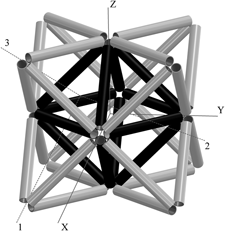
Designing structures that have minimal or zero coefficients of thermal expansion (CTE) are useful in many engineering applications. Zero thermal expansion is achievable with the design of porous materials. The behavior is primarily stretch-dominated, resulting in favorable stiffness. Two and three-dimensional lattices are designed using ribs consisting of straight tubes containing two nested shells of differing materials. Differential Poisson contraction counteracts thermal elongation. Tubular ribs provide superior buckling strength. Zero expansion is achieved using positive expansion isotropic materials provided axial deformation is decoupled by lubrication or segmentation. Anisotropic materials allow more design freedom. Properties of two-dimensional zero expansion lattices, of several designs, are compared with those of triangular and hexagonal honeycomb nonzero expansion lattices in a modulus-density map. A three-dimensional, zero expansion, octet-truss lattice is also analyzed. Analysis of relative density, mechanical stiffness, and Euler buckling strength reveals high stiffness in stretch-dominated lattices and enhanced strength due to tubular ribs.
Type 304L stainless steel (SS) samples were used to investigate the correlation between carbide precipitation and triple junction structure derived from crystallographic data obtained by the orientation imaging microscopy associated with electron backscattered diffraction. The samples were solution treated and annealed at different sensitization temperatures/time to introduce various degrees of carbide precipitation at the interface region, thus different degrees of selectivity toward triple junctions. Four models were used to characterize triple junction microstructures: (i) the I-line and U-line model, (ii) the coincident axial direction (CAD) model, (iii) the coincident site lattice (CSL)/grain boundary (GB) model and (iv) the plane matching (PM)/GB model. Among them, the I-line and U-line model is the most effective in identifying special triple junctions, i.e., those exhibiting the beneficial property of high resistance to carbide precipitation. The results showed that the percentage of special triple junctions (I-lines) immune to carbide precipitation, increased from 35 to 80%, as the precipitation became more selective toward triple junction structures due to the corresponding sensitization heat treatment conditions, whereas more than 80% of random triple junctions (U-lines) exhibited susceptibility to carbide precipitation regardless of the sensitization conditions.
Crystal and X-ray powder diffraction data are presented for the Al3Ho2Si2 ternary compound. The powder pattern was indexed and refined on a monoclinic cell with the Al3Y2Si2 structure type with space group C12/m1, a = 10.1096(2) Å, b = 4.020(6) Å, c = 6.5734(6) Å, β = 100.848(2)°, V = 262.37 Å3, Z = 2ρx = 5.910 g cm−3, F30 = 142.8(0.006, 35), and RIR = 0.91.
Open pore metal foams may be of interest as regenerators because of their large specific surface area and their high porosity. In this experiment, three aluminum foam samples (pore size 2–2.36 mm and around 65% porosity) were manufactured by the replication process. The volumetric heat transfer coefficient and number of transfer units (NTU) of the foams and a packed bed of steel ball bearings (2 mm diameter) were determined using a single-blow transient technique over the range 500 < Rem < 1400. The NTU values of the foams and ball bearings both reduced with increasing Reynolds number (flow velocity). The pressure drop across the matrices increased with the velocity, though the values for the metal foams were much lower than that of the ball bearings, indicating that they may have potential for this type of application.
The 3D morphological evolution of titanium foams as they undergo a two-step fabrication process is quantitatively characterized through x-ray micro- and nano-tomography. In the first process step, a Cu–Ti–Cr–Zr prealloy is immersed in liquid Mg, where Cu is alloyed with Mg while a skeleton of crystalline Ti–Cr–Zr is created. In the second step, the Mg–Cu phase is etched in acid, leaving a Ti–Cr–Zr foam with submicron struts. 3D images of these solidified Ti–Cr–Zr/Mg–Cu composites and leached Ti–Cr–Zr foams are acquired after 5, 10, and 30 min exposure to liquid Mg. As the Mg exposure time increases, the Ti–Cr–Zr ligaments grow in size. The tortuosity loosely follows the Bruggeman relation. The interfacial surface distribution of these Ti-foams is qualitatively similar to other nano-porous metal prepared by one-step dealloying. The characteristic length of the Mg–Cu phase and pores are also reported.
Copper (I) oxide (Cu2O) is a direct band gap semiconductor with p-type conductivity and is a potential candidate for multi-junction solar cells. In this work, incoherent light source based photo-assisted metal-organic chemical vapor deposition (MOCVD) was used to deposit high quality Cu2O thin films on n-type <100> silicon and quartz substrates. X-ray diffraction studies reveal that crystalline Cu2O is deposited. UV-Vis-NIR spectroscopy results indicated a band gap of 2.44 eV for Cu2O thin films. Transmission electron spectroscopy results show that the Cu2O film grows in the form of three-dimensional islands composed of smaller nanocrystalline grains in the range of 10–20 nm. I–V measurements indicate that the Cu2O/n-Si device fabricated using the MOCVD process has a lower dark current density than other devices reported in the literature.
Hyperbranched copper phthalocyanine (CuPc) with uniform spherical morphology has been firstly obtained by ethylene glycol solvothermal synthetic route. The highly dispersed spherical CuPc aggregates with a diameter of ∼500 nm. X-ray diffraction indicated that the molecules were stacked into one-dimensional b-axis aggregate. In addition, the split Soret band together with the broadened and blue-shifted Q-bands in the optical spectra suggested the H (face-to-face) type of interactions in the arrangement of macrocycles in a dense-packed structure. Due to its good symmetrical structure and unique morphology, the hyperbranched spherical CuPc showed excellent broadband microwave absorption behaviors in a frequency of 2–18 GHz. Over an absorber of 5 mm thickness, an absorption bandwidth of 12 GHz corresponding to reflection loss below −10 dB can be obtained. The high value of microwave reflection about −50 dB at the frequency of 16.5 GHz also suggested that the hyperbranched spherical CuPc can be used as promising microwave absorbing materials.
Morphological and crystallographic effects of a high magnetic field on the primary Al6Mn phase formed during the solidification of hypereutectic Al–3.25wt%Mn were investigated. Without the field, the primary Al6Mn crystals are mainly concentrated in the lower part and reveal a dispersed needle-like shape. In three dimension, the needles are in the form of a quadrangular prism (laterally bound by {110} and preferentially growing along <001>). When the magnetic field is applied, they tend to be distributed homogenously and show some extra agglomerate- or chain-like forms (preferentially extending along <100>). Furthermore, they also tend to preferentially orient with <100> parallel to the field direction. The homogenous distribution is caused by the magnetic viscosity resistance force. The “agglomerates” or “chains” are the result of a “bifurcation effect” due to the breakdown at the sharp edges of the quadrangular prisms. The preferential orientation should be attributed to the magnetocrystalline anisotropy of Al6Mn.
Four-layer multiwalled carbon nanotube (MWNT) thin films were deposited via dropcasting (1 mg/mL MWNTs and 10 mg/mL SDBS) onto filter papers that vary in pore size (1, 5, 25, and 40 µm) to determine the effect of the underlying substrate structure on the in-plane properties of the films. The films (<100 nm thick) were dried using vacuum filtration, and drying in a 65 °C heater with and without a ceramic heating board. DC resistance of the films ranged from 6 × 10³ to 9.3 × 10⁹ Ω. Impedance spectroscopy analysis revealed a low and a high frequency inductive response and two parallel R–C circuits for the more conducting thin films. High resistance films were fit by a single RC circuit with a constant-phase element. The differences in the in-plane electrical responses of the different MWNT films can be explained by the degree of carbon nanotube surface coverage, obtained as a result of using different pore size filter papers. The drying method utilized also affected the CNT network formation and its resultant electrical properties.
(Ti,Mn)Al/Al2O3 composites were successfully synthesized by reactive hot pressing from Ti–Al–TiO2–MnO2 system. The effect of Mn coming from the Al–MnO2 reaction on the microstructure and mechanical properties of (Ti,Mn)Al/Al2O3 in situ composites was investigated in detail. The results show that the as-prepared products are mainly composed of (Ti,Mn)Al matrix (including a little of Ti3Al) and Al2O3 particles, together with a few amount of Al77.5Mn22.5 phases. The (Ti,Mn)Al matrix is refined and the in situ generated Al2O3 particles distribute uniformly on the boundaries of (Ti,Mn)Al by incorporation of Mn. The (Ti,Mn)Al/Al2O3 composite with 1.92 wt% Mn possesses the best mechanical properties. Compared with Mn-free samples obtained from Ti–Al–TiO2 system, the hardness, flexural strength, and fracture toughness are enhanced by 53.46%, 76.49%, and 64.21%, respectively. The strengthening and toughening mechanisms were also discussed specifically.