To save content items to your account,
please confirm that you agree to abide by our usage policies.
If this is the first time you use this feature, you will be asked to authorise Cambridge Core to connect with your account.
Find out more about saving content to .
To save content items to your Kindle, first ensure no-reply@cambridge.org
is added to your Approved Personal Document E-mail List under your Personal Document Settings
on the Manage Your Content and Devices page of your Amazon account. Then enter the ‘name’ part
of your Kindle email address below.
Find out more about saving to your Kindle.
Note you can select to save to either the @free.kindle.com or @kindle.com variations.
‘@free.kindle.com’ emails are free but can only be saved to your device when it is connected to wi-fi.
‘@kindle.com’ emails can be delivered even when you are not connected to wi-fi, but note that service fees apply.
This work reports the preparation of iron-doped alumino-phosphate glass using microwave (MW) radiation at 1723 K in comparision with a conventional resistance heating furnace at the same temperature. X-ray diffraction analysis of the sample prepared in an MW furnace has confirmed glass formation which is similar to that of glass prepared in an electric furnace. Glass transition temperatures (Tg) for MW and conventional melted glass samples were observed to be 866 and 873 K, respectively. Higher Fe2+/(Fe3+ + Fe2+) ratio was reported in glass prepared in the MW furnace compared with the conventional furnace. The Fourier transform infrared spectra for both the samples indicate identical nature. It was observed that the maximum power required for melting glass in MW heating was 0.85 kW, which is around 25–30% of the power consumed by the conventional resistance heating furnace. In addition, the time needed to melt the glass in the MW furnace was found to be 3–4-fold lesser than the time required in the resistance heating furnace.
We present a comparative ab initio study of surface diffusion of Li and Na on planar and curved graphene. The barrier for diffusion is ~0.1 eV lower for Na than for Li, and is changed significantly by curvature. The maximum change is similar for Li for Na, of the order of ±0.1 eV on the convex and concave sides. The difference in barrier for metal atoms adsorbed on the concave and convex sides can reach 0.2 eV. This modulation of the diffusion barrier by curvature is therefore expected to affect significantly the rate capability of graphene-based anodes.
We employed ab initio global structural prediction algorithms to obtain the ground-state structure of CuBO2 This is a very promising p-type transparent conductive oxide that was synthesized recently, and thought to belong to the delafossite family. We proved that the true ground state is certainly not the delafossite structure, and that the most promising candidate is a low symmetry monoclinic phase. This is still a layered structure, but with boron and copper having a different coordination with respect to the delafossite phase.
We demonstrate that alternating the oxygen partial pressure gradient across a yttria-stabilized zirconia (YSZ) electrolyte membrane prior to solid oxide fuel cell (SOFC) testing with nanoporous Pt electrodes greatly increases (e.g. by >70-fold at 350 °C) peak power density compared with devices without pretreatment. Transiently altering the oxygen activity at the cathode–YSZ interface appears to change the wetting characteristics of the nanoporous Pt, significantly affecting the stability and low-temperature performance of the SOFCs. Image analysis and impedance spectroscopy results suggest that an increase in triple-phase boundary area fraction at the cathode–YSZ interface contributes to the observed effect.
Microcellular foams, with cells of the order 10 μm, have been studied for over two decades. But little research has been done to study the effect of molecular weight on solid-state microcellular foaming. In this study, polyethylene terephthalate (PET) with a range of intrinsic viscosity (IV) 0.68–0.81 dL/g was used to investigate the effect of molecular weight on microcellular foaming process and resulting foam microstructures and properties. In the saturation step, IV showed negligible effect on sorption and desorption of CO2 in PET for all the conditions explored. In the foaming step, we found relative density increased with increasing IV. Also, as IV increased, cell size decreased and cell nucleation density increased. We hypothesize that lower chain mobility in higher IV samples led to more localized cell nucleation, resulting in a higher nucleation density, and also more constraints for cell growth, resulting in a smaller cell size. In addition, higher IV foams were found to have smaller skin thicknesses.
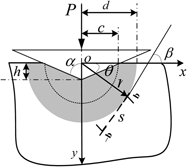
An experimental study on the indentation hardness of NiTi shape memory alloys (SMAs) by using a spherical indenter tip and a finite element investigation to understand the experimental results are presented in this paper. It is shown that the spherical indentation hardness of NiTi SMAs increases with the indentation depth. The finding is contrary to the recent study on the hardness of NiTi SMAs using a sharp Berkovich indenter tip, where the interfacial energy plays a dominant role at small indentation depths. Our numerical investigation indicates that the influence of the interfacial energy is not significant on the spherical indentation hardness of SMAs. Furthermore, the depth dependency of SMA hardness under a spherical indenter is explained by the elastic spherical contact theory incorporating the deformation effect of phase transformation of SMAs. Hertz theory for purely elastic contact shows that the spherical hardness increases with the square root of the indentation depth. The phase transformation beneath the spherical tip weakens the depth effect of a purely elastic spherical hardness. This study enriches our knowledge on the basic concept of hardness for SMAs under spherical indentation at micro- and nanoscales.
In this study, a powder blend representing 6061 Al-alloy was first mixed with Al2O3 ceramic particles and then foamed by using the powder compact melting method. 6061-Al2O3 foams and control specimens 6061 foams (without ceramic reinforcement) were produced. The effects of both different ratios of Al2O3 particle addition and different kinds of heat treatment on hardenability, structure and mechanical behavior of the final foams were investigated. Foams that were fully heat treated had the highest hardness values, and they performed best with an increase in collapse strength up to 100% over the untreated samples. Improved cell structure and decreased drainage were obtained when the Al2O3 addition was not more than 5 vol%. The compression test results were interpreted in terms of the foam’s microstructure, and correlations were made relating to the unloading modulus and compression strength of the foams to the relative density.
Solid-state microcellular foaming (SSMF) process was used to produce porous chemical mechanical polishing (CMP) pads in a variety of pore size and porosity range, using a variety of thermoplastic polyurethane (TPU) resin hardness. By controlling the pore size, porosity, and pad hardness, one is able to manufacture CMP pads that offer tunable pad properties. A brief introduction to the SSMF manufacturing process and thereby, unique microstructures created is first addressed followed by inner layer dielectric (ILD) CMP results, describing the effects of top TPU foam sheet properties, such as hardness, pore size, and porosity on ILD removal rate (RR) and wafer defects. Softer TPU-based porous pads showed significantly lower wafer scratch counts, while only a moderate increase in the ILD RR was seen with increasing resin hardness for similar pore size and porosity pads. Pore size has insignificant influence on wafer defect count but has significant influence on the ILD RR profile. CMP pads made from small pore size foams cause a nonflat RR profile.
Metal matrix syntactic foams are promising materials with high energy absorption capability. To study the effects of matrix strength on the quasistatic compressive properties of syntactic foams using SiC hollow particles as reinforcement, matrices of Al-A206 and Mg-AZ91 were used. Because Al-A206 is a heat-treatable alloy, matrix strength can be varied by heat treatment conditions, and foams in as-cast, T4, and T7 conditions were tested in this study. It is shown that the peak strength, plateau strength, and toughness of the foams increase with increasing yield strength of the matrix and that these foams show better performance than other foams on a specific property basis. High strain rate testing of the Mg-AZ91/SiC syntactic foams showed that there was little strain rate dependence of the peak stress under strain rates ranging from 10−3/s to 726/s.
Zeolite-based supports for inorganic membranes intended for gas separation have the potential to increase the resistance to thermal shock-induced cracking compared with ceramic or metallic substrates. We have studied the effect of exposure at 90 °C of hierarchically porous silicalite-I substrates to aqueous solutions at pH 2.0, 10.6, and 13.0 for periods up to 168 h. Silicalite-I supports were produced in binder-free form by pulsed current processing and using clay-binders by conventional thermal treatment. Long-term (168 h) acid and alkali treatment of the silicalite-I substrates results in a slight removal of silicon (in acid) and aluminum (in alkali) and does not affect the specific surface area and the crystalline microporous structural features but broadens the size distribution of the macropores. The mechanical strength remains unchanged after exposure to both alkaline and acidic solutions and the binder-free substrates display more than 20 times higher strength than the binder-containing materials.
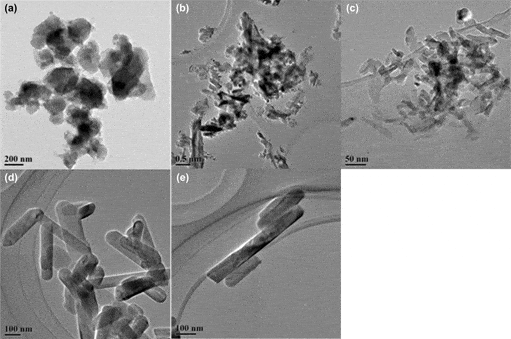
Molybdenum trioxide nanostructures were synthesized, to make highly friction resistant molybdenum disulfide, by low temperature hydrothermal reaction without using any template or catalyst. The as-synthesized materials were sulfided with H2S at 400 and 800 °C. X-ray diffraction, scanning electron microscopy, transmission electron microscopy, Fourier-transform infra-red spectroscopy, and thermogravimetric analysis were used for the physical characterization of the materials. The oxide material is highly crystalline with unique morphology. The factors affecting the size and shape of the synthesized materials were studied in detail. The crystalline nature of the materials decreased after the sulfidation process at 800 °C without any change in morphology. The wear resistance and lubricity of the material were studied under harsh conditions. The comparative study of these materials with MoS2 prepared by the hard templating method (using mesoporous silica template) reveals that the new material synthesized by direct hydrothermal route is pure phase and has better wear resistance and antifriction properties. Ultra high stability of the material is the most distinguished property of the material synthesized.
A facile inexpensive route has been developed to prepare ZnO hierarchical materials with microplate/nanohole structures based on the colloidal monolayer template by the precursor thermal decomposition. These hierarchical structured materials demonstrated an excellent superhydrophobicity with self-cleaning effect and an enhanced photocatalytic performance to organic molecules, which are attributed to big roughness and large surface area of such special hierarchical structures. The formation mechanism of such hierarchical structures was investigated in detail by tracing morphology changing at different precursor concentrations. At high precursor concentration, both incompletely restricted ZnO growth of colloidal templates and preferable growth of microplates take place at the same time, and hence, ZnO hierarchical materials with microplate/nanohole structures are formed. With increasing precursor concentration, the number density of ZnO microplates tends to be larger. The large number density of ZnO microplates and holes on the microplates render the sample a large surface area and surface roughness, leading to good superhydrophobicity and photocatalytic activity. Such hierarchical ZnO micro/nanostructured materials have important applications in environmental science, microfluidic devices, etc.
The development of porous metals has led to the need for an accurate prediction of the physical and mechanical properties of the many possible fabricated structures. For applications where yield stress needs to be reduced, while maintaining a high conductivity, the optimization of the pore dimensions, volume fraction, and pore spacing is required. A finite element model has been developed to simulate the effects of these factors on the electromechanical behavior of porous copper. This model was validated against samples of copper with mechanically induced pores as well as a copper GASAR sample. Good agreement (within an error of ±3%) was shown between the model and experimental data for the resistivity and effective modulus for both the mechanically induced pore and the GASAR samples, although the low ductility of the samples was not predicted and restricts the application of the simulation.
Incorporation of porosity into a monolithic material decreases the effective thermal conductivity. Porous ceramics were prepared by different methods to achieve pore volume fractions from 4 to 95%. A toolbox of analytical relations is proposed to describe the effective thermal conductivity as a function of solid phase thermal conductivity, pore thermal conductivity, and pore volume fraction (νp). For νp < 0.65, the Maxwell–Eucken relation for closed porosity and Landauer relation for open porosity give good agreement to experimental data on tin oxide, alumina, and zirconia ceramics. For νp > 0.65, the thermal conductivity of kaolin-based foams and calcium aluminate foams was well described by the Hashin Shtrikman upper bound and Russell’s relation. Finally, numerical simulation on artificially generated microstructures yields accurate predictions of thermal conductivity when fine detail of the spatial distribution of the phases needs to be accounted for, as demonstrated with a bio-aggregate material.