To save content items to your account,
please confirm that you agree to abide by our usage policies.
If this is the first time you use this feature, you will be asked to authorise Cambridge Core to connect with your account.
Find out more about saving content to .
To save content items to your Kindle, first ensure no-reply@cambridge.org
is added to your Approved Personal Document E-mail List under your Personal Document Settings
on the Manage Your Content and Devices page of your Amazon account. Then enter the ‘name’ part
of your Kindle email address below.
Find out more about saving to your Kindle.
Note you can select to save to either the @free.kindle.com or @kindle.com variations.
‘@free.kindle.com’ emails are free but can only be saved to your device when it is connected to wi-fi.
‘@kindle.com’ emails can be delivered even when you are not connected to wi-fi, but note that service fees apply.
We have studied the magnetoresistance (MR) of hydrogen plasma-treated pure ZnO wires of tens of micrometer diameter at different temperatures. A negative MR of 1% at 8 T applied field is measured for all wires at 4 K, independent of the temperature (300 K … 773 K) used during the hydrogen treatment. However, a positive MR develops, the higher the treatment temperature. The MR can be explained with a semiempirical model taking into account local magnetic moments and the s–d exchange interaction. These results together with field anisotropy in the MR indicate the appearance of magnetic order due to the hydrogen treatment in agreement with recently published reports on the influence of hydrogen in bulk ZnO single crystals. Hydrogen doping may provide a way to trigger defect-induced magnetism in small oxide structures.
Electrical fields can be used to heat selectively dislocations and grain boundaries to a much higher temperature compared with the bulk. This selective joule heating, if uncontrolled by limiting the current flow, can lead to melting of grain boundaries and sintering of poly- and nanocrystalline materials close to the theoretical density in a much shorter time due to fast diffusivities of the order of 10−4 to 10−5 cm2/s in the liquid. I refer to this sintering mode as selective-melt sintering, which can occur at lower overall temperatures with much lower energy consumption compared with conventional sintering involving solid-state diffusion.
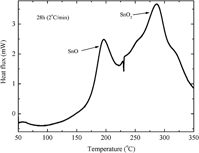
The effects of stearic acid on the high-energy ball milling of tin powder have been investigated. The mean crystallite sizes, microstrain, and phase transformations were examined using different techniques like x-ray diffraction (XRD), Rietveld refinement method, and differential scanning calorimetry (DSC). After 28 h of milling, the Rietveld analysis showed the stabilization of Sn mean crystallite sizes at around 50 nm. Due to the presence of oxygen in stearic acid, the milling process gradually produced an amorphous Sn oxide phase. The DSC thermogram of the sample milled for 28 h showed two exothermic peaks separated by an endothermic peak. Based on the DSC measurements, two samples were annealed at 240 and 350 °C for 20 min. The annealing at 240 °C confirmed the presence of an amorphous phase which crystallized in nanostructured tetragonal SnO phase. The annealing at 350 °C revealed the nucleation of nanostructured tetragonal SnO2 phase.
Hyperbranched polyurethane/Fe3O4 nanoparticles decorated multiwalled carbon nanotube (Fe3O4-MWCNT) nanocomposites were prepared by the in situ polymerization technique. The presence of Fe3O4 nanoparticles on the surface of the MWCNTs was confirmed by x-ray diffraction and transmission electron microscopic studies. The saturation magnetization value of Fe3O4-MWCNT was 0.23 emu/g. The glycidyl ether of bisphenol-A epoxy cured thermosetting nanocomposites exhibited enhanced tensile strength (6.4–38.5 MPa), scratch hardness (3.0–8.5 kg), and thermal stability (241–292 °C) with the increase of loading of Fe3O4-MWCNT (0–2 wt%). The nanocomposites possess good shape fixity over the repeated cycles of test. The nanocomposites also showed good shape recovery under the application of microwave irradiation. The shape recovery speed was found to be increased with the increase of the content of Fe3O4-MWCNT. Thus, the studied thermosetting nanocomposites have potential to be used as noncontact shape memory materials.
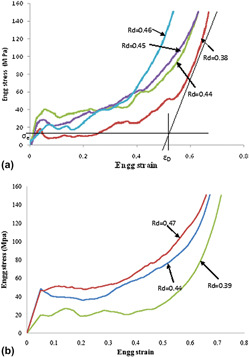
LM13 Al-alloy—cenosphere hybrid foam (HF) was made by foaming LM13 alloy–cenosphere mixture through a stir casting technique using CaCO3 as a foaming agent. In the melt mixture, 35 vol% of cenosphere was used and the foaming temperature was varied (660 and 690 °C). The foam contains microporosities as well as macroporosities and hence these are referred as HFs. The age-hardening characteristics and thereof deformation behavior of these foams have been examined using both microhardness and plateau stress measurements. It is further noted that energy absorption and plateau stress are maximum, and densification strain is minimum under peak-aged condition irrespective of the density of HF. Empirical relations are proposed to predict plateau stress, densification strain, and energy absorption as a function of aging time and relative density.
Natural fiber composites are becoming more attractive for applications as energy absorbers in the automotive industry despite their high moisture absorption characteristics. The main objective of this paper is to study the impact strength and moisture absorption properties of long fiber and short fiber hybrid composites using a kenaf/polyethylene terephthalate fiber reinforced in the polyoxymethylene matrix. The results obtained from the impact test gave 10.8 J/cm for the longer fiber hybrid composites, which is higher compared to 8.0 J/cm obtained for the short fiber hybrid composites due to less fiber pullout from the matrix. A moisture content of 0.92% and percentage water absorption of 6.77% were obtained for the long fiber composite due to poor interfacial adhesion between the fiber and the matrix. A high void content of 0.52% and porosity of 1.21% also accounted for high water and moisture absorption of the long fiber hybrid composite.
Solid oxide fuel cells (SOFCs) offer an efficient energy conversion technology for alleviating current energy problems. High temperature proton-conducting (HTPC) oxides are promising electrolytes for this technology, since their activation energy is lower than that of conventional oxygen-ion conductors, enabling the operating temperature reduction at 600 °C. Among HTPC oxides, doped BaZrO3 materials possess high chemical stability, needed for practical applications. Though, poor sinterability and the resulting large volume of highly resistive grain boundaries hindered their deployment for many years. Nonetheless, the recently demonstrated high proton conductivity of the bulk revived the attention on doped BaZrO3, stimulating research on solving the sintering issues. The proper selection of dopants and sintering aids was demonstrated to be successful for improving the BaZrO3 electrolyte sinterability. We here briefly review the synthesis strategies proposed for preparing BaZrO3-based nanostructured powders for electrolyte and electrodes, with the aim to improve the SOFC performance.
The structure of ultrathin amorphous carbon (a-C) films synthesized by filtered cathodic vacuum arc (FCVA) deposition was investigated by high-resolution transmission electron microscopy, electron energy loss spectroscopy, and x-ray photoelectron spectroscopy. Results of the plasmon excitation energy shift and through-thickness elemental concentration show a multilayered a-C film structure comprising an interface layer consisting of C, Si, and, possibly, SiC, a buffer layer with continuously increasing sp3 fraction, a relatively thicker layer (bulk film) of constant sp3 content, and an ultrathin surface layer rich in sp2 hybridization. A detailed study of the C K-edge spectrum indicates that the buffer layer between the interface layer and the bulk film is due to the partial backscattering of C+ ions interacting with the heavy atoms of the silicon substrate. The results of this study provide insight into the minimum thickness of a-C films deposited by FCVA under optimum substrate bias conditions.
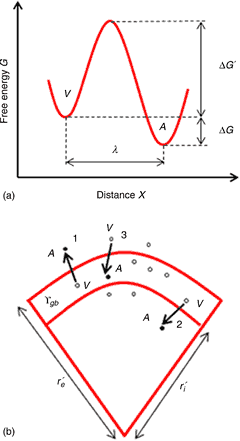
Grain boundary segregation provides a method for stabilization of nanocrystalline metals—an alloying element that will segregate to the boundaries can lower the grain boundary energy, attenuating the driving force for grain growth. The segregation strength relative to the mixing enthalpy of a binary system determines the propensity for segregation stabilization. This relationship has been codified for the design space of positive enthalpy alloys; unfortunately, quantitative values for the grain boundary segregation enthalpy exist in only very few material systems, hampering the prospect of nanocrystalline alloy design. Here we present a Miedema-type model for estimation of grain boundary segregation enthalpy, with which potential nanocrystalline phase-forming alloys can be rapidly screened. Calculations of the necessary enthalpies are made for ∼2500 alloys and used to make predictions about nanocrystalline stability.
Metal oxide optoelectronics is an emerging field that exploits the intriguing properties of the ns orbital-derived isotropic band structure as a replacement for traditional silicon-based electronics in advanced active-matrix information displays. Although the device performance of metal oxide thin film transistors (TFTs) has been substantially improved, the device reliability against external light and gate bias stress remains a critical issue. This paper provides a literature review of light-induced gate bias stress instability in metal oxide TFTs and explain the importance of photo-bias instability in the applications of metal oxide TFTs to optoelectronic device. The rationale of threshold voltage (Vth) instability under the negative bias illumination stress (NBIS) condition is discussed in detail. The charge trapping/injection model, oxygen vacancy photoionization model, and ambient interaction model are described as plausible degradation mechanisms. Finally, the possible approaches to prevent NBIS-induced Vth instability are proposed based on an understanding of the NBIS instability.
A novel surface enhanced Raman scattering (SERS) substrate was produced by combining Ag nanoparticles (AgNPs) and carbon nanocoils (CNCs). Three different methods were developed for loading AgNPs on CNCs, which include (i) direct deposition of AgNPs on CNCs by radio-frequency magnetron sputtering (RFMS) to form an Ag–CNC hybrid, (ii) deposition of a TiO2 film on CNCs by RFMS, followed by photoinduced growth of AgNPs to form an Ag–TiO2–CNC hybrid (called A-substrate), and (iii) deposition of a TiO2 film on CNCs by spin coating and then photoinduced growth of AgNPs to form an Ag–TiO2–CNC hybrid (called B-substrate). Experimental SERS results showed that B-substrates exhibited the highest SERS enhancement with an enhancement factor of over 107 for rhodamine 6G. The as-prepared Ag–TiO2–CNC substrates also showed much higher Raman signal enhancement than ordinary planar SERS substrates in our system. This was mainly due to the unique three-dimensional structure where the large surface area was available for loading more densely packed AgNPs which contribute to abundant Raman hot spots.
Reinforced and Prestressed Concrete remains the most comprehensive text for engineering students and instructors as well as practising engineers. This second edition has been updated to reflect recent amendments to the Australian Standard for Concrete Structures AS3600-2009. The content is presented in a clear, easy-to-follow manner and this edition features even more illustrative and design examples to aid comprehension of complex concepts. Part I addresses the analysis and design of reinforced concrete structures; Part II covers topics on prestressed concrete. Additional technical and practical information is set out in four appendices. Each chapter includes a set of problems that consolidates what students have learnt. Worked solutions to the problems are available to instructors on the companion website at www.cambridge.edu.au/academic. Thorough in its treatment, with many practical formulas, diagrams and tables, this book is an indispensable resource for students and engineers in their continuing learning and professional education.
Light emitted by molecules embedded within metal nanoparticle clusters is strongly enhanced by interaction with surface plasmons. This allows, for example, the observation of Raman scattering from individual molecules. The symmetry of the metal cluster may affect the Raman-scattered light by generating new polarization states. This article reviews the use of symmetry theory to analyze the plasmonic normal modes of metal nanoparticle trimers. The lowest bright energy modes are degenerate for an equilateral triangle but split when the symmetry is broken. When a single molecule in the gap between two of the particles emits, it excites the plasmon modes, typically off-resonance, and the ensuing interference between the modes rotates the polarization of the emitted light. This so-called Raman optical activity can generate circularly polarized light at the Raman frequency. This curious phenomenon, which was demonstrated experimentally, may prove useful for future plasmonic devices.
Discovered by Richard Van Duyne in 1976, surface-enhanced Raman spectroscopy (SERS) has enjoyed a continual expansion in interest over the past 36 years benefitting from a series of discoveries, new fields, and technological capabilities, all of which have greatly contributed to the current broad interest in this topic. The focus on nanoscience and nanotechnology that began in the early 1990s naturally put a spotlight on SERS as a quintessentially nanoscale phenomenon. This article discusses some of the key field-shaping developments in SERS from a historical and a materials perspective, providing background for the articles in this issue of MRS Bulletin.