To save content items to your account,
please confirm that you agree to abide by our usage policies.
If this is the first time you use this feature, you will be asked to authorise Cambridge Core to connect with your account.
Find out more about saving content to .
To save content items to your Kindle, first ensure no-reply@cambridge.org
is added to your Approved Personal Document E-mail List under your Personal Document Settings
on the Manage Your Content and Devices page of your Amazon account. Then enter the ‘name’ part
of your Kindle email address below.
Find out more about saving to your Kindle.
Note you can select to save to either the @free.kindle.com or @kindle.com variations.
‘@free.kindle.com’ emails are free but can only be saved to your device when it is connected to wi-fi.
‘@kindle.com’ emails can be delivered even when you are not connected to wi-fi, but note that service fees apply.
A quasicrystal (QC)- based alloy composite was made by copper mold casting under a low-vacuum level condition at the bulk metallic glass (BMG)- forming composition (Zr65Cu15Al10Ni10)90Nb10. The QC alloy consisted of a majority of icosahedral quasicrystal phase and a small amount Zr-rich glassy phase. Under uniaxial compression at room temperature, the BMG alloy exhibits a certain plastic strain; the QC alloy is much stronger but brittle. The icosahedral glass model was used to describe the I-phase structure. The structure–property relations of the BMG and QC alloys are discussed assuming the common preferential icosahedral atomic structure in both cases and the existence of local glue structure in the BMG structure.
A simple and modified solvothermal method using oxalate precursor, used to synthesize Cd1−xNixO (x = 0.047, 0.102, and 0.163) nanoparticles and their phase structure, morphology, optical and magnetic properties, have been investigated. X-ray diffraction studies revealed that as-prepared Ni-doped CdO solid solutions are highly crystalline and stabilized in a monophasic cubic CdO structure. X-ray diffraction and ICP-MS studies confirmed the incorporation of Ni2+ in a CdO matrix. The average grain size was found to be 30, 15, and 11 nm, respectively, using transmission electron microscopic studies. High surface area in the range of 118–143 m2/g has been achieved for these solid solutions using the multipoint BET method, which increases on increasing Ni concentration in Cd lattice site. The optical band gap of these solid solutions shows red shift to the undoped CdO. Ni-doped CdO nanoparticles exhibit co-existence of paramagnetism and ferromagnetism.
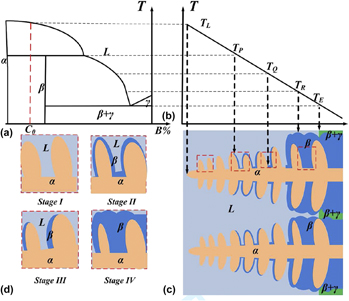
Sn–40 at.% Mn peritectic alloys were directionally solidified at different growth rates (1–100 μm/s) under a steep temperature gradient (40 K/mm). The migration of secondary dendrite arm was observed in this peritectic alloy in which both the primary phase and the peritectic phase are intermetallic compounds with nil solubility. This migration is caused by coupling remelting/solidification at the hot/cold sides of the liquid pool between two adjacent secondary dendrite arms by temperature gradient zone melting. Its novel feature is that the remelting temperature of primary phase is a little higher than the solidification temperature of peritectic phase. Analytical solutions based on the assumption that the solubility of both primary and peritectic phases are nil have been proposed to describe this migration. It has also been found that the migration of secondary dendrite arm is most obvious at intermediate growth rates under steep temperature gradient in the directionally solidified Sn–40 at.% Mn peritectic alloy.
Self-assembled nanostructures often exhibit unique properties that are distinct from those of bulk materials. During the past decade, significant progress has been made in the assembly of nanorods and understanding some of the self-directing assembly mechanisms, particularly related to gold nanorods. Nonetheless, methods that can be scaled up to large areas for device-scale applications are yet to be established. This review describes various routes that are being actively pursued to achieve assembly of nanorods. Self-assembly methods that utilize external forces such as electric field or gravitational forces are reviewed. Additionally, self-assembly schemes using chemical and biomolecule linkers are presented. Other important routes, such as template assisted assembly, Langmuir-Blodgett, and nanorod assembly methods carried out in solution phase are also discussed. The latter includes recently reported approaches to produce superstructured particles through self-assembly. Solvent evaporation and drying can also strongly contribute to the assembly of nanostructures. The final section presents self-assembly routes that primarily exploit the drying kinetics of solvents.
Zinc oxide (ZnO)–single-walled carbon nanotubes (SWCNTs) nanocomposite thin films have been grown by chemical bath deposition method. The changes in structural and chemical properties were studied by means of x-ray diffraction, field-emission scanning electron microscopy (FESEM), transmission electron microscopy (TEM) and Fourier transform infrared spectroscopy (FTIR). The average crystallite size of ZnO doped with 0.1 and 0.5 wt% SWCNTs was measured about 14.69 and 17.76 nm, respectively. Texture coefficient of the carbon peak (002) was investigated as more than 3.2995 for ZnO mixed with 0.5 wt% SWCNTs. SEM images revealed the ZnO and SWCNTs entangled between the particles. TEM images estimated the inner and outer diameters of SWCNTs to be about 4.86 and 11.32 nm, respectively. FTIR analysis proved the formation of Zn–O and C bonding in the thin films. The performance of the dye-sensitized solar cells (DSSCs) was found to depend on the loading of SWCNTs. The power conversion efficiency increased from 0.078 to 0.684% after loading with 0.1 wt% SWCNTs. Higher amount of SWCNTs (0.5 wt%) was determined as ineffective in improving the performance of ZnO-based DSSCs.
In this study, we are reporting the time- and temperature-dependence of the electrical resistivity and temperature-dependence of the Hall voltage in neodymium nickelate thin films. The films were deposited on a lanthanum aluminate substrate [LaAlO3 (001)] by a pulsed laser deposition technique, with thicknesses ranging from 0.6 to 120 nm. Time-dependent electrical transport measurements indicated the formation of a kinetically stable metallic glassy phase rather than a stable insulating phase on cooling below the transition temperature, TM-I. Comparisons of the low-temperature behavior with that of common insulators further supported this claim. Hall effect measurements on the 1.2-nm sample showed a local maximum in the carrier concentration just below the TM-I on both the heating and cooling cycles. This again confirmed the proposed low-temperature structure, in that, for the 1.2-nm sample, there was a minimal degree of supercooling before transitioning to a kinetically stable glassy phase.
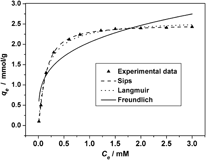
In the present study, aminofunctionalized mesoporous silica (AFMS) was synthesized using the anionic surfactant N-lauroylsarcosine sodium as template and 3-aminopropyltrimethoxysilane as costructure directing agent. The synthesized mesoporous silica was characterized by the Fourier transform infrared spectra, x-ray diffraction, N2 adsorption-desorption, scanning electron microscopy, and transmission electron microscopy techniques. The application for the removal of Ni2+ from aqueous solution using the synthesized mesoporous silica as adsorbent was investigated. It was found that the solution pH affected adsorption of Ni2+ greatly. The kinetic data of adsorption showed that the removal rate of Ni2+ was substantially high. The adsorption isotherms were fitted using the Sips, Langmuir, and Freundlich models, respectively, and the results showed that the Sips model was the best one to describe the experimental data. From the data of Sips, the maximum adsorption capacity of Ni2+ in respect of the extracted sample is 2.48 mmol/g, much higher than those reported in other literature. The possible adsorption mechanism of Ni2+ on the AFMS was proposed.
We examine the development of stable bimetal interfaces in nanolayered composites in severe plastic deformation. Copper-niobium multilayers of varying layer thicknesses from several micrometers to 10 nanometers (nm) were fabricated via accumulative roll bonding (ARB). Investigation of their 5-parameter character and atomic scale structure finds that when layer thicknesses refine well below one micrometer, the interfaces self-organize to a few interface orientation relationships. With atomic scale and crystal plasticity modeling, we identify that the two controlling factors that determine whether an interface is stable under high strain rolling are orientation stability of the bicrystal and interface formation energy. A figure-of-merit is introduced that not only predicts the development of the prevailing interfaces but also explains why other interfaces did not develop. Through a suite of nanomechanical and bulk test results, we show that ARB composites containing these stable interfaces are found to have exceptional hardness (∼4.5 GPa) and strength (∼2 GPa).
The organic light-emitting (OLE) materials have attracted great interest due to their potential applications in sensors, biodetectors and OLE devices. However, highly efficient emission from organic solids is still a great challenge because of the aggregation-caused quenching effect. In this article, a three-dimensional (3D) organic-inorganic hybrid nanoparticle, based on polyhedral oligomeric silsesquioxane (POSS), was precisely fabricated via click chemistry with high yield, and its structure was characterized by Fourier transform infrared spectroscopy, 1H, and 29Si nuclear magnetic resonance spectroscopies, and Matrix-Assisted Laser Desorption Ionization Time-of-Flight Mass Spectrometry, respectively. The resultant 3D organic-inorganic nanohybrid showed significantly enhanced emission in solid film (Φfilm 80%) with a slight red-shift as compared with its organic counterpart, (Φfilm 14%), which exhibits a large red-shift in solid film, due to the deaggregation effect of POSS. Simultaneously, the resultant nanohybrid also exhibited good film formability, excellent spectrum and thermal stability (>250 °C) due to the introduction of POSS.
This complete, yet concise, guide introduces you to the rapidly developing field of high throughput screening of biomaterials: materiomics. Bringing together the key concepts and methodologies used to determine biomaterial properties, you will understand the adaptation and application of materomics in areas such as rapid prototyping, lithography and combinatorial chemistry. Each chapter is written by internationally renowned experts, and includes tutorial paragraphs on topics such as biomaterial-banking, imaging, assay development, translational aspects, and informatics. Case studies of state-of-the-art experiments provide illustrative examples, whilst lists of key publications allow you to easily read up on the most relevant background material. Whether you are a professional scientist in industry, a student or a researcher, this book is not to be missed if you are interested in the latest developments in biomaterials research.
The microstructure evolution and mechanical responses are investigated in uniaxial tensile test performed on AZ31 magnesium alloy sheets processed by the flat extrusion container. A novel emphasis based on the texture was used to estimate the relative magnitude of hardening effects related to the deformation twinning. The anisotropic behavior of the sheets is sensitive to the orientation of the crystals with respect to the loading direction. This is ascribed to the effect of the initial texture and the activation of their relative critical resolved shear stresses on slip and twinning. The increased accumulated hardening increases the twin nucleation stress. The deformation twinning significantly induces an asymmetry in the yield behavior. Moreover, it remarkably prolongs the slope of the stage II in the working hardening curve. An accepted notion is proposed that the preferential activity of deformation twinning exerts a significant effect on mechanical anisotropy during tension.
The fast dissolution of certain calcium-containing compounds makes them attractive carriers for trace minerals in nutritional applications, e.g., iron and zinc to alleviate mineral deficiencies in affected people. Here, CaO-based nanostructured mixed oxides containing nutritionally relevant amounts of Fe, Zn, Cu, and Mn were produced by one-step flame spray pyrolysis. The compounds were characterized by nitrogen adsorption, x-ray diffraction, (scanning) transmission electron microscopy, and thermogravimetric analysis. Dissolution in dilute acid (i.d.a.) was measured as an indicator of their in vivo bioavailability. High contents of calcium resulted in matrix encapsulation of iron and zinc preventing formation of poorly soluble oxides. For 3.6 ≤ Ca:Fe ≤ 10.8, Ca2Fe2O5 coexisted with CaO. For Ca/Zn compounds, no mixed oxides were obtained, indicating that the Ca/Zn composition can be tuned without affecting their solubility i.d.a. Aging under ambient conditions up to 225 days transformed CaO to CaCO3 without affecting iron solubility i.d.a. Furthermore, Cu and Mn could be readily incorporated in the nanostructured CaO matrix. All such compounds dissolved rapidly and completely i.d.a., suggesting good in vivo bioavailability.
Lattice volume expansion or amorphization renders EuTiO3 ferromagnetic, although the stable phase of crystalline EuTiO3 is an antiferromagnet. The lattice volume expansion is induced into the crystalline EuTiO3 thin film by utilizing the lattice mismatch between the thin film and a substrate. The magnetization at low temperatures monotonically increases with an increase in lattice volume for the crystalline EuTiO3 thin film, coincident with the results of calculations based on the hybrid Hartree–Fock density functional approach. The ferromagnetic interaction between Eu2+ ions is enhanced by the amorphization as well; the amorphous EuTiO3 thin film becomes a ferromagnet, and the Curie temperature is higher for amorphous Eu2TiO4 than for its crystalline counterpart. The phenomenon, that is, the volume expansion- and amophization-induced ferromagnetism, is explained in terms of the competition between ferromagnetic and antiferromagnetic interactions among Eu2+ ions.
Red and near-infrared photons of longer wave lengths are poorly absorbed in thin film silicon cells and advanced light trapping methods are necessary. The physical mechanisms underlying the light trapping using periodic back reflectors are strong light diffraction, coupled with plasmonic light concentration. These are contrasted with the scattering mechanisms in randomly textured back reflectors. We describe a class of conformal solar cells with nanocone back reflectors with absorption at the Lambertian 4n2 limit, averaged over the “entire” wave length range for hydrogenated nanocrystalline silicon (nc-Si:H) thin-film solar cells. The absorption is theoretically found for 1-μm nc-Si:H cells, and is further enhanced for off-normal incidence. Predicted currents exceed 31 mA/cm2. Nc-Si:H solar cells with the same device architecture were conformally grown on periodic substrates and compared with randomly textured substrates. The periodic back reflector solar cells with nanopillars demonstrated higher quantum efficiency and photocurrents that were 1 mA/cm2 higher than those for the randomly textured back reflectors.
The liquid phase plasma reduction method has been applied to prepare silver nanoparticles from a solution of silver nitrate (AgNO3) using a bipolar pulsed electrical discharge system. The excited states of atomic silver, hydrogen and oxygen as well as the molecular bands of hydroxyl radicals were detected in the emission spectra. As the discharge duration increased up to 10 min, silver particle peaks produced by surface plasmon absorption were observed around 430 nm. Both the particle size and the particle numbers were observed to increase with the length of the plasma treatment time and with the initial AgNO3 concentration. Spherical nanoparticles of about 5–20 nm in size were obtained with the discharging time of 5 min, whereas aggregates of nanoparticles of about 10–50 nm in size were mainly produced with the discharging time of 20 min. The cationic surfactant of cetyltrimethylammonium bromide (CTAB) added with the CTAB/AgNO3 molar ratio of 30% was shown to inhibit nanoparticle aggregation.
This study presents a polymerization of L-lactide and poly(ethylene glycol) of various molecular weights to produce biodegradable poly(L-lactide)-poly(ethylene glycol) (L-PEG) block copolymers. The chemical structures, crystallization behavior and thermal properties of L-PEG copolymers were investigated using proton nuclear magnetic resonance spectroscopy, Fourier transform infrared spectroscopy, gel permeation chromatography, thermogravimetric analysis and differential scanning calorimetry (DSC). The analysis of isothermal crystallization behavior of L-PEG copolymers using the Avrami equation revealed that the grain growth of L-PEG200 and 600 were unstable, jumping between one dimension and two dimensions. By contrast, the grain growth of L-PEG2000 was more stable, with a growth trend toward three dimensions. The results of L-PEG isothermal crystallization by DSC indicate that within a range of 123–127 °C, the crystallization rate was higher at lower temperatures. The values of the crystallization constants in the Avrami equation were also lower.
Films of 3-aminopropyltriethoxysilane films (APTES) deposited from nonpolar solvents show unusual hardness and tribological properties. The morphological origin of this behavior is determined using x-ray reflectivity. The deposited APTES films are smooth, evolving from a sparse structure when less than two-molecule-thick (<1 g/cm3) to a dense structure (1.26 g/cm3) when thicker. Previously reported improvements in wear resistance and hardness are due to the unusually dense nature of the APTES film. The density of multilayered APTES film has implications for its use as an interface-coupling agent because the film density limits the reactivity of embedded amine groups. A high-temperature cure (120 °C) does not affect film density but does significantly improve hydrolytic stability. Given their high density, predictable reactivity, stability and resistance to wear, multilayered APTES films are well suited for interfacial modification designed to improve mechanical properties, provided the films are properly cured.
Nanosized oxides of barium strontium zirconate of general formula Ba1-xSrxZrO3 (0 ≤ x ≤ 1) have been prepared over the entire range of x for the first time by polymeric precursor route using citric acid and ethylene glycol. These solid solutions were investigated by means of powder x-ray diffraction, transmission electron microscopy, scanning electron microscope and Brunauer, Emmett and Teller surface area studies. X-ray diffraction studies reveal the monophasic nature of the powders at 1000 °C. The grain size was found to be in the range of 17–52 nm for all the oxides at 1000 °C. Specific surface area of these solid solutions comes out to be in the range of 49.1–94.4 m2/g. Smallest particle size with highest surface area has been achieved for x = 0.25 and comes out to be 17 nm and 94.4 m2/g respectively. Dielectric constant (ε) and dissipation factor (D) were investigated as a function of frequency and temperature. The room temperature dielectric constant of Ba1-xSrxZrO3 was found to be maximum 105 for x = 0.20 at 1 MHz.
Resistance degradation of zirconium (Zr)-doped barium titanate (BaTiO3) was investigated. A series of Ba(Ti1−yZry)O3 powders and coarse-grained ceramics ranging y from 0 to 0.1 were prepared. The increase of Zr concentration systematically increased the time to as well as electric field to degradation. Such behaviors directly corresponded to those of ionic conduction contribution as evaluated by the Warburg impedance. The magnitude of Warburg impedance decreased with the increase of Zr concentration, which demonstrates that the Zr incorporation inhibits the ionic conduction caused by oxygen vacancies. The prototype multilayer ceramic capacitor (MLCC) samples were also prepared by applying these Ba(Ti1−yZry)O3 base powders and formulated X5R additives of commercial application. In this case, however, such distinct difference in degradation behavior with the variation of Zr concentration did not appear. It is supposed that the influence of additives far outweighs the effect of relative difference in the ionic conduction of Ba(Ti1−yZry)O3 under the MLCC test condition where the applied electric field strength is much higher than those for the coarse-grained bulk ceramics. Resistance degradation of MLCC under such high field might not be explained by only oxygen vacancy-related behavior alone.
Two thiophene-based semiconductors, a vapor-deposited small molecule and an amorphous polymer, as well as pentacene for comparison, show potential in enhancing the thermoelectric properties of tellurium (Te) nanowires. For vapor-deposited films, Te nanostructures form directly on glass substrates or organic semiconductor films. The resulting Te power factor (S2σ) was enhanced from 36 to 45 W/mK2 (56 for pentacene) because the bilayer provides an enhancement in Seebeck (S) without compromising conductivity (σ). For solution deposited polymer blends, we obtained power factors from a Te nanowire network that alone would not have sufficient connectivity (up to 0.1 µW/mK2). While the organics are unoptimized, they are prototypical materials for further development.